


Reviewed
It Started in Damascus: How the Long Syrian Revolution Reshaped Our World
by Rime Allaf
Searching for Solidarity: Revolutionary Dreams and Radical Social Movements
by Nour Ghazal Aswad
Defiance: A Memoir of Awakening, Rebellion and Survival in Syria
by Loubna Mrie
Days of Love and Rage: A Story of Revolution
by Anand Gopal
Transformed by the People: Hayat Tahrir al-Sham’s Road to Power in Syria
by Patrick Haenni and Jerome Drevon
One way of approaching politics is to think of it in emotional terms. How do different groups in society, or different nations, bond with and love each other or, on the contrary, demonize and then ignore or fight each other? This question is taken up by the authors of a clutch of new and recent books on Syria that ask how Syrians relate to each other, as well as how the world beyond Syria shows solidarity with, ignores or misrepresents Syrians.
“It Started in Damascus: How the Long Syrian Revolution Reshaped Our World,” by the commentator and former Chatham House Associate Fellow Rime Allaf, explains how, having brought down the old bourgeoisie and landowning class, Hafez al-Assad’s regime elevated a new, loyalist “velvet society,” distinguished above all by its freedom from accountability. Under the rule of Bashar al-Assad — whom Allaf characterizes as arrogant yet indecisive, a ham-fisted politician and “an ill-equipped and temperamental ruler” — the crony elite and their entourages also flaunted outlandish wealth, in contrast to the immiseration of the majority of Syrians. In what became known as the kingdom of silence, most followed the rule of “survival of the quietest.” It was the velvet elite that made all the noise.
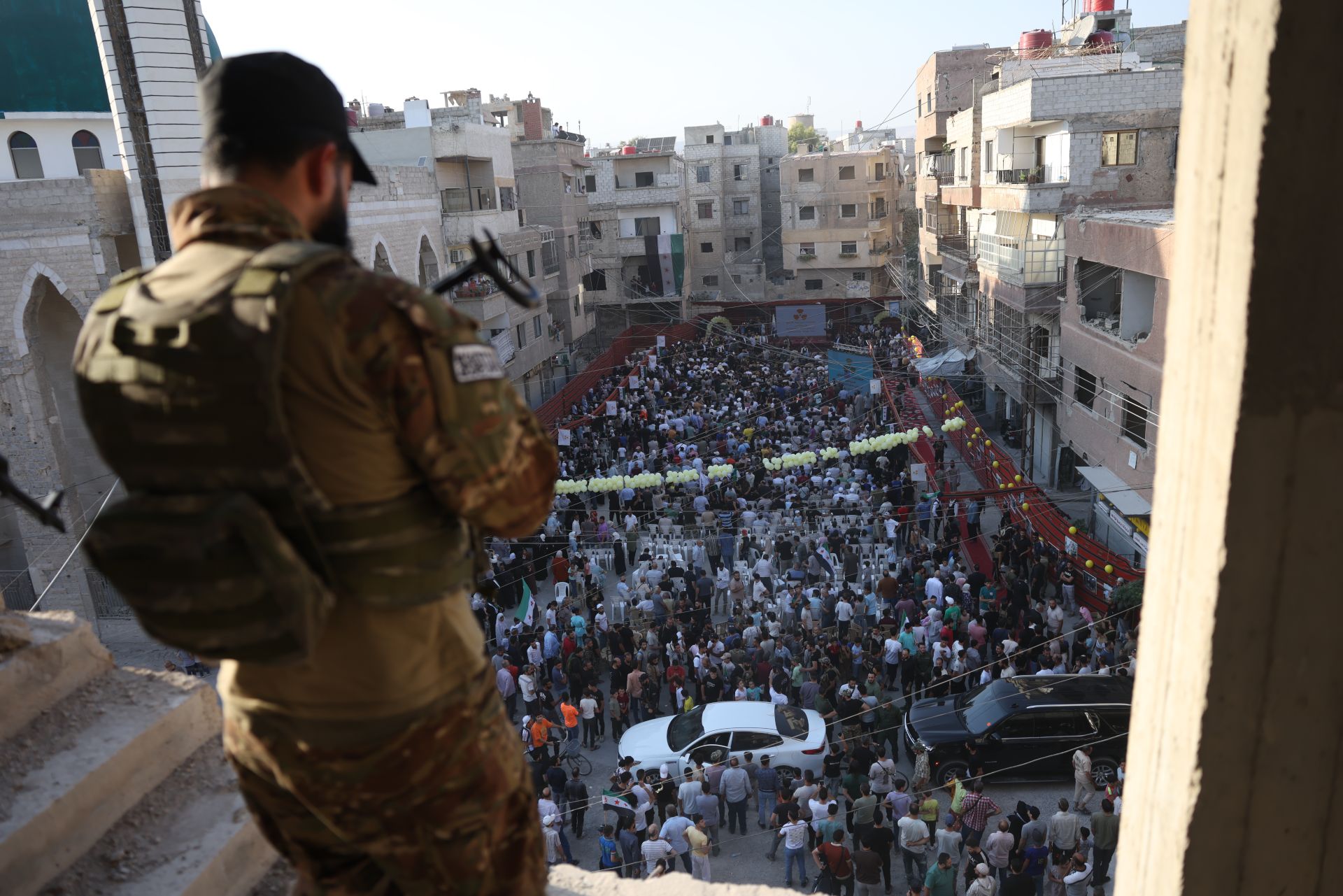
The unfeeling arrogance of this elite and their almost colonial attitude to those they considered their subjects is perhaps best illustrated by recently leaked videos of Bashar mocking the inhabitants of the war-wrecked Ghouta suburbs of Damascus before he was overthrown. “They don’t have enough to eat, but they spend money on building mosques,” he said from behind the wheel of his car, giggling as if his role in starving the area had nothing to do with it. “God damn the people of the Ghouta.”
As well as this affective gulf dividing the rulers from the ruled, Assad regime policies cut Syrians off from the rest of the world, from global goods as well as ideas. In the Hafez years, bananas and tissues were expensive luxury items that only appeared in the markets when a regime crony chose to bestow a delivery. Import taxes put almost all foreign items out of reach of ordinary people. Over 5 million Syrians, nearly a quarter of the population, were also banned from traveling abroad as punishment for their presumed disloyalty.
Yet Western scholars, journalists, politicians, diplomats and even “anti-imperialist” activists consistently ignored the conditions and wishes of ordinary Syrians, cutting them off again. Allaf’s book is most successful when she sets her account of disastrous regime failures against the willed misrepresentations of the polity in Western media and scholarly output. She charges these commentators with a failure to see Syrian society behind Orientalist assumptions and geopolitical headlines that often turned out to be wrong. Their reporting was “superficial … laden with clichés, accompanied by simplistic analysis and some outright nonsense.”
Allaf includes among those who knew and cared little for Syrian society the scholar “whose body of work included one of the most flattering and forgiving biographies a tyrant could hope for.” She is diplomatic enough not to name the culprit, but Syria-watchers will recognize Patrick Seale, a British journalist and historian of the Middle East. That biography and a great deal of other commentary gave the impression that Hafez al-Assad was a “fox,” a deft and cunning political operator. Allaf’s analysis depicts someone much clumsier and much more brutal. Hafez lost the Golan Heights to Israel and locked Lebanon into conflict while subjecting Syria to economic stagnation and “national identity theft” as its streets, libraries, schools and lakes were renamed after the tyrant. Worst of all, he exploited and expanded sectarian and ethnic cleavages between Syrians in order to shore up power.
When she covers the revolutionary years, Allaf combines a nuanced exploration of diplomatic responses to the crisis with an insider account of attempts to build a political opposition outside Syria, and she returns to her theme of a Western media that takes no account of ordinary Syrians. Journalists described Bashar as “soft-spoken” and repeatedly pointed out that he was Western-educated, that his wife was British-born, and that he wore a suit, as if these details weighed against the daily war crimes. Western media sought endless “exclusive” interviews with Assad well after it had been proved that he consistently lied; a whole page is given to listing these “exclusives.” The same sort of journalist sometimes sneered — no doubt correctly — at Al Jazeera’s fawning interviews with senior al Qaeda figures. Some journalists embedded with Assad regime forces. Some even interviewed prisoners in Assad’s notorious prisons. In those cases, unsurprisingly, the prisoners “confirmed” that they were not in fact revolutionaries but foreign-backed terrorists. Meanwhile, no serious interviews were conducted with opposition leaders. Revolutionaries were always called “rebels,” a descriptor usually inaccurately prefixed by “U.S.-backed.” The Assad regime was constantly called “secular,” though it was perhaps the most sectarian force in the country, at least until the rise of the Islamic State group. And Western journalists applied a “war on terror” framing to the conflict even before Assad had created the conditions for a regional clash of Sunni and Shiite jihadists.
Allaf’s critique extends to Western oppositionists, Islamophobes and conspiracy theorists, then all the way to the U.N., which spent $82 million at the Four Seasons, a hotel owned by a sanctioned Assad crony, but failed to ameliorate the desperate conditions of Syrians under bombs and in refugee camps. “The Syrian Revolution exposed everyone, everywhere,” Allaf writes.
Academic and activist Nour Ghazal Aswad’s “Searching for Solidarity: Revolutionary Dreams and Radical Social Movements” continues and further refines the theme. She quotes the activist Samira Khalil, who was disappeared in Douma in 2013, presumably by the Jaysh al-Islam militia, and who wrote, “The world has closed its heart and gone away.” Ghazal Aswad illustrates the abandonment with examples that include the aftermath of the first Trump administration’s assassination (in 2020) of Islamic Revolutionary Guard Corps commander Qassem Soleimani. Though everybody understood that Trump had acted for his own reasons, the killing was celebrated by Syrians who had suffered from Soleimani’s starvation sieges and mass expulsions on Assad’s behalf, and by quite a few Iraqis and Iranians too. American leftists, on the other hand, elevated Soleimani as an uncomplicated heroic victim, and expressed the fear that a terrible war would be catalyzed by the assassination, as if Syria weren’t already being incinerated by Iranian bombs. They saw only the imperialism of the state they lived within, and didn’t take into account that Iranian imperialism existed too, and was crushing Middle Easterners.
Ghazal Aswad blames this blindness on a “reverse moral exceptionalism,” that is, the “tendency to vigilantly insist on one’s nation as behind every malevolent event of significance on the world stage.” Such an attitude leads its bearers to ignore not only the agency of foreign states, but of foreign populations too. At its most extreme, it leads to the sort of insulting, absurd and inhumane conspiracy theories that cast Syrians not as revolutionaries choosing to risk their lives for freedom but as childish victims of a Western-inspired regime change plot.
This attitude ignores the agency, most specifically, of the remarkable people who throw themselves into revolutionary activity, potentially sacrificing their freedom, safety and lives. Ghazal Aswad calls them “radical subjects,” that is, “those who underpin the revolutionary phenomenon,” who “imagine liberatory futures and take decisive actions to dismantle oppressive systems” at great personal risk. Righting the wrong, she dedicates space to describing some of Syria’s radical subjects, figures well known in the country but little known abroad, from the goalkeeper turned fighter and revolutionary singer Abdel Baset Sarout to the beloved defector from the regime forces and then eloquent Free Army commander Abu Furat.
This is important because the Syrian revolutionary experience could teach lessons to the world, if only the world were listening. But Ghazal Aswad’s book is relevant even to people who are not focused on Syria, because it theorizes solidarity in general, drawing parallels to struggles everywhere, including Black Lives Matter, Native American advocacy and Palestine activism. It is a book for everybody interested in how we should practice politics, and how we should center the human beings at the heart of political struggles.
“Searching for Solidarity” is an academic enquiry whose language can sometimes perplex the nonacademic, but that effect is greatly mitigated by the author’s constant return to personal and emotional registers. Though she is careful not to include herself in the category of radical subject, and though she stresses and interrogates her exile, hers is very much a Syrian voice. Sections such as her extended remembrance of her relative Rafi, who was killed by the regime in the 1980s, make this a lyrical and passionate as well as an academically rigorous book.
Loubna Mrie’s widely praised “Defiance: A Memoir of Awakening, Rebellion and Survival in Syria” is also not short of passion. It is the autobiography of a “radical subject” from the same Alawite sect as Assad, more specifically from the Alawite-Assadist nouveau riche. Her father and uncles were prominent regime-aligned men of violence and corruption. One uncle was granted a steel import monopoly as recompense for the family’s services to the regime.
Still a teenager when the revolution erupted, Mrie rebelled against the regime, against her father, against misogyny, and against sectarian labeling. She experienced and eloquently describes two competing solidarities — that of the nonsectarian democratic revolution on the one hand, and that of Alawite-Assadist loyalists on the other. Both are described from the inside — from multicultural Damascus, where Mrie told people her sect to contradict the regime propaganda that the revolution is Salafi-jihadist, and from Jableh and rural Latakia, where most Alawites believed the propaganda, and where a Sunni rebel, unable to believe that she was a revolutionary, wanted to kill her as an “Alawite spy.” “I find it mind-blowing that, in the same country,” she writes, “some people cannot see past sectarian lines, while others don’t see sect at all.” The division between these rival emotional communities ripped right through her life, tearing her from one context and then another, and destroying her family.
She grew up with her mother and sister, first in Damascus and then among her extended family in Jableh on the coast. As the revolution began, just as Homs was called “capital of the revolution,” so Jableh was called “capital of martyrs” — the martyrs being those who had died fighting for Assad. Despite her solidly Assadist upbringing, a defiant Mrie soon pushed back against the combination of political, patriarchal and class oppression that shaped her environment. After attending a protest in Damascus and witnessing Syrians being gunned down, she became a revolutionary activist. Her father’s ultimate response to her disobedience was so shockingly cruel that I won’t mention it here lest I spoil the reader’s suspense. But the story is well known to followers of the Syrian Revolution.
“Defiance” is enormously successful as a coming-of-age narrative and as a description of a place and a time. It is Mrie’s compelling personal story that drives the narrative through its various stages, as she attends classes and protests, documents events in the liberated areas, works for a nongovernmental organization in Istanbul, and finally finds herself emotionally adrift in New York. Her account of her own trauma-driven behavior in exile is perceptive and honest. Her relationship with aid worker and then Islamic State victim Peter Kassig adds yet another layer of tragedy.
Beyond the personal story, “Defiance” is of immense political importance. Syrians need to remember and tell the positive stories of cross-sect solidarity, of the many who refused to blindly toe the sectarian line. This is why narratives such as Loubna Mrie’s are even more necessary in Syria than they are outside — and why an Arabic translation (or perhaps adaptation) of “Defiance” is so urgently called for. The book doesn’t avoid the sectarian issue but addresses it directly. By so doing, it complicates sectarian generalizations and the logic of collective guilt.
Beyond autobiography, the most remarkable literary exercise in centering Syrian revolutionaries — in fact, perhaps the most remarkable nonfiction book I’ve ever come across — is Anand Gopal’s “Days of Love and Rage: A Story of Revolution.” This book follows the lives of six revolutionaries from Manbij, a city in northern Syria, presenting them in full context and full novelistic detail. Rather than simply telling the reader about socioeconomic and political conditions, Gopal shows his characters undergoing indebtedness, dispossession, imprisonment and crushed ambition. The people depicted here are real, breathing humans made available for revolution by real-life factors like a stymied love affair or the disdain of a class superior.
“Days of Love and Rage” is intense, comprehensive and epic in scale. The achievement seems almost too much for one man, and the book was in fact produced by a process that Gopal calls “collective journalism.” As well as surveying social media records and making research trips to the war zone, the author hired half a dozen research assistants originally from Manbij who spread around the world to conduct over 2,000 interviews. The synthesis of this abundant information, and the compulsive, lucid prose — all presumably done by Gopal — still seems too much for one person to have accomplished. Documenting the lives of these people in such detail, recognizing the importance of what they were doing, is in itself an act of solidarity, and the book creates a channel of emotional connection between Syrians and international readers. This (at last) is the kind of attention from the world that Syrian revolutionaries wanted and deserved.
Gopal traces the revolution in Manbij from its first beginnings as an underground movement, carefully depicting key transformations in popular perception. At a certain point, what had been seen as misfortune came to be understood as injustice, and the quiescence that had seemed responsible suddenly signaled a moral failing. These transformations reached a critical mass about a year in, when the city’s mood shifted, and the revolutionary component grew from a small minority to the overwhelming majority. Then came the initial, euphoric liberation when the regime fled: “There was a different sky and a different wind. It was as if new and unknown birds alighted on the branches.”
The city’s first Revolutionary Council had been selected in secret. Now, a dozen different assemblies formed. These were “debating clubs, mutual aid societies, and protest groups all in one. Some were effectively workers’ unions, some were craft guilds, and others were artist collectives.” There were women’s assemblies too, and a women’s newspaper. The women of Manbij were “fighting two revolutions at once,” against Assad and against patriarchal honor codes.
Gopal’s close-up focus shows numerous revolutions unfurling within the larger revolution as alliances were made and unmade. A senate was formed, then a People’s Assembly was elected by the smaller assemblies. In turn, the People’s Assembly elected a new revolutionary council. The old council refused to disband, so for a while two councils competed. The “assembly republic” was riven by class conflict and by clashing concepts of liberty. The debate raged in Manbij’s impressive array of free newspapers and Facebook pages as well as in street protests and counterprotests.
Meanwhile, self-defense militias were formed by workers, or by fellow members of a football club. Some militias went rogue, looting and kidnapping. There was a crime wave. All the while, the regime subjected the city to bombing.
For a long time, only two of the city’s 80 rebel outfits were Islamist. When Islamists started arriving from abroad and declared their willingness to die fighting Assad, however, it looked to some like “actual international solidarity.” Gopal’s explanation of the rise of the Islamic State in Manbij is illuminating, illustrating how the organization’s populist exploitation of class tensions counted even more than its military prowess. Many of the poor ended up supporting the Islamic State against the liberal-bourgeois council because they desperately needed price controls on bread and rents, and price controls contradicted the council’s understanding of liberty. “Persistent inequality usually sounds democracy’s death knell,” writes Gopal. Such observations make this book relevant to societies everywhere, to declining democracies as well as to those newly born.
Across Syria, Islamists stepped into the vacuum of state collapse. They promised law and order and basic services, as well as solidarity with the Sunni Muslims bearing the brunt of Assad’s war. Back in 2015, Ahmad al-Sharaa cast the revolution as “a battle of destiny for the Sunni people” and his organization (Jabhat al-Nusra at the time) as “the shield that protects the Sunnis from the daggers of the Rafidha [Shiites] and the Nusayriah [Alawites].” Once Jabhat al-Nusra had rebranded as Hayat Tahrir al-Sham (HTS), however, it worked hard to broaden its appeal beyond the jihadist base.
Patrick Haenni and Jerome Drevon’s “Transformed by the People: Hayat Tahrir al-Sham’s Road to Power in Syria” tracks this new Islamist project, which inherited power when the regime finally collapsed. HTS set up a civilian Salvation Government to rule over its Idlib fiefdom, allowed a degree of democracy, stopped fielding religious police, and contradicted Salafist purism by working with the Sufi sheikhs and organizations that are more representative of Syrian Sunnis. Once Idlib’s front lines stabilized and society’s “war conservatism” had moderated, book and science fairs proliferated, and shopping malls, restaurants and car showrooms opened. Even under bombs, Idlib’s economy boomed. And HTS reached out to minority religious groups.
In other words, popular pressure and HTS’ national ambitions made it forge bonds with Syrians beyond its original constituency. “Transformed by the People” is indispensable for understanding this crucial part of the story, showing how it wasn’t actually so surprising that Christian or Ismaili towns welcomed advancing HTS fighters in December 2024, or that al-Sharaa was welcomed at the White House in November 2025. HTS wouldn’t have been able to win the final battle against Assad and then inherit what remained of the Syrian state had it not undergone the process described here. Along with the economic collapse in regime-controlled territory and the defeat or weakening of the Islamic State, Russia and the Iranian-backed militias, the newfound social discipline and political intelligence of HTS were essential conditions for Assad to fall.
The book could be criticized, however, for an overreliance on elite HTS interlocutors. Many of the lower-ranking cadres have not jettisoned either purist extremism or Sunni identitarianism to the same extent. This results in a leadership that fears alienating its aggrieved and angry base, hence the lack of rapid, transparent trials and punishments for those who committed crimes against Alawites and Druze in March and July 2025. Social divisions that seemed miraculously erased at the time of liberation soon returned, and continue to plague the post-Assad polity.
The new government still enjoys high levels of popularity among most Syrians — certainly among most Sunni Arabs. Allaf emphasizes that Syrians — historically a nation of traders and travelers — chafed at the isolation they suffered under the Assads and longed for openness to the world. This explains their enthusiasm at any moment during the Assad years when it seemed the isolation might be lifted, for example, during the 1991 talks on Arab-Israeli peace, at which Syria was represented by Allaf’s father, the renowned diplomat Mowaffaq Allaf. It also helps to explain the current admiration for Ahmad al-Sharaa’s global diplomatic offensive. In September 2025, the Syrian president addressed the U.N. General Assembly. It was the first time a Syrian leader had spoken from that podium since 1967. Syria, he said, was “reclaiming its rightful place among the nations of the world.”
Meanwhile, al-Sharaa has been reunifying the national territory and connecting it to neighboring countries. Great progress has been made in establishing gas connectivity with Turkey and Azerbaijan, electrical connectivity with Jordan, an oil pipeline with Iraq, and Silk Link internet connectivity. There are also plans to relaunch the Hijaz Railway linking Turkey to Saudi Arabia via Syria.
These factors provide good reasons to admire the new leaders, yet caution is necessary. Allaf remembers the “delirious optimism” with which many welcomed Bashar’s ascent to power in 2000. “People wanted to believe in this modern fairy tale of the saviour,” she writes, “or a reign of promise, of sunny days after so much proverbial rain.” We know how that story ended.
Despite al-Sharaa’s successes, Syria remains a polity frayed at the edges. Dispossessed Sunnis still suffer the elements in refugee camps. Many Kurds feel bruised after military defeats and do not yet trust Damascus. Frightened Alawites demand federalism on the coast. Most Druze want nothing to do with the Syrian state. If Syria is to succeed, healing the bonds between its divided communities is even more essential than making connections with the outside world.
Gopal writes that “Revolution reflects … a profound crisis of faith,” but also of the “radical hope” that sustains revolutionaries even when their cause seems hopeless. Where can we find such radical hope today?
People sometimes ask if Syrians can revive the revolution’s democratic impetus, given the general exhaustion and the fierce identity politics generated by the war years. Gopal points out that the people of Manbij built assemblies, newspapers and trade unions because they “felt compelled to secure the goods crucial to life, like free information and clean streets and fresh bread, and could only do so by allying with each other.” Such political activity will inevitably continue now for the simple reason that there is so much work to be done. If individuals and communities don’t work together, they won’t secure the crucial goods they need. The work is already happening at the local level, as committees and councils are reformed or built for the first time, and it is likely to happen much more at the national level now that the national territory is very nearly unified.
The answer to Syria’s current divisions lies in collective action, in the democratic pursuit of the collective good.
Become a member today to receive access to all our paywalled essays and the best of New Lines delivered to your inbox through our newsletters.