


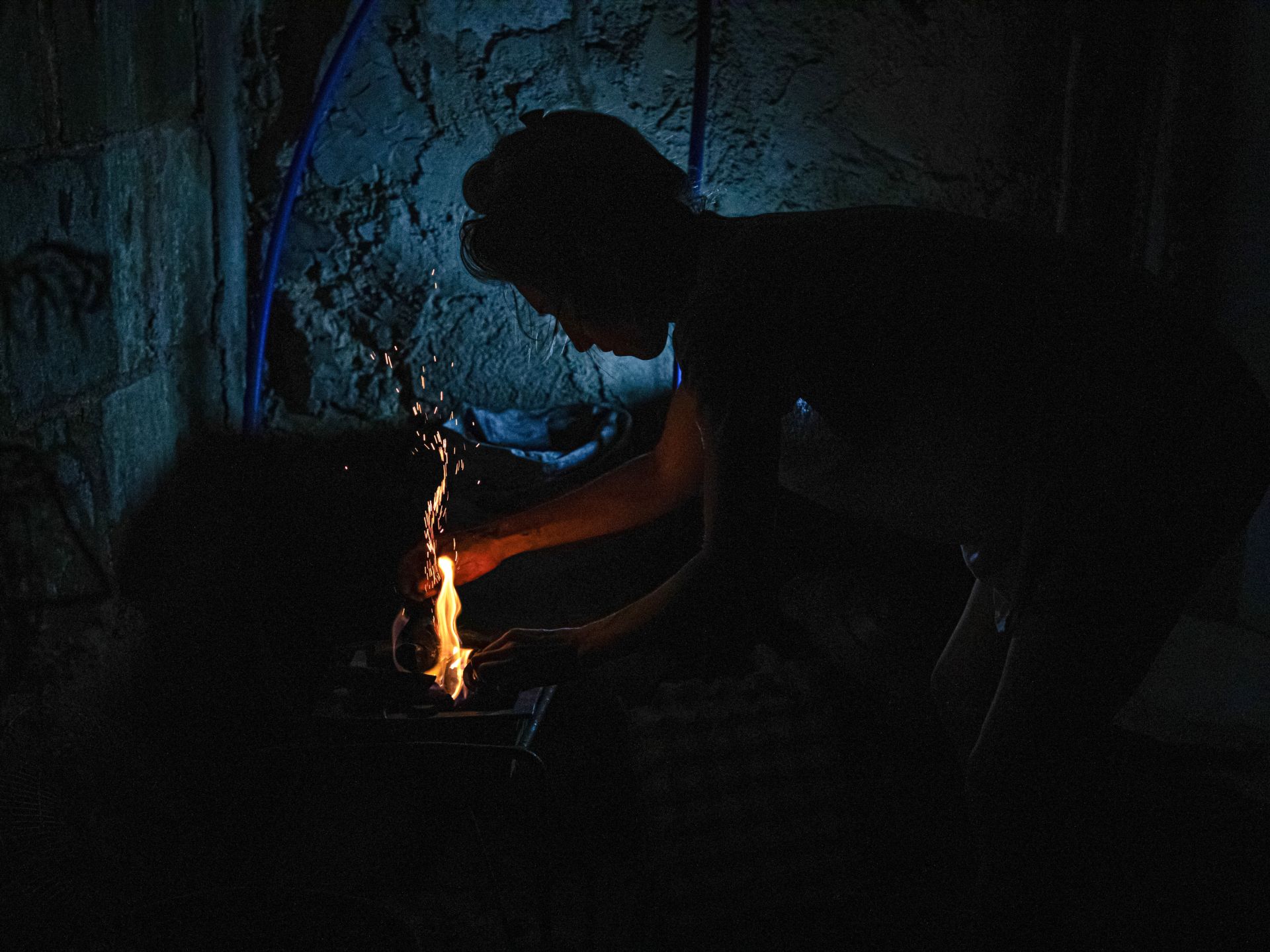
Day after day, Cubans register the duration of blackouts as a new unit of time, dictating when house chores and work get done. “We didn’t have electricity for eight hours, then only three and a half hours with power,” a retired accountant in Havana told New Lines. “And now they’ve cut it off again. What a lack of empathy for us ordinary people.”
Until last year, the island’s citizens could at least rely on the weekly schedule of power cuts released by the state electricity company — even if it was sometimes untrustworthy. Since January, however, blackouts have been far longer and more unpredictable. The U.S. blockade has impeded the flow of oil imports, which are required to keep the national electricity grid running.
In March alone, the grid collapsed three times, making the total seven in a year and a half. “The last time, I was wishing that people in my block would go outside to bang pots [a common form of protest] so I would go out, too,” recalled the accountant, who spoke to us anonymously, as did the other interviewees for this piece.
Since the Trump administration’s kidnapping of Venezuela’s then-President Nicolás Maduro in Caracas in January, the threat of a U.S. invasion has loomed large in the conversations of ordinary Cubans. That anxiety became acute in April, when President Trump declared that there would be “a new dawn for Cuba.” Shortly after, it was reported that U.S. State Department officials had met in Havana with members of the Cuban government to discuss a number of political, economic and social reforms. The implicit warning was clear: Cuba’s failure to carry out these changes would have consequences.
Most Cubans who spoke with New Lines expressed wariness about the possibility of a U.S. invasion. All of them, however, voiced a desire for some kind of change, because conditions on the island have become untenable. One secretary told New Lines with a sense of urgency that she was hoping for “something, anything.”
Continuous power outages have unleashed a cascade of other problems: Taps go dry since water can’t be pumped, food rots away, internet connections slow down until they disappear, shops and banks close earlier or can’t operate, leaving people without access to money.
Those who rely on electricity for cooking have no choice but to cook with charcoal or wait indefinitely for the power to come back on. “Those with butane gas are lucky,” a receptionist told New Lines. The night before, electricity was restored at 2 a.m. in her neighborhood on the outskirts of Havana. She then started preparing rice and beans so that her elderly mother would have something for lunch while she was at work.
With no gas, the sharp reduction in traffic has emptied once-busy avenues. Elementary schools are expected to keep functioning, but teachers struggle to show up to class. University students have been sent home to proceed with the academic year remotely, via an online platform. Trash piles up in seemingly every other corner. Rising inflation is the only constant.
Meanwhile, hospitals are running at a fraction of their capacity, worn down by the lasting effects of the COVID-19 pandemic, state underinvestment and U.S. sanctions. Bribes have also become common; offering money or a gift is sometimes the only way to get proper medical attention. A former clerk told New Lines that she got to an emergency care center with a heavy cough. A doctor ordered her a blood test, but she only got it after underhandedly paying the technician herself.
And even when there’s electricity, sometimes the service is unstable and there are voltage drops: Fans briefly reduce speed, lights blink, the fridge restarts. The ups and downs damage electric appliances, but a regulator — or simply disconnecting them — is all the protection that most people can get.
On a street stall in Playa, in west Havana, a woman was buying a rechargeable bulb. The salesperson told her that it was the last one. “People buy them like crazy. These and voltage regulators.”
Power outages also mirror mounting inequalities: While some turn on generators or invest in installing solar panels, others just light a candle or use the light of their phones.
On March 31, a Russian oil tanker docked in Matanzas province, carrying 730,000 barrels of oil. It was the first shipment in three months. The White House said that it would assess on a case-by-case basis whether the U.S. will allow other vessels to arrive. “But one can’t live counting boat to boat,” an engineer told New Lines.
Unsurprisingly, the official rhetoric demands stoicism for the umpteenth time. State-affiliated organizations have called for a celebration on Labor Day (May 1), as a way to “show the unity of Cubans and their patriotism.”
“Cuba won’t give up. Nobody here gives up,” said Cuban President Miguel Díaz-Canel during a demonstration on April 16 in Havana, commemorating 65 years since Fidel Castro proclaimed the Cuban Revolution’s socialist character. Dressed in military uniform, Díaz-Canel encouraged Cubans to be ready for U.S. aggression. “We don’t want it [the war], but it’s our duty to prepare ourselves to avoid it — and, if it’s unavoidable, to win it,” he stressed.
Throughout this year, 10 “national defense days” have taken place, with high-ranking officers and ordinary people demonstrating combat readiness, following Cuba’s military doctrine known as “la guerra de todo el pueblo” (“the people’s war”). As per this doctrine, in case of military aggression, every Cuban will have the means to fight the enemy.
“It’s not that I’m with those in power [in Cuba]. But how could I allow someone from abroad to attack me?” a security guard told New Lines. “If they [the U.S. forces] come, I’m willing to take a rifle because they won’t differentiate between those in favor of or against the Cuban government.”
The secretary questioned why the island’s authorities are engaging in dialogue with their historic enemy rather than with the people. Tellingly, “¡Hablen con el pueblo!” (“Talk to the people!”) was one of the slogans chanted by demonstrators in Santiago de Cuba during the massive protests that took place on July 11, 2021 — the largest demonstrations in three decades in the country. The deadly toll of the COVID-19 pandemic, long blackouts and general scarcity prompted people to take to the streets across the island.
A young artist also voiced his frustration with the government to New Lines: “They say they are having conversations. But what worries me is that those of us who are most affected [by the crisis] are caught in limbo amid the strategic game of both sides,” he said.
The so-called “normalization” of relations between the two countries, initiated under presidents Raúl Castro and Barack Obama, brought a boom of private business, U.S. travelers visiting the main Cuban cities and an overall feeling of prosperity that soon turned out to be ephemeral.
Now, expectations are far more circumscribed — shaped by a desperate need to improve basic living conditions.
As weeks go by, signs of the island’s deterioration are found everywhere. The National Botanical Garden announced its closure “till further notice,” given the shortage of fuel for maintaining its exhibits and transporting workers. In some quarters, smoke from burning stacks of garbage — in daylight or in the dark of blackouts — chokes residents, adding to the sense of dystopia.
As in the 1990s “special period” — a period of economic and social catastrophe in Cuba following the collapse of the Soviet Union — paper editions of national dailies circulate only once a week, while local newspapers have stopped being printed. Nearly 80% of small- to medium-sized private companies have reported a drop in sales.
But even as Cubans wait for the improvement of basic conditions, other concerns have begun to surface.
An architect from an independent firm in Havana told New Lines that a few months ago they didn’t have a single project, but now they get almost more clients than they can handle. Betting that a brighter future is not far off, some are buying real estate in the hopes of prospering once economic recovery reaches the island. “Something is already happening, we just don’t know what,” she reckoned.
The accountant would prefer that these transformations come from Cubans themselves, not from the U.S. “Well, changes are always dangerous,” she said. “I remember when the Soviet Union collapsed, Russia went through a lot of hardship, even though it’s a rich country. Imagine what it would be like for us, who have nothing. It’s dangerous, but it’s necessary, because with the current situation … I just don’t see the light at the end of the tunnel.”
Become a member today to receive access to all our paywalled essays and the best of New Lines delivered to your inbox through our newsletters.