


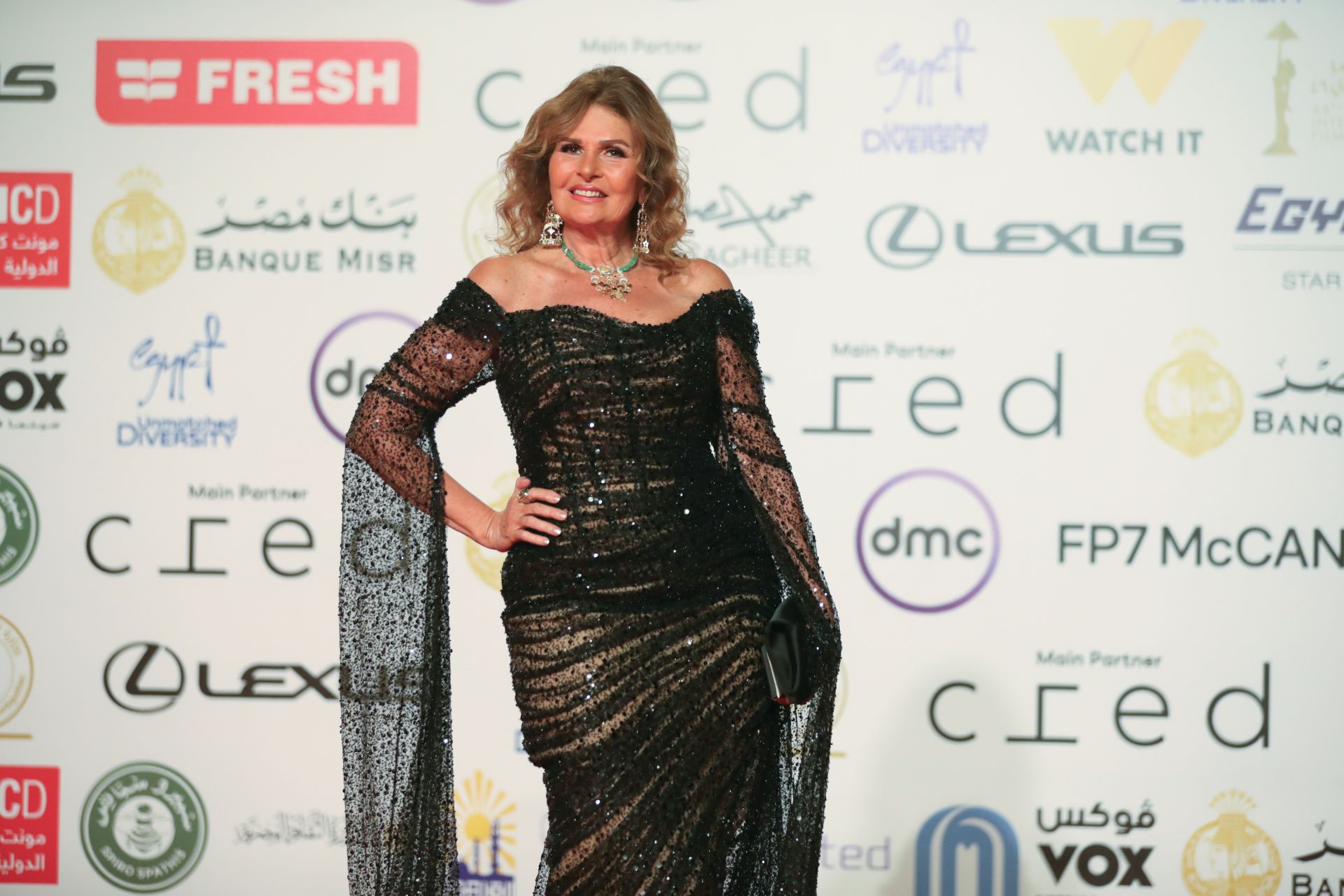
Among the many stars Egypt has produced during its decades at the epicenter of Arab cinema, few have been such a permanent fixture as Sivin Hafez Nessim, known to the world simply as Yousra. It is now the 50th year since the celebrated performer debuted on screen in the 1977 film “Fatat Tabhath Aan al-Hubb” (“A Girl Searching for Love”), and despite her esteemed status and countless awards, the 71-year-old continues to perform. Her latest film, “El Set Lamma (Veto)” (“Ms. Lamma (Veto)”), was released in August 2026. The key to Yousra’s longevity has been her versatility, both in her acting and in her ability to adapt to an ever-changing film industry.
It is perhaps fitting that Yousra’s career began with “Fatat Tabhath Aan al-Hubb,” as in some ways the film’s title could describe her own story. Born in Cairo on March 10, 1955, Yousra’s parents divorced when she was young. She was raised primarily by her father and has spoken candidly about the sadness she feels at being deprived of her mother for much of her childhood.
This year, Yousra celebrates another milestone — 30 years of marriage to filmmaker Khaled Selim, son of former professional soccer player and actor Saleh Selim. The godmother of Egyptian cinema has no children of her own, a fact she has discussed openly over the years. “You know, I always dreamt of being a mother, now I thank God that I’m not,” she told Harper’s Bazaar in 2023, a sentiment that is still taboo, especially when espoused by a woman of influence. With characteristic honesty, she went on to confess that the fear of losing one’s children is part of the reason she is glad not to have any. “But I’m the ‘mother’ of all my friends’ children. And I do that with love and with pleasure,” she added. Yousra’s private life has been the source of much media speculation over the years, to which she has tended to respond with stoicism. “Every rumor resembles the person who spreads it,” she told an interviewer in 2000.
Two things stand out in speaking to Yousra, her friends, her colleagues and her fans. The first is that she is a true artist, dedicated primarily to the aesthetic rather than the commercial side of her craft. The line between popular and artistic work is often difficult to draw in Egyptian cinema, and Yousra has rarely seemed preoccupied with the distinction, moving between leading and ensemble roles as each project demands. A huge part of her success is down to her versatility: Over the decades, she has shown a remarkable ability to transition between completely different parts with ease. Friends, collaborators and co-stars have praised Yousra for her deep commitment and her ability to immerse herself in a character.
Then there is Yousra the person. Despite her fame and its longevity, those who know Yousra describe her as unassuming and private. Some have even called her shy at times. Yousra’s longtime friend and colleague Marianne Khoury told New Lines that the star remains insecure about taking on roles that make her appear old. But it is perhaps the combination of this genuine, relatable vulnerability with her breadth of talent that explains Yousra’s continued popularity with audiences and why, after half a century, she still has such a rare, authentic connection with her fans.
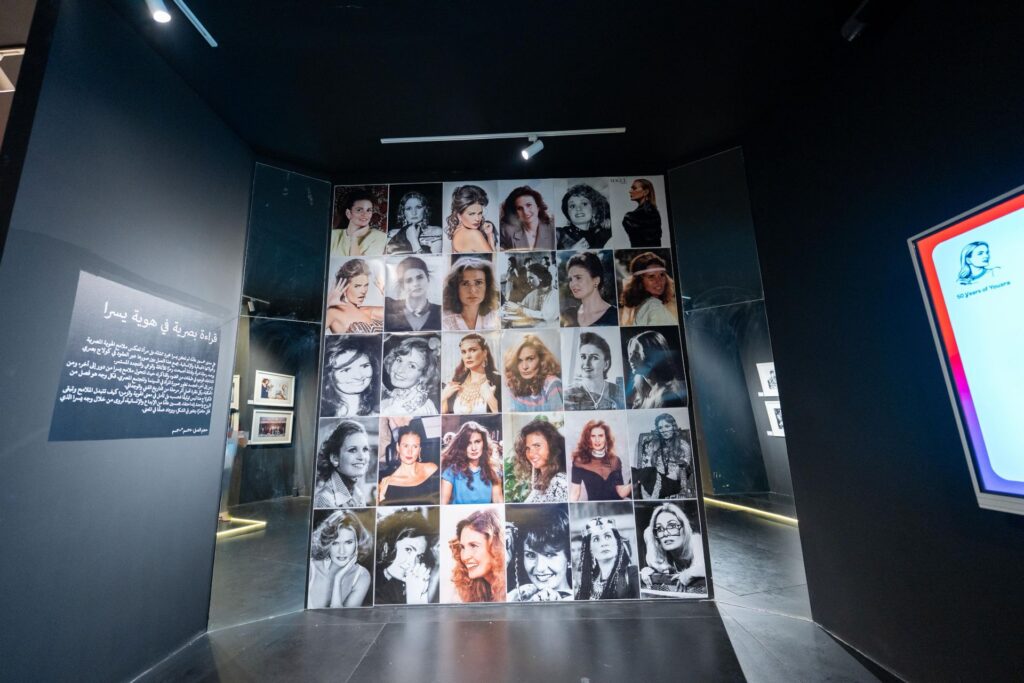
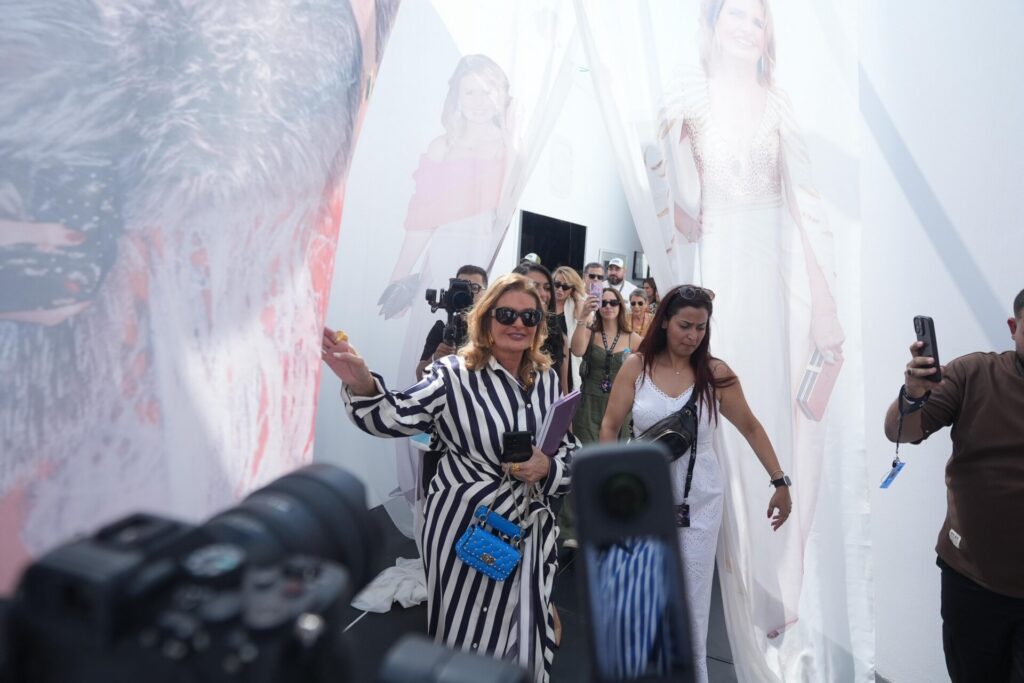
In late 2025, Yousra was honored in an exhibition at the El Gouna Film Festival titled “50 Years of Yousra.” The exhibit presented what curator Sara El Tonsi called “a visual biography,” featuring new footage, photos, paintings, collages, magazine covers and unique items donated by the actor. These included a golden necklace, crafted for Yousra’s role in “El Mohager” (“The Emigrant,” 1994) by renowned Egyptian designer Azza Fahmy, and the iconic dress from the film “Al-Irhab wal Kabab” (“Terrorism and Kebab,” 1992), designed by Yousra herself. A selection of Yousra’s many awards was also on display, recognizing her decades-long excellence in singing as well as acting. The exhibition was one of the main focal points at El Gouna, the swanky Red Sea town that named a street after her in 2018. “Oh wow!” Yousra exclaimed at the opening of the event. “Where did all of these years go? I don’t feel it has been 50 years. I feel like it was 50 minutes!”
It is possible to level charges of inauthenticity at El Gouna — the town itself was built from scratch in the early 1990s as a walled-off playground for the elite. Some feel that the film festival exudes some of the phoniness of its location, with some of its exhibitions being less neutral retrospectives than thinly veiled public relations exercises. While there is some truth in this, “50 Years of Yousra” went beyond mere celebration, offering an informative and engaging look at her five decades in film and public life. The festival’s broader program also ranged widely in geography and genre, and its most recent edition included films from every continent, from “The Voice of Hind Rajab” to the Spanish blockbuster “Sirāt.”
El Tonsi was one of many who paid tribute to Yousra’s versatility as a secret of her success. “One of the most remarkable aspects of Yousra’s performances is her ability to reinvent herself across decades while maintaining emotional sincerity,” she told New Lines. “In the exhibition, we created a collage of 30 portraits tracing her transformation through five decades.”
“50 Years of Yousra” used artificial intelligence to enable visitors to appear alongside Yousra in a selection of the star’s most famous scenes or pose for a photograph and be edited into one of her movie posters. The contrast between the 1970s magazines displayed at the entrance of the exhibit and the use of modern, interactive technology at its exit underlined the breadth of time Yousra has spent at the pinnacle of Egyptian cinema. Indeed, the exhibition ended with a fabric installation titled “The Eternal Presence,” which framed fashion as central to her staying power in Egyptian cinema and popular culture. Festivalgoers were also treated to a 360-degree film narrated by actor Maged El Kedwany, consisting of a mash-up of some of the highlights of Yousra’s career as an actor, singer, public figure and United Nations goodwill ambassador.
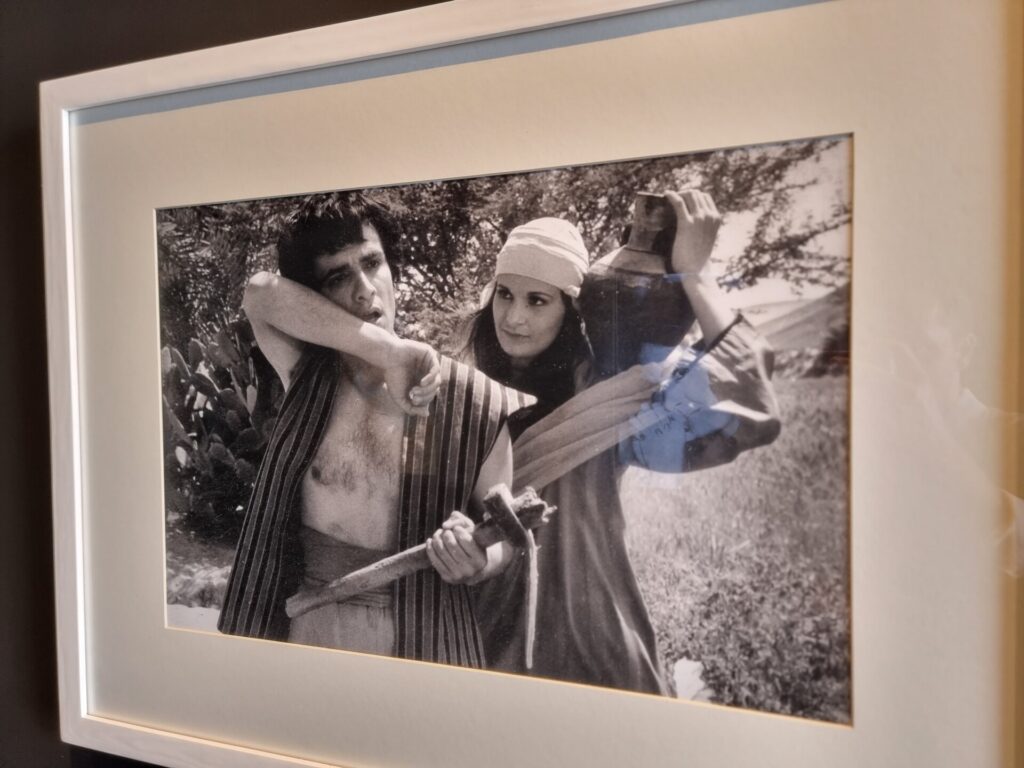
Yousra has appeared in many of the best-known Egyptian films of the past half-century. Her more than 80 films include such classics as “Hadduta Masriya” (“An Egyptian Story,” 1982), “Al-Irhab wal Kabab,” “El-Mansi” (“The Forgotten,” 1993), and “Imarat Yaaqubian” (“The Yacoubian Building,” 2006), an adaptation of Alaa Al Aswany’s celebrated novel.
Her filmography suggests a wide acting range. Her talents have been sought after by renowned writers, directors and performers from completely different schools and styles. She was a trusted co-star of perhaps Egypt’s most lauded living actor, Adel Emam, on 17 occasions. The legendary director Youssef Chahine also knew that he could throw Yousra into any role and she would make it her own. The films of these two giants of Arab cinema are generally considered to belong to completely different genres, and the two never collaborated on any major work. Yet the common denominator was the unique talent of Yousra. She was the bridge between these two disparate cinematic worlds.
Yousra’s work with Emam, director Sherif Arafa and scriptwriter Wahid Hamed is among her very best. The four collaborated on five acclaimed films of the 1990s: “El-Laeb Maa el-Kebar” (“Playing With the Big Boys,” 1991), “Al-Irhab wal Kabab,” “El-Mansi,” “Tuyoor el-Zalam” (“Birds of Darkness,” 1995), and “El Noom fi el-Asal” (“Sleeping in Honey,” 1996). In 2025, Yousra told Morocco’s public broadcaster SNRT that these films succeeded because they brought together the great trio of Emam, Hamed and Arafa. But when I raised the topic with moviegoers at Cairo’s Zawya Cinema, several audience members who spoke to New Lines suggested that this trio should be considered a quartet, with Yousra being as integral as the three men. These five deeply intelligent films all satirize Egyptian society and government with a timeless wit, their common motif being that of the helpless individual who becomes entangled in a vast, opaque bureaucracy. The films are similar in tone, pitching an outsider against the world.
“‘Al-Irhab wal Kabab’ remains one of the most iconic films in Egyptian cinema, combining social commentary, humor and humanity in a way that still resonates today,” El Tonsi told me. “In ‘Tuyoor el-Zalam,’ Yousra really shows her ability to merge performance with social commentary.” As a modern viewer, the canny prescience of these films is truly striking. The work is arguably more relevant to Egypt now than ever before, maybe because the freedom — and perhaps the will — to create such biting satire has been suppressed for the time being. Since that time, the vast majority of Egyptian film and television studios have merged into a single entity known as United Media Services, which is primarily run by the state General Intelligence Service, known as the mukhabarat. “One of my professors used to refer to Mubarak as ‘Egypt’s most liberal dictator’ — he didn’t care much about speech as long as it remained speech,” an Egyptian film insider told New Lines, referring to former Egyptian President Hosni Mubarak. “Adel Emam himself told a story about his film ‘El-Sefara fi el-Imara’ [‘The Embassy in the Building,’ 2005] being banned by the mukhabarat. Emam then called Mubarak personally, and Mubarak allowed the movie to be released,” he continued. “Those days are over.”
“Yousra’s performances with Chahine stand out, in particular, as they shaped an important part of her cinematic language and artistic evolution,” El Tonsi said. She made a point of prominently displaying an enormous portrait of Yousra and Chahine in her “50 Years of Yousra” exhibit.
Yousra collaborated with Chahine on “Hadduta Masriya,” “Iskandaria Kaman wa Kaman” (“Alexandria Again and Forever,” 1989), and “Alexandria … New York” (2004) — the last three installments of the great director’s four-part autobiographical series on the city of his birth. In each case, Yousra played Chahine’s romantic interest. The pair also worked together on Chahine’s critically acclaimed 1994 film “El Mohager.” Yousra has never sought controversy, but “El Mohager” was one of many occasions when controversy came looking for her. The film was removed from many cinemas in Egypt due to the perception that it sought to lampoon certain religious figures, such as the prophet Joseph. Today “El Mohager” is considered one of Chahine’s (and Yousra’s) greatest works.
Marianne Khoury, Youssef Chahine’s niece and a producer on “Iskandaria Kaman wa Kaman” and “Alexandria … New York” spoke warmly of Yousra and her artistic relationship with her uncle. “I first met Yousra more than 45 years ago when she was cast in my uncle’s film ‘An Egyptian Story,’” Khoury told New Lines. “Even then, she struck me with her warmth and natural charm. She acted like family with us. Beneath the star persona, she is deeply human, kind and generous.” Khoury was also the creative director of El Gouna Film Festival, a role from which she stepped down earlier this year.
Like so many of her contemporaries, Khoury praised Yousra for her adaptability and commitment to her craft. “As an actress, Yousra is remarkable for her versatility and emotional intelligence,” she said. This multifacetedness is not limited to Yousra’s on-screen life. “Few actors maintain relevance across generations while remaining authentic and inspiring,” Khoury continued. “Yousra has learnt how to use the right human resources, modern marketing and communications tools to do so. She has done it all with grace and intelligence.”
Despite her revered status, some critics argue that Yousra has not received the acclaim afforded to her male co-stars. Some who spoke to New Lines suggested that there is a patriarchal element at play here: In the panoply of great Egyptian film stars, she has perhaps not quite attained the notoriety of male co-stars such as Chahine, Emam and Ahmed Zaki. Another aspect of the charge that Yousra is underrated is that she is often grouped together with figures such as Nadia Elgendy and Elham Shahin, despite there being little to connect them but for their being women actors working around the same time.
Khoury believes this analysis misses what is truly great about Yousra’s work: “Yousra shines most when paired with a strong director or co-star, in particular Youssef Chahine and Adel Emam,” she said. “She was truly a muse for Youssef Chahine, inspiring some of his most personal and memorable films. Her talent often lies not in dominating a scene alone, but in transforming it, creating chemistry and elevating everyone around her.”
Given such prestigious big-screen success, one could imagine Yousra resting on her laurels and cashing in on typecast roles for the rest of her career. Instead, she saw another opportunity to develop her art. Around the turn of the 21st century, Yousra moved to conquer the small screen as well. She has now starred in some 30 television series, many of them running in Egypt’s sought-after Ramadan evening slots, when popular series are shown throughout the holy month. These include “Awan El Ward” (“Time of the Rose,” 2000), “Ahlam Adeya” (“Ordinary Dreams,” 2005), “Qadiyyet Rai Aam” (“A Matter of Public Opinion,” 2007), “Sharbat Loz” (2012), “Saraya Abdeen” (“Abdeen Palace,” 2014), and “Foq Mostawa el-Shobohat” (“Above Suspicion,” 2016).
Not content merely to star in these successful shows, Yousra’s move into Ramadan series has arguably helped transform the genre. These beloved programs once tended to be telenovela-style soap operas with familiar, often predictable storylines. In contrast, Yousra’s annual series became hotly anticipated for their willingness to deal with deeper sociopolitical issues and bring them to a broad, socially diverse audience. “Qadiyyet Rai Aam” tackles misogyny and rape — sensitive topics in themselves, made more so by the fact that the show underlines the role class often plays in the abuse of women, with the perpetrators being ultrarich and the victims being lower- or middle-class. The 2008 series “Fi Aydee Amina” (“In Safe Hands”) covered freedom of the press and corruption in Egypt, while “Khas Giddan” (translated for international audiences as “Up Close and Personal,” 2009) looked at the challenges of becoming a successful woman in the country. In 2010, Yousra played a forensics expert in “Bel Shamaa al-Ahmar” (“In Red Wax”), a series that shone a light on the ugly underworld of organized crime. In 2012, “Sharbat Loz” starred Yousra as the eponymous poor, divorced woman struggling to support her two younger brothers.
Work like this was part of a shift in the character of Ramadan series and, with it, an expansion of the public’s perception of what those shows could be. One industry insider told New Lines that that period, from around 2007 to 2012, represented “a golden era for free speech in Egyptian television, when taboo subjects and invisible people were placed in the spotlight.” Yousra played no small role in this shift and continues to tackle such subjects to this day. Her most recent film, “El Set Lamma (Veto),” stars Yousra as Dina El-Kurdi, a media figure who launches a campaign combating violence against women titled “Women Have the Right To Veto.”
As in her cinema career, Yousra’s television work showcases her incredible versatility. In just one example of many, Yousra immediately followed her performance as the struggling divorcee Sharbat Loz with “Foq Mostawa El Shobohat,” in which she portrayed a well-to-do lady of Cairo’s wealthy Sheikh Zayed neighborhood. “She is a real character actor,” the Egyptian painter and friend of Yousra’s, Farid Fadel, told New Lines. “She has never been imprisoned in one type of role. She is a true artist.” So many of those who know Yousra echoed this sentiment — that the star cares about her work for its own sake, always seeking a challenge, and turning down potentially lucrative roles that do not inspire her artistically. “Along with all this, she remains down-to-earth and is very kind and encouraging to others,” Fadel continued. “She is not pretentious; she always takes the time to say hello. Yousra is genuine.”
Now 71, Yousra remains as relevant as ever. The fact that she speaks fluent English has opened international doors outside of show business that have been closed to some of her forerunners and contemporaries. She sits on the jury of several film festivals and has been a United Nations goodwill ambassador. She is outspoken on modern issues and, in recent years, has cautioned against the deleterious effects of social media on art and creativity. “Those platforms are a regression in thought,” she said last year. “A place of premeditated, prefabricated, ready-made prejudices. … It has become an enemy for artists and creative people.”
But Yousra’s career has so far been able to withstand these modern pressures, be they political or technological. The film industry has changed almost beyond recognition over the past five decades, but her ability to adapt her style to change with it is what distinguishes her. Today, the star is experiencing one of the most prolific creative periods of her career. On top of the release of “El Set Lamma (Veto)” in August, she recently completed filming on another feature, “Banat Faten” (“Daughters of Faten”). On the small screen, the star has a 10-part romantic drama series, “Qalb Shams” (“Heart of the Sun”), scheduled to come out in December.
While another 50 years might be a little much to ask, millions will be hoping that Yousra continues to give us provocative and interesting work for a long time to come.
Become a member today to receive access to all our paywalled essays and the best of New Lines delivered to your inbox through our newsletters.