


In an AI-animated video called “Khamenei again,” a Lego rendition of an angry Donald Trump appears as a caricature of excess in a casino. The president plays dice before the scene quickly cuts to Trump on the edge of a navy vessel, adrift above a graveyard of sunken ships bearing American flags. The scenes are set to a rap diss track, taunting him with lines like “You crossed the ocean just to find your grave,” and “You sacrifice soldiers to pay for your spoil.” The rest of the two minutes and 40 seconds are just as scathing: a panicky Lego Trump sinking in a pile of Epstein files, the refrain “L-O-S-E-R” appearing onscreen again and again, a gravestone stamped with Trump’s name and “1946-2026.”
The video, and many more like it, have racked up millions of views and drawn a lively response from audiences around the world during the ongoing Iran war. They convey dominance through humor and ridicule, by projecting an exaggerated version of Iranian military power contrasted with American and Israeli decline. The videos, some of which are put out by groups sympathetic to the Iranian government and some by individuals, are a new frontier in Iran’s propaganda reach. But they also signal something much wider.
This is “slopaganda,” the use of AI-generated material, sometimes called AI slop, as propaganda. Politicians have been using it for some time, ever since AI models that generate hyperrealistic videos first came out.
India’s 2024 elections marked a turning point in the normalization of AI use in election campaigns (as explored in this New Lines story). From videos parodying Prime Minister Narendra Modi to those resurrecting dead political figures, AI helped amplify and tailor campaigns in ways that would not otherwise be possible.

The “slopagandist in chief,” however, is Trump himself, who has posted dozens of AI-generated images and videos from his main account and the official White House account — including one of him in a fighter jet dumping excrement on No Kings protesters.
Trump’s White House has become fond of posting such content, often described in the media as “memes.” Yet they fulfil a much deeper purpose for a president so often at odds with established precedent. They allow him to mythologize his own acts in real time, without waiting for photographers or painters to do so. They allow him to portray himself the way he wants to be seen, and the way his supporters most enjoy — as someone strong, patriotic and just a bit of a troll to his liberal opponents. Even his supporters, however, appear to have limits.
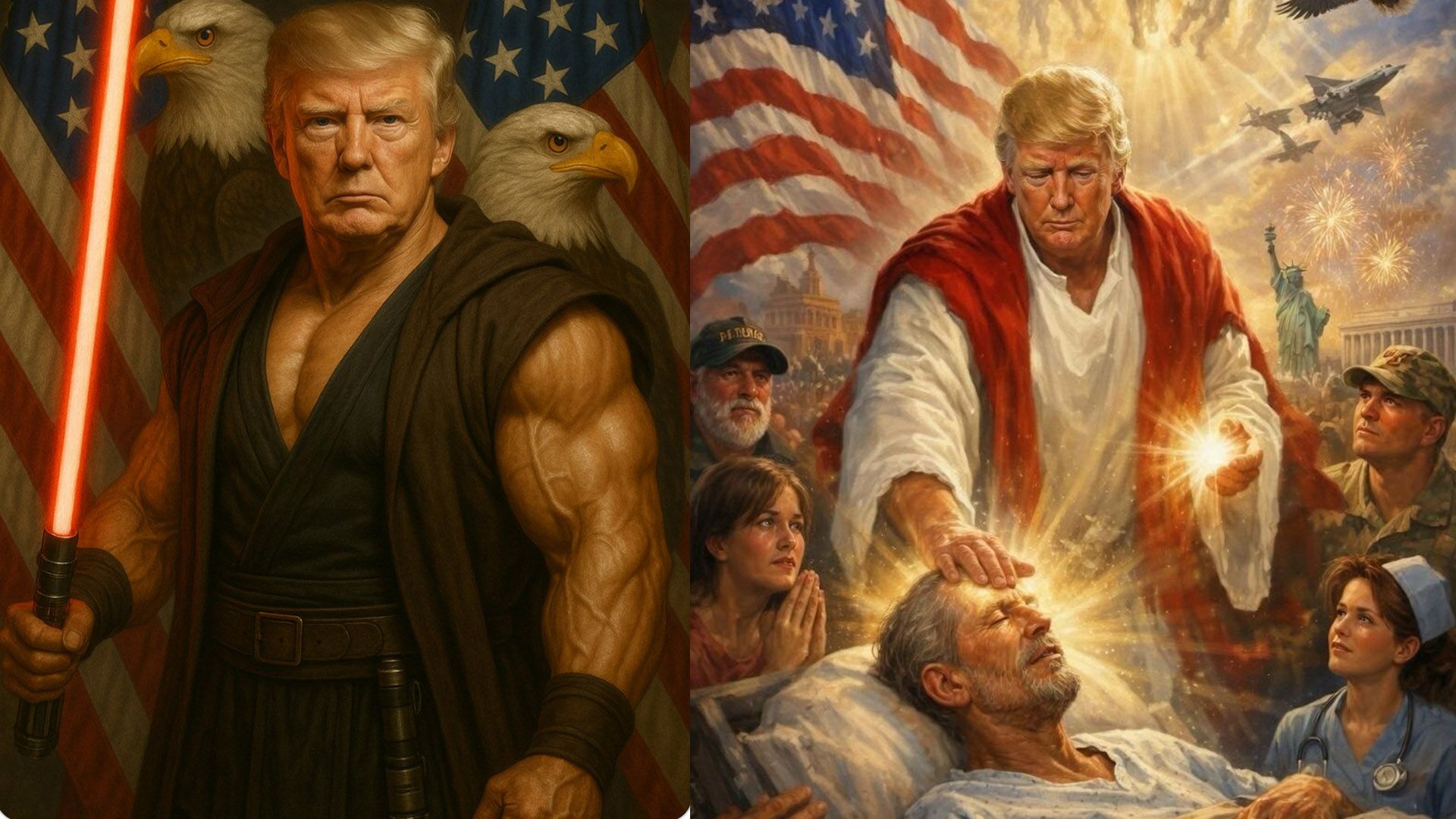
On April 13, Trump posted an AI image to his Truth Social account depicting him in the likeness of Jesus, wearing a white robe and red sash, one arm raised and holding an orb of light, the other extended toward the forehead of a man as though blessing him, in a pose that borrows from classic Christian iconography of Christ as a healer. The image fuses the depiction with that of an American flag and another sacred American icon, the bald eagle.
The post was deleted after it drew criticism across political lines. The backlash was swift, with one official from within the administration telling The Washington Post that the image had gone too far and was “sacrilegious at best.” Conservative media figure and “unabashed church lady” Megan Basham posted on X: “I don’t know if the President thought he was being funny or if he is under the influence of some substance or what possible explanation he could have for this OUTRAGEOUS blasphemy.” She implored the president to ask for forgiveness. Pointing out that the post coincided with Orthodox Easter, former U.S. representative and Trump supporter-turned-critic Marjorie Taylor Greene posted, “I completely denounce this and I’m praying against it!!!”
Trump’s response — that he thought the image depicted him not as Jesus but as a doctor — suggests something broader at work: Yes, Trump’s Christian base was likely outraged at him depicting himself as Christ (this despite him previously depicting himself as the pope). But the outrage shows something else — that his base is now taking his AI slop seriously.
Trump’s great political power has always been that his base instinctively understands him; they take him, in a phrase widely used during his first term, seriously but not literally. But this meme has shifted that, and they are now taking him both literally and seriously.
It’s part of a wider phenomenon associated with AI videos. The hyperrealism of the videos means that people can take the images and videos literally, if they choose to. The videos, unlike previous iterations of AI material, actually look real. That’s one of the most intriguing aspects of the U.S.-Iran slopaganda wars, that people are sharing the pro-Iran videos and in some way choosing to believe them. It’s not necessarily that they think Iran is actually winning the war, as depicted in the videos. Rather, many pin their hopes on it being true. They choose to believe it.
The videos thus serve as a kind of Rorschach test: People see in them what they want to believe, what they wish to be true.
This points to a dynamic that is likely to grow as AI imagery becomes more prevalent: the more hyperrealistic the images are, the more they allow people to look past them to an underlying message or “emotional truth.” It’s almost as if the realism of the AI material allows the audience to suspend their disbelief.
Audiences know that Trump isn’t piloting a fighter jet over Washington, but the realism of the video allows them to register what they already believe — that he could, and would, and is the kind of president who should. The same is true of the Iran videos: Whether Iran is winning or not becomes largely irrelevant when the events depicted capture some emotional truth for viewers.
That may also hint at why Trump’s Jesus image crossed a line. Far from being open to interpretation, it was too literal. The hyperrealism of the medium made the message clear. In the space between political beliefs and political imagery, at least a little must be left to the imagination.
“Spotlight” is a newsletter about underreported cultural trends and news from around the world, emailed to subscribers twice a week. Sign up here.