


It’s 5:30 a.m., and a tent is already raised outside the fortified building that houses the U.S. Immigration and Customs Enforcement (ICE) field office in Dallas, Texas. It’s possible to make out the top floor of the building, where windows have remained boarded up since a deadly shooting occurred at the facility in September of last year.
A gate opens and closes as unmarked cars with tinted windows come and go, many with deep dents and scrapes around their corners and sides — a hint, perhaps, of their rough activities when “in the field” in the streets of Dallas. Some are missing their front license plates; others show that they’re from other states. Occasionally a vehicle flaunts its affiliation with ICE.
Meanwhile in the tent — the world of La Colectiva North Texas — a small team of volunteers goes about its daily tasks. The volunteers set up bilingual signs advertising the free information they offer. They fill up coolers with chilled water bottles. They lay out snacks, children’s toys and a slew of information packets on a foldable plastic table. Sweat begins to bead on their foreheads as the oppressive heat of the city rises with the sun.
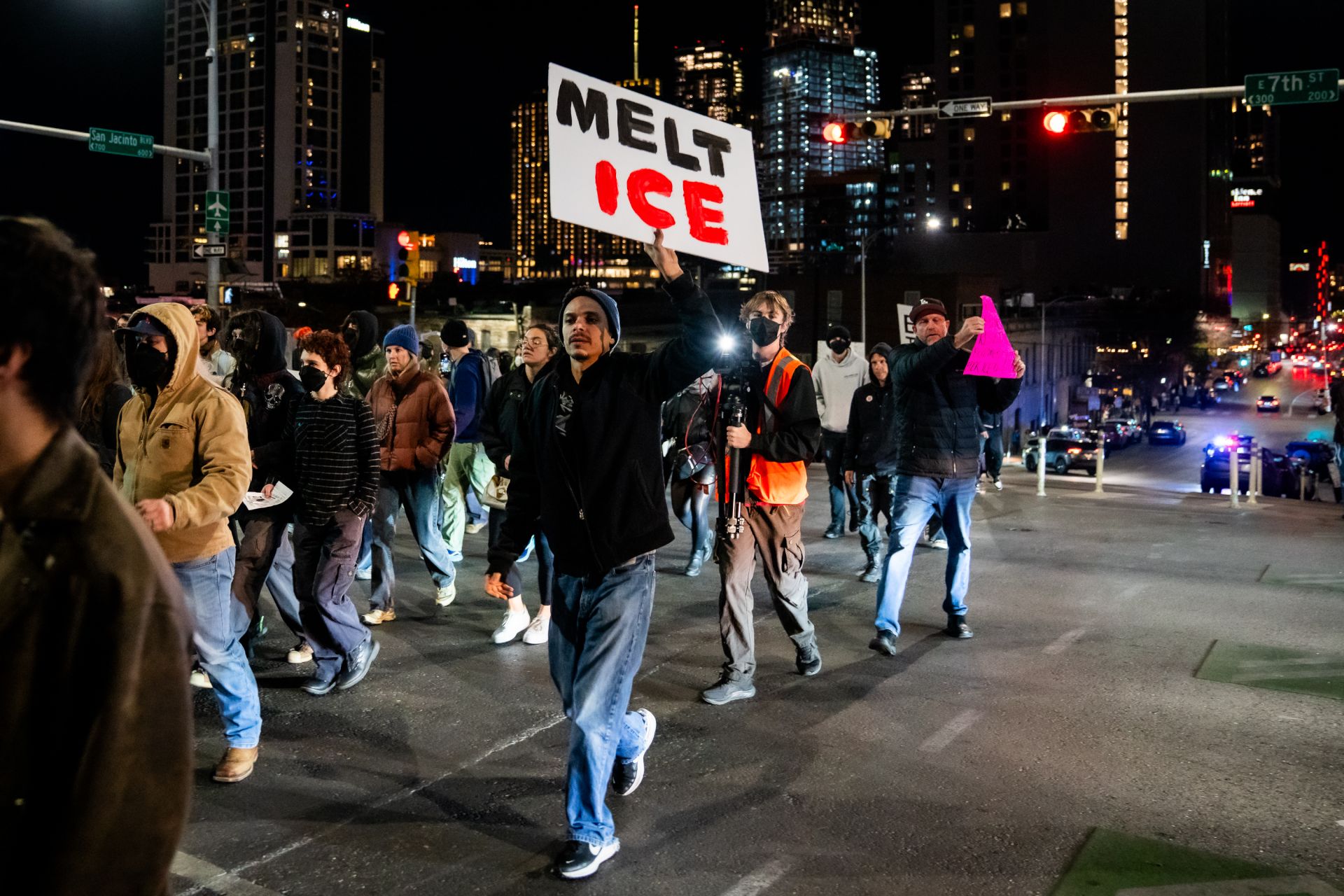
The scene captures how ICE and the grassroots response to its aggressive tactics continue to shape the rollout of President Donald Trump’s anti-immigration policies. And it comes on the heels of the controversial Texas law known as Senate Bill 4 (S.B. 4), which enlists local and state police as a de facto immigration law enforcement arm for ICE.
When ICE’s violent and ultimately deadly tactics were caught on camera early this year in Minnesota, it shocked the country, angering even Republican lawmakers and leading to the ouster of then-Homeland Security Secretary Kristi Noem. Her replacement has vowed to pursue the same policies out of the public eye.
“My goal in six months,” Markwayne Mullin said at his Senate confirmation hearing, “is that we’re not the lead story every single day.”
In Dallas, community organizers have noted a shift to a quieter, behind-the-scenes approach that seeks to avoid the explosive confrontations that dominate headlines. But in May, the Texas Senate passed legislation to help ICE continue its aggressive pursuit of arrests.
While legislation already allowed police forces to cooperate voluntarily with ICE, under S.B. 4 Texas local police are now compelled to comply with ICE detainer requests: If police systems show an ICE detainer request on an individual that they have apprehended, they are required to turn them over to the federal authority.
“A detainer,” explains Sarah Cruz, a policy and advocacy Strategist with the American Civil Liberties Union (ACLU) of Texas, “is a request from ICE that the police hold an individual that they suspect of violating immigration law for whatever reason for 48 hours to give them time to take them into their own custody.”
S.B. 4 further empowers Texas police to detain people suspected of being noncitizens or attempting to enter the state illegally. Sentences can carry up to six months in jail. Anyone previously denied admission or previously deported from the country who reenters the U.S. risks a possible sentence of up to 20 years.
Civil rights groups, including the ACLU of Texas, have voiced concerns and made legal challenges to the bill since it was first passed. They argue that S.B. 4 essentially allows immigration enforcement by those who are not immigration officers or judges, and that it encourages racial profiling, which has become rampant since the U.S. Supreme Court lifted a ban on it in September, sparking an outcry by rights groups. And because of S.B. 4, any encounter with Texas police, including a routine traffic stop, has become a de facto encounter with ICE.
Meanwhile, back at the Dallas ICE center, some of the immigrants who arrive for their prearranged appointments have driven for hours from other states, sometimes through the night, fueled by nerves and fear. They’ll eat when they get out, they say.
La Colectiva volunteers sheltering from the harsh sun under their tent are used to hearing this. They’ve spoken to hundreds of people as they make their way into meetings inside the building. They have, therefore, an intuition about the risk each individual faces as they walk toward the office. Sometimes, they’ll press a bag of food into their hands; they don’t expect to see them again anytime soon.
La Colectiva is just one of many grassroots efforts by civil society organizations offering support to immigrants in a constantly evolving legal environment.
That often means dealing with mundane details that are otherwise overlooked as a consequence of detention, like making sure that family members have a copy of car keys, for instance. If a set of keys enters the building and the individual is detained, the car is likely to get towed, incurring hundreds of dollars in costs and further stress for all involved.
“Do not leave your loved ones in the dark,” read leaflets pressed into anxious hands. “Prepare in advance and leave them a clear plan, with access to the money they may need to cover rent, food, and any other expenses.”
They also ensure that someone on the outside has the details of the immigration case so they can track progress and trace the individual in the system.
In the early afternoon, the heat is oppressive. It’s about this time that the volunteers start to get a sense of whether the ICE field office has met its daily quota.
“I’m getting a little nervous,” Zoya Choudhry, one of the volunteers, tells me. She nods in the direction of two people anxiously waiting on the edge of the parking lot. “They’ve been waiting on a loved one since 10:30, and he hasn’t come back out.”
There are two reasons for her concern, she explains. First, she’s noticed that men are more likely to be detained; and second, the man told her on his way in that he was requested to come into the ICE office a couple of days before his court date. That’s unusual.
Migrants following legal procedures are typically required to attend regular appointments with ICE. There are often simple reasons for this, like reporting any change of address, which must be done within five days of a move. But they might also be called in for compliance monitoring, updates on case progression or any other procedural reason — all mundane operations of a federal body overseeing immigration.
ICE’s website highlights a different aspect of its work, however, identifying itself as a force defending the country against “immigration crime.”
“Ever wonder who ICE officers and agents are arresting in your community?” a banner asks, linking visitors to the “wow” page on the DHS site, where visitors are encouraged to browse through — and ogle at — mugshots of some of those recently arrested. The page “is highlighting the worst of the worst criminal aliens arrested” by ICE, it reads. Over 3,000 pages showcase 12 mugshots each, along with their full name, national origin and the alleged crime for which they were arrested, but no information indicating a trial or conviction.
Browsing through the site, New Lines found that most of them are men, arrested for alleged sex crimes alongside other violence or fraud. Alleged gang affiliations are sometimes mentioned, with no information on the validity of the claim.
According to Transactional Records Access Clearinghouse (TRAC), an independent research center at Syracuse University, 70% of those held in ICE detention do not have a criminal conviction as of April 4, 2026.
But all mug shots, along with identifying information and alleged crimes, can be posted on social media from the Homeland Security website with the press of a button.
Some of the people that pass through La Colectiva’s tent have been attending meetings for years — regular check-ins that are part of normal immigration procedures. They struggle to understand the warnings from the volunteers, who request that they fill out a privacy waiver to help people on the outside advance their case, something they’ve never needed help with before. Nowadays, following legal procedure doesn’t necessarily protect them from arrest, detention and deportation.
Women who arrive for their appointments are sometimes told to call in their partner, even though there is no legal requirement to do so. The volunteers tell me this tactic is used as “a trap” to lure in male partners who are vulnerable to deportation with the assumption that a single mother would then self-deport to join her partner abroad.
“This is your asylum case,” Zoya has had to warn many arrivals before they enter the ICE center. “You don’t have to bring anyone else; your partner isn’t part of this. They’re aggressive though, they’re going to threaten you, they’re going to be rude.”
“But,” she adds, “people obviously want their partners for support. And they just want to do everything right.”
Parsing what is a requirement and what is not is increasingly difficult, as processes change and individuals are often requested to come in for appointments in quick succession with little information as to why.
Even meetings for routine procedures, like registering an address change in compliance with the law, potentially put attendees at risk of detention. If they are detained wrongfully, there’s a chance they might get out following a habeas corpus petition — which invokes the constitutional right of a person in custody to be brought before a court — but the costs associated with filing a petition can be prohibitive, reaching into the thousands.
La Colectiva regularly hands out the numbers of trusted attorneys who offer free consultations, but they also warn that if a detainee is moved between detention centers, the petition must start again. As they help detainees’ loved ones understand their legal options, they try to inform them about other practical issues, including how to send money to someone in detention (sending more than $30 isn’t advisable, they say, as money can’t be moved between centers with the detainee).
“They’re usually crueler with the men,” Zoya explains. She’s learned that single men are at the greatest risk of detention when they come in for these appointments. “If a man goes in, no medical conditions, no kids, and he comes back out, that’s when I know they’ve probably met their quota.”
That afternoon, one young man seems to get lucky. He exits an appointment with a piece of paper in hand; he’s been told to go to an address nearby but doesn’t understand why. The volunteers know what this address means, and explain that he will have an ankle monitor fitted.
The point of all this, and of the extra appointments, the volunteers guess, is to make life hostile for immigrants in the U.S., despite their legal status — to make the system so inhospitable, nerve-racking and opaque that people ultimately opt to self-deport.
Throughout the day, the convoys of ICE vehicles go in and out of the gates, offering a glimpse of the agency’s continued efforts to detain people, both those who show up voluntarily to comply with the rules, and those detained on the streets on the basis of the language they speak and their physical appearance. One tactic that seems to be currently favored by ICE is to target gas stations in the early hours of the morning, when people are fueling up to head into work.
“They often go out in a pack,” says Brad Russell, a member of Clergy League for Emergency Action and Response Dallas-Fort Worth (CLEAR DFW), an interfaith coalition in the region, “which I think usually means they have an assignment and they’re going to swarm a neighborhood.”
Outside the field office, the divide between the workers arriving ensconced in cars and trucks, often in convoys, and the volunteers on the concrete is palpable. Early in the afternoon, a large white Chevrolet pickup truck, raised so high it towers over the sidewalk, drives head-on up to the tent, blocking out the sunlight. It sparks instant fear, and one of the volunteers scrambles out of a camping chair to dash out of its path. But then it stops. The driver, unidentifiable, towering above the sidewalk, puts it into reverse and drives off.
Intimidation and surveillance are nothing new to La Colectiva, so while they’re careful not to interfere with ICE’s work, to avoid obstruction of justice charges, they still feel at risk given their proximity. Every volunteer has a signed privacy waiver, “just in case.”
A few weeks earlier, a woman got out of an Uber outside the office. She came up to the tent and asked what they were doing. Eric Falkerth, a pastor and member of CLEAR DFW, a familiar presence outside the office, was there at the time. He found out that she wasn’t there for an appointment but for a job interview.
“Oh, well, I hope you’ll consider it carefully,” he recalled telling her, “because one of the things we say, especially the pastors, is that the agents are causing moral injury to themselves just like soldiers coming back from war. I’m very confident that that’s happening to everyone in this building.”
Members of the religious community in Dallas, particularly CLEAR DFW and Faith Commons, hold vigils outside the building every Monday morning, and are a common presence at the tent where they offer prayer for anyone who might need and desire it. There are numerous requests throughout the day, and some in the group also pray for the members of ICE that they not cause harm to others or themselves.
The woman went into her interview, but as she was leaving, she stopped by the tent once more. She wanted to let Eric know that she didn’t think this was for her.
“I think you’re making a really good choice,” he recalls responding. “You will find a really good job where you don’t hurt your soul.”
She smiled, got back into her Uber, and left.
As midafternoon approaches, the tide of visitors arriving for appointments begins to slow, and the volunteers begin to pack up the tent, carefully arranging everything in the back of the car. In the morning, another team of volunteers will arrive and set up again, before the ICE appointments commence at 6 a.m.
Early the next morning, a young family approaches the tent. They speak briefly with the volunteers before going into the building. Shortly after, the father and youngest son walk back out to wait on the rest of the family. The son, no more than 5 years old, plays with a pack of toys provided by La Colectiva.
His father tells me that his wife is self-deporting and returning to Mexico. Their two older sons, from a previous marriage, will also go with her. They are driving south directly after the appointment, crossing into northern Mexico that same day. They should be in Monterrey, Nuevo Leon, by nightfall.
Their youngest son, born in Mexico, is a U.S. citizen through his father. Together, they will drive back into the U.S. a few days later, leaving the rest of their family behind, far from the reach of ICE.
This story was produced with support from the Fund for Investigative Journalism (FIJ). It is part of an ongoing joint investigation between the Center for Collaborative Investigative Journalism and New Lines Magazine.
Become a member today to receive access to all our paywalled essays and the best of New Lines delivered to your inbox through our newsletters.