


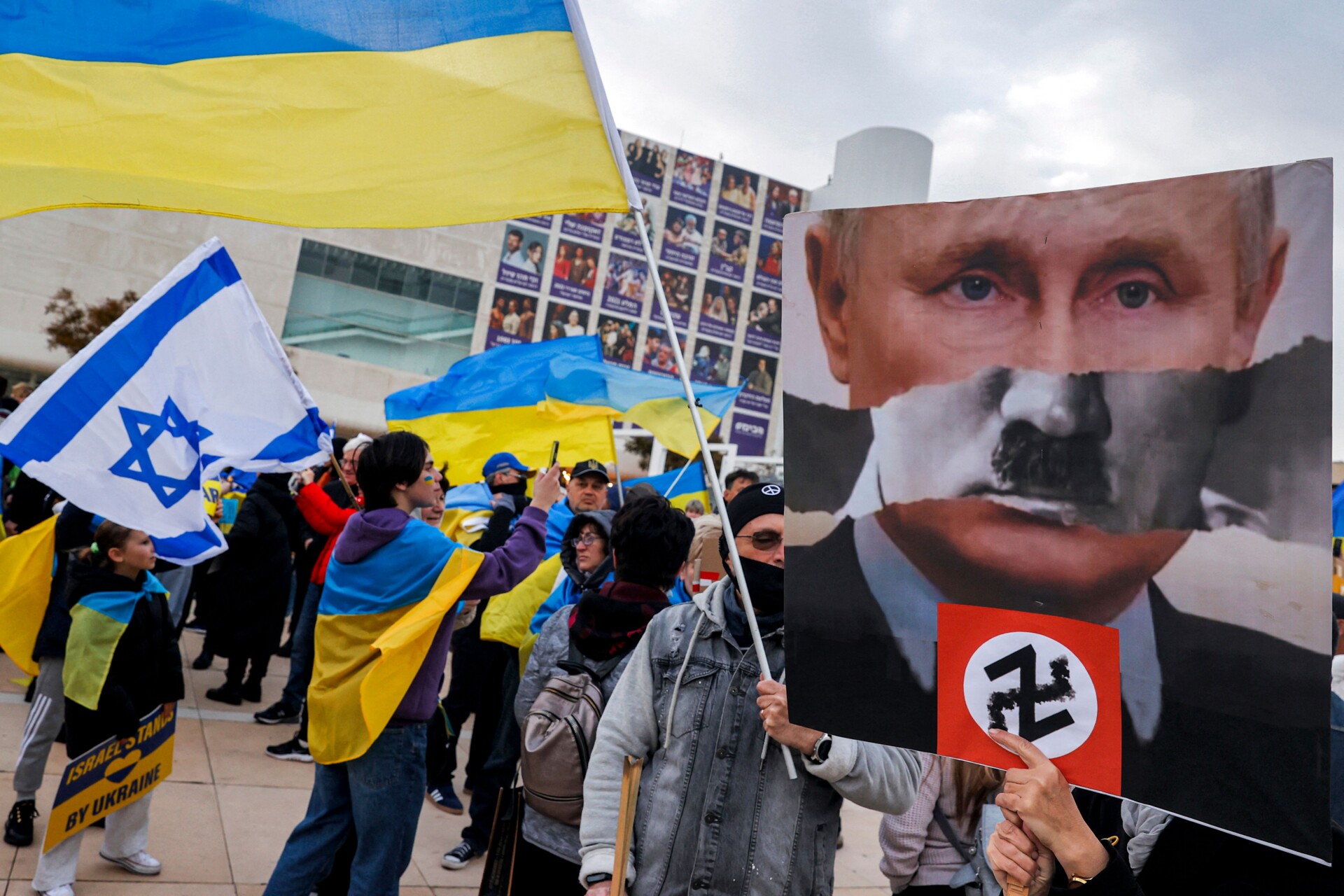
In late February 2022, a fistfight broke out in Kibbutz Lotan, a small eco-community in southern Israel.
Dima, an immigrant from Luhansk, a Ukrainian city occupied by Russian proxies since 2014, clashed with Anton, an immigrant from Russia’s far east.
As Russian missiles struck Ukrainian cities and armored columns pushed toward Kyiv, Anton, who worked on the kibbutz dairy farm, decided to celebrate Defender of the Fatherland Day, a Russian military holiday. For Dima, that was unbearable.
Anton was baffled by his neighbor’s anger. He insisted he had nothing to do with the war. He was an Israeli, he said, merely marking a holiday associated with the army in which he had once served.
For veteran Israel-born members of the kibbutz, the incident was even more shocking. They were used to thinking of both men simply as Russians who spoke the same language, barbecued together in the evenings and appeared to belong to the same community.
Similar confrontations unfolded across Israel during the first months of the full-scale invasion. The popular grocery stores that Israelis had always called “Russian” shops, selling products like buckwheat groats, smoked fish and the fermented drink called “kvass,” suddenly hung up Ukrainian flags. People who had spoken Russian all their lives abruptly switched to Ukrainian.
Then came a new wave of immigration: Tens of thousands of Russian citizens arrived in Israel, driven not by the physical dangers of war but by their opposition to it. They, too, found themselves misunderstood, this time by longtime Russian-speaking residents of the country, by people embracing a new Ukrainian identity, and certainly by Hebrew-speaking Israelis.
Over the past four years, the war has fundamentally reshaped Israel’s Russian-speaking community.
With national elections coming in October, political parties are once again competing for the “Russian vote.” Yet a campaign tactic that seemed perfectly sensible in 2019 — a giant billboard showing Benjamin Netanyahu shaking hands with Russian President Vladimir Putin — would today be political poison.
At first glance, sympathy for Russia appears to have vanished from Russian-speaking Israel. Yet support for Ukraine has become far more complicated than it once seemed.
By the mid-2000s, what Israelis often called “the Russian question” — the social and political integration of the massive immigration wave from the former Soviet Union during the 1990s — had largely faded from public debate, says Julia Lerner, an associate professor of sociology and anthropology at Ben-Gurion University of the Negev. The children of those who were born in the USSR and then immigrated grew into adulthood themselves, assimilated and identified as Israelis, rather than immigrants.
Lerner noticed it in her own classroom.
“At some point, I felt that the ‘Russian question’ was simply no longer relevant,” Lerner says. “I even stopped teaching my seminar, ‘Russia in Israel: People, Culture, Ideology.’” She explains that it wasn’t low enrollment that led her to stop teaching the seminar, but rather her feeling that the topic itself was no longer pertinent.
Russia itself appeared to be stabilizing. Many Israeli immigrants from the former Soviet Union restored ties with relatives who had remained there. Some bought property in Russia. Others began sending their children to spend summers with grandparents. Even Israelis without Russian roots increasingly traveled there.
Russian television also became a fixture in many households.
“It wasn’t only pensioners watching,” Lerner says. “Grandchildren sat in front of the television with their grandparents. It became a way of transmitting rituals, meanings and cultural habits.”
By 2017, Israeli attitudes toward Russia had reached their most favorable level in years. According to Pew Research Center data, 35% of Israelis held a positive view of Russia, while 61% viewed it negatively.
At the same time, the public representatives of Russian-speaking Israel were changing. Increasingly, the community’s most visible figures came from the 1.5 generation — people who were not quite first-generation immigrants, having arrived in Israel as children with their parents.
One of them is Alex Rif, head of the One Million Lobby, an advocacy organization for Russian-speaking Israelis. Rif immigrated to Israel from Ukraine before starting school. Today, she prefers to speak and write in Hebrew, yet much of her public work centers on the interests of immigrants from the former USSR.
In the 2010s, she and her colleagues fought stereotypes that portrayed immigrants from the former Soviet Union as insufficiently Jewish or as importing Christian customs to Israel. They argued, for example, that celebrating New Year’s Eve — a Soviet-era secular holiday — and putting up a decorated tree did not make someone a bad Jew.
For decades, the dominant political figure in the community was Avigdor Lieberman, a Soviet-born politician who came to Israel in 1978. Lieberman, who lives in a West Bank settlement and often expresses deeply racist opinions of Palestinians, co-founded the hawkish, rigorously secular party Yisrael Beiteinu (“Israel Our Home”) in 1999 to represent immigrants from the former USSR.
But as the younger generation came of age, many no longer saw themselves primarily as members of an immigrant community. Because they felt Israeli, they were less inclined to vote as an ethnic bloc for a party that represented an immigrant group. At the same time, Lieberman was repositioning Yisrael Beiteinu, changing it from an immigrant party to one with a broader mandate that combined anti-religious positions and far-right, anti-Palestinian views that encompassed Palestinian citizens of Israel.
Ahead of the 2019 election, Netanyahu decided to compete aggressively for those voters.
At the headquarters of his Likud party, there was a giant new banner that showed Netanyahu shaking hands with Putin beneath the slogan: “Netanyahu. A Different League.”
By then, Russia had already annexed Crimea, and Russian-backed forces were fighting across the Donbas region in eastern Ukraine. Dima, who had owned a coal mine in Luhansk, one of the region’s largest cities, lost his business. Unable to rebuild his life in Kyiv, he immigrated to Israel and ended up in Kibbutz Lotan. Meanwhile, a growing number of Russian immigrants dissatisfied with developments back home were arriving in Israel. They would later become known as the “Putin aliyah” (“aliyah,” or “going up,” is the Hebrew-Israeli term for Jewish immigration to Israel).
Yet the conflict remained largely abstract for many Russian-speaking Israelis before 2022, says Emil Shleimovich, editor-in-chief of Israelife and formerly head of Detaly, one of Israel’s largest Russian-language news outlets.
“For people who were not closely following events,” he says, “both sides looked the same: equally corrupt, equally poor, equally lacking in rights.”
On May 9, 2025, 62-year-old engineer and photographer Vitaly Kardashov joined a protest in downtown Haifa.
A Victory Day parade organized by the Russian Consulate was making its way through the city. Kardashov stood in its path holding a sign that read: “Don’t dishonor our grandfathers’ memory — they did not bomb Kyiv.”
The marchers erupted in abuse. Several participants then beat him and threw him into a fountain.
Kardashov has lived in Israel for 35 years. For most of that time, he participated in Victory Day marches himself.
“There was nothing political about them,” he recalls. “Hundreds of people came out to remind Israel about those who died fighting Nazism, including countless Jewish veterans of the Red Army.”
Living in Israel changed the way he viewed the holiday.
“You begin to understand that every victory is, above all, a sacrifice,” he says. “But in recent years, Victory Day celebrations have increasingly taken place under the auspices of the Russian Consulate. People carrying Russian flags may do so innocently, but they end up linking that victory to Russia’s current war against Ukraine.”
According to the sociologist and anthropologist Varvara Preter, the Victory Day commemorations were originally the initiative of immigrants who arrived in Israel during the great post-Soviet wave of the 1990s.
Israel already had Holocaust and Heroism Remembrance Day. But Soviet Jewish veterans did not fit neatly into either of the groups it commemorated.
As a result, even after Putin transformed Victory Day into a highly militarized spectacle, most Israelis continued to celebrate it independently of contemporary Russian politics. Only after the full-scale invasion of Ukraine did the holiday become divisive. Suddenly, Israelis with Soviet roots found themselves confronting questions of identity.
“The war was a real shock,” Kardashov says. “At the factory where I worked, everyone was simply Russian until 2022. Then people started separating into groups. Everyone was trying to figure out where everyone else stood.”
Most of his friends opposed the invasion. But not all.
“There were two people who would say: ‘Yes, it’s unjust, yes, it’s inhumane. But Putin has his reasons. Nothing personal — he just wants to bring Ukraine back into the orbit of the former Soviet Union.’”
For liberal Israelis of Russian origin, the war brought a different kind of loss.
“For us, the war meant losing what we considered a symbolic home,” Lerner says. “It shattered the idea that Russia could be another place to which we belonged.”
In 2022, she sold the apartment where she had grown up in St. Petersburg.
A March 2022 survey by the Israel Democracy Institute found that 69.3% of immigrants from the former Soviet Union blamed Russia and Putin for the war. Most of those respondents had no relatives in Ukraine, while many still had family members living in Russia.
By 2025, a Pew survey found that unfavorable views of Russia among Israelis had climbed to 82%.
The Israeli Friends of Ukraine organization grew out of a volunteer initiative formed during the Maidan protests of 2014, which evolved into what Ukrainians call the Revolution of Dignity after the pro-Russian President Viktor Yanukovych abandoned a landmark agreement with the European Union, leading to anti-government demonstrations. The violent dispersal of largely peaceful demonstrators at the hands of the security forces made international headlines. Yanukovych eventually fled the country.
After Ukrainian security forces shot demonstrators in February of that year, seven wounded protesters were brought to Israel for medical treatment. Anna Zharova, then an employee of the Jewish Agency, the organization that helps Jews immigrate to Israel, responsible for Moscow, St. Petersburg and Kyiv, became one of the organizers. Later that year, the group was formally registered.
“2014 was the moment Ukraine first entered the Israeli conversation,” Zharova recalls. “People started asking what this country was and where it was located.”
On March 7, 2014, the group organized a rally to protest Russia’s takeover of Crimea outside the Russian Embassy in Tel Aviv. The 500 or so participants included immigrants from Russia, Moldova, Latvia and Central Asia.
For its first eight years, virtually all of the organization’s activities were conducted in Russian. Like most Ukrainian Jews of their generation, the group’s members spoke Russian because earlier generations had largely shifted away from Yiddish as they entered the Russian-speaking urban culture of the Russian Empire and later the Soviet Union. Festivals celebrating Ukrainian Jewish culture were held in Russian. Programs for children whose fathers had been killed fighting Russian-backed forces were conducted in Russian. The group even brought a documentary about the defenders of Donetsk Airport to Israel — and screened it in Russian.
“I switched to Ukrainian on Feb. 24, 2022,” Zharova says. “At home I still use some Russian. I’m from Kherson, my husband is from Luhansk — both heavily Russified regions. We studied Ukrainian in school almost like a foreign language.”
Now, she regrets raising her children primarily in Russian. Zharova estimates that roughly half a million Israelis trace their roots to Ukraine. Yet not all of them identify with Ukraine itself.
“About 90% of those who arrived after 2014 probably do,” she says. “Maidan and the annexation of Crimea had a huge impact on identity. Then there are people like me — those who left long ago but had the chance to live in an independent Ukraine.”
Historically, immigrants from the former Soviet Union participated less than other Israelis in major protest movements, whether the social justice demonstrations of 2011 or the protests against the judicial overhaul in 2023.
But on Feb. 26, 2022, roughly 17,000 people gathered on Tel Aviv’s Rothschild Boulevard to protest Russia’s invasion of Ukraine.
For the first eight or nine months of the war, Zharova says, activism consumed nearly all of her time. She even abandoned acting school, a childhood dream she had only recently begun pursuing.
Alex Rif also immigrated from Ukraine. Unlike Zharova, she does not speak Ukrainian. Her engagement with the war, meanwhile, faded after the Hamas-led attack on Israel on Oct. 7, 2023.
“For the first two years, we spent enormous amounts of time explaining to Israelis what was happening in Ukraine,” she says. “After Oct. 7, that moved into the background.”
Language itself has become a source of tension. Shleimovich, the Russian-language Israeli newspaper editor, describes one illustrative experience.
“A Ukrainian woman asked me to promote her channel, and I did so free of charge,” he says. “A few days later I asked whether she could include a link to my publication, Detaly. She replied that her channel’s policy did not allow the promotion of Russian-language resources.”
Perhaps the most striking example is Dani, an engineer who moved to Israel from Russia in 2018 after becoming convinced that his opposition activism could eventually land him in prison; he chose Israel because of his Jewish grandfather.
Since the full-scale invasion, he has spoken Ukrainian exclusively. When we talk, he speaks Ukrainian, and I answer in Russian. The languages are closely related, and after years of reporting on Ukraine, I rarely have trouble understanding him. That arrangement feels natural to him.
“I don’t have any Ukrainian ancestors,” Dani says. “But I consider myself Ukrainian.”
Lerner believes a distinctly Ukrainian-Israeli community is now beginning to emerge.
“At its core are people who came from Ukraine as children, members of the 1.5 generation, and even people born here,” she says. “The war became a catalyst that allowed them to articulate their Ukrainian origins as a source of identity.”
In early 2022, Lerner told her students that a large number of political refugees from Russia would soon arrive in Israel. Many were puzzled.
“Even students from Russian-speaking families couldn’t understand it at first,” she says. “They wondered why people from Moscow or St. Petersburg would abandon their apartments and careers. After all, the war wasn’t happening to them. That’s a very Israeli way of looking at things.”
Immediately after the full-scale invasion, Rif and her colleagues approached Naftali Bennett, who was then prime minister, with an emergency plan for absorbing a large influx of immigrants.
“The budgets of the Ministry of Aliyah and Integration were tiny,” Rif recalls. “We argued that Israel needed to rapidly expand Hebrew-language programs and employment assistance. Bennett listened and opened the doors. But a few months later, his government collapsed.” (Netanyahu was reelected).
The scale of the migration was unprecedented. Following Russia’s full-scale invasion, 171,000 people immigrated to Israel, including 106,000 from Russia and nearly 20,000 from Ukraine, according to Svetlana Chachashvili-Bolotin of the Ruppin Academic Center. She estimates that between 30,000 and 40,000 Russian-speaking immigrants from this wave have since left the country.
The One Million Lobby puts the total number of immigrants from Russia, Ukraine and Belarus over the past decade at as many as 250,000, including many Belarusians who fled the regime’s violent crackdown on the 2020 pro-democracy protests.
As tens of thousands of newcomers arrived after 2022, Israel experienced a familiar phenomenon: conflict between different waves of immigration.
The newcomers found themselves criticized not only by immigrants who had arrived decades earlier, but even by members of the so-called Putin aliyah — the politically motivated migrants who had begun arriving after Russia’s annexation of Crimea in 2014.
Their main complaint was straightforward: The war in Ukraine had begun in 2014. Why, they asked, had these people remained comfortably in Russia until 2022?
The latest arrivals soon acquired a nickname: the “pumpkin aliyah.” The term originated with the first major public controversy surrounding the new immigrants.
In the fall of 2022, the journalist Tatyana Sheremet, who had recently moved to Israel from St. Petersburg, complained on Facebook that she missed Starbucks’ seasonal pumpkin spice latte. Starbucks does not have a presence in Israel, and Sheremet joked that she was suffering without it. The backlash was immediate.
“It’s really a conflict of languages and cultural codes,” explains Varvara Preter, the sociologist. “Many people saw the post and thought: There’s a war in Ukraine, and they’re complaining about coffee.”
But Sheremet’s use of the word “suffering,” Preter argues, was deliberately ironic.
“That kind of postironic language developed in Russia during the 2010s. People who immigrated earlier often don’t recognize it as irony.”
Zharova is not particularly fond of the pumpkin aliyah either.
“That coffee post really upset me,” she says. “It immediately showed me there was a divide between these people and those who genuinely support Ukraine. They’re former [Alexei] Navalny activists. They say they’re pro-Ukraine, but where are their actions? Many of us have friends and relatives who have been killed in this war. We’ve been living with this since 2014. People who arrived in 2022 often act as though everything began in 2022. They’re focused on their own concerns. That’s hard to relate to.”
According to Rif, the current conflict between veteran immigrants and the pumpkin aliyah differs from previous tensions because this time the Israeli government has become part of the story.
“They’re not simply failing to stop the hostility,” she says. “They’re helping legitimize it.”
For several months after the change of government, she and her colleagues assumed officials simply did not understand the challenges facing the new immigrants.
“Then it became clear that they didn’t really want this aliyah,” she says. “Ministers publicly argued that many of the newcomers were not Jewish according to Halacha [Jewish religious law] and had come only to obtain an Israeli passport and collect Israeli benefits.”
One particularly controversial move involved shifting millions of shekels away from integration programs and toward campaigns encouraging immigration from Britain and France. The message, critics argued, was clear: Some immigrants were more desirable than others.
“Private ulpan vouchers disappeared,” Rif says, referring to government-funded subsidies that allowed new immigrants to study Hebrew at private language schools instead of the traditional state-run schools for learning the language. “And the traditional ulpan system makes it extremely difficult to combine language studies with full-time work.”
“We survey immigrants every year, and the numbers keep getting worse. One-third say they never attended an ulpan at all and 45% say their children are struggling to integrate into Israeli schools. More than half (55%) say they feel Israel has not ‘opened its doors’ to them and that they are not truly welcome.”
The outbreak of war after Oct. 7, 2023, only deepened those concerns. Before the Gaza war, roughly 90% of respondents in the One Million Lobby’s surveys said they planned to remain in Israel permanently. Afterward, that figure fell to 75-80%.
Yet the government’s ambivalence may also have a political explanation. Many of the newcomers hold views that differ sharply from those of Israel’s current governing coalition.
An Israel Democracy Institute survey found that 95% of immigrants who arrived from post-Soviet countries between 2014 and 2023 rejected the idea that Jews should enjoy greater rights than non-Jews in Israel.
Only 12% agreed that Israel needs a strong leader unconstrained by parliament or public opinion.
Among earlier immigrants from the former Soviet Union, that figure was 44%. Among Israel’s Jewish population as a whole, it was 60%.
Many analysts view the new immigrants as a largely liberal constituency that could ultimately be worth one or two parliamentary seats. Lerner believes this reflects the social composition of the newer immigration waves.
“The great immigration of the 1990s was socially heterogeneous,” she says. “It included every kind of person imaginable. It was a cross-section of Soviet society. The waves of 2014 and 2022 are much more selective in terms of education and class.”
With national elections scheduled for Oct. 27, Israeli political parties are once again courting Russian-speaking voters. Rif sees that renewed interest as, at least in part, the result of years of advocacy. She recently accepted an offer to run on the list of a new party headed by Gadi Eisenkot, the former military chief of staff. Eisenkot has positioned himself as a centrist and, according to the polls, presents the only serious challenge to Prime Minister Netanyahu.
Israeli politicians still seem unsure what to do with this emerging Ukrainian-Israeli identity.
That became particularly evident in April 2026, when a dispute over allegedly stolen Ukrainian grain unexpectedly spilled into Israeli politics.
Two bulk carriers loaded with wheat and barley arrived in Israel one after the other. The cargo was presented as Russian, but Ukrainian investigators from the volunteer project Myrotvorets, which documents individuals and activities linked to Russia’s war against Ukraine, said they had obtained evidence that part of the grain had been loaded in ports located in Russian-occupied Ukraine.
Kyiv asked Israel to block the shipments.
The first vessel was unloaded without incident.
Ukraine then threatened to pursue European sanctions against the companies purchasing the grain. Israeli Friends of Ukraine organized a protest. Eventually, the second vessel was denied entry to the port.
Yet the Ukrainian threats themselves angered many Israelis.
“Russian-speaking Israelis have a particular mindset,” Shleimovich says. “We’re perfectly willing to criticize Israel ourselves. But criticism from the outside often produces the opposite reaction.”
“Of course Israel shouldn’t be buying stolen grain. There’s no argument about that. But Ukraine threatens Israel with sanctions while not threatening Turkey in similar situations because Turkey supplies Bayraktar drones and provides other forms of cooperation. People who strongly dislike Russia and sympathize with Ukraine suddenly find themselves saying: ‘Enough already.’”
One of them was Alexander, a St. Petersburg-born artist who left Russia after the invasion. In 2022, an exhibition of his work at Moscow’s Tretyakov Gallery was canceled because his anti-war stance ended any prospect of exhibiting in major state museums. He remains strongly supportive of Ukraine.
During the dispute over the grain shipments, Alexander shared a post by another recent immigrant from Russia, Ilya, who had participated in pro-Ukrainian rallies in Israel after the invasion. Ilya argued that Ukraine was demanding action from Israel while applying far less pressure to larger importers of Russian grain such as Turkey. Alexander publicly agreed.
Neither man had abandoned support for Ukraine. What frustrated them was something else: the feeling that Israel was being singled out for criticism.
For some Russian-speaking Israelis, support for Ukraine no longer automatically determines their position on every dispute involving Kyiv. As the war drags on, solidarity with Ukraine increasingly coexists with another identity — that of Israelis defending what they see as their own country’s interests.
Lerner believes signs of fatigue with Ukrainian rhetoric appeared much earlier.
“After [Ukrainian President Volodymyr] Zelenskyy’s speech to the Knesset in March 2022 failed to resonate, doubts began to surface. People started asking whether some of what Russian propaganda was saying might be true,” she says. “I know a scientist who spent the first years of the war completely immersed in the Russian-Ukrainian conflict. He practically severed all ties with Russia. But recently he traveled there again. The anti-Israel shift in parts of Europe changed the way he saw things. For some Russians, it pushed them back toward Putin.”
Such cases remain difficult to quantify. But Lerner believes they reflect a broader shift among some Russian-speaking Israelis after Oct. 7, 2023.
This is happening despite Russia’s increasingly hostile posture toward Israel. Moscow regularly hosts representatives of Palestinian militant organizations. Iran, Israel’s principal regional adversary, has become one of Russia’s closest strategic partners.
Russian state media routinely republishes Iranian narratives without verification. In May, a group of 40 Israeli citizens arriving in Moscow was detained for about five hours without food, water or access to toilets. During interrogations, some were told that Iran was Russia’s ally, that “Iran’s enemy is our enemy,” that Israelis were not welcome in Moscow, and that they “shouldn’t have come.” Yet all of this generated less discussion in Israel than another dispute involving Ukraine.
On May 28, the same Myrotvorets project added Dani Dayan, chair of Yad Vashem, Israel’s Holocaust memorial, to its list of “enemies of Ukraine.”
The move came after Yad Vashem expressed concern over the ceremonial reburial in Kyiv of Andriy Melnyk, a leader of one faction of the Ukrainian nationalist movement during World War II. Some of his followers participated in the persecution and murder of Jews during the Nazi occupation of Ukraine.
For many Russian-speaking Israelis, such controversies increasingly collide with another layer of identity: their identities as Israelis and as Jews. Over the past four years, Israel’s Russian-speaking community has fragmented into several distinct identities — Ukrainian, anti-Putin Russian, Soviet, and simply Israeli.
The old umbrella category of “Russian Israelis” still exists as a demographic label. As a community, however, it has become something far more complicated. And there may be no putting it back together again.
Become a member today to receive access to all our paywalled essays and the best of New Lines delivered to your inbox through our newsletters.