


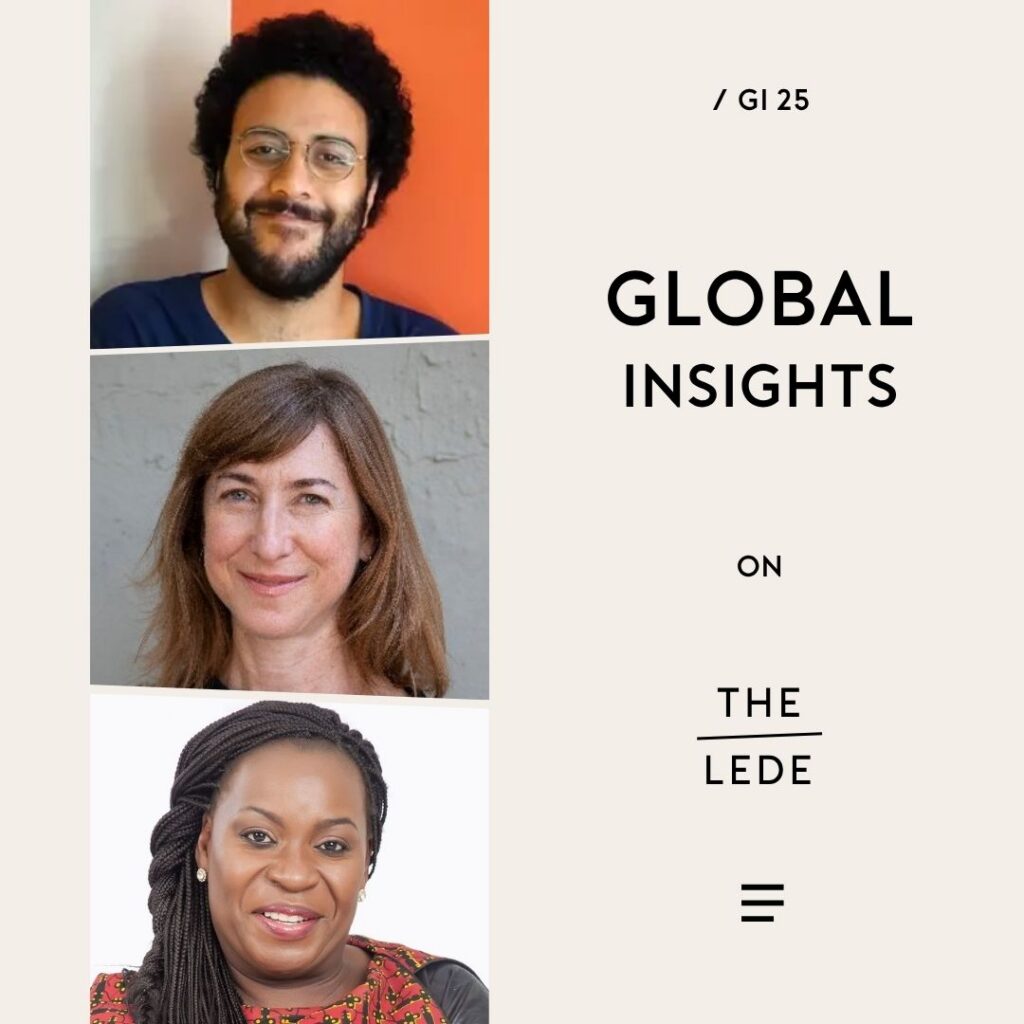
Hosted by Kwangu Liwewe Agyei
Featuring Rida Abu Rass and Dahlia Scheindlin
Produced by Finbar Anderson
Listen to and follow The Lede
Apple Podcasts | Spotify | Youtube | Podbean
To say that a divide exists in Israeli politics today is an understatement, political scientist Dahlia Scheindlin tells Kwangu Liwewe Agyei on this month’s episode of Global Insights on The Lede.
With a pivotal parliamentary election upcoming in October, the supporters of incumbent Prime Minister Benjamin Netanyahu “are a lot more optimistic about where Israel’s going, because they think the wars of the last few years are the right direction,” Scheindlin says. “But there is a fundamental chasm. It’s a huge abyss between the worldview of that minority, which is a substantial minority, and the majority who do want a change.”
“Anybody who’s not with him is somehow in collusion with terrorists. That’s how you exploit nationalist sentiments in an ethnonationalist conflict.”
Netanyahu maintains his grip on power in Israel through his brand of skillful, if cynical, populism. “‘Left-wing’ means they will concede to the Palestinians, they will give up territory or, frankly, that they are terrorists. And this is what Netanyahu has argued for years, and he’s doing it to this very day,” Scheindlin says. “Anybody who’s not with him is somehow in collusion with terrorists. That’s how you exploit nationalist sentiments in an ethnonationalist conflict.”
Israel’s opposition seems unwilling to challenge Netanyahu’s tactics. “On the one hand, he’s really facing an uphill battle, even according to just the data,” Scheindlin says. “Having said that, Israeli opposition parties have a self-imposed, arbitrary and frankly racist constraint of trying to avoid building a coalition with parties representing Arab or Palestinian citizens of Israel.”
Political scientist Rida Abu Rass offers a slightly different take on the divide within Israeli politics. “What this disagreement obscures is actually a very strong national consensus within Israel, and this consensus has only strengthened since Oct. 7,” says Abu Rass. “There is a very strong agreement within the Jewish Israeli community regarding the boundaries of legitimate discourse. Within those boundaries, there is fierce and strong disagreement, but there’s strong agreement on what falls outside of it.”
What falls outside of it, says Abu Rass, is any kind of coalition-building with Arab partners, despite Arab citizens making up over 20% of Israel’s population. “Cooperating with Arab politicians — even when they go as far as omitting any reference to their Palestinian identity, omitting any demand for a two-state solution — even when they give those up, there is a very strong taboo against including Arabs in government,” Abu Rass says. “That falls outside of the bounds of legitimacy within the Israeli political system.”
That does not mean there is no role for Arab politicians within the Israeli political process, says Abu Rass. “On the Palestinian side, we need a leadership that is able to take ownership of not only the community’s parochial struggle within Israel, but also of the Israeli democratic left more broadly,” he argues. “We’re not seeing that on the Israeli side, and I think there is room for that on the Palestinian side that would say, ‘Yes we are representatives of the Palestinian community, but we’re also here to advance a broader left-wing project, a Jewish-Palestinian partnership,’ and not leave that role to the Jewish Zionist left, because there hasn’t been a strong experiment in that kind of binational leadership coming from that side over the last few decades.”