

Millions of Americans consider it important for faith to play a major role in their children’s education. Ehsan Sayed is one of them. That’s why he was excited that a new voucher program in Texas would pay tuition at Brighter Horizons Academy. His excitement turned into uncertainty for a simple reason: He wants to send his children to an Islamic school that authorities are wary of.
The state’s $1 billion universal school voucher program is well into its launch this year, offering over $10,000 to eligible families so they can pay tuition to private or religious schools. But whether students of Brighter Horizons Academy can access the same vouchers that members of other religions have used without difficulty remains uncertain. The idea of “religious freedom” in America — and whose religion gets to benefit from such freedom — has a tumultuous history rooted in a long-standing struggle over who the country is for and who counts as American.
At the founding, there were two competing strains in the American constitutional project. One strain was a fervent commitment to religious freedom that made space in the country for members of different faith traditions. Eighteenth-century England had a state-supported church with the king as its head. The government persecuted dissenting Christians like Puritans and Quakers. For example, one English Puritan was sentenced to life imprisonment and had his ear cut off by Anglican authorities in 1630. As a result, English settlers came to America seeking a place to practice their faith in peace. The desire for religious liberty is reflected in the first state constitutions written in 1776, while Americans were fighting for independence. In 1776, the Constitution of Pennsylvania guaranteed that “no man ought or of right can be compelled to attend any religious worship, or erect or support any place of worship, or maintain any ministry, contrary to, or against, his own free will and consent.”
The second strain was a desire to make America a Christian country that reflected particular doctrinal convictions. Soon after English settlers came to the New World, they began persecuting other Christians who differed on how to practice the religion. Massachusetts Puritans banished Anne Hutchinson, a pious woman who had grown increasingly influential in the colony, for questioning their religious establishment, and she fled to Rhode Island.
America’s first state constitutions also privileged specific understandings of Christianity. Most emphatically, the 1778 South Carolina Constitution declared that “The Christian Protestant religion shall be deemed, and is hereby constituted and declared to be, the established religion of this State.” At some point during the founding era, nine states had established churches that were supported by taxpayer dollars, including Massachusetts and Virginia. Unsurprisingly, these states also frequently limited officeholders to professing Protestant Christians. The Declaration of Independence may have said that “all men are created equal,” but early American practice often treated different religions unequally in terms of who had basic rights.
These contradictory impulses showed up in the surprising decision of several states to prevent pastors from serving in office. New York asserted the prohibition was because pastors “are, by their profession, dedicated to the service of God and the care of souls, and ought not to be diverted from the great duties of their function.” Tennessee continued to bar pastors from office until late in the 20th century, when the U.S. Supreme Court found such exclusions unconstitutional.
The U.S. Constitution resulted in part from a conversation about the efficacy and wisdom of America’s first state constitutions. But it failed to resolve the tension between giving Christianity pride of place and preserving religious liberty. The U.S. Constitution specified that there could be no religious tests for federal office of the sort several states imposed, while leaving in place such tests for state office. The First Amendment prohibited the federal government from establishing a national church (it would have been exceptionally difficult for Americans who practiced so many variations of Christianity to agree on what a national church would look like). However, the First Amendment, at least as understood in the 18th century, also prohibited the federal government from interfering with established state churches. In Elk Grove v. Newdow, Justice Clarence Thomas suggested that the First Amendment’s language may in fact still allow states to have official churches.
In the 19th century, widespread immigration by Irish Catholics sparked a nativist backlash that included rioting in major cities. Catholics were portrayed as criminals who were loyal to the Pope instead of to America. One result was an attempt to amend the U.S. Constitution to prevent states from using public money on religious schools to which many Catholics sent their children. The amendment had a high-profile champion in U.S. Sen. James Blaine, a Republican from Maine, who ran for president three times. The amendment fell only four votes short of the two-thirds support in the U.S. Senate that is required to propose a constitutional amendment to the states for ratification. At one point, 38 state constitutions had so-called “Blaine Amendments” forbidding the use of state money on religious schools. Although these amendments did not single out Catholic schools specifically in their text, they were widely understood to accomplish that objective. Because they were a majority, Protestants could and did shape public school instruction to inculcate students with their worldview, including mandating reading from the Protestant Bible (Protestants and Catholics use different versions of the Bible). Because they were a minority, Catholics could not similarly shape public school instruction. As a practical matter, therefore, refusing to give state aid to religious schools affected Catholics more than Protestants.
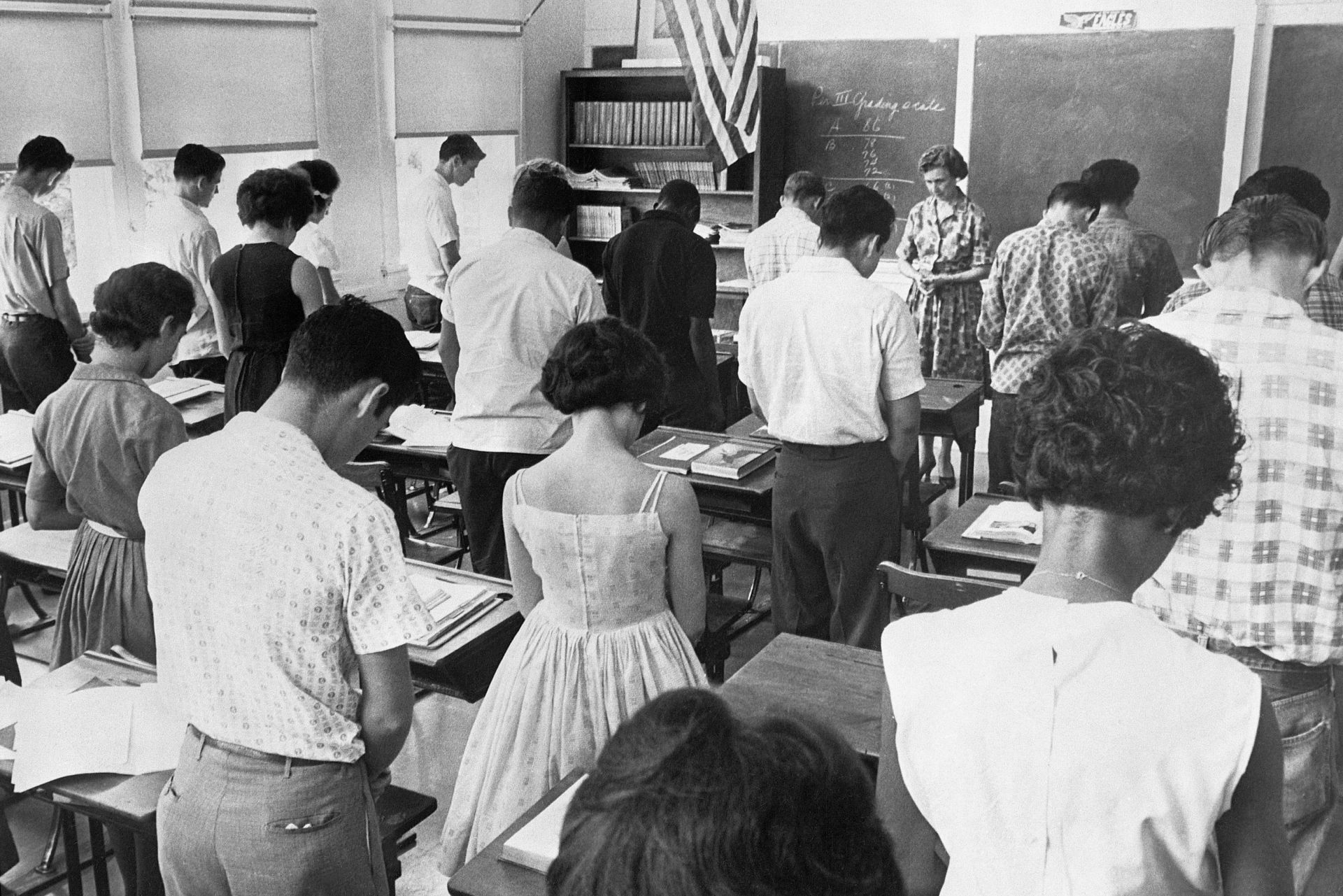
And Catholics were not the only ones to face hostility. Jewish people encountered rampant antisemitism. During World War II, Jehovah’s Witnesses, who regard a salute as a form of worship and respectfully abstain from saluting any flag, were expelled from schools for failing to salute the American flag. The U.S. Supreme Court initially upheld the expulsions in Minersville School District v. Gobitas before finding them unconstitutional in West Virginia v. Barnette. The latter case prompted perhaps the most forceful defense of religious liberty in U.S. Supreme Court history. “If there is any fixed star in our constitutional constellation, it is that no official, high or petty, can prescribe what shall be orthodox in politics, nationalism, religion, or other matters of opinion, or force citizens to confess by word or act their faith therein,” wrote Justice Robert Jackson, who eventually prosecuted Nazi war criminals at Nuremberg.
Over time, the divides between different Protestant denominations and between Protestants and Catholics have become less salient in our politics. The modern religious liberty case forming the backdrop of our debates involved Native Americans who smoked peyote as a religious rite. When they were fired from jobs as drug counselors for smoking peyote, Oregon denied them unemployment benefits. In Employment Division v. Smith, the U.S. Supreme Court allowed Oregon to deny benefits because the case involved a criminal law against peyote that applied equally to adherents of all religions and did not target any one religion.
Outraged, a bipartisan coalition with members as diverse as Newt Gingrich, the architect of the Republican takeover of the U.S. House of Representatives in 1994, and Ted Kennedy, the famous liberal “Lion of the Senate,” passed the Religious Freedom Restoration Act (RFRA). The law required courts to take a much more skeptical look at government actions that undermined religious freedom. The government could only do so when it had a “compelling” reason, like preserving public safety, and the restriction was necessary to accomplish that objective. The U.S. Supreme Court narrowed the law to apply only against the federal government in 1997. However, 30 states have laws like RFRA on the books.
In the 21st century, the movement for LGBTQ+ equality has made enormous strides. Starting with Massachusetts in 2003, states began to recognize a right to gay marriage. In 2015, the U.S. Supreme Court joined this trend and interpreted the U.S. Constitution to require all states to recognize gay marriage. This has revealed a tension between religious liberty and antidiscrimination law. Can a state cite an antidiscrimination law to punish an individual who refuses to bake a cake for a gay wedding because of their religious views?
The U.S. Supreme Court said “no” in Masterpiece Cakeshop v. Colorado Civil Rights Commission. In the past decade, as its composition has shifted, the court has repeatedly ruled in favor of religious believers in high-profile cases. It sided with a high school football coach praying at midfield right after a game ended, with a Missouri church-based preschool denied a grant because of Missouri’s Blaine Amendment, and with Mainers challenging a state policy of paying tuition to secular schools but not schools that provided religious instruction. Despite these court victories, many conservative Christians see themselves as an embattled minority. Demographic changes have probably encouraged this view. As recently as the 1990s, about 90% of Americans identified as Christians, according to Pew Research. But now, only about two-thirds of Americans identify as such. In fact, 60% of white evangelicals believe Christians face discrimination in the United States. They now view themselves as important beneficiaries of RFRA laws, something akin to the Native American plaintiffs in Smith. President Trump has signaled sympathy for these sentiments by signing an executive order establishing a task force to root out what he calls “the anti-Christian weaponization of government.”
Muslim Americans like Sayed likely hoped to benefit from legal developments that gave greater leeway to religious believers. Yet Islamophobia remains pervasive. After the 9/11 attacks, there was a wave of hate crimes and incendiary anti-Muslim rhetoric. In a phenomenon that 19th-century Catholics would recognize, elected officials have asserted that Muslim radicals are conspiring to replace our constitutional order with Sharia law. But where President Bush condemned hate crimes and declared that “Islam is peace,” just six days after the 9/11 attacks, Trump has taken a different path. During his 2015 campaign to secure the Republican presidential nomination, Trump released a statement saying, “Donald J. Trump is calling for a total and complete shutdown of Muslims entering the United States until our country’s representatives can figure out what is going on.” The U.S. Supreme Court later upheld a narrower ban affecting certain nationals from Iran, Libya, Somalia, Syria and Yemen — all majority-Muslim countries — along with certain North Koreans and Venezuelans. Of course, Trump is not completely indifferent to the plight of refugees. Last year, he offered white South Africans a chance to come to the United States and threatened to end assistance to South Africa’s government over alleged discrimination against white people.
In perhaps the ultimate irony, Oklahoma’s Attorney General Gentner Drummond, who identifies as a “committed Christian,” opposed authorizing what would have been the nation’s first Catholic (or religious) charter school. States do not have to permit charter schools. When they do, charter schools are tuition-free and publicly funded. But they have more flexibility than traditional public schools in areas such as setting curricula and disciplinary policies. Drummond warned that if Oklahoma allowed a Catholic charter school, “tomorrow we may be forced to fund radical Muslim teachings like Sharia law.” Mr. Drummond sued his own state’s Virtual Charter School Board for violating the First Amendment’s Establishment Clause by authorizing the school, and took the case to the U.S. Supreme Court. With Justice Amy Coney Barrett recusing, the outcome was a tie, failing to definitively resolve the case.
However, the issue of whether the First Amendment permits religious charter schools is likely to recur. We know that the Catholic charter school in this case had four votes. And Barrett may very well provide a fifth vote to the next religious school seeking recognition. Once that precedent is set, Islamic charter schools will have a powerful First Amendment claim. If that happens, the reason we may not see a proliferation of such schools obtaining public money is that officials in certain states are so determined to avoid supporting Islamic schools that they reluctantly refuse to support Christian schools. They could do so by simply refusing to allow charter schools at all and ending voucher programs. In areas where conservative Christians have political clout, they may make the same calculation that 19th-century Protestants made: infusing Christianity into public schools and withholding state assistance that would be necessary, as a practical matter, to enable families with dissenting religious views to escape. Several states have passed laws requiring classrooms to display the Ten Commandments. Texas is considering mandating Bible reading in public schools.
In this environment, Texas and Florida both refused to allow many Islamic schools to participate in their voucher programs. Their stated concern was that certain schools were affiliated with the Council on American Islamic Relations (CAIR). Gov. Greg Abbott of Texas and Gov. Ron DeSantis of Florida have designated CAIR as a terrorist organization. The federal government does not designate CAIR as a terrorist organization.
For now, a lower court has intervened on behalf of Brighter Horizons Academy and other Islamic schools, allowing them to participate in the Texas voucher program. Sayed is, for now, eligible for voucher assistance to send his two children to school. How long he will be able to benefit is anyone’s guess.
As America celebrates its 250th anniversary, George Washington’s message to a synagogue offers hope that should sustain Muslims wondering about their place in America in this political climate. “It is now no more that toleration is spoken of as if it were the indulgence of one class of people that another enjoyed the exercise of their inherent natural rights, for, happily, the Government of the United States, which gives to bigotry no sanction, to persecution no assistance, requires only that they who live under its protection should demean themselves as good citizens in giving it on all occasions their effectual support.” Only that vision of religion in such a diverse republic can hold us together and ensure we are all treated with dignity.
Become a member today to receive access to all our paywalled essays and the best of New Lines delivered to your inbox through our newsletters.