

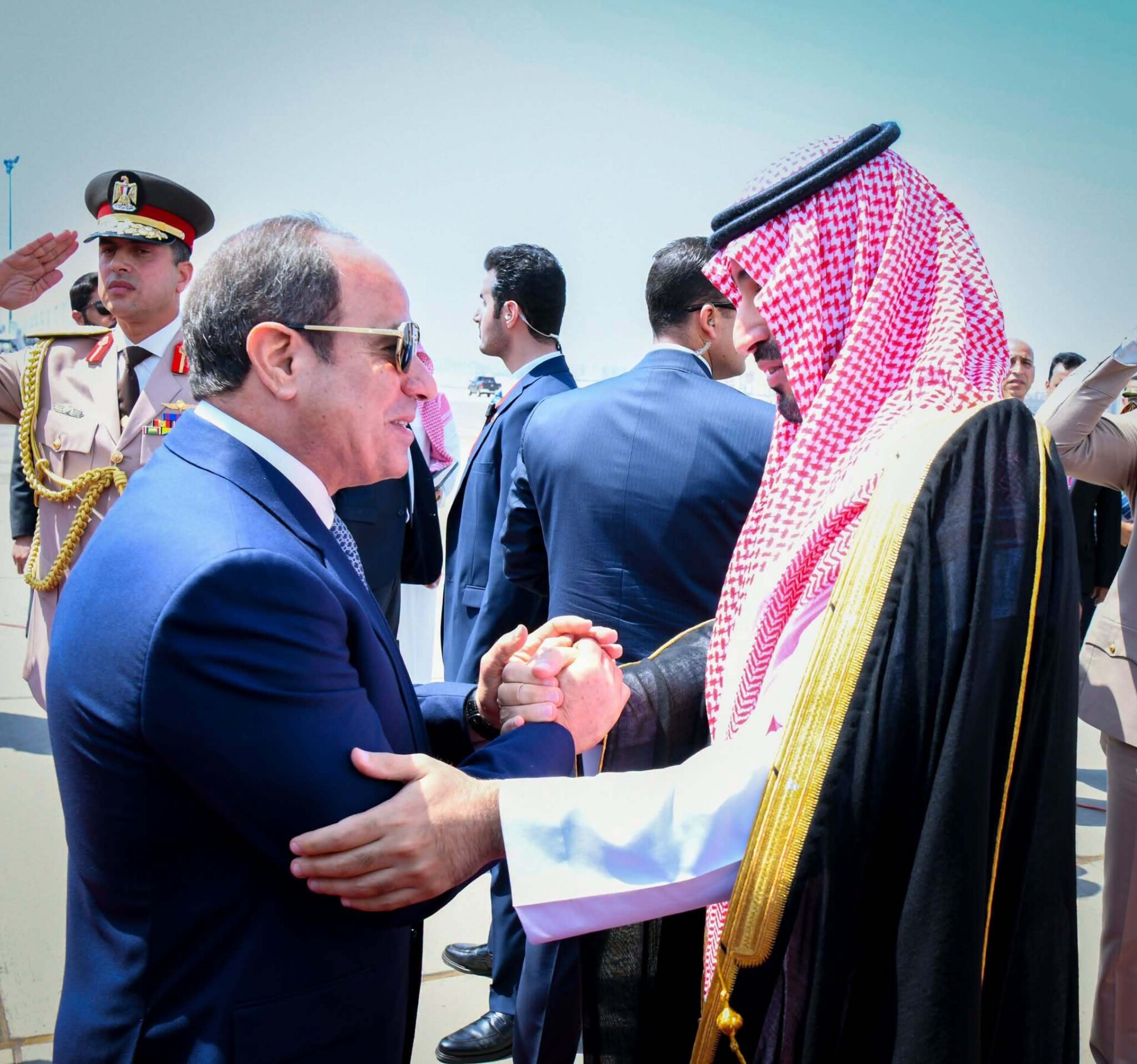
Egypt is flexing its muscles as it prepares to help defend Saudi Arabia from Yemen’s Houthis. The decision reflects a commitment to protect the kingdom, but it could also drag Egypt into a regional conflict that continues to escalate.
While Egypt clearly views Saudi security as intricately tied to regional stability, any military maneuver risks provoking a sustained retaliation. Strikes targeting Egyptian infrastructure could weaken its already fragile economy, resulting in even more domestic and regional unrest.
That partly explains Egypt’s traditionally cautious foreign policy, which has continued under President Abdel Fattah el-Sisi. In 2015, Egypt did not partake in the Saudi-led coalition against the Houthis, nor did it join the recent Mecca Pact — a defense alliance between Turkey, Saudi Arabia and Pakistan.
Egypt now believes that staying on the sidelines threatens its security more than asserting its might.
The Houthis are already trying to change Egypt’s assessment. On Oct. 27, the Iran-backed group stated that they consider Cairo’s decision to aid Riyadh a “declaration of war.” The statement came a day after Egypt’s Parliament approved Sisi’s request to provide military support to Saudi Arabia if called upon to do so.
Ahmed Aboudouh, an associate fellow of the Middle East and North Africa Program at Chatham House, believes that Egypt is preparing to proactively manage the risks.
He told New Lines that the operations were likely to be defensive, but that this could mean not only defending from within Saudi territory, but also defending Egypt by attempting to limit the Houthis’ ability to attack Egyptian targets.
“My sense is that Egypt’s role will be confined to air and naval defense,” Aboudouh added.
He explained that Saudi Arabia’s vast size and critical assets make it difficult to intercept the barrage of Houthi airstrikes — a challenge that Egypt could help with.
On Oct. 10, the Houthis hit Riyadh International Airport, killing 13 people and injuring more than 300. It was the deadliest attack on the kingdom in more than a decade.
In addition, Aboudouh expects Egyptian naval vessels to enter the Bab al-Mandab Strait to protect the strategic route from Houthi attacks. Commercial ships traverse this critical strait to reach the Suez Canal, a lifeline for Egypt’s economy and one of its most reliable sources of foreign currency.
In 2024, Houthi attacks on Red Sea shipping — ostensibly to pressure Israel to end its war on Gaza — diverted traffic away from the Suez Canal. Egypt earned just $4 billion from commercial shipping that year, compared with $10.2 billion the year before.
The stakes are higher due to rising oil prices, brought on by the U.S.-Israeli war on Iran, which are driving up the cost of vital imports and pushing Egyptians deeper into poverty.
Egypt’s economy has been on a downward spiral since Sisi came to power in a coup in July 2013. He has relied heavily on external loans to finance arms purchases and large-scale infrastructure projects that enrich the military.
This economic model has failed to boost Egyptian exports and has crowded out the private sector while resulting in ballooning debt. In July and August 2026, the country spent at least 96% of its government revenue on interest payments.
Attacks on critical infrastructure could plunge Egypt’s economy to new lows by spooking investors and tourists and disrupting exports. This, in turn, could cause the local currency’s value, which recently tumbled to 56 Egyptian pounds to the U.S. dollar, to drop further still.
Nancy Okail, an expert on Egypt and the president and CEO of the Center for International Policy, suspects that Saudi Arabia will help Egypt avert an economic collapse if it comes under attack from the Houthis.
She added that Egypt’s calibrated support for Saudi Arabia still risks pulling it into a regional quagmire. “A limited deployment could lead to an officer getting killed. That could then result in internal pressure [on Egypt’s government] to retaliate,” Okail told New Lines.
But staying out of the conflict may not insulate Egypt from the threat of retaliation. In July, a drone struck Egypt’s Mediterranean port of Damietta, causing a fire that engulfed two gas vessels.
While nobody claimed responsibility, analysts widely suspect that an Iran-backed armed group was behind the attack. Houthi strikes on Saudi Arabia have added to Egypt’s sense of urgency about assuming an assertive regional role, said H. A. Hellyer, a senior associate fellow at the Royal United Services Institute.
He explained that Egypt considers Saudi Arabia an important counterweight to Iran’s axis and what he described as Israel’s project of regional “paramountcy,” which enables it to violate established norms and precedents whenever it sees fit.
The United Arab Emirates is also competing against Egypt and Saudi Arabia for influence in the Red Sea and Horn of Africa.
“Egypt views the stability of Saudi Arabia as quite crucial to the overall regional order,” Hellyer said.
Ongoing attacks on Saudi Arabia could undermine the kingdom’s ability to project power, thereby jeopardizing Egypt’s national security interests.
Over the last few years, Egypt and Saudi Arabia have aligned on foreign policy objectives regarding maritime and, specifically, Red Sea security. Both support an end to Israel’s war on Gaza and back the Sudanese national army against the UAE-backed Rapid Support Forces.
“Egypt has a long-standing posture — regionally speaking — to avoid escalation and to not make enemies when it doesn’t need to. But in this situation, it decided that it simply can’t leave the Saudis to be hit in this fashion,” Hellyer told New Lines.