

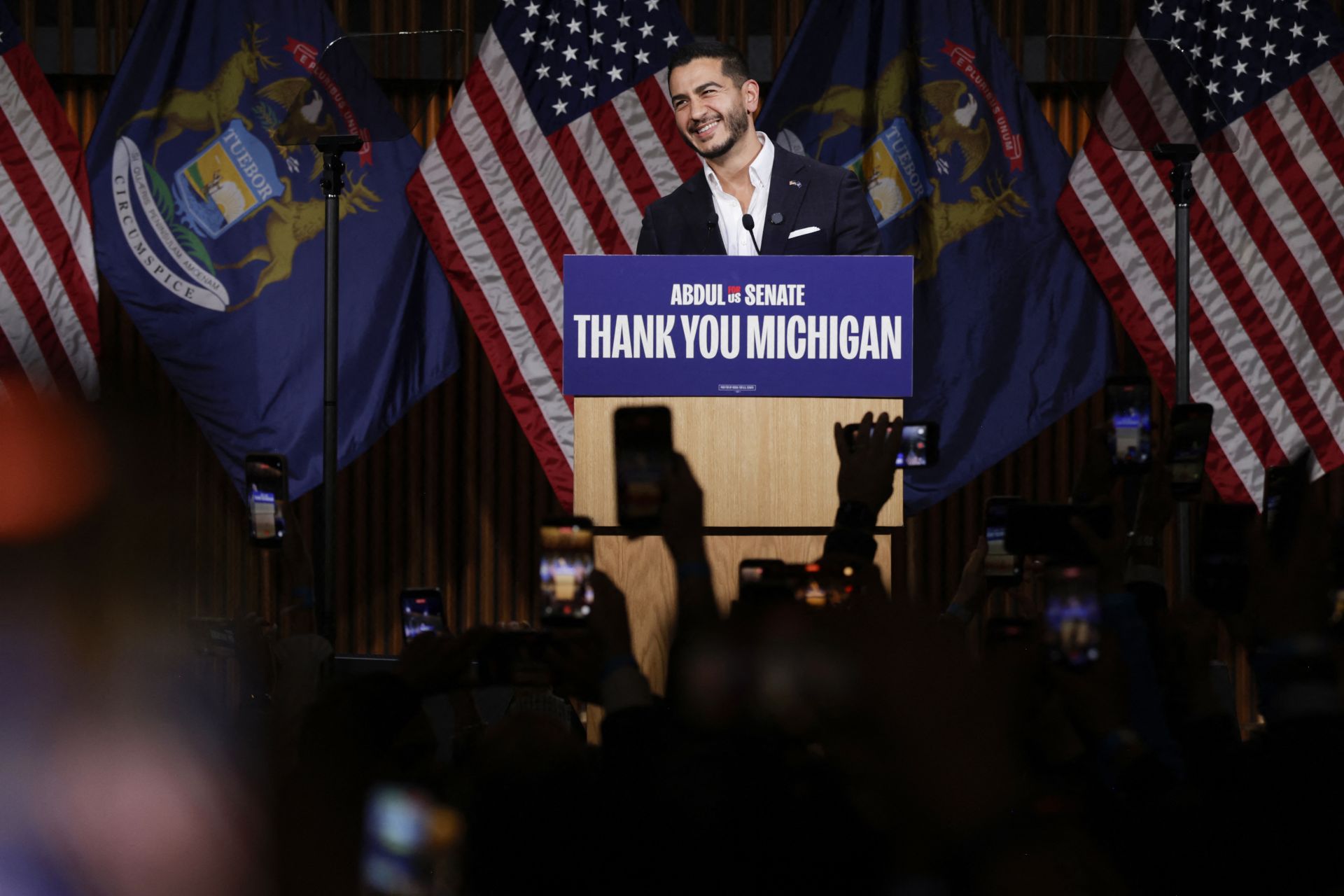
Michigan Sen.-elect Abdul El-Sayed broke the news of his historic victory to his supporters in a jam-packed ballroom in Detroit around 1:30 a.m. Wednesday, after a grueling 18-month campaign in which he overcame record-breaking outside spending, a flood of anti-Muslim attacks and intraparty mayhem.
“We can defeat the cynicism of a politics that preys on our earnestness, undersells our intelligence and exploits our disagreements,” El-Sayed said in his speech. “Tonight, Michigan, we beat a machine, and we proved once again just how big America really is.”
El-Sayed will be the country’s first Muslim senator, helping propel a blue wave that swept the country on Tuesday, and representing a state that Donald Trump won just two years earlier. Republican candidate Mike Rogers and his allies campaigned on Islamophobic tropes that tested the power of anti-Muslim animus in U.S. politics. On Wednesday, Muslim Americans and El-Sayed’s broad coalition of supporters celebrated his victory in the face of that barrage.
Sara Basha, a 37-year-old resident of West Bloomfield, Michigan, told New Lines at the Democrats’ election night party that El-Sayed’s victory felt “surreal.”
“It just feels like it’s a win for all of us and it’s a win for the nation,” Basha said, wearing a “Bashas for Abdul” shirt her cousin had designed for the family. “And it just goes to show that all this hatred has no place in America.”
Seven hours earlier, Dana Shabeeb, a 38-year-old dentist in Bloomfield Hills, Michigan, was waiting with her friends near the front of the line before doors opened for the Democratic election night party in Detroit. She said that her 11-year-old son’s name is also Abdul and he’d been wearing his “Muslims for Abdul” shirt every day, even while he was trick-or-treating over the weekend.
Also in line was Marwan Issa, an education consultant in Ann Arbor, Michigan. Issa, who said he’s known El-Sayed for over 25 years, told New Lines that El-Sayed’s candidacy showed that Muslims can’t be used as the “boogeyman” in American politics.
“I think he’s gonna pull this off. I’m hoping for a five-point victory,” Issa said Tuesday evening, shortly before polls closed. By Wednesday morning, the results showed El-Sayed had secured a seven-point lead over Mike Rogers, his Trump-endorsed opponent.
El-Sayed outperformed former Vice President Kamala Harris in all of Michigan’s 83 counties, according to The Associated Press. In Detroit, he narrowly surpassed Harris despite having lost the Black-majority city to Rep. Haley Stevens in the contentious Democratic primary three months earlier.
Lynda Jackson, an African-American woman and the recording secretary for the United Auto Workers labor union chapter in Detroit, said at the party, as Michigan awaited the election results, that she had “that Obama feeling of hope” about El-Sayed. “That same joy, that same feeling that something great is happening.”
As a union worker, Jackson said she supported El-Sayed because of his refusal to accept corporate and other special-interest money, a central point of his campaign message.
Donning a “Jews for Abdul” shirt, 39-year-old Detroit resident Dan Klein said he was most excited about the Senate election and what he called a “history-making race.” But he said it was a shame that it took a Muslim with three degrees who was also a Rhodes Scholar, high school football captain and University of Michigan valedictorian to get to this point, because other politicians have to “clear much lower bars than Abdul has had to face.”
About 10 miles west of Detroit, Dearborn set a record for turnout, according to Mayor Abdullah Hammoud, with nearly 57% of registered voters showing up to the polls. An overwhelming majority, 82%, voted for El-Sayed. The Arab-majority city has come under the national spotlight in recent months as anti-Muslim demonstrators, some of whom also went on to rally against El-Sayed, descended on it.
On Tuesday afternoon, Abdul Galil Ahmed, a 74-year-old retired Detroit public school teacher, stood outside a Dearborn polling station wearing an “I voted” sticker. Ahmed had already cast his ballot but said he wanted to check whether there was an “Abdul for Senate” sign at the location.
Ahmed said El-Sayed’s candidacy reminded him of the excitement he felt for Obama’s campaign in 2008. He also said he was energized to see people in his community, especially the newer generation, get involved in politics and show up to the polls. “I’m so happy to live up to this point to see these young people taking things up,” he said.
Back at the party in Detroit, moments after El-Sayed declared victory, Umar Kamal told New Lines that he’d driven up from Chicago to support the Michigan candidate. “I think we all saw a little bit of ourselves in him,” said Kamal, a 35-year old anesthesiologist.
“For so many years since 9/11, everyone’s always made us outsiders, as if somehow we have asterisks around our citizenship. And now, at least it’s a sign that we are American just as anyone else.”