

The Egyptian parliament will vote next Monday on whether to authorize President Abdel Fattah el-Sisi to send military support to Saudi Arabia, following two days of debate in the legislature that began on the weekend.
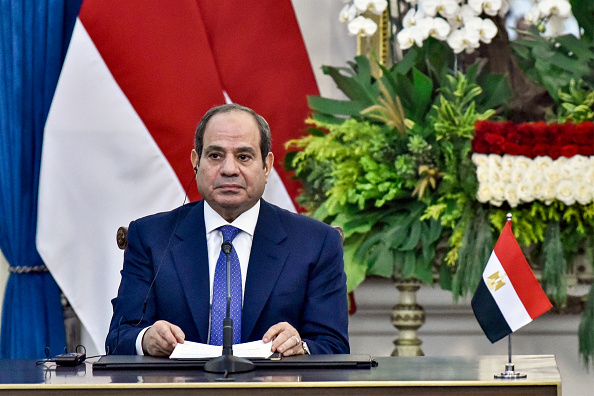
Sisi asked parliament to hold an emergency session to authorize him “to take any measure [needed] to protect Saudi Arabia,” he said on Saturday during a speech at the graduation ceremony at the Military Academy. “I am speaking here not to attack anyone, but only to defend” Saudi Arabia, he said, referring to the escalating attacks the kingdom is facing at the hands of the Houthi militia.
According to the Egyptian constitution, the president cannot declare war or send armed forces to combat outside the state’s territory without consulting the National Defense Council and with the support of a two-thirds majority in the House of Representatives.
Egypt’s National Defense Council, headed by Sisi, approved providing Saudi Arabia with “all necessary and possible forms of support” on Sunday without specifying their nature.
On the same day, the parliament held a closed session to discuss Sisi’s request, but extended the sessions “due to the large number of speakers requesting the floor,” Mostafa Bakry, a parliamentarian, said in a post on X.
Bakry stressed that Egypt is still keen to seek a political solution. Officials agreed to continue talks on an initiative that aims to guarantee a halt to “hostile actions” against Saudi Arabia and other Arab countries, ensuring safety and freedom of maritime routes and initiating a process to reach a political solution to the crisis. Bakry added that, next Monday, the parliament will take a position that reaffirms Egypt’s “firm and principled” solidarity with Saudi Arabia.
The war in Yemen began in 2015 after a Houthi takeover of the capital, prompting the launch of a Saudi and UAE-backed campaign that has lasted over a decade. The Houthis are backed by Iran. Houthi attacks against the kingdom, which shares a long border with Yemen, intensified in the last couple of months amid the U.S.-Iran war and a Houthi campaign aimed at retaking the west coast region on the Red Sea, which the Houthis seized in September, in their biggest military and geopolitical victory in years.
Houthi drone strikes on three Saudi Arabian airports in the past month left at least 19 people killed and 364 injured. These attacks also caused damage to oil infrastructure and energy exports, and caused financial losses for airports that were forced to shut down following repeated attacks.
Egyptians make up about 11% of Saudi Arabia’s total foreign population, making them the fourth largest foreign community in the kingdom. Bilateral relations between both countries stretch for over 100 years, with strategic economic partnership based on investment, trade, energy cooperation and financial ties.
Egypt is currently negotiating with Saudi Arabia to renew $5.3 billion in deposits held at the Central Bank of Egypt, which were due for repayment this month, according to a Bloomberg report.
Egypt’s relationship with Saudi is strong, but the public feeling toward Yemen, as a fellow Arab country, is also something for politicians to consider. The suggestion of Egyptian involvement in the Yemen war has brought rare, and veiled, criticism.
Responding to public concerns in Egypt regarding the possibility of sending troops to Saudi Arabia, Egyptian parliamentarian Reda Abdulsalam said on Sunday that, if Egypt intervenes in Saudi Arabia, it will only be to help defend vital facilities, airports, water and electricity plants, “without sending a single Egyptian soldier to Yemen” or “directing a single bullet against brotherly Yemen,” he asserted in a video he posted to his Facebook account.
Asked whether Egypt’s participation to defend Saudi Arabia could be considered a form of involvement in the war between the Houthis and Saudi Arabia, Mohammed al-Bukhaiti, a member of the political bureau of Yemen’s Houthi movement, said on Sunday in a televised interview that “any form of participation, whether direct or indirect, minor or major, constitutes participation in the crime and injustice against Yemen.”
“We do not expect Egypt to become involved in the aggression against Yemen,” al-Bukhaiti added.
In a message addressed to the Egyptian parliament, the president of the parliament in the Houthi-controlled Yemeni capital, Yahya Ali al-Rai, warned that Egypt’s involvement poses “a great threat to its national security and domestic stability.” Analysts saw the message as a “veiled threat” against Egypt if it chooses to get involved in fighting against the Houthis.
In Egypt, three parliamentary members refrained from voting on the proposed decision, according to local press. The Egyptian Social Democratic Party, a liberal party that has members in Egypt’s House of Representatives, also refrained from voting, stressing the importance of Egyptian diplomacy in containing escalation rather than “finding itself bound by military commitments that go beyond what national necessity requires,” a party statement said.
A similar stance was echoed in the Egyptian Press Syndicate statement that called for dialogue and diplomacy between Arab countries, stressing that Arab blood must not be shed.
Meanwhile, the Grand Imam of Al-Azhar University, Egypt’s and the world’s largest Sunni Islamic academic institution appealed to Arab and Muslim nations to form what he called a Mediation and De-escalation Committee — to include representatives from across the Arab and Muslim world — to take immediate action to “defuse ongoing crises and conflicts,” his statement read.