

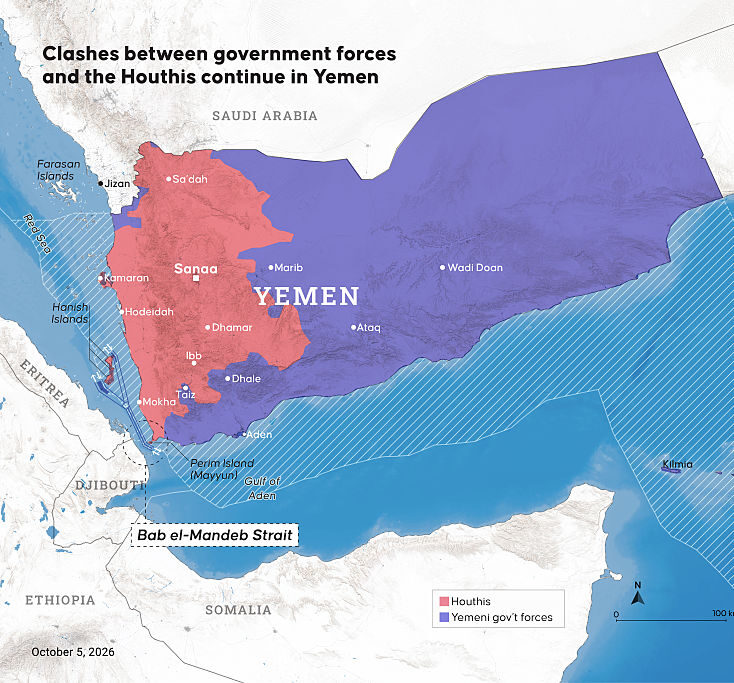
Over the past several days, the Houthis have launched attacks on Saudi Arabia, including at Riyadh’s international airport, killing at least 20 people.
The attacks come a month after the Houthis took over the strategic Bab al-Mandab Strait in the Red Sea, further strangling international shipping routes and oil supplies as the Strait of Hormuz crisis continues.
The offensives are the latest escalation in Yemen’s war, for years largely ignored by the international community before gaining relevance in the aftermath of the war in Gaza.
Feeling abandoned by the United States, Saudi Arabia responded to recent attacks on its southern border and maritime shipping by cultivating an alliance with two of the world’s other major Sunni Muslim powers, Pakistan and Turkey. Both countries intend to send troops to fortify Saudi’s southern border with Yemen.
The conflict is becoming more sectarian, and thus threatening to mirror the Sunni-Shiite violence endured in Iraq, Lebanon and Syria, said New Lines contributing writer Farea Al-Muslimi.
I spoke via video with Al-Muslimi, who is also a Yemen and Gulf researcher at Chatham House in London, to ask him how the war in Yemen reached this stage, what it means for regional powers and how he sees it developing in the foreseeable future.
He told me that the main pivot in the Yemen war took place in the aftermath of the Hamas attacks on Israel on Oct. 7, 2023, and the start of the Gaza war. It was the Iran-backed militia’s chance to insert itself as a major player in the so-called “Axis of Resistance” — after Israel had already killed Lebanese Hezbollah chief Hassan Nasrallah and his top aides, striking a blow against Iran’s allies in the Levant.
But the Houthis’ first taste of major international relevance came when they attacked international shipping lanes in the Red Sea, targeting Israeli and Saudi ships and disrupting the flow of goods and oil.
Moving forward, this strategy is sure to keep the Houthis on the international stage, Al-Muslimi explained. “Projecting power, trying to stabilize what they have and somehow trying to cash cow where they are right now is what we’ll see happening,” he said.
Their next move will probably involve imposing fees on ships that pass through Bab al-Mandab, he added, while conducting more cross-border attacks on Saudi Arabia and targeting oil refineries there.
I asked him why it was that Saudi Arabia, which spends more than $80 billion annually on defense and has some of the most sophisticated U.S. hardware, appears so unable to fend off Houthi attacks on its territory.
It is absurd, as Al-Muslimi put it, that for years we’ve been watching “one of the richest countries of the world bombing the poorest of the world,” and it has little to show for it.
What is it, exactly, that has contributed to this untenable situation on the Arabian Peninsula?
It’s “a problem that has to do with the imagination,” Al-Muslimi explained. “And what I mean is that the Gulf has been looking to Yemen as a problem. But if you think of it as an opportunity, then you start thinking of including [Yemen] in the GCC economic framework,” thus allowing it to become part of the Gulf’s economic prosperity, he added.
“But so far the thinking has been: ‘How can we keep Yemen isolated? …. How can we contain it?’” he said.
Part of this containment strategy seems to be enlisting more international players in the conflict. Recent reports suggest that even Syria was planning to send fighters to Yemen, though Damascus has denied these claims. Al-Muslimi suspects it may still happen. “If you were Ahmad al-Sharaa, you would have a lot of jihadists you’d want to dump,” he said.
At the very least, the war in Yemen may attract lone jihadists from around the globe. And then we may have yet another global crisis of militant violence, this time a coming together of al Qaeda in the Arabian Peninsula and al Qaeda in Bilad al-Sham (another name used by Jabhat al-Nusra, the militia group led by al-Sharaa until it became part of Hayat Tahrir al-Sham, which spearheaded the toppling of the Assad regime).
Meanwhile, the humanitarian crisis continues to grow. In the past two months alone, over 200,000 people have become internally displaced. And because displaced Yemenis have not caused a major refugee crisis beyond the country’s borders, due mainly to the limits of geography and a culture that eschews fleeing, the international community seems inured to the human cost there — an indifference that plays into the Houthi strategy for international relevance.
“The Houthis have learned very well — if you create a river of blood of Yemeni people, no one will give a damn internationally,” Al-Muslimi said. “But if a drop of oil spills out in the Red Sea, that will create panic across the world, not just in the West.”