


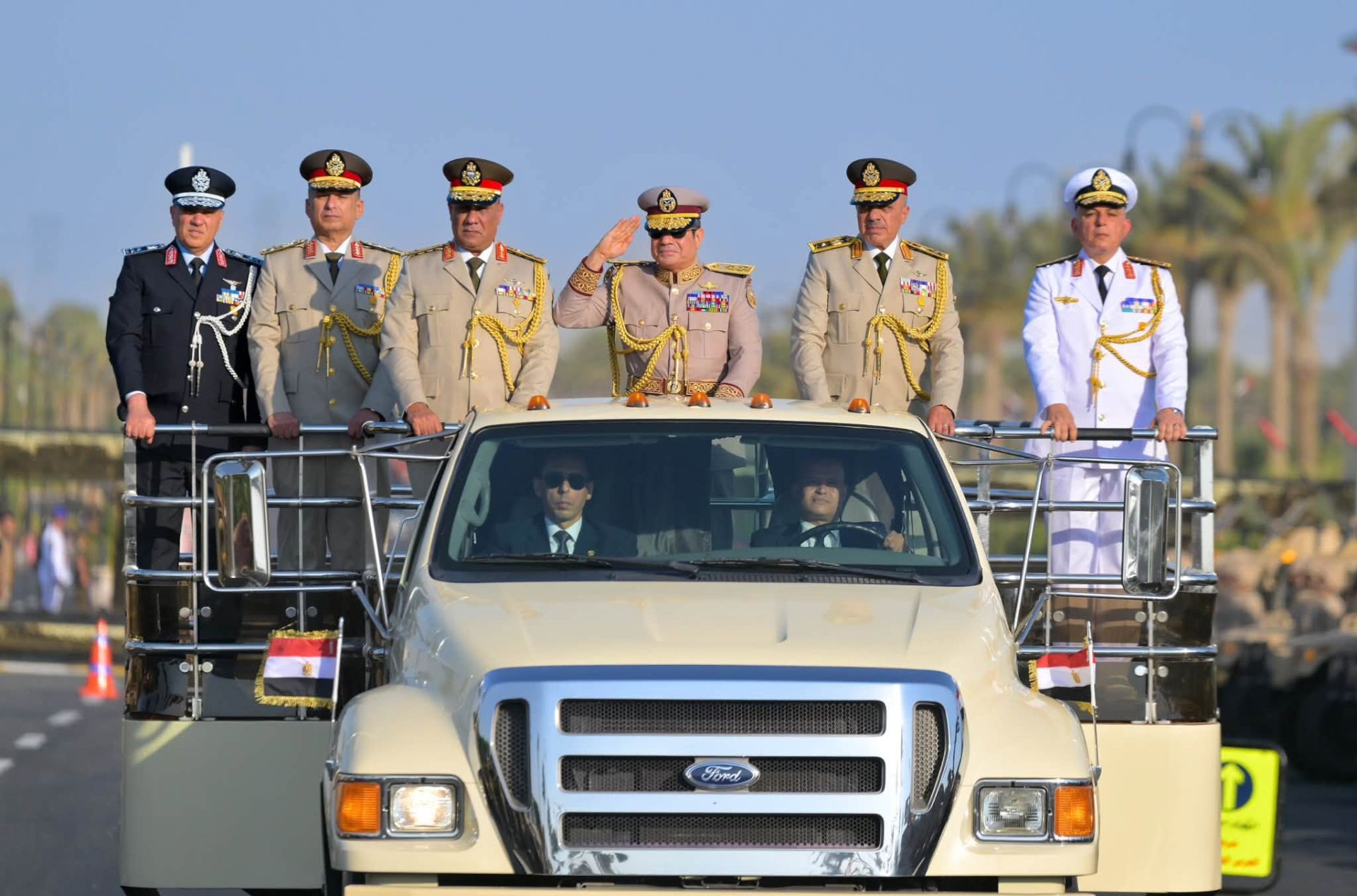
Egyptian President Abdel Fattah el-Sisi spent years presenting the New Administrative Capital as a symbol of Egypt’s future, a desert metropolis built to solve Cairo’s congestion woes and anchor what the regime calls the “New Republic.” Critics argued that its real purpose was not administrative efficiency, but a type of insulation from the Egyptian people. At this weekend’s inauguration of the Strategic Command headquarters, dubbed “the Octagon,” Sisi seemed to confirm that view.
“Allow me to tell you why the state’s strategic leadership is here,” he said, departing from his prepared remarks. “There was a day when the Constitutional Court and the Council of Ministers were under siege, and one day, they were threatening the Ministry of Defense, and one day, they were besieging Media Production City. … It was imperative for the state to move out of the capital so that this kind of thing wouldn’t happen again.”
The Octagon’s name is an apparent nod to the Pentagon, borrowing the language and symbolism of the world’s most recognizable military headquarters. The choice of an English name is one aspect of how the complex is being presented — as a command center representing Egypt’s ambitions as a regional military power. The sprawling site covers more than 9 million square meters and includes 13 zones containing the Ministry of Defense, Armed Forces command, data centers, secure communications networks, simulation facilities and cybersecurity infrastructure.
The Octagon was inaugurated with all the spectacle and military pageantry one would expect. The state-produced broadcast painted it as a historic achievement and a symbol of national strength, with sweeping drone shots, orchestral music and images of Egypt’s armed forces in different uniforms and choreographed stances, as well as of Sisi’s wife Entissar Amer and daughter Aya, both dressed in white. The ceremony featured military bands, aerial displays and Sisi appearing in military uniform for one of the few times in more than a decade, touring the facility as helicopters flew overhead before the main event. Some of the comments on social media analyzed his various insignias, with one user on X commenting: “El Sisi never served in combat but he wears the Medal of Military Courage, awarded for bravery in combat. How come?”
For political economist Timothy Kaldas, deputy director of the Tahrir Institute for Middle East Policy, Sisi’s remarks amounted to a rare admission of the logic behind the administrative compound itself. “The new administrative capital and the Octagon, as Sisi explained in his speech, are about allowing the regime to be under less pressure from the public in the event of future unrest or protest,” Kaldas told New Lines. “It’s about regime security first and foremost.”
The Egyptian socialist writer and activist Hossam el-Hamalawy, whose recently released book “Counterrevolution in Egypt: Sisi’s New Republic” examines how the post-2013 regime dismantled the conditions that produced the 2011 uprising, argues that one of the central lessons the military establishment drew from Hosni Mubarak’s downfall was that its greatest vulnerability lay not in a foreign adversary but in the ability of mass movements to occupy public space, surround state institutions and exert pressure on centers of power. The Octagon is that logic made concrete.
Perhaps one of the most revealing aspects of the inauguration was the recurring theme of 2011. Fifteen years after Egyptians flooded the streets demanding bread, freedom and social justice, the revolution remains a cautionary tale for the Egyptian state. Sisi returned repeatedly in his speech to the events of January 2011, portraying them as a source of economic devastation whose consequences Egypt continues to bear. The Egyptian fact-checking platform Matsda2sh has consistently challenged those claims, noting that official economic data does not support blaming Egypt’s current debt crisis on the uprising alone.
One of the defining chants of the 2011 uprising was that “the people and the army are one hand.” The Octagon represents the inversion of that slogan: The army is no longer imagined as standing alongside the people but is now housed in a vast, heavily fortified compound at the heart of a new city designed around physical distance and spatial control.
For anyone watching, this logic has been visible for years. One of Sisi’s first acts when he assumed power in 2013 was to order the violent dispersal of Mohamed Morsi supporters’ sit-ins in Rabaa, which left more than 1,000 dead in what Human Rights Watch called a crime against humanity and one of the largest single-day killings of demonstrators in recent history. In his weekend speech, Sisi framed these measures as a matter of precaution rather than politics. “The evildoers and terrorists won’t stop,” he said. “We have to take the necessary precautions.”
Following the 2013 crackdown, the Egyptian state embarked on a broader remaking of urban space. In addition to new protest laws that severely restricted public assembly, Tahrir Square was redesigned and securitized. New bridges, highways and road expansions transformed large sections of Cairo. Researchers and urban planners have long argued that these changes made it easier for security forces to move through the city while reducing the capacity for mass gatherings and roadblocks.
Yet Kaldas argues that the significance of the project extends beyond urban design. The New Administrative Capital and the Octagon were built at enormous financial cost during a period of mounting debt and declining living standards. Early estimates placed the cost of the new capital at roughly $58 billion, though the final figure remains unclear. Much of the construction was carried out through military-linked entities, allowing the armed forces to expand both their economic role and institutional influence.
“Both from a regime physical security perspective, in terms of isolating the leadership from the general population, and building up the financial resources and loyalty that buys within the military, both of those things are about prioritizing regime security over Egypt’s other interests,” Kaldas said. He notes that achieving that insulation required vast borrowing, military-led construction and the diversion of resources from other priorities.
In el-Hamalawy’s analysis, Sisi’s consolidation of power after 2013 was an effort to reorganize the relationship between the armed forces, intelligence services, police and state institutions around regime survival. The military was expanded economically and politically, while the boundaries between civilian administration and security structures became increasingly blurred. The Octagon represents the architectural expression of that broader transformation: a state where command, surveillance and decision-making are concentrated and physically separated from the society over which they rule.
Organizations like the human rights advocates HuMENA have long observed that the relocation of ministries and government agencies to a fortified district surrounded by gates and security infrastructure was meant to create an environment in which protest becomes far more difficult. Researchers like Rowaq Arabi similarly described the project as relocating Egypt’s political and military institutions from the contested spaces of Cairo into a highly controlled environment separated from the urban dynamics that enabled the 2011 uprising. Sisi’s remarks this weekend confirm these assessments.
The Octagon raises another question: Does concentrating military command, communications systems, data infrastructure and strategic leadership in a single location appear counterintuitive? The regime’s critics quickly seized on this apparent contradiction. As one X user commented: “Centralizing a plethora of Armed Forces HQs in one place means they’d be vaporized in a single Israeli strike. Sisi has selfishly squandered national security.” The project seems to make the most sense as a way to guard, not against a foreign army, but the threat of domestic unrest.
The Octagon is more than a military headquarters; it’s a monument to the governing principle of Sisi’s New Republic, one that places regime security first.
“Spotlight” is a newsletter about underreported cultural trends and news from around the world, emailed to subscribers twice a week. Sign up here.