

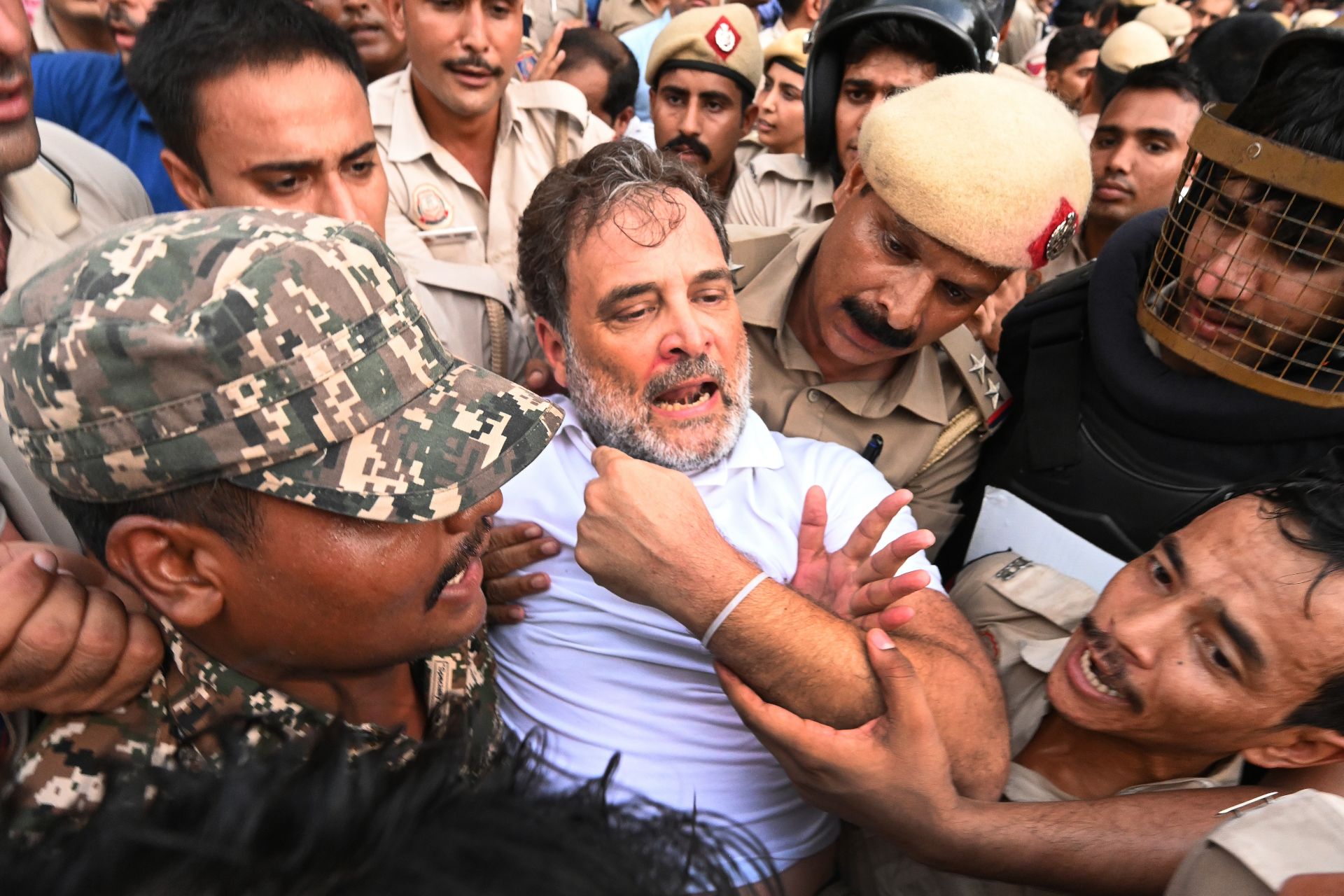
His nose is bloodied, his eyes wide and fixed ahead, his face a mix of defiance and agitation. The image of Rahul Gandhi — the leader of the Indian National Congress and the opposition in the Indian Parliament — resisting his detention by the Delhi Police outside Prime Minister Narendra Modi’s residence has left a strong imprint on the Indian public imagination.
Politics thrives on optics, and the visuals of security personnel physically grabbing Gandhi as he lay on the ground, speaking into the media’s mics, saying, “This is democracy happening right now,” quickly spread throughout India and around the world. He later posted a video showing himself missing a shoe, his clothes muddied.
Gandhi — the first leader of the opposition to lead a street demonstration outside the prime minister’s residence in India’s recent political history — was arrested as he objected to the security forces’ brutal crackdown against tens of thousands of young demonstrators in Delhi.
Political experts believe this could be a defining moment in Gandhi’s two-decade political career, as anti-Modi protests spread in different parts of the country.
“In politics, the greatest insult is irrelevance. Rahul Gandhi is no longer being ignored. He is now viewed as a challenger [to Modi],” Rasheed Kidwai, veteran Indian journalist and political commentator, told New Lines. Kidwai has written extensively on the Congress Party and the Gandhi family.
Gandhi belongs to a storied political family involved in the Indian freedom movement. His great-grandfather, Jawaharlal Nehru, was independent India’s first prime minister. His grandmother, Indira Gandhi, and his father, Rajiv Gandhi, were also prime ministers before being assassinated in 1984 and 1991, respectively. His mother, Sonia, led the 140-year-old Congress Party for over two decades.
While political lineage granted him national recognition, it also invited relentless scrutiny. For much of his career, Gandhi, who entered active politics in 2004, was dismissed by critics as an ineffective and unserious politician — a reluctant heir of a political dynasty.
But developments on Tuesday have brought about a visible shift in his public image, even as his decision to protest has divided opinion.
One faction accused him of pulling attention away from the protest movement led by the Cockroach Janata Party; another argued that he made the right call by keeping his demonstration independent.
Gandhi had been raising the issue of exam leaks and educational reform for months, and one could argue that he was trying not to surrender the political agenda to another force, Sugata Srinivasaraju, author of “Strange Burdens,” a political analysis of Gandhi’s ideas and leadership, told New Lines. “To do that, he needed to create a dramatic political moment,” Srinivasaraju said.
Mainstream television, usually hostile to him, was forced to broadcast his protest. Channels that rarely air his press conferences ran them this time, added Kidwai.
Moreover, Gandhi’s act of physical courage, refusal to play the victim after his arrest, and downplaying of the rough treatment he received has only added to his credibility and popularity. New graffiti, thanking him by name, has appeared on the walls around the main protest site in Delhi.
Gandhi, often seen as the main opposition to Modi, has struggled to gain public trust as someone who could lead the country since a Congress Party-led government was ousted in 2014 following countrywide anti-corruption protests.
“He began with enormous historical baggage,” Kidwai said. “Congress is India’s oldest political party and had governed for decades. Many people agreed with some of Rahul Gandhi’s criticisms of the government but didn’t trust the messenger because of the Congress legacy and the dynasty label.”
The middle class was perhaps his biggest obstacle, Kidwai said. Even as they benefited from economic reforms introduced under previous Congress party-led governments, there was “a deep, almost pathological dislike of Congress among sections of the middle class.”
Moreover, the ruling Bharatiya Janata Party (BJP), and a mainstream media friendly to it, had reinforced the perception through a sustained messaging campaign that Gandhi was a “pappu,” a colloquial Hindi term used to describe someone as naive, incompetent or unserious. It became synonymous with Gandhi’s public image, amplified for years through speeches, television debates, memes and social media.
But that is no longer the case. “I think the ‘pappu’ image is now in the past,” Kidwai said. “Rahul Gandhi is suddenly being seen as a serious politician.”
The government’s own response bears that out, Kidwai said, pointing to the decision to dispatch the minister of state in the Prime Minister’s Office alongside the home secretary to handle the situation — a sign, in his view, of how seriously Gandhi is now being taken.
Gandhi’s image had begun to shift in 2023, when he undertook the “Bharat Jodo Yatra,” a march covering roughly 2,200 miles on foot from the southern tip of the country to the north over the course of five months. This week’s protest has dramatically accelerated that recasting.
Political experts, however, reiterated that in electoral politics, only results matter. The real test for Gandhi will come in the upcoming elections in Uttar Pradesh, the northern state long considered a bellwether in Indian politics.
Gandhi’s advantage, however, is that he is a pan-Indian political figure, Kidwai said. “Everyone knows him. Whether people like him or dislike him, nobody ignores him. That is precisely why the BJP spends so much energy attacking him.”