

During the first week of August 2021, the temperature reached 127 degrees Fahrenheit in Sidi Bouzid, the dusty interior city in Tunisia where the Arab Spring began. Despite the oppressive heat, Kais Bouazizi, whose cousin Mohamed had instigated the revolution when he set himself on fire in a desperate act after being harassed by the police, was feeling energized. Days earlier, the democratically elected outsider president, Kais Saied, had invoked emergency measures that he said allowed him to shut down Parliament, fire his Cabinet and take sole control of the country for 30 days to get it back on track. On national television, he brandished a ream of paper with what he claimed were the names of Tunisians who had stolen billions from the government. He was going to right the ship, end corruption, tackle the pandemic, get the economy on track and fulfil the dreams of the revolution.
“It’s naive to think that 10 years’ worth of corruption can be tackled in 10 days,” Bouazizi, who had voted for Saied in the 2019 election, told me on that sweltering afternoon five years ago. “Give the man some time.” I asked if he was worried about the consolidation of power. He felt no great loss seeing the dysfunctional Parliament dissolved. When his mother was sick with the coronavirus the previous month, he had watched her “gasping for breath because we couldn’t find an oxygen bottle,” Bouazizi told me. “Meanwhile, these clowns in Parliament are slapping each other.”
That week, I took a road trip through the country to ask people what they made of Saied’s move. Was it a coup, was it the continuation of the revolution or was it something else? Most were sanguine over the downfall of the much-despised government. Saied Shoura, whose cousin was killed in police custody in the coastal city of Sfax earlier that year, told me he was elated, that finally it seemed like the dreams of the revolution would come true.
“We felt like we’d been suffocating for a decade,” he told me. ”We were patient for almost 11 years. Why not one more month?”
Five years on, Shoura, Bouazizi and the rest of Tunisia are still waiting for Saied to fulfill his promises. But this past weekend, over 2,000 of their compatriots took to the streets to show that their patience is wearing thin. Rather than making progress toward the revolutionary goals of “work, dignity and freedom,” Saied has instead single-handedly dismantled the gains made during the revolution, rewriting the constitution, hollowing out the judiciary, criminalizing speech, and jailing opponents, journalists, civil society members, activists and thousands of migrant workers.
“We’re not tenants of this country, we’re its owners,” Wissam Sghaier, the spokesperson for the center-left Al Jomhouri opposition party, told Al Jazeera at the protest. People hoisted signs with messages including “Stop the oppression, give us back our hope” and the Tunisian classic, “Degage” (“Get out”). It was a rare public expression of dissatisfaction in a nation that has seen its freedom of speech and assembly sharply curtailed in recent years.
But for many Tunisians, it isn’t the political process that brought them to the streets; it is the decline in living standards that feels untenable. The protest took place under the same sweltering heat that, five years earlier, helped bolster Saied’s move. But this summer, millions of Tunisians have faced regular power blackouts, as the grid, which has not had its capacity increased in the last five years, struggles to keep up with demand. Dozens of people have died due to heat-related illness. Hot drifts of garbage pile up even in the well-heeled neighborhoods near the presidential palace. The prices of milk, eggs and bread have crept up steadily.
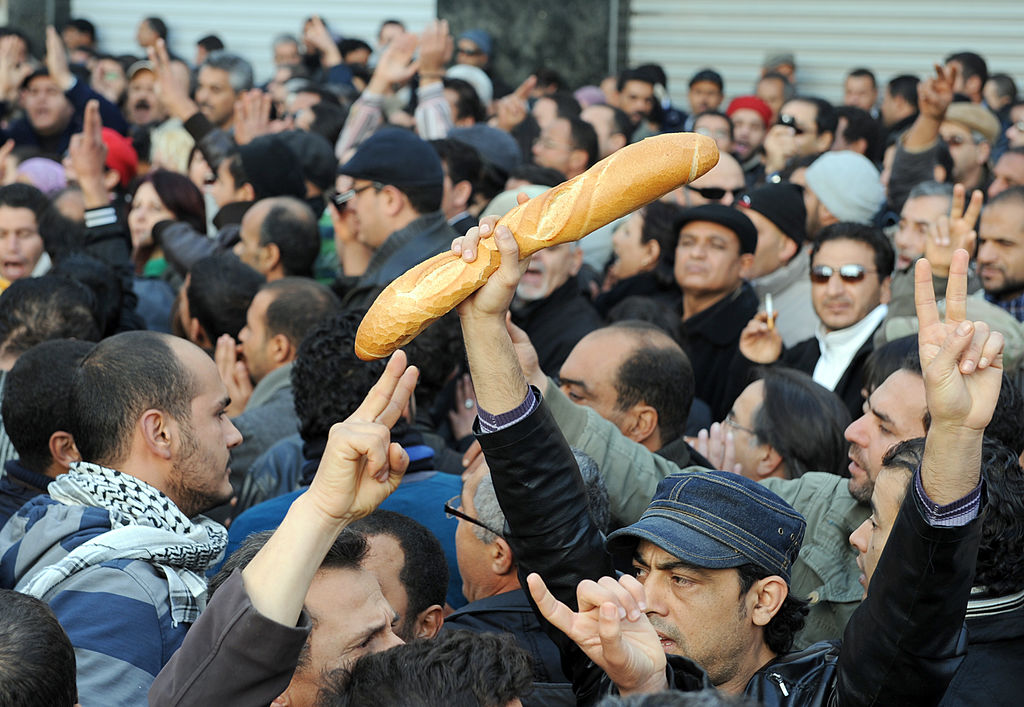
In the revolution of 2011, and again in the protests leading up to Saied’s coup in 2021, people held aloft the soft baguettes that Tunisians eat with almost every meal as a symbol of what they wanted — a way to get their daily bread, the simple things that brought decency and dignity to the poor. This morning I asked half a dozen people if they could name the current prime minister. None could. But every one of them could tell me that the cost of food was going up, and that power cuts were making life worse.
Neither the physical nor political heat from the weekend will be enough to topple Saied, but the protests show that, although Tunisians may be exhausted, their revolutionary flame has not been entirely snuffed out.