


Sounam lost her younger brother, Faizan, in riots in Delhi six years ago. Officers of the Delhi Police were caught on camera forcing the 23-year-old to sing the national anthem as they beat him and three other Muslim men with their batons. Faizan succumbed to his injuries days later. He was the youngest of nine brothers and sisters. Recently, one of his siblings also died, of natural causes. Just as the seven who remained began to rebuild their lives, each of them received notices from India’s Election Commission saying they had been taken off the draft voter rolls as part of a nationwide revision. The reason: Each had been listed as the son or daughter of someone claimed as a parent by six others, one of the many “logical discrepancies” cited in similar notices sent to millions across the country.
India’s Foreign Minister Subrahmanyam Jaishankar received a notice. So did Delhi’s chief minister, Rekha Gupta, former Vice President Jagdeep Dhankhar and veteran Bharatiya Janata Party (BJP) leader Lal Krishna Advani. The Nobel laureate Amartya Sen and 94-year-old historian Romila Thapar got them too. In fact, one of the three election commissioners, Sukhbir Singh Sandhu, wasn’t spared either. India had nearly a billion voters during the 2024 national elections. Now, over 130 million Indians, more than the population of countries such as Japan, Egypt and the Philippines, have been left off the draft voter rolls in an exercise called the Special Intensive Revision, or SIR.
While election officers went to the homes of the powerful to verify their papers and bring them back onto the voter roll, ordinary Indians have been running from pillar to post to have their names counted. Sounam and her siblings don’t know what to do next. “Our brother was forced to prove his Indianness until his last breath. Now, after his death, the rest of us are having to prove it by running around with documents to show that we are in fact Indian,” Sounam told New Lines.
The exercise began last year, when the Election Commission revised voter rolls in Bihar ahead of its state election. More than 6.5 million voters found their names missing in that state alone. In West Bengal, 13.6 million voters were flagged for “logical discrepancies” ahead of its state election in April, and nearly 9 million were ultimately removed from the rolls. The BJP won and formed its first government in the state, but in more than half of its 294 seats, total deletions were more than the victory margins. Muslims, who have largely voted against the BJP, were the most affected.
As the exercise has rolled out nationwide, news reports from across the country have raised similar red flags: voters who cast ballots in previous elections being deleted, minorities bearing the brunt and the BJP reaping the electoral benefit. On Oct. 5, the Supreme Court of India issued notices to Prime Minister Narendra Modi’s government, the Election Commission and Chief Election Commissioner Gyanesh Kumar on petitions alleging Kumar had taken SIR decisions unilaterally.
This followed a startling revelation from The Indian Express, a prominent national daily, that two election commissioners serving alongside Kumar had objected on record to SIR-related decisions at least 14 times in the last 10 months, at one point describing the change to one particular form as “unauthorized and illegal.” Under the law, the commission is meant to act unanimously or by majority, and the two dissenting commissioners formed a majority of the three-member body.
In a four-page statement after the expose, the Election Commission said that “differing views” are a “normal part” of the deliberations. It added that agendas for all meetings would now be circulated in advance and the minutes issued, implying that had not been the practice so far. But the response did little to ease the growing skepticism and public anger, because this time the allegations were coming not from the opposition or activists but from inside the Election Commission itself.
The fallout has posed a direct challenge to Modi, since he had appointed Kumar along with Home Minister Amit Shah despite the written dissent of the leader of the opposition, Rahul Gandhi, in 2025. Former Chief Election Commissioner Om Prakash Rawat said this was the first time since India’s independence in 1947 that so many eligible voters had lost their right to vote. Another former chief election commissioner, Shahabuddin Yaqoob Quraishi, called the SIR a “scam” and said the commission must be “criminally prosecuted.” Ashok Lavasa, a former election commissioner, called for the SIR to be scrapped. The BJP has been almost alone in defending the commission.
“If any process results in disenfranchising millions and millions of Indian citizens, making them second-class citizens in their own country, in the sense of being citizens without voting rights, such a process is intrinsically arbitrary,” said sitting Supreme Court Judge Ujjal Bhuyan while addressing law school students in Hyderabad recently. “No amount of whataboutery can justify it. It strikes at the very heart of the constitution, and I would go to the extent of saying that it is a negation of the constitutional order which we have adopted under the Constitution of India.”
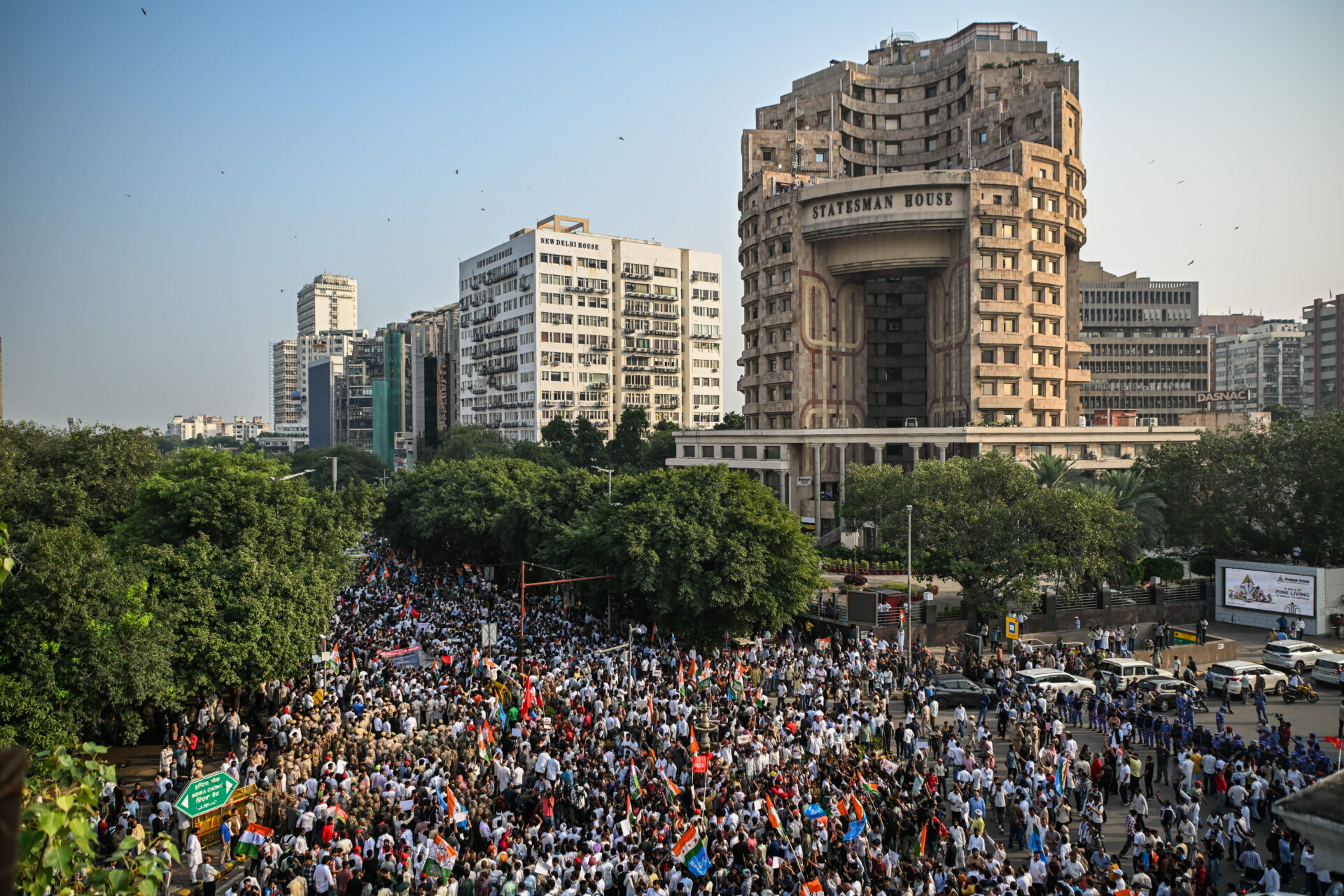
The outrage has sparked a fresh wave of protests in the heart of Delhi, demanding not just Kumar’s resignation but the cancellation of the SIR itself and a return of the voter rolls as they were before the exercise began. Since Oct. 2, the anniversary of Mahatma Gandhi’s birth, student and civil society groups have been marching to Jantar Mantar, the same spot where thousands protested against the education minister in July.
After rallies in Mumbai and Bengaluru, the Cockroach Janata Party (CJP) also called a protest in Delhi on Oct. 10. The government turned the capital into a fortress. More than 40,000 police and paramilitary forces were deployed. After CJP leaders were detained aboard their flight, minutes after landing in Delhi, many supporters found themselves confused about how to reach Jantar Mantar, where the CJP had called for them to gather, since the area around it was heavily barricaded. Thousands were detained, along with several journalists and independent YouTubers covering the protests.
Opposition parties, led by Gandhi, have also been hitting the streets. On Oct. 6, over 230 members of Parliament from 19 parties marched to the Election Commission’s headquarters. The police stopped them short of the building, but Gandhi and other Congress party leaders sat nearby for hours until they were detained at night. They hit the streets the next day, only to be brutally detained again. On Oct. 12, however, tens of thousands marched to the Supreme Court as Gandhi had called for, along with several opposition leaders, in the first protest against the commission where protesters outnumbered the police. Standing alongside Gandhi was Neha Bora, a student leader who has also become the face of the movement.
Much of the anger spilling onto the streets also stems from the impunity granted to the election commissioners by a 2023 law that bars civil and criminal prosecution against serving or former election commissioners for acts carried out in office, for life. No other officeholder, not even the prime minister, has such protection. The law also changed how election commissioners are chosen. Previously, they were nominated by a panel comprising the prime minister, the leader of the opposition and the chief justice of India. But the law replaced the chief justice with a union minister of the prime minister’s choosing, giving the government two out of three votes.
In August 2025, Gandhi, a senior leader of the Indian National Congress, was the first to accuse the BJP of “vote chori” or vote theft, alleging large-scale fraud in a Bengaluru parliamentary constituency in 2024. In November that year, he alleged that a photograph of Larissa Nery, a Brazilian hairdresser, with no connection to India, appeared 22 times on the voter rolls of a single constituency in Haryana. Local checks later confirmed the anomalies. The Election Commission dismissed his allegations, but doubts about the electoral process began to take root. Even before that, a Lokniti-CSDS survey had found that the share of voters who trusted the Election Commission “to a great extent” had fallen from 51% in 2019 to 28% in 2024.
Yet now, political commentators say, the SIR has shaken the one part of Indian democracy that most citizens still trusted. The independence of elections has, in the past, been revered by the voters and feared by politicians. Even those who don’t necessarily have strong political views hold their right to vote dear. But recent revelations signal the capture of the last independent institution, the Election Commission; following the judiciary, much of the mainstream media and the central investigative agencies have largely bent to the Modi government.
For decades, India’s elections were cited as the strongest argument that democracy could work at an enormous scale, in a country of more than a billion people, with widespread poverty and profound social diversity. “Given the kind of history India has had, people here really value their right to vote. This SIR will now shake up people’s faith in the entire electoral process,” Anjali Bhardwaj, a transparency rights activist, told New Lines. “Elections take place in North Korea and Russia too. But for it to be meaningful, people need to have faith in the electoral process.”
Now, warnings are being issued. “Americans should pay attention to the systematic manipulation of voter rolls in India — in the name of purging ineligible voters — and be afraid. Be very afraid,” the Indian-American journalist Bobby Ghosh wrote on X. The issue has significance for the United States because in August President Donald Trump mentioned Kumar and cited India’s example while making a case for the Safeguard American Voter Eligibility (SAVE) Act, which introduces documentary proof of citizenship for voters to register.
When a booth level officer (BLO) visited 60-year-old Koushalya Kumar, living in a slum in historic Old Delhi, informing her that the SIR was underway and she should gather as many documents as she could if she wanted to stay on the voter roll, she nodded vacantly at first. Later, her neighbors explained how much the exercise mattered. In her small shanty that she shares with other family members, Koushalya then dug out voter slips from past elections, hoping they would be enough. Soon, a notice arrived informing her they were not. She had not sufficiently shown that she or her parents were on the electoral rolls prepared during the last intensive revision, in 2002. “I am old enough to be a grandmother. My mother is long dead. How do I find these ancient documents?” she asked New Lines.
In the past, the burden lay with the state. Election officers went door to door to enroll voters. It was the BLO’s job to verify proof of residence and age. Now, the onus has shifted onto the citizen, and the BLOs are being asked to verify citizenship through ancestry. Indian voters had not previously been asked if they or their parents appeared on an earlier roll, but the Election Commission is now demanding this for the first time.
To do so, it has changed Form 6, used to register voters, and included questions about the parents of the voters, which the dissenting commissioners called “unauthorized and illegal,” per The Indian Express. These forms cannot be altered or rewritten at will, but may only be changed through Parliament. The Election Commission claimed the modification was approved by the Supreme Court, but on Oct. 5 Chief Justice Surya Kant said that the apex court had made no such approvals, which raised serious concerns about the workings of the commission.
Earlier, Gandhi drew in Tata Consultancy Services, demanding to know who at the Election Commission ordered them to change Form 6. The tech services giant handles the commission’s digital backend.
For many, it is impossible to prove that they or their parents were on the rolls in 2002. “My parents died when I was a little boy, in our village in Uttar Pradesh. How do I ask my dead parents to prove they were in the voter roll in 2002? I am also not in touch with any relatives,” Aslam Khan, a shopkeeper who did not find his name on the draft roll, told New Lines. He moved to Delhi about a decade ago and has voted there ever since.
Khan’s life has been thrown into disarray, as have the lives of millions who have received notices citing “logical discrepancies,” a vague term causing widespread confusion. Apart from more than six children mapped to the same parent, as in the case of Faizan’s siblings, other “logical discrepancies” include differences in the spelling of a voter’s name between the current rolls and those prepared in 2002, and an age gap of less than 15 years or more than 50 years with one’s parents, or of less than 40 years with one’s grandparents. Any of these can be cited to remove a person from the rolls.
Political observers say these criteria are arbitrary, as none of them, on its own, is evidence that someone does not belong on the voter roll. Many voters took to social media to show that “logical discrepancies” were just clerical errors. But now they have to appear at hearings with documents to prove it.
In neighborhood after neighborhood, people have been digging through old documents, calling distant relatives and pleading with BLOs to put them back on the roll. They have to stand in queues for hours, amid the chaos of screams and pleas. The scenes are reminiscent of 2016, when Indians lined up outside banks and ATMs after Modi announced demonetization at a few hours’ notice.
Together with BLOs, electoral registration officers (EROs) in each constituency make voter registration a hyperlocal exercise — decentralization that leaves no single person or office with the authority to decide who gets to be on the rolls. This time, however, the Election Commission has centralized the process through software called ECINet, run by its information technology division in Delhi, into which EROs must feed each voter’s details and documents.
According to officers who have used it, Delhi has the final word on who gets accepted. Even after voters have done everything to prove they belong on the list, and local officials are convinced, the decision still rests with Delhi. In Goa, according to The Indian Express, when the EROs tried to restore 97 previously deleted voters, they could not, as ECINet only allowed the Delhi office to do so.
The 2020 Delhi riots, in which Faizan was killed, came on the heels of nationwide protests against the Citizenship Amendment Act (CAA) and the National Register of Citizens (NRC). The CAA fast-tracked citizenship for non-Muslim migrants from Pakistan, Bangladesh and Afghanistan, while the NRC was meant to be a single register of who counted as a “legitimate” citizen of the country. Political observers had warned that, paired with the CAA, the NRC could become a means of excluding Muslims. While the CAA was passed in Parliament, a nationwide NRC never materialized. But many now see the SIR as the NRC by another name.
During the SIR, the Election Commission’s Form 7 — which lets a voter object to someone else’s inclusion in the roll on account of death or change of address, or seek deletion of their own name — has become a prevalent tool to exclude Muslim voters in different parts of India.
Until 2022, objectors could only challenge names in their own “part” of the roll, a small unit roughly equivalent to a neighborhood. But that year, the commission amended the rules to let any voter seek the deletion of any name on their constituency’s roll, a change that blew the scope of objections wide open.
Several cases have been reported recently in which Form 7 has been used to target Muslims. In Jharkhand, a BJP booth level agent filed 200 Form 7 applications, seeking the deletion of Muslim voters. He was briefly arrested. In Uttarakhand, five men linked to the BJP filed 6,500 objections against Muslims voters. In Hyderabad, a BJP poll worker filed objections against 30 Muslims from the same family. In Karnataka, senior and booth level officers alleged they were being pressured to sign Form 7 applications targeting thousands of Muslim voters. Several police complaints have been filed in the state against this malpractice.
Since many of these “objection” forms were filled out not by hand but digitally, it has created suspicion that they were perhaps prepared in bulk. And the pattern has gone beyond objections. A report by the Hyderabad-based SPECT Research Association noted that exclusions in Delhi’s draft rolls fell disproportionately in Muslim-majority constituencies, along with those reserved for so-called scheduled castes (or Dalits) and those with large migrant populations.
“This concept of anyone being able to file objections to someone else being on the voter roll hasn’t historically been a thing at all. Even when the form existed, it wasn’t weaponized like this,” P.V. Ramesh, a retired bureaucrat who served as an ERO in the 1980s, told New Lines. “What we were told is that we must try to include as many people as possible. No one should be left behind. Now, it’s the complete opposite.”
Sabir Ahmed, head of Sabar, a West Bengal-based organization researching the SIR, told New Lines that in Hindu-majority neighborhoods, if some streets or houses belong to Muslims, objections are often filed exclusively against those residents. The Election Commission, he said, “is so rigid about making sure people have all the right documents to make it to the voter roll. On the other hand, there are no checks and balances over these objections. Anyone can file them and ruin someone’s chances of being included.”
Even though outrage over the SIR is evident in the protests, it is less clear whether it has reached the BJP’s own supporters. Ram Avtar, a 50-year-old lifelong BJP supporter, told New Lines he did not find his name on the SIR draft list, despite having several documents in hand. “All political parties purely exist to fill their bags,” he said. Still, he continues to back the BJP. “My father, grandfather, all voted for the BJP. I still like the work they do. I like what they do for women’s safety.” Incidentally, his statement comes at a time when the alleged gang rape of a 17-year-old girl by three men posing as Delhi police officers has set off a separate wave of protests across the country. Of his own deletion, he said, “We all have our karma.”
Ram Avtar may find his way back onto the rolls. Many others won’t. “Our fieldwork shows that even if upper caste Hindus get removed from the draft rolls, they are able to find their way back through their social network. They’ll know someone who will know the election officer or the booth level agent. Plus, on average, they’ll have better literacy to figure out their way through the system,” Ahmed said. “So the disproportionate burden is on Muslims, lower castes, and Adivasis.”
For the poor, a voter ID card serves as a gateway to other rights that come with being recognized as a citizen. It is frequently the only proof of residence they have, which unlocks subsidized rations, pensions and other welfare benefits. But many now fear that losing their place on the voter roll could mean losing all of that too. In West Bengal, that fear has already come true. The new BJP government ordered voters deleted in the SIR to be struck off the lists for subsidized rations, and women among them to be cut off from Annapurna Bhandar, the state’s cash-transfer scheme for women. Another order directed that their caste certificates should be examined and possibly canceled. Chief Minister Suvendu Adhikari said those deleted were “not Indians,” even though the Supreme Court stated that deletions from voter rolls do not determine a person’s citizenship.
Bhardwaj pointed out that in a landmark 2001 case, the Supreme Court interpreted Article 21 of the Indian Constitution, which guarantees the rights to life and personal liberty, to include a right to food for every person living in India, citizen or not. “On the ground, most poor or marginalized people don’t have many ID cards, but they tend to have voter IDs, because historically the Election Commission has ensured everyone gets to vote,” she said. “Now, by removing the poor from the voter roll, their access to a lot of welfare is being snatched.”
In a northeastern Delhi slum, when a BLO came to drop off notices of removal, most residents wanted to know whether it would cost them their free rations. “If we lose access to treatments at a government hospital or welfare benefits, we won’t know how to survive,” Nishat Khatoon, the elected pradhan, or leader, told New Lines.
Khatoon’s slum is home to both Hindus and Muslims, and all of them fear being sent to Bangladesh. They talked about it as a joke. “I don’t even know Bengali. What will I do there?” asked Mohammad Ibrahim, a resident. “If you don’t know Bengali, you’ll die there,” Khatoon replied, chuckling. “We are laughing about this, but we can’t afford to take any of this lightly. Our life is at stake here,” said Ajit Singh, who lives in the same slum.
The fear has roots in what the authorities have been doing across the country. “Bangladeshi migrants” has become a fig leaf for demonizing poor Bengali Muslims, exploiting long-standing anxiety in border states over illegal migration from Bangladesh, with no data to back it up. “Detect, delete, deport” was a central slogan of the BJP’s campaign in West Bengal, a state that accounts for more than half of India’s border with Bangladesh.
Since Adhikari became chief minister in May, his government says it has sent more than 10,000 people to Bangladesh, with close to 2,000 more held in “holding centers” awaiting removal. And it isn’t only West Bengal. Suspected Bangladeshi migrants have been picked up in different parts of the country, including states ruled by the Congress party.
The coming days will test whether any of the pressure building up against the polling body will hold. Opposition leaders, students and civil society members are all on Delhi’s streets. The government, the Election Commission and Kumar have to respond to the Supreme Court. A separate challenge to the commissioners’ lifelong legal impunity is still pending.
Meanwhile, the SIR continues across the rest of the country. For millions holding deletion notices, the struggle to prove they are voters, and citizens, continues. “India will serve as an absolutely terrible example to the U.S. and other nations whose leaders want to use their whims and fancies to eliminate people,” said Ramesh, the retired bureaucrat. “The SIR needs to be completely scrapped.”