


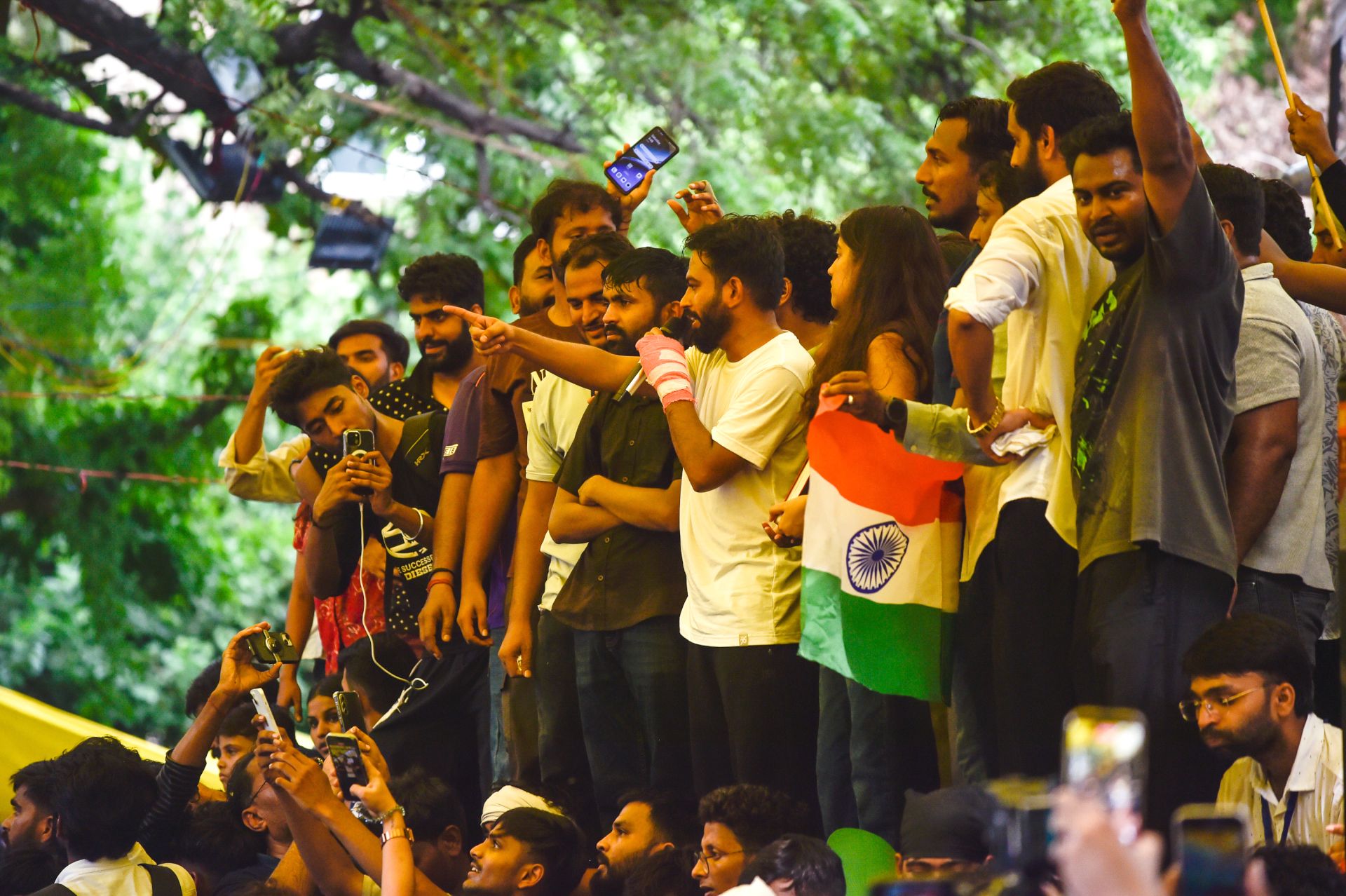
Riding high on its win after forcing the resignation of India’s education minister, Dharmendra Pradhan, the Cockroach Janata Party (CJP), an outfit satirically named after the ruling Bharatiya Janata Party (BJP), announced two weeks ago that it will continue functioning as a political pressure group and mobilize across the country. Its first campaign, “Fix the Schools,” seeks to transform public schools in rural areas, which largely serve the poor and marginalized and are often plagued by crumbling infrastructure, broken or nonfunctioning toilets and an inferior quality of education. In the last decade, 94,000 public schools have closed down across India, an average of 25 a day, according to the government think tank NITI Aayog, contributing to a drop of nearly 23 million in student enrollment. The think tank cited falling fertility rates, school consolidation and difficulty retaining students at higher levels of education as reasons for the decline.
Responding to the CJP’s call, Abdul Hafiz, a 27-year-old law student in West Bengal, in eastern India, visited the public school in his village, Karishunda, over 90 miles west of the state capital, Kolkata, to survey its condition per guidelines issued by the CJP to its volunteers. That night, a mob of men came and beat him. When his father, Sheikh Mohammad Mafik, tried to intervene, they assaulted him too. Two days later, Mafik succumbed to his injuries and died. Hafiz alleged that the perpetrators belonged to the BJP. Later, a BJP leader was among the eight men arrested. Ashutosh Ranka, the co-convenor of the CJP, who visited Hafiz at his home, also held “BJP goons” responsible. The CJP’s national spokesperson, Saurav Das, said the attack showed that the government led by Prime Minister Narendra Modi was “anti-knowledge, anti-school, anti-science, and anti-intellectual.” Das did not, however, add anti-Muslim.
That people were being “murdered simply for demanding better schools” made CJP founder Abhijeet Dipke’s “blood boil,” he said, in a statement that was criticized on social media because he neither mentioned Hafiz’s Muslim identity nor called the attack a hate crime.
Dipke, and the movement he founded, gained international fame after amassing over 25 million followers on Instagram and spearheading the largest protest movement against the Modi government in years. He was interviewed by CNN’s Christiane Amanpour and featured on Democracy Now! and in The New York Times, among other international outlets. India’s so-called cockroach revolution has become well known around the world. But back home, many have been disappointed with the CJP’s silence on the prevalence of the right-wing Hindu nationalist ideology known as Hindutva in Indian society, and the party’s failure to explicitly call out the anti-Muslim nature of the BJP and that of its affiliates.
Mafik’s killing was only the latest manifestation. Earlier, as celebrations ensued on the day of Pradhan’s resignation, one CJP volunteer, Mohammad Junaid, was conspicuous by his absence. He had gone viral for being a constant presence, in his visibly Muslim attire, feeding protesters round the clock. But a night before the resignation, Junaid was detained by the police. He alleged that his father was interrogated and that bank details and IDs of his relatives were also collected. When he was released from detention, a shivering Junaid broke down on camera. Besides a handful of phone calls, he said, the CJP leadership hadn’t been in touch with him at all.
In another interview, Junaid said that even an animal, cared for over 24 hours, is remembered, and he stayed with the protesters for 35 days, only to be forgotten. Days later, however, he posted that everything was fine between him and the CJP leadership, and that there was no rift.
The incident highlighted the failure of a movement — successful in its primary demand — to address one of the biggest fault lines facing India today. In the 12 years of Modi’s Hindu majoritarian rule, Muslims have faced disenfranchisement, dehumanizing rhetoric from senior government ministers, abuse in Parliament (a sitting Muslim parliamentarian was called the slur “katua,” a derogatory reference to circumcision, by a BJP member a few years ago) and a normalization of lynchings as part of a broader wave of hate crimes. The bulldozing of Muslim homes and businesses has become commonplace as a form of collective, extrajudicial punishment.
The recent protests were not the first under the Modi government. They followed the year-long farmers’ protests led by farmers’ unions, and others spearheaded by Muslim women, who participated in sustained sit-ins across swaths of the country to resist the passage of the Citizenship Amendment Act. This law, which not only introduced religion as a parameter of citizenship but also excluded Muslims in its provisions, drew opposition from hundreds of thousands of people across the country. BJP leaders labeled the protesters “traitors” and “terrorists who should be fed bullets, not biryani,” and the government cracked down on them in the wake of the Delhi riots that followed in February 2020. Many Muslim activists have been in prison ever since, including the young scholars Umar Khalid and Sharjeel Imam, who have been held under the largely unbailable provisions of the stringent, anti-terror Unlawful Activities (Prevention) Act.
Early in the protests, when Das, the CJP’s national spokesperson, was asked whether he would express support for Khalid, he dismissed the question, saying it had nothing to do with the movement. Many were stunned by this position, especially since, not long before, Das had called Khalid “the bravest” and criticized his incarceration “over false, frivolous charges.” But that was before the CJP’s formal founding in May. He later clarified that the protests brought together many different people who supported — and opposed — different things. “But they’ve all united for a cause, and it’s very important to maintain that unity,” Das told Maktoob, an independent news outlet focused on human rights and minorities in India.
Khalid was himself a student leader at Delhi’s premier Jawaharlal Nehru University when he was first jailed in 2016 under India’s sedition law, which was followed by his ongoing incarceration from 2020. Since he first entered public discourse a decade ago, Khalid has become an emblem of dissent, particularly for Indian Muslims. But the BJP has repeatedly used his name as a red line, describing him as a “hardened criminal” and treating anyone associating with him in any capacity as guilty by extension — though of what crime is unclear, since Khalid has not been convicted of anything, nor has his trial even begun.
A deliberately vague set of assumed actions is often used to malign Khalid and his supporters. This was observed during the student protests too. As protesters held “Free Umar Khalid” posters during the recent youth uprising, police registered cases against them in multiple states, and activists summoned by the Goa police were asked to fill out a questionnaire with pointed questions about Khalid, according to The Indian Express.
But the CJP leadership has continued to maintain its distance from Khalid. In his Independence Day speech on Aug. 15, Modi called for “dimagi naxal” people (people with Maoist thinking) to be “identified and isolated,” which was widely interpreted as a barb aimed at protesting students. Das then objected to the phrase’s use to describe protesters in a TV news debate. When a BJP spokesperson insisted that it wasn’t aimed at all protesters but only those raising pro-Khalid slogans, in line with the trend to discredit any support for Khalid as objectionable, Das responded by asking the spokesperson to produce evidence of such sloganeering, insisting no such slogans had been used. Das was later criticized for not asking instead what would be wrong with such slogans.
The CJP leadership is neither oblivious to the critique that they do not adequately address Hindutva, nor are they unaware of the privilege they carry. In an interview, Dipke said that if he had a Muslim name, he’d have likely already been in prison. While he also said that Khalid should get a trial and that legal proceedings should not be stopped, he did not explicitly call for his release. Many people saw this as a failure to call a problem by its name, while alienating Muslims even as the CJP builds a broad-based movement. It raises the question: As a generation of Indians comes of age, how does the cockroach movement address the oppression of the country’s religious minorities by Hindutva? Does it gain overall by not addressing it, and lose more if it does?
The CJP’s leadership insists that the narrow focus of its demands is a conscious call. “We don’t want to divert ourselves from education. If we start talking about Hindutva or on a religious basis, there is no difference between us and BJP-Congress,” Aafreen Nawaz, national secretary of the CJP, told New Lines. Her statement betrayed a nervousness prominent in Indian politics regarding the term “Hindutva”; anyone who so much as signals a conversation about oppression of Muslims is quickly accused of playing “Hindu-Muslim politics” and contributing to “polarization.”
Although Nawaz acknowledged the anti-Muslim bias prevalent in Indian society, she believed the CJP was doing right by sticking to select issues. “If education is fixed, the next generation will make better decisions,” she said. “As a Muslim, I have never felt out of place in this team — our principles align.”
Not everyone is convinced by the CJP’s reasoning for maintaining its silence on Hindutva, certainly not within the Muslim and other marginalized communities, for whom the stakes are highest. “It’s true that many Gen Zers who participated in the protests may not have cared for Umar and Sharjeel — they may not even know who they are, since they would’ve been children six years ago,” Muzzammil Imam, an activist and Sharjeel Imam’s brother, told New Lines. “But since the CJP has been able to build such a large platform, this is an opportunity to raise awareness on these matters too, instead of evading them.”
Pradhan was replaced as education minister by Pralhad Joshi, who had previously defended the early release of 11 men convicted of raping Bilkis Bano, a Muslim woman who was 21 years old and five months pregnant at the time of the assault, and murdering her family during the 2002 Gujarat riots. The incident remains a landmark case of anti-Muslim violence in India. “How will replacing Pradhan with Joshi lead to systemic change?” Imam asked. “A farsighted movement would care about this question, not just for Muslims but for everyone.”
Nida Sultan, a 20-year-old Delhi University student, spent 10 days going to the cockroach protest religiously — even making Instagram reels from the site — wanting to show solidarity with those affected by irregularities in India’s examination system. Gradually, though, she grew disillusioned. “The CJP’s inability to take a stand for Muslim students who are in jail, or stand with the Muslims being harassed for participating in their protest, was very disappointing,” she told New Lines. “I stopped going to the protest after I realized that.”
Among the most vocal supporters of the CJP is Yashaswinee Raje Singh, a content creator and BJP leader Vikram Singh’s daughter, who faced immense backlash from the Hindu right for supporting the protests. While acknowledging that the CJP had emerged around very specific grievances and had successfully demonstrated that young people in India can organize, the younger Singh said that the unfair targeting of Muslim students and political activists should be part of its agenda. “If the CJP wants to grow into a genuinely effective force to offset the establishment then it cannot ignore the larger structural realities we currently live and operate in,” she told New Lines.
Dipke founded the CJP in May, after Surya Kant, the chief justice of India’s Supreme Court, compared activists and unemployed youth to “parasites” and “cockroaches.” To India’s youth, the comment embodied the political establishment’s attitude toward them, coming as it did after a series of examination irregularities and the suicides of at least 21 students. After Dipke called for a protest in Delhi, the noted activist Sonam Wangchuk joined him on an indefinite hunger strike. But after Wangchuk was forcibly moved to a hospital, the protests outgrew their limited demands and became a conduit for broader anti-government sentiment that had been bubbling under the surface for months.
On July 20, as hundreds of thousands showed up for a march to the Parliament to demand Pradhan’s resignation, protesters faced severe police brutality, including pellet gun injuries and baton charges. Protests spread across the country, and several anti-Modi slogans were raised. One of the most popular was “Jab Jab Modi Darta Hai, Hindu-Muslim Karta Hai” (“Whenever Modi is scared, he does Hindu-Muslim politics”), which illustrated public anger over the BJP’s use of communal politics to distract from its failures.
“The CJP became a lightning rod for public anger, but the protests were much bigger than about them alone. There are certainly many people who joined the protests because they wanted to counter the BJP’s divisive politics,” Sarayu Pani, a Mumbai-based political analyst, told New Lines. “It should not be scared of tapping into that sentiment. I think they are overstating what they stand to lose if they explicitly speak against Hindutva.” Pani described the CJP’s role as akin to a “break shot in billiards.” “What happens to the balls on the table after that is beyond their control,” she said.
Neeru Sharma, a 72-year-old woman from the western state of Rajasthan, lied to her children about attending a family event in Delhi, when all she really wanted to join was the protest. “All the BJP does is Hindu-Muslim politics. It’s so divisive and hateful, I’ve grown sick of it,” Sharma told New Lines. But she hasn’t always felt this way. A longtime BJP voter, Sharma said she had “bought into” the party’s media management. “But after everything they’ve done in the country over the years, I turned against them. Now I’ve seen the violence against protesters firsthand, and that has made me even angrier.” She was referring to the police brutality in Delhi on July 20.
Even as the public has expressed exhaustion with the BJP’s divisive rhetoric and an appetite for confronting Hindutva politics, the CJP has made active attempts to steer their protests clear of the issue. This was visible in its efforts, albeit unsuccessful, to curtail the popular “Azaadi” (freedom) slogan, long branded as “anti-national” and “seditious” by the Hindu right. A rallying cry in the Kashmir Valley, it became popular nationally during Khalid’s sedition controversy, and found resonance during the recent protests too. But Ranka appealed to protesters to stick to a narrower, curated set of four slogans. The idea, he said, was to avoid giving the government an excuse to construct “negative narratives” about the protest.
With the CJP’s boots on the ground now, every school survey risks a clash with Hindutva — as was the case on Aug. 21, when CJP leaders and volunteers visited a school in Rajasthan. They were attacked on camera by a group that the CJP alleged was sent by the BJP. In videos shared by the team, volunteers could be seen being chased and beaten, their cars pelted with stones. “Outsiders sent by BJP to KILL CJP workers,” wrote Ranka, describing the attack.
“They don’t get to pick which society they operate in. This is a Hindutva-dominated society, and no matter what the CJP says, they will be dragged back into having to confront it,” Pani said. Earlier, Das’ residential address had been leaked by right-wing individuals and portals on social media, some of whom even showed up outside his home in Delhi and posted videos of it. Mafik’s killing was a staggering example of Hindutva forcing its way onto the playing field.
The Hindu right has a history of communalizing protest movements or national crises, recasting them within its majoritarian framework. It portrayed the farmers’ protests as a Khalistani, or a Sikh separatist, conspiracy; accused Muslims of spreading COVID-19 through “corona jihad” during the pandemic; and routinely brands interfaith relationships as “love jihad.” In 2018, when an 8-year-old girl was gang-raped and murdered in the Muslim-majority region of Jammu and Kashmir, two BJP ministers participated in protests supporting the accused — seven Hindu men, led by a group called the “Hindu Unity Movement.”
Dipke’s own experience as a leader of the movement has shown that identity politics are unavoidable in present-day India. When the Boston University graduate, who started the platform on social media while still in the U.S., revealed his Dalit identity publicly, he faced a barrage of caste-based abuse and trolling online. At the Delhi protest site, a woman who threw ink at him shouted “Jai Sri Ram” (“Hail Lord Ram”), a popular communal war cry, while being taken away by police. More recently, an AI-generated image circulated showing Dipke holding a certificate for a “master’s in toilet cleaning,” another attempt at caste-based humiliation.
Despite the pervasive nature of Hindutva, and its insistence on being included in every sphere of public and private life, the CJP’s silence and reluctance to respond have revealed the limits of a secular-liberal movement in addressing the persecution of minorities under Modi. Its pragmatic, issue-based approach, which some have termed “apolitical,” has left it ideologically unanchored — capable of mobilizing large numbers around concrete, immediate grievances, but without a coherent political vision for confronting the deeper structural forces from which those grievances spring.
Apoorvanand, a columnist and Hindi professor at Delhi University, called the CJP’s reluctance to address Hindutva “disingenuous.” “Behind this reluctance, what they are hiding is their lack of courage. If they represent the young, they should not suffer from the same weakness that the old secular parties once did, and confront Hindutva head-on,” he told New Lines. “After all, Hindutva affects every aspect of life in India today.”
Moreover, an issue-specific protest of this kind isn’t unprecedented in India, and in fact, its limits have long been exposed. When India Against Corruption (IAC), a “nonpolitical” movement in 2011, morphed into the Aam Aadmi Party (AAP), its leaders repeatedly called it “postideological,” meaning they had moved past ideological differences, such as secularism versus Hindutva, to focus on pragmatic problem-solving, catering to the immediate need of ridding the country of corruption. “Large numbers of Muslims participated in the IAC movement, and later also joined the AAP. But despite that, AAP was first ambiguous on Hindutva and later began accepting arguments presented by it,” Apoorvanand added. The movement not only initiated the fall of the Congress party, but also created a vacuum that the BJP filled in 2014.
The CJP’s reluctance stands out even more starkly against the example of Neha Bora, president of the left-wing student body, All India Students’ Association (AISA), who has been unequivocal in calling out the BJP’s Hindutva politics. Bora held a 23-day hunger strike as part of the CJP-led protests, and has repeatedly called the attack on Hafiz and his father a “communal attack and murder.” At a recent public event, she said the resignation of the education minister was not enough, nor was defeating the BJP in elections. “To win back our country,” Bora said, the BJP and Hindutva must be uprooted “from Indian soil.” She has also vociferously supported Khalid.
A second AISA leader who also joined that hunger strike, Aameen Amitoj, a 28-year-old doctoral student at Delhi’s Ambedkar University, has a deceptively Muslim first name, but he comes from a Sikh background and identifies as an atheist. That hasn’t mattered in how fellow Indians view him. “I have faced the consequences of being Muslim despite not being Muslim,” Amitoj told New Lines. He has often been denied apartments to rent in Delhi because of his Muslim-sounding name, a common prejudice faced by Muslims across Indian cities. Amitoj, speaking a month after the end of the hunger strike, said it’s important to call out anti-Muslim atrocities explicitly. “When we talk about the privatization of education, we have to talk about the fact that there are Muslim students who are unjustly incarcerated. Market fundamentalism and religious fundamentalism are two sides of the same coin.”
One of the conditions of ending the protests, per the negotiations between the CJP and the government, was that police charges against protesters would be dropped. Many of these charges targeted Muslim protesters, including one case in which Assam police arrested three Muslim students for merely making a WhatsApp group to coordinate a protest. The CJP recently announced another protest on Sept. 5 in Delhi over the government’s delay in acting on that promise.
On Sept. 1, in a big win for the student movement, the Supreme Court quashed the police complaints against the protesters, prompting the CJP to cancel its scheduled gathering. But the recent fatal attack on its volunteer in West Bengal, along with the police cases already filed against protesters for supporting Khalid, show that Hindutva’s grip on India’s polity affects even movements that set out to avoid it.
Become a member today to receive access to all our paywalled essays and the best of New Lines delivered to your inbox through our newsletters.