


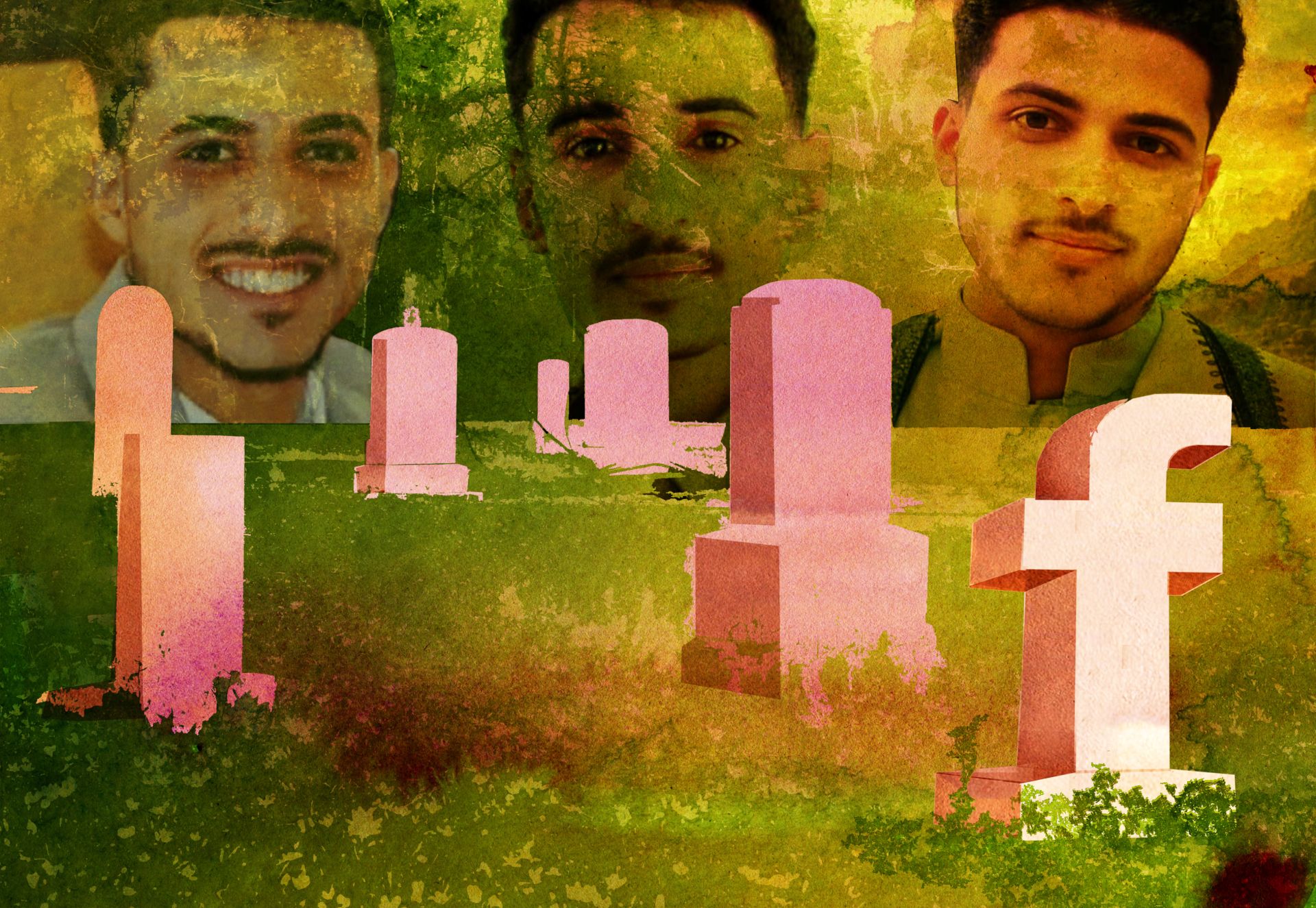
Until early September, my Facebook feed looked much as it always had. Posts from friends, relatives and people with whom I shared mutual friends revolved around everyday life: weddings and engagement celebrations, condolences for elderly people who had died and the occasional tragedy of a traffic accident. Other posts reflected Yemenis’ daily struggles: prolonged power cuts, disruptions to education, a worsening economic crisis and the familiar long queues outside gas stations.
Then, on Sept. 3, Houthi fighters launched a major military offensive against government-held areas of western Yemen, seizing six districts within a week. A month later, the internationally recognized Yemeni government responded with Operation Dawn of Yemen, aimed not only at recapturing lost territory but also at driving the Houthis out of other areas under their control. As fighting intensified across the front lines, an unusual number of mourning posts began appearing in my Facebook feed.
Facebook remains Yemen’s public square, a place where people mourn their dead, celebrate milestones, document their lives and argue fiercely over the country’s politics. By early October, as the Houthis advanced deeper into government-held areas of Taiz province and approached the eponymous city itself, my feed had turned into an endless stream of obituaries. Parents grieved for their sons. Wives mourned their husbands. Friends wrote heartbreaking tributes to men they had known since childhood.
As I began reading and collecting these posts, Facebook’s algorithm appeared to take notice of my interest. Each time I opened the platform, more photographs of the dead appeared, many shared by people who were not even on my friends list. Scrolling through Facebook began to feel like walking past a wall covered with photographs of the dead.
“Hisham, the hero, my brother and beloved martyr, please come back, you troublemaker. My heart aches from your absence,” wrote Shehab al-Shehabi, a journalist, on Facebook on Oct. 13, sharing a photograph of Hisham, who looked barely out of childhood, dressed in a shirt, with a tan tactical vest.
Unlike in Houthi-controlled areas, where information about fighters’ deaths appears to be tightly controlled and casualties are often announced through official funerals, families and friends in government-controlled areas openly share photographs, names and personal stories of those killed on the battlefield, making public expressions of grief more visible and spontaneous.
By early October, the Houthis had seized control of the last government-held road linking Taiz to other Yemeni cities, effectively tightening their decade-long siege of the city.
Long regarded as Yemen’s cultural capital and a cradle of intellectuals, poets and politicians, Taiz put up fierce resistance as more of its residents joined the fighting. As the battles intensified, mourning posts multiplied across social media.
But what distinguished this wave of mourning were the lives revealed by the photographs and Facebook pages of those killed. Many appeared to have been pursuing futures far removed from the battlefield. Some were mourned with photographs showing them in university graduation gowns, others in suits and ties. Their Facebook pages were filled with memories of campus life, celebrations of academic achievements and discussions about master’s degrees, graduation projects and career ambitions.
By late October, I had collected more than 700 Facebook posts mourning friends and relatives killed in the fighting, and saved them in a dedicated folder on the platform. Although mourning posts continued to flood my feed, I decided to stop collecting them. The process had become increasingly time-consuming, and I felt I had gathered enough material to begin reaching out to the people behind the posts. I wanted to know more about the young men whose photographs had flooded my feed. Who were they? What had their lives been like before the war? What dreams had they left behind? I assumed that even if only a small fraction of those I contacted agreed to speak, their accounts would be enough to help me piece together the lives behind the mourning posts.
But I soon discovered that reaching grieving friends and relatives was far more difficult than finding their expressions of grief online. Many of my messages went unanswered. Others politely declined, apologizing for their inability to speak. One response seemed to sum up the reluctance I encountered: “I don’t want to reopen old wounds.”
After repeated attempts to reach the friends and families of those killed, I eventually managed to speak with relatives of a few young men whose photographs and tributes had particularly caught my attention. Their stories began to reveal the lives behind the faces that had filled my Facebook feed.
For more than two decades, I have reported on successive waves of conflict in Yemen, from the Houthis’ wars against the Yemeni government before 2010 and al Qaeda’s deadly attacks to the current war, which has raged since late 2014. The scale of death in this conflict is not unprecedented. Earlier rounds of fighting might have been deadlier. What makes this war different is the extent to which relatives and friends have turned to social media, not only to mourn their loved ones but also to document their names, faces and stories.
Those stories reveal a complex tapestry about the sacrifices that Yemeni society has endured and the cost of the war. Many of the young men mourned on social media did not necessarily plan on joining the battle, but often did so with motives that mixed wanting to defend their country with seeking a better livelihood in the absence of job opportunities.
Among the mourning posts that caught my attention was one featuring a photograph of Omar Mukhtar Naif, a thin young man with a broad smile, wearing a light gray suit, white shirt and black tie, seated among other young men in what appeared to be a university classroom.
Neither the photograph nor his Facebook page, where he went by the name Omar Naif, offered any obvious indication of his military life. Instead, his posts revealed an ambitious youth who dreamed of becoming a petroleum engineer, finding a good job and starting a family.
Born in 1999, Omar was killed on Oct. 11 while fighting the Houthis in Jabal Habashi, west of Taiz, according to his grieving father, Mukhtar, who lives in Taiz city and who agreed to speak to New Lines about his son. “Omar was an ambitious young man who loved his homeland. He was passionate about his studies, well-mannered, and aspired to be a role model for other ambitious youth,” his father said. Omar’s Facebook page was filled with photographs documenting his university years and posts about his hopes for the future. His lively exchanges with friends offered glimpses of an outgoing person who enjoyed life and had plans for the years ahead.
On Oct. 26, 2022, Omar posted a photograph of himself wearing a black graduation gown and mortarboard, with pink flowers blooming behind him. He looked directly at the camera, a faint smile on his face. Friends congratulated him and wished him success in the years ahead.
His father recalled that Omar had graduated from a petroleum engineering college in the southern province of Shabwa. He dreamed of becoming an instructor at the same college, working at an oil refinery or traveling to Saudi Arabia in search of better opportunities.
None of those dreams came true.
“Once he had completed his studies, he sought to enter Saudi Arabia in order to improve his standard of living, with the goal of getting married and living like everyone else. He wanted to become a college instructor, but he couldn’t. He also aspired to either stay in Shabwa, return to Aden, travel to Saudi Arabia, or go back to Marib to work in the refineries. He was a man with ambition,” his father said.
On Oct. 9, 2020, Omar Naif shared a photograph of himself alongside an image of two hands wearing engagement rings. Above the photographs, a question appeared in bright yellow letters: “How will you begin 2021?” Below, Omar offered his answer: “Engaged.”
His friends teased him in the comments. “Dream on, the dream is free,” one wrote, followed by laughing emojis. Another wished him a happy year. Omar had long dreamed of getting married and starting a family, his father said.
“Whenever he heard that someone was getting married, he would tell his mother, ‘So-and-so has gotten engaged,’” his father recalled, describing his son’s frustration at remaining unmarried.
After failing to find a better-paying job in the petroleum sector, the field he had studied at university, or an opportunity to work in Saudi Arabia, Omar took a job at a money exchange company, earning a salary that barely covered his living expenses.
“He had no job, so he ended up working at a currency exchange firm. No one would hire him for a position in his field of engineering. He chose to work at the exchange firm rather than remain unemployed,” his father said.
But Omar came close to fulfilling his goal of marriage. His mother had found a prospective bride and approached her family to discuss the match. The families had agreed, and an engagement ring had been purchased. Everything was ready for Omar and his family to visit his bride-to-be and make the engagement official.
“He was overjoyed. His happiness was beyond words,” his father recalled of Omar’s reaction when his mother told him about the arrangements.
Yet marriage remained financially out of reach. Omar needed to raise at least $5,000 to cover the dowry, engagement expenses and furniture for his future home. He also had to help support his family. His father, a military officer, said he had not received his salary for some time, adding to the family’s financial difficulties.
Omar’s job at the money exchange firm offered little hope of saving enough to cover these expenses. So, early in 2025, he joined the government’s Nation Shield Forces and traveled to an area near Yemen’s border with Saudi Arabia, where the troops were assembling.
“He joined the Nation Shield Forces because he had no other way to improve his financial situation and living conditions. He wanted to get married and needed to save a large sum of money for the wedding,” his father said.
Joining the military meant putting his engagement plans on hold until he could save enough money to marry. Weeks before his death, Omar was among the Nation Shield troops redeployed from their positions near the Saudi border to his home province of Taiz, where they were sent to reinforce government forces fighting the Houthis. The deployment brought him closer to his family, allowing him to spend time with his parents even as he took part in the fighting.
One day before he was killed, Omar put on his military uniform and said goodbye to his parents. His parting words to his mother suggested that he knew he might never return.
“He told his mother, ‘Pray for me. I might return, or I might be martyred,’” Mukhtar recalled.
As he recounted the moment he learned of his son’s death the following day, Mukhtar took a deep breath, his voice heavy with grief. “I lost a piece of my heart and one of my finest sons,” he said. Mukhtar then turned to Facebook to announce his son’s death, sharing the news with his friends and followers. “I wrote on my page: ‘Omar al-Mukhtar, a glorious martyr.’ Praise be to God,” he recalled.
Another young man whose death was widely mourned on Facebook was Al-Bara al-Mashwaly, a 21-year-old university student killed while fighting the Houthis in Taiz. Friends and relatives shared his photograph and mourned the loss of someone whose ambitions extended far beyond the battlefield.
In one photograph circulated in the mourning posts, Al-Bara wore a brown traditional Yemeni outfit, with a patterned shawl draped over his shoulders and a cellphone tucked into his chest pocket. Born in 2005, Al-Bara was a soldier who was also in his third year studying information technology at university. He dreamed of leaving Yemen and establishing his own IT business in Saudi Arabia, according to his close friend and classmate, Muhannad Abdul Kareem. “He used to talk a lot about Turkey and Saudi Arabia and about establishing his own IT company in Saudi Arabia. He loved journalism and writing about people’s problems,” Muhannad said.
When the new academic year began in September, Al-Bara did not attend classes. His absence worried Muhannad, who began asking about him and discovered that he was on the front lines defending Taiz. According to Muhannad, Al-Bara had been besieged by Houthi forces for 40 hours.
When Al-Bara returned to the city on Oct. 12, Muhannad urged him not to go back to the battlefield while the fighting was raging. Although Muhannad supported resisting the Houthi offensive, he feared for his friend’s safety. Two days later, on Oct. 14, Al-Bara was killed.
“You have reopened old wounds. I feel as though I am reliving all my memories with him right now. Al-Bara was like a brother to me and a dear friend,” Muhannad said, taking a deep breath as he recalled their friendship. Muhannad said he had also wanted to join the fighting alongside Al-Bara, but his family had prevented him from doing so.
In the past, media outlets affiliated with the warring parties often reserved their tributes for senior officers and commanders, while thousands of ordinary fighters died with little public recognition.
Omar had celebrated his graduation and dreamed of getting married. Al-Bara hoped to complete his studies and set up a business in Saudi Arabia. Neither lived to realize those ambitions.
Together, the condolences, photographs and tributes shared on social media have become an informal archive of Yemen’s war, preserving fragments of the hopes and dreams of a generation that might otherwise have been buried alongside those who carried them.
I have long since left Omar’s and Al-Bara’s Facebook pages behind. Yet their smiling faces still appear in my feed, as friends return to remember them, leaving a simple message beneath their photographs: “Allah yerhamak” (“May God have mercy on you”).
“Spotlight” is a newsletter about underreported cultural trends and news from around the world, emailed to subscribers twice a week. Sign up here.