


On Oct. 8, U.S. Secretary of Defense Pete Hegseth strode across the deck of the USS Abraham Lincoln to deliver one of his trademark blasts of wrath. The aircraft carrier had just docked in San Diego following a 286-day deployment marred by reports of low morale, a lack of food and suicide attempts. In an interview with the MAGA influencer Jack Posobiec for the right-wing Real America’s Voice outlet, Hegseth ripped into the media for its critical coverage of the ship’s condition and the war that had caused its marathon service.
But Hegseth’s most animated comments came when he was asked about the upcoming execution of Nidal Hasan, who murdered 12 soldiers and one civilian at Fort Hood on Nov. 5, 2009. Announcing that Hasan would face a firing squad on Dec. 3, Hegseth remarked, “We’ll make sure that people are able to watch it. That it’s public.” With the internet teeming with videos of extrajudicial aerial strikes against alleged drug runners and point-of-view clips of drones obliterating targets in Iran, the moment marked another addition to Hegseth’s carnival of death.
The response to Hegseth’s plan was bipartisan disgust. Republican Rep. Austin Scott recoiled, posting on X that “live-streaming executions is what jihadists do,” while Democratic Sen. Jack Reed argued the “barbaric spectacle” would serve as “a gift to anti-American terrorist recruiters.” Even while battling cancer, Pope Leo XIV weighed in, writing on X that the death penalty is “inadmissible” because “the common good can be safeguarded and the requirement of justice can be met without recourse to capital punishment.” The pontiff concluded his post with the hashtag #NoDeathPenalty.
Recognizing that he was playing a losing hand, on Oct. 15 President Donald Trump announced on Truth Social that “this event will not be streamed.” Trump’s cancellation statement was as unhinged as Hegseth’s original declaration: blaming the tragedy on an alleged “intelligence failure” by the Obama administration, linking Hasan’s killing spree with the actions of “Terrorists and SCUM” and invoking the discredited claim that the death penalty serves as a deterrent.
The firing squad may not be livestreamed, but the White House’s carnival of death — its illegal aerial strikes in the Caribbean and Pacific, its posting footage of kill shots in Iran, its murderous ICE campaign and more — is in full swing. And that carnival has deep roots in U.S. history. As I have chronicled in my two-volume history of the death penalty, “Executing Democracy: Capital Punishment and the Making of America,” the nation’s evolving sense of itself, its understanding of what it means to live in a democracy, has always been entwined with fierce debates about such public displays of violence.
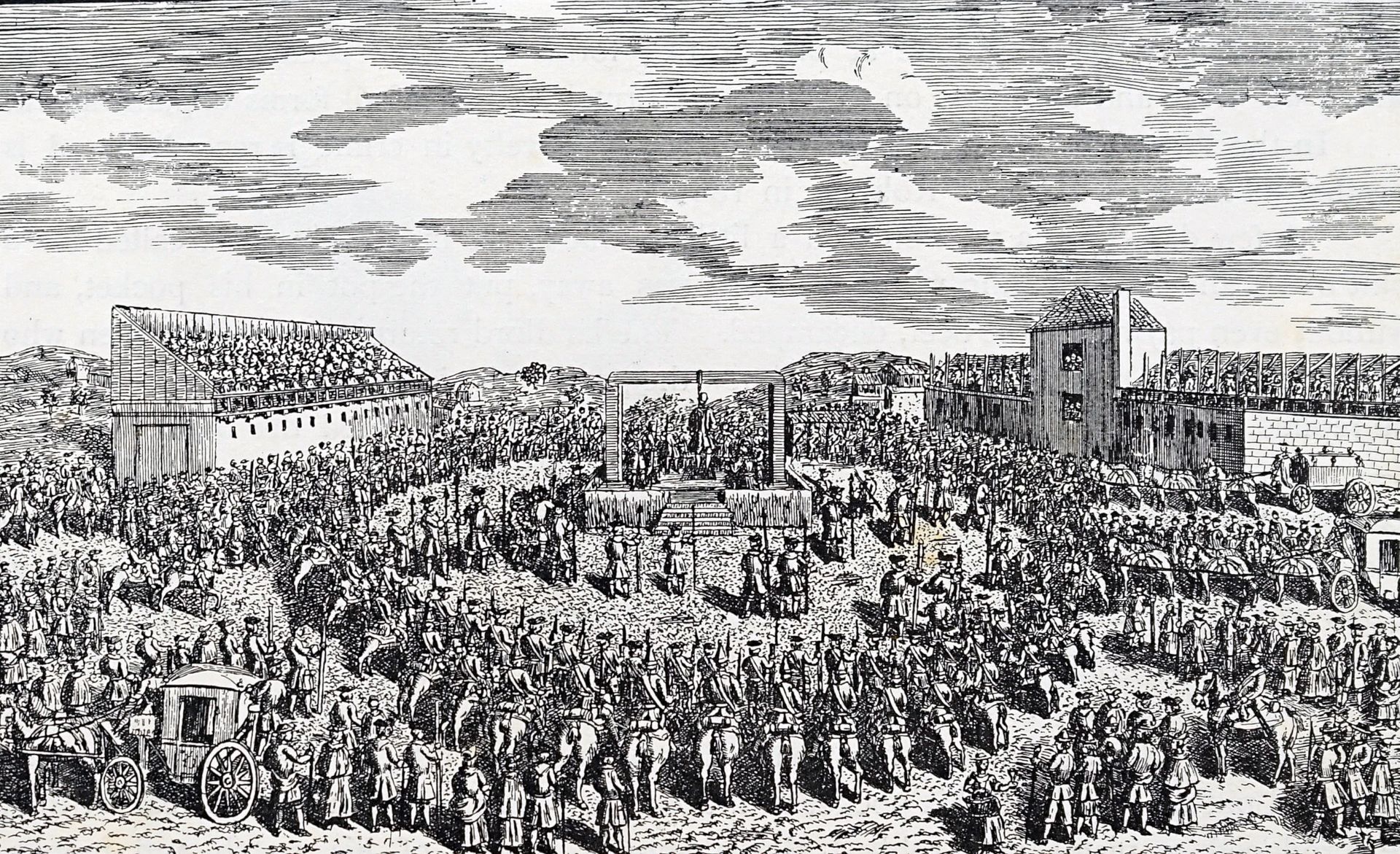
In the days before television, radio and smartphones, communal life in America unfolded in the public square. Fairs, marches, political debates, dances, weddings — the nation’s social life happened in the open air. But the biggest crowds and the rowdiest parties happened on hanging and torture days. Throwing the shrew in the stockades, flogging a misbehaving servant, tarring and feathering the stranger, making the homeless drunkard “ride the rails” — these were all forms of public torture where crowds would gather to shame someone. For example, “riding the rails” entailed an offender getting paraded around town while strapped to a horizontal pole shaped to inflict maximum pain on the rider’s genitalia. Crowds howled at the spectacle. Accompanied by heavy drinking and theatrical mockery from the audience, such events resembled carnivals wherein a sense of community formed around the collective ability to inflict pain upon others.
Hangings were usually accompanied by sermons meant to justify the violence in the name of an angry God, yet the victims were granted “last words,” which often amounted to profanity-laced tirades against corrupt judges, a feckless sheriff, abusive husbands or the sociopathic slave masters who turned large swaths of America into industrial-level killing grounds. Less reminders of the somber majesty of law and order than debacles of debauchery, hanging days were messy affairs.
For conservative clergy, hanging sinners meant honoring God’s righteous fury. For slaveholders, snapping a few necks meant displaying their lord-like ability to inflict violence on Black bodies, which had the effect of fostering a sense of racial allegiance among poor white farmers, who might have felt oppressed by the plantation elite. Arrayed in opposition, progressive Quakers, proponents of the Enlightenment and slavery abolitionists argued that public executions were lessons in barbarism. For these opponents of the death penalty, public displays of death offered disgusting evidence that the new nation was failing to invent political norms free from the old ways of Europe’s murderous kings.
Throughout U.S. history, these debates fell along familiar fault lines: Proponents of public violence argued that a good killing served as a lesson in consequences and would deter other would-be malcontents, while opponents argued that the butchery hardened viewers’ souls, sapping them of benevolence. In “Executing Democracy,” I refer to this latter position as “the brutalization thesis,” which argues that, as viewers are taught to watch more violence and to accept public torture as a normal part of daily life, they dull their revulsion to pain, slowly losing their capacity for compassion.
By the end of the Civil War, most Americans came to realize that public killings did not deter other criminals; they simply injected barbarism into the public square. Then, in a spasm of postwar racial backlash, the South erupted in thousands of extrajudicial lynchings. Yet the embarrassment of watching racists party while stringing up another African American turned the nation’s stomach against such public enactments of the death penalty. As the nation slowly accepted the “brutalization thesis,” public hangings were phased out in favor of less spectacular methods — executions were relegated to dark, quiet places, sequestered from scrutiny. No one has been executed in public in America since 1937.
Oblivious to his national history and the fact that scholars have found no evidence that executions fulfill the goal of deterrence, Hegseth argued in his America’s Real Voice interview that executing Hasan in public would play a salutary role “because people need to understand there are serious consequences for these types of things.” In his Truth Social post canceling the spectacle, Trump reinforced Hegseth’s faulty thinking, musing: “I think streaming the execution for all to see might have been a strong deterrent.”
Countering that position with a contemporary example of the brutalization thesis, Justin Mazzola, deputy director of research at Amnesty International USA, responded to Hegseth’s announcement by saying a public execution would be “reprehensible,” adding: “Livestreaming the taking of a life by firing squad would only compound the cruelty of the death penalty and perpetuate the cycle of violence that the authorities purportedly seek to end.”
While I concur with the Pope and Mazzola, Hegseth’s tirade of Oct. 8 and Trump’s post of Oct. 15 both speak to issues larger than the death penalty. Hegseth’s call for a return to the old way of public torture, coupled with the White House’s reveling in other forms of public killings, means the nation is veering away from any sense of mature deliberation and decency, instead succumbing to a barrage of violence. Just last week, at a raucous campaign rally in South Carolina, Trump celebrated a man who punched a heckler. “Man, I loved that,” the president said. “It takes courage to do that at a Trump rally,” he said. “He got whacked.” The crowd erupted in applause.
The temptation to wield America’s science fiction-like military arsenal against perceived enemies can be difficult to resist, seducing even reasonable figures into authorizing unwise strikes. But in the hands of men like Trump and Hegseth — who revel in a sense of aggrieved masculinity and who seek accolades through performances of vengeance — the temptation becomes more like a compulsion. Deploying MQ-9 Reaper drones, F-35 jet fighters and AC-130J gunships, the White House has launched an aerial campaign of death against alleged drug runners in the Caribbean and Pacific. Since the first announced strike on Sept. 2, 2025, the White House and its supporters have justified the killings by claiming the alleged drug runners were terrorists. Exemplifying the way Trump and Hegseth perceive themselves as producers of spectacular entertainment, footage of the strikes has been posted to social media, offering viewers video game-like kill shots. X is now filled with such clips, with MAGA devotees cheering on the killings, as in the anonymous @andweknow feed, which thrills at the carnage, announcing on May 30: “U.S. forces turn drug boat into fireball.”
The intelligence flagging the suspects has not been shared publicly, Congress has not been consulted, and the strikes clearly violate international law. Nonetheless, estimates suggest close to 70 events have killed roughly 230 people. Reporting to the United Nations on Sept. 9, Ben Saul, the special rapporteur for counterterrorism and human rights, argued these extrajudicial killings “flagrantly violate fundamental human rights.” The drug boat killings illustrate the essence of the Trump-Hegseth carnival of death: Acting on secret evidence, stretching the norms of military engagement and acting unilaterally with no congressional oversight or public debate, they disburse deaths that are then converted into social media content.
Maj. Nidal Hasan was an Army psychiatrist who treated veterans returning to Fort Hood from deployments in Iraq and Afghanistan. As his patients’ stories of horror from the front lines accumulated into a tableau of misery and pain, and as his devotion to Islam deepened following his mother’s death, Hasan slipped into depression, alienation and rage. On Nov. 5, 2009, he went to work, shouted “Allahu Akbar” and opened fire, killing 12 soldiers and a civilian and wounding another 32 people before being shot and apprehended by police officer Mark Todd. Had Todd not intervened, the killing spree could have been much worse, as Hasan went down with what the Los Angeles Times reported were 177 rounds of unfired ammunition.
Hasan’s radicalization had been no secret to colleagues, who worried about his wavering allegiance to America and his escalating instability. His defense lawyer, John Galligan, was so struck by his client’s emotional volatility that, prior to Hasan firing him, he planned to pursue an insanity defense. While the killer had been in email contact with a range of Islamic extremists prior to his rampage, The New York Times reported that a joint investigative team from the FBI and the Army’s Criminal Investigation Command found “no evidence that he was directed or steered into violence.” As in so many cases, the motives driving Hasan’s murderous rampage remain murky, offering an unsettling cocktail of political resentments, religious fanaticism and emotional instability.
Speaking at Fort Hood five days after the shootings, then-President Barack Obama offered the nation a sense of higher purpose. He opened with a simple but profound observation: “For those families who have lost a loved one,” he said, “no words can fill the void that’s been left.” There are no easy fixes for tragedies, no responses capable of healing the hurt. Some losses cannot be assuaged. Nothing can bring back those murdered by the perpetrator.
The implication of Obama’s speech, reflecting positions embedded in the work of groups such as Murder Victims’ Families for Reconciliation that are opposed to the death penalty, was that sliding from the pain of loss into pursuing vengeance debases the memory of those we have lost and fills our days with an insatiable rage. Instead, the honorable response to pain is to rise above it, for, the president preached, “Your loved ones endure through the life of our nation. Their memory will be honored in the places they lived and by the people they touched. Their life’s work is our security and the freedom that we all too often take for granted.” Converting senseless death into purposeful remembrance, the president lifted the dead into national heroes, announcing: “Their lives speak to the strength, the dignity, the decency of those who serve, and that’s how they will be remembered.” Sermonic, somber, striving for a sense of historical grandeur, the president tried to acknowledge and then elevate his audience’s pain, moving away from anger and vengeance toward glimmers of healing.
In his tirade aboard the USS Abraham Lincoln, Hegseth could not resist attacking Obama. Incredulous that Obama did not use the word terrorism in his eulogy — remember, at the time, the FBI found no evidence of a credible terrorism link — Hegseth performed MAGA rage. “It was a radical Islamist terror attack. Remember what Obama called it? ‘Workplace violence.’ That’s what we’re up against. That’s the worldview we’re up against.”
The fact that Obama uttered no such phrase in his speech is beside the point, for Hegseth’s anger was not based on disagreements with specific lines from Obama’s speech but on his interpretation of “the worldview” MAGA has risen to cleanse from the nation. To lock in that point, Trump’s Truth Social post canceling the livestream berated “Barack Hussein Obama” for presiding over the FBI’s “key intelligence failure.” For Hegseth, Trump and the MAGA faithful, it is always Obama’s fault.
To add insult to the perceived injuries the MAGA gang was “up against,” in the final weeks of his failed presidency, Joe Biden commuted the death sentences of 37 of the nation’s 40 federal death-row inmates. The outbursts from Hegseth and Trump, then, targeted the words of Obama and the actions of Biden — amounting to another shot in MAGA’s culture war. Within the carnival of death, forgiveness is for losers. Self-reflection is for wimps. Dialogue is the mark of cowardice. Conservative clergy of the 18th century would concur. The slave masters would concur. Hasan must not only die; he must die in a public display of righteous violence.
These different positions on capital punishment reveal some of the fault lines in American politics. While Obama sought to calm the nation by speaking to higher callings, Hegseth hoped to bathe the nation in the fury of more violence. While Obama tried to console his audience with the myth of an overarching national purpose leading toward justice, Hegseth hoped to satisfy the thirst for vengeance by publicly killing another lost soul. Whereas Obama understood that justice comes with loss and pain, Hegseth hoped a public execution would fill our collective sorrow. Biden thought the federal government should limit its involvement in the execution business; Trump’s Truth Social post glories in the violence, saying it would show the world “how America deals with Terrorists and SCUM.”
While Hasan’s televised execution has been canceled, the White House’s obsession with violence is unchanged, meaning the carnival of death is primed to roll on. The internet still crawls with grainy videos of kill shots against alleged drug runners labeled “terrorists.” Under Hegseth’s leadership, the U.S. Central Command Video Gallery shows clips of U.S. hardware blowing up unnamed targets in Iran. ICE continues to spread violence in the streets of U.S. cities. Speaking in Kansas following the riots in France, Trump claimed the unrest was caused not by student protesters and aggrieved citizens but by “migrants, jihadists and communists” intent on destroying “Western civilization.” A prophet of doom, the president then anticipated that a “blue wave” of Democratic victories in the midterm elections would lead to France-like chaos, because that is “what radical Democrats want to do to America.”
Canceling Hasan’s public execution does not change the fact that, for Trump and Hegseth, politics is warfare in which “Western civilization” is under perpetual threat. In that cataclysmic clash, only righteous violence prevails. But as the long and winding road of American history shows those who care to look, you cannot kill your way to justice.
Become a member today to receive access to all our paywalled essays and the best of New Lines delivered to your inbox through our newsletters.