

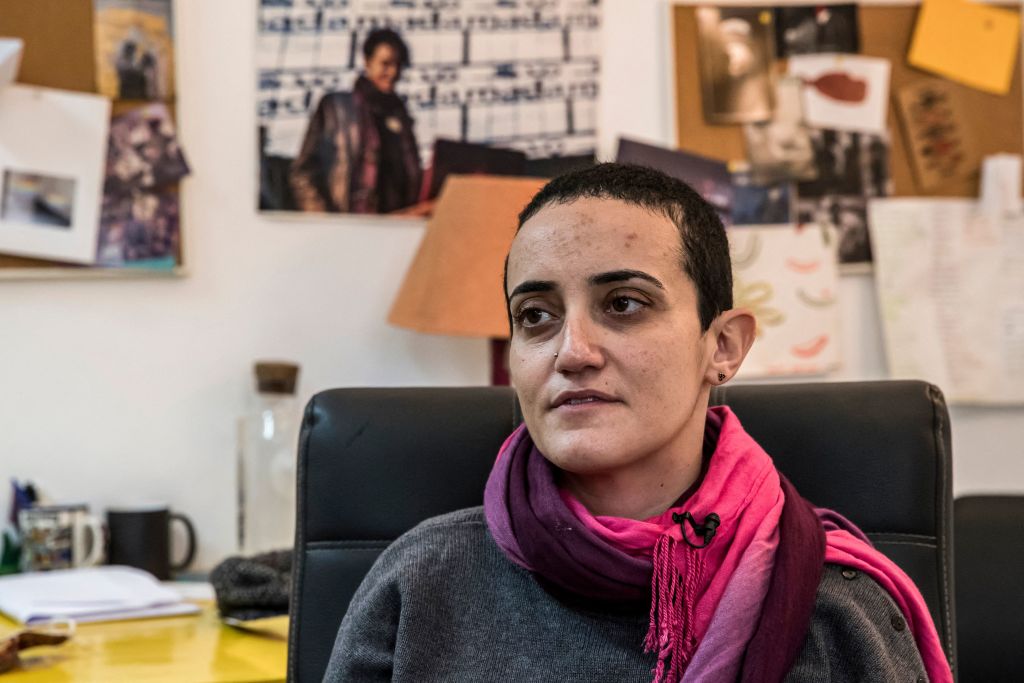
On the far eastern edge of Cairo, on Oct. 27, 2026, the New Cairo Misdemeanour Court (NCMC) was the scene of two events that will shape the future of independent journalism in Egypt. In a fourth-floor courtroom, the judge asked the litigants to leave their seats and clear the room for three minutes. Three minutes, it turned out, were all he needed to remove one of Egypt’s most prominent independent news outlets from the scene. He fined Lina Attalah, the editor-in-chief of Mada Masr, 3 million Egyptian pounds (around $53,450) for running a website without a license, and ordered the closure of the outlet that had fended off this fate for more than 13 years, holding firm against website blocking and official harassment of its journalists.
At the same time, three floors away in the same building, lawyers were gathering in another courtroom for a detention-renewal hearing for six journalists: the entire newsroom of Matsda2sh (“Don’t Believe It”), a platform that specializes in fact-checking and verifying news. Over videoconference, the Supreme State Security Prosecution (SSSP) extended their detention by 15 days on top of the time they had been held since Sept. 28, 2026, as they faced charges including joining a terrorist group and spreading false news. Together, the two cases illustrate how authorities are targeting independent media through different legal mechanisms, from licensing prosecutions to national security charges.
The scenes sum up the state of independent journalism in Egypt, amid a fraught political climate and mixed signals that swing between a security clampdown and the prospect of a loosening of restrictions. A clear pattern stands out: official rhetoric warning of threats to national security has risen in lockstep with an escalating campaign against independent media.
Since Oct. 14, 2026, President Abdel Fattah el-Sisi has issued a string of warnings about what he called attempts to “target national consciousness and tamper with Egyptians’ collective memory” and to “bring down states from within,” as well as “disinformation campaigns targeting Egyptians’ will.”
These warnings came alongside his announcement that his presidency will end in 2030, and his remarks about a detailed plan, along with a program run by the Military Academy, to train future leaders and prepare potential successors. At the same time, he asked the country’s legislature to authorize him to provide military support to Saudi Arabia in its war against the Houthis in Yemen. These moves have created a context that links preparations for a handover of power after 2030 with rising attacks on journalists, which began with the arrest of the Matsda2sh reporters and has now included the closure of Mada Masr. The message is that the narrow space left for independent journalism is gone, and the field now belongs to state-run media alone.
For the judge of the NCMC, the matter was simple and straightforward, leaving no room for debate. “My job is simple: Is there a license or not?” he repeated during the trial. The lawyers replied that the case involved a long series of applications, correspondence, demands and lawsuits that the outlet had pursued in an effort to obtain a license over the eight years since the Supreme Council for Media Regulation (SCMR) was formed.
“It’s simple,” the judge said again. “Take the case file, read it here in session, and when you’re ready to make your arguments, tell me.” One of the lawyers asked: “Why does there have to be a ruling today? Why won’t the court give us time to review the case file?” The judge fell silent, then called a recess to decide how to proceed.
About an hour later, the judge returned to a courtroom that had been cleared of other litigants and their lawyers. All that remained were Mada Masr’s founder Attalah, her eight lawyers and a handful of journalists, along with several officers and security personnel. The judge began by rejecting the lawyers’ requests to postpone the decision. The lawyers stood by their requests, but that won no stay of execution for an independent news outlet.
Suddenly, a security officer opened the courtroom door, and a new lawyer walked in. The judge announced that he had appointed him to defend Attalah. She flatly refused, insisting on the lawyers who had come with her, but to no avail. The judge entered into the record the requests of the court-appointed lawyer, who did not even bother to voice them; the judge took it upon himself to spell them out. The maneuver allowed the court to record the appearance of a defense while bypassing the objections and procedural requests of Attalah’s actual lawyers, who had sought access to the case file, licensing documents and witnesses before presenting their arguments. As the lawyers objected, the judge read out the verdict. Security forces seized Attalah roughly and held her at the court for several hours until the fine was paid in full. Minutes before her release, she was informed that a ruling in absentia had been issued against her in 2024, sentencing her to a year in prison in a case involving charges of spreading false news and operating a website without a license. The ruling had not been mentioned during the proceedings, and her lawyers had not been informed of it. Its sudden appearance threatened to keep her in custody even after the fine had been paid. Her lawyers filed a request to reopen the case, and the same court set a hearing for Nov. 11, 2026, resuming a familiar, endless cycle of security and judicial harassment.
The expedited closure order, issued by the NCMC at the very first hearing in the case, is the culmination of 13 years of relentless pressure on the outlet and its journalists. It began in November 2015, when military intelligence summoned Hossam Bahgat, then a journalist at the outlet, over an investigative report on the military trial of 26 army officers accused of plotting a coup.
Bahgat was then brought before the military prosecution, which ordered him held for four days pending investigation before releasing him after only three. He was charged with publishing information about the armed forces that harmed national interests.
In May 2017, the authorities escalated their campaign against the outlet, blocking access to it through several of Egypt’s internet service providers as part of a wave that targeted a number of news websites. A source speaking to the state-run Middle East News Agency justified the blocking at the time, saying it targeted websites that published content supporting terrorism and extremism and deliberately spread lies.
Blocked or not, Mada Masr kept up its investigative work. In December 2017, it published an investigation revealing that the General Intelligence Service (GIS) had acquired Egyptian Media Group, which owns the private ONtv channel network and a large number of Egyptian media companies. The outlet followed up with further reporting that traced, stage by stage, how the GIS took control of both state and private media in less than two years.
In line with this editorial vision, Mada Masr reached the height of its confrontation with the authorities in November 2019, when it published a report on the reassignment of the president’s son, Mahmoud el-Sisi, an officer in the GIS, to a lengthy posting at Egypt’s mission in Russia. Citing sources inside the GIS, the outlet reported that he had been moved because he had mishandled several files under his responsibility and embarrassed his father.
The security response came at dawn on Nov. 23, 2019, with a raid on the home of one of the outlet’s editors, Shady Zalat, who was arrested. The following afternoon, security forces stormed the outlet’s office and held 18 journalists inside for hours, before arresting Attalah, along with journalists Rana Mamdouh and Mohamed Hamama.
They took all three to the Dokki police station near their office, and from there drove them, handcuffed, in a police car to an unknown destination, most likely the SSSP in New Cairo. But the car turned back to the station, where the three were released at the same time as Zalat, who had been arrested two days prior.
There, the officer who had led the raid on Mada Masr’s office told them that a “sovereign figure,” whose identity is still unknown, had stepped in at the last minute to stop their imminent detention. They considered it a miracle: an escape from a grinding judicial system capable of wearing down journalists with endless routine procedures.
The morning after the raid, the team reminded themselves that they were “children of the crisis” and that they would “remain loyal only to our profession,” the motto Attalah had used when she launched the outlet on June 30, 2013, amid mass protests and unprecedented political polarization.
According to Attalah, Mada Masr set out from the start to offer an alternative: journalism that asks questions and holds power to account, that moves beyond the simplistic binary of “with us or against us,” and that approaches stories from different angles in search of the missing piece of the picture and what the authorities deliberately conceal.
Mada Masr’s steadfastness in the face of blocking and harassment, and its journalists’ persistence in tackling thorny policies and issues, were met by the authorities sharpening their tools and stepping up their pursuit, while dragging out every case. Each unwelcome story became a case for prosecutors to investigate, particularly the SSSP, which investigates suspects in political cases. Each time, Attalah and the outlet’s journalists were questioned, then released on bail.
The bail began at 2,000 Egyptian pounds in May 2020 (about $127 at the time), when Attalah was arrested outside the Tora Prison complex while interviewing Laila Soueif, the mother of the jailed activist Alaa Abd el-Fattah. Soueif was trying to deliver medical supplies and cleaning products to her son, who was on hunger strike amid restrictions on prison visits during the COVID-19 pandemic. Attalah was charged with photographing a military facility.
By Oct. 21 of this year, bail had climbed to 100,000 pounds (about $1,780), when the SSSP charged her with spreading false news with the aim of disturbing public peace, after questioning her about Mada Masr’s coverage of a wave of prison protests across the country.
Since 2022, the authorities have added a second charge to the usual accusation of spreading false news, one now used against Attalah, whenever the outlet’s journalists are prosecuted: “establishing and operating a website without a license.” Mada Masr had applied for a license in 2018 and resubmitted its application in 2020, but received no response to either within the legally prescribed time frame. The outlet later learned that its application had been rejected, without being properly notified, and challenged the decision in court.
In late August 2022, Mada Masr published a report on investigations into suspected corruption involving prominent members of the Nation’s Future Party, one of the pro-government parties with the largest presence in Egypt’s parliament. Party members filed complaints against three of the outlet’s journalists, and in September the Public Prosecution summoned all three, along with Attalah.
They were charged with spreading false news liable to disturb public peace and harm the public interest, using social media to cause disturbance, and insulting and defaming Nation’s Future members of parliament. Beyond the charges arising from the complaints, prosecutors showed Attalah a memo the Supreme Council for Media Regulation had sent for inclusion in the case file, stating that it had rejected the outlet’s license application, a decision the outlet had never been formally notified of, as the law requires.
That memo, submitted to prosecutors in September 2022, has hung like a sword over the outlet and its editor-in-chief ever since, opening the door to fines of thousands of pounds every time the outlet faces publishing charges. Nor did the ordeal end there. In February 2024, the SCMR itself, the body charged with regulating the press and media, filed a complaint with the Public Prosecution against the outlet over a report on scenarios for displacing Palestinians from Gaza.
In August 2025, the SSSP summoned Attalah for questioning in a new case, over a report on complaints of abuse and poor conditions in Badr 3 Prison. The report drew on a leaked letter attributed to Hassan el-Brens, a senior Muslim Brotherhood figure and former deputy governor of Alexandria held in the prison, as well as information about a hunger strike by several inmates protesting their conditions. Prosecutors charged Attalah with operating a website without a license in addition to spreading false news, and released her on bail of 30,000 pounds (about $620 at the time).
Mada Masr had in fact applied to the SCMR twice: first in October 2018, less than two months after the law governing its work was issued on Aug. 27 of that year, and again in August 2020, after the law’s executive regulations came out that February. Neither application received a response.
When Mada Masr learned that the SCMR had rejected its application without notifying it or properly explaining its reasons, it went to the administrative courts to challenge the decision. During the hearings, the outlet asked the court to compel the SCMR to produce the rejection notice and its grounds, but the court threw out the challenge with finality in December 2023.
After years of judicial and security maneuvers aimed at obstructing an independent news outlet, the NCMC adopted the SSSP’s latest characterization of the case. It treated Mada Masr’s earlier license applications as if they had never existed, and held that Attalah had founded and run the outlet without a license from the day the Press and Media Regulation Law took effect, Aug. 28, 2018, until she was first referred to trial on that charge on Oct. 22, 2026.
On that basis, the NCMC imposed the unprecedented fine of 3 million pounds on Attalah, a ruling that will mark Oct. 27, 2026, as the day the authorities set out to close the book on independent journalism, silencing one of Egypt’s most prominent independent news outlets and anyone who dares to follow in its footsteps.