


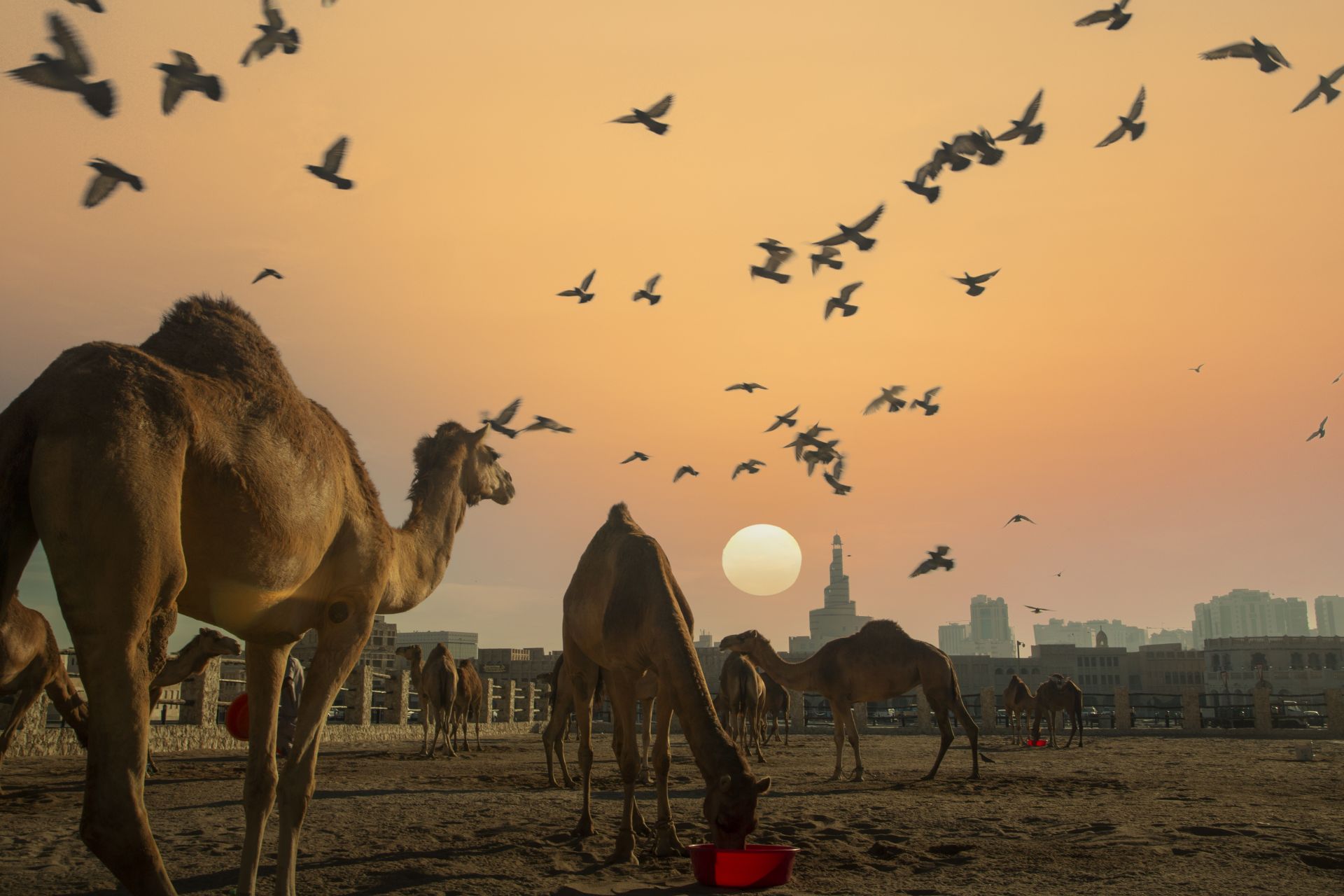
In sixth-century Arabia, a man wakes up at night and begins to saddle his she-camel, something he must have done countless times, and she’s tired of it. The man is al-Muthaqqib al-Abdi, a pre-Islamic Arab poet whose three surviving poems have been acclaimed by classical and modern critics alike. In this poem, we glimpse a rare form of consciousness, in which the borders between man and camel almost disappear. In the poet’s mind, they coexist within a shared matrix of existence that doesn’t split the world into subject and object, into the human being standing here and nature out there.
Al-Abdi says in his poem (my translation is informed in part by the rendering of the late-19th- and early-20th-century scholar C. J. Lyall):
When I rise at night to saddle her,
she sighs the sigh of a sorrowing man.
As I lay out the girth for her, she says:
“Is this forever to be his way, and mine?
Must all of life be stopping and setting out again?
Will he never spare me or keep me from harm?”
To me, the ingenuity of these lines lies in their directness, honesty and lack of imposed poetic devices, despite the highly structured verse. The poet, the camel and the journey itself share a seamless order of being while also remaining distinct from one another. Their knowledge of each other is so intimate that he reads her groan as a sigh that reveals her suffering to him. Yet move he must, as the harsh realities of the desert demand.
The coming of Islam ruptured that shared matrix and the worldview that came with it, calling on people to take stock of the world and see in it signs pointing to the one God. But this new way of seeing never fully destroyed the earlier mode of perception that had been present during the Jahiliyya — the name given to the pre-Islamic period of Arabian history, literally meaning the “age of ignorance.” Some Bedouin herders still form close attachments to camels they know by name, a present-day trace of that older intimacy, similar to the way that many in the Arab world and beyond bond with their horses; I saw some of these interactions firsthand when I lived in the UAE. Such intimacy could persist even as abstract concepts and dissecting principles gained authority, pulling humans away from their surroundings and setting them at a distance.
Greek philosophers also distanced us from that older state of consciousness, attempting to unearth principles that lie beneath appearances. But these ways of understanding aren’t a plain story of loss. They’re part of who we are today, and they’ve broadened our knowledge, while at the same time making the world we inhabit a subject of interpretation. The same dissecting attention also turned inward. Motives, memories and desires, as well as other inner states and processes, were studied through the lenses of ever finer distinctions. That inwardness helped humans understand themselves but also increased their sense of separation, even alienation, from the surrounding world. In a major strand of modern literature, human beings are transfixed by the self and immersed in its workings. But even in highly inward-looking literature, the older intimacy also emerges, albeit in fleeting moments. Outside literature, we can experience it, however briefly, when grief, pain or the approach of death overwhelms the interpretations through which we have learned to experience the world.
Islam brought new ideas and hierarchies to the Arabian peninsula, though one can trace continuities. The tribe was still central, for example, but the concept of the “ummah” (the community of believers) created bonds beyond kinship. Arabic, long the language of poetry and tribal memory, became the language of revelation, theology and law, and was studied in new ways. Weather, animals and the passage of time could now be understood as signs of divine power in addition to their role in the psyche of old poets as intimate forces that act on one another. Literature from before and after the Quran shows the rupture that this caused between humans and their environment.
A similar rupture took place elsewhere, such as in ancient Greece and later Western traditions, as people drew ever-finer distinctions and sought to make sense of the world through theories and physical laws. In time, people turned this type of dissecting attention to their own minds, which only deepened the rupture of the old matrix. No small part of modern literature shows human beings absorbed in the self and gives only rare glimpses of the older way of experiencing the world.
Over centuries of propagation, these new conceptions, including of the self, gained power as they added influential new layers through which experience is mediated and therefore interpreted. These new layers — lenses that shape both our perception and understanding — have made it difficult to inhabit the form of consciousness in which human beings, their natural surroundings and time are felt as belonging to a single order of being, and in which the world isn’t seen from the outside but felt and experienced from within. But these new layers have also expanded our knowledge and helped us understand ourselves better.
These new lenses (and the concepts and distinctions that create them) can limit our experience, though without necessarily being incorrect or unhealthy. Once a way of perceiving and understanding the world becomes familiar enough, it directs our attention before we have a chance to think. In that process, we learn what to focus on and what to ignore. An animal we know now manifests before us differently — as a sign of God’s power. That way of experiencing the world has taught us a great deal. Asking the listener to take stock of how the camel was created acted as a powerful call to investigate and learn about what is already intimately familiar, showing it in a new guise. This call, repeated in the Quran in relation to other things, was taken by the 12th-century Andalusian Philosopher Ibn Rushd as a directive for philosophical investigation. But as this new lens of experience and understanding gains authority and calcifies, we readily stick labels on things, leaving little room for whatever falls outside it. Doubtless, humans have always filtered experience through worldviews shaped by societies, but with increasingly abstract concepts, these filters became more elaborate, explicit and authoritative. The examples from the Quran and early Greek thought are just the beginning of the rupture from that old way of experiencing the world.
The old matrix was still deeply present in Islam even as the rupture kept widening. In the Quran, listeners are asked, “Will they not consider the camels — how they were created?” (88:17). But the Quran doesn’t deny its intimate place in Arab life, and that’s perhaps why it gives the example in the first place (rather than, say, elephants, which are seemingly more majestic and which, as classical commentators rightly pointed out, the Arabs knew little about). In this sense, the old matrix didn’t vanish, but was interlaced with an authoritative Quranic interpretation of the world. The old tribal world also remains in full force in the poetic duels of Jarir and al-Farazdaq, two leading poets of the Umayyad period (661-750 CE), when the caliphate was based in Damascus. When the Bedouin poet al-Rai al-Numayri sided with al-Farazdaq, Jarir attacked him and his entire tribe in the so-called “Skull-Crusher” poem: “Cast down your eyes, you are of Numayr / you will never rank with Ka’b or Kilab.”
Yet in the same Jahili-spirited ode, prophecy and the Quran stand at the top of the tribal pecking order: “The one who set down the book has humiliated you.”
Then:
I have climbed above you to the summit of my Khindifi line;
beneath it, you see ranks hard to climb.
Within it lie the Prophet’s Pool and its twin streams,
and those who inherited prophecy and the book.
Later use of pre-Islamic poetry by grammarians, lexicographers and Quranic commentators vividly shows how the coming of Islam created a new conceptual framework for seeing the world, including nature, through efforts to analyze language and interpret revelation. They preserved this poetry because each line was a capsule of tribal heritage and culture. But that was only part of the reason for its preservation (leaving aside members of tribes who continued to relay their poetic traditions, as some Arab tribes still do today). It was in large part the need to understand and interpret the Quran that led early scholars to dissect the poetry for its vocabulary, grammar and metaphors, and with that, the poetic line moved from being only a “bayt,” which literally means a house, to being a “shahid,” a witness, as well.
This gave poetry a new utility without stripping it of its older functions. The same approach was applied to language, which became the object of grammar, and to revelation itself, which was pored over by commentators, theologians and jurists. The evolution of Islamic disciplines and the translation of Greek, Indian and Persian works into Arabic deepened the rupture of the old matrix and the experience that came with it for a growing portion of the population.
The Greeks had already been through their own transition from existence within the shared matrix — where the human being is formed alongside animals, weather, place and time in a single field of experience — to a ruptured state, heavily mediated by fine distinctions and high concepts. In the case of Islam, when large swaths of peninsular Arabia lacked sophisticated urban civilization on the scale of ancient Greece, the rupture came through revelation. The Greeks’ route was different. By the time the rupture began to take root, they already had an advanced technological civilization, political systems and laws. Homer, with all the complexity of his epics, is still part of the old matrix. Gods and humans, animals and weather, landscape and conflict appear within one continuous field, acting upon one another. The key is that they visibly coexist within a single order of being without losing their distinctive features. This is a different worldview from that of later Greeks, a difference that becomes especially clear in the period after the rupture was widened by highly abstract conceptions and distinctions.
The rupture is visible in early theater and philosophy. Tragedy pits blood vengeance against civic order and makes the opposition itself a subject. An older narrative could be all about vengeance without acknowledging that contrast. In the “Oresteia” by the Athenian playwright Aeschylus, written in the fifth century BCE, Orestes kills his mother, on Apollo’s command, to avenge his father, and goddesses of vengeance (the Furies) pursue him for the crime. The case comes before the goddess Athena’s newly established court. By the time Aeschylus wrote his “Oresteia” trilogy, Athens already had courts and civic institutions, but tragedy gives that system a dramatic, even sacred, foundation and an intellectual one too. In that sense, tragedy helps legitimize the polis while showing that the polis can’t trample on the older forces. In the end, the Furies aren’t banished but honored while being stripped of their old authority. The rupture is acted out for the audience through the distinction between revenge and law. This makes theater perhaps more effective than philosophy at instilling such distinctions in the public mind, at least in its immediate impact.
Philosophy, for its part, takes a scalpel to the world, dissecting inherited concepts and assumptions, as well as nature itself, down to its constituent elements. This begins even before Socrates enters the scene. Parmenides, a pre-Socratic Greek philosopher, deals a massive blow to established ways of perceiving the world, including the one that sees everything within a shared matrix. That matrix doesn’t merge everything into an undifferentiated unity of being, as Parmenides does, but holds many things together without making them one thing. To say that being is one and that change, plurality, birth and decay are only appearances is a huge conceptual leap.
Ancient philosophers also busied themselves with making distinctions about the soul, examining thought, feelings and perception. And once we get there, the rupture of the old matrix seriously deepens because we aren’t merely trying to make sense of what’s out there and how we perceive it, but are actually dissecting the inner workings of our own selves. That is, we become objects of our own investigation and interpretation. Over centuries, this attention to the self intensifies the distinction between subject and object, the human being standing here and the world over there.
The self is already alive and kicking in ancient poetry, tragedy and scripture — Odysseus crying himself out on Calypso’s island, the inward voices of the Psalms and Job, and the first-person grief, longing and pride of pre-Islamic poetry. But Augustine, the North African Christian theologian and bishop who lived and wrote in the fourth and fifth centuries CE, dissects the self, including memory and guilt, with a severity rarely seen in ancient writings. In his autobiographical work, “Confessions,” Augustine, a philosopher of fine distinctions, turns the conceptual habits and tools used to interpret the world inward upon his own restless life. The outside world never really disappears, but we see it through his memory, and from there, we can see how his actions pass through the filters of guilt.
Islamic civilization produces its own strand of inwardness and self-focused attention. It’s already established in the Sunna, the body of practices and reports attributed to the Prophet Muhammad, in the concept of “niyya,” or intention. The idea is that whatever one does takes its merit from the intention that makes it happen. This is inseparable from Islam’s fiercely antithetical stance toward “shirk” — compromising the oneness of God, whether by directing one’s intention or religious actions toward something other than God, or by associating divine attributes with another being. So the unflinching focus should be on inspecting one’s intentions, namely, whether they’re directed toward God or tarnished by other motives. This is not the raw devotion of the old matrix (not that such devotion doesn’t exist even in highly organized and intellectualized religions) but a conceptual devotion characterized by dissecting scrutiny of intention and where it is directed.
This kind of scrutiny produced some major texts around “muhasaba,” or self-reckoning. Al-Ghazali, a mystic, theologian and jurist in the 11th and 12th centuries, tells us in his autobiographical work “Deliverer From Error” about crises in the throes of which he questioned everything from the foundations of knowledge to his motives, including those behind taking up a professorial position. Al-Ghazali is a great example of how Sufism can bring one close to the old mode of consciousness (where the human being and the world coexist in one field of experience), and can even go farther than that in certain mystical states where awareness of the self can disappear, but also of how deeply conceptual and hierarchical Sufism can be. In his “Revival of the Religious Sciences,” al-Ghazali rearranges the Islamic religious disciplines into a system that’s directed toward salvation in the afterlife and purification of the inner life. Its final two major sections have book-length treatments of love of God, intention, self-examination, meditation and remembrance of death.
Even early Sufi experiences that bring one close to the shared field of existence are still underpinned by abstract concepts. In divine love poetry, one directs one’s entire being toward God. There, intention, as an act of the heart and will, is intertwined with divine love. Both love and intention are directional, but they behave differently. Intention gives an act its end, while love concentrates the desiring self around that end. So it’s a state that comes close to the old matrix, where the self and other elements act upon one another, but that very state is built on abstract concepts and was certainly born after the rupture. A poem attributed to the eighth-century Sufi mystic Rabia al-Adawiyya sums up this concentration:
I love you in two ways: a love of passion,
and a love because you warrant it.
As for the love of passion,
it is my fixation on remembering you above all else.
Ibn Sina, the 11th-century Muslim philosopher known in the West as Avicenna, takes conceptual abstraction further, applying it to both the world and the self. He distinguishes between the essence and the existence of a thing, separating what a thing is from the fact that it exists (we can understand what a phoenix is even if no phoenix exists). In his famous “flying man” thought experiment, he asks the reader to imagine a fully grown man suspended in midair, cut off from all sensation and unaware even of his own body. Even in that state, the man would still know that he exists. “Our awareness of ourselves is our existence,” he writes. Ibn Sina is an important bridge because his conceptions traveled far and endured in both the East and the West, and because his deep conceptual abstractions touched both the self and our understanding of reality. That certainly widened the rift with the older mode of consciousness through systematic abstract concepts that remained influential for centuries.
By this point, the rupture is inward as well as outward. We have a world interpreted as signs or principles, and a self examined through intention, guilt, and hidden motives. Friedrich Nietzsche, perhaps the most explosive of German philosophers, tries to stir an older state of consciousness. He’s almost obsessed with what he calls the “Dionysian” state of intoxication in which the boundaries of the individual begin to dissolve, bringing the person into closer touch with the vitality of life. Nietzsche distrusts the rule of calculation and the detached, self-observing intellect. His attack is really against a way of thinking that has been estranged from instinct and action.
Over the past two centuries, literature has fed on philosophy but also supplied it with some of its strongest material through its exploration of the inner workings of consciousness and memory. Literary works often bring those experiences to life even as they develop new conceptions, while philosophers usually approach them through more abstract distinctions and concepts. But literature also develops a mediation of its own. Its forms and accumulated examples can reach such a level of authority that they stand between the writer and the world, so that experience reaches the page through what has already been written. Jean-Jacques Rousseau, the 18th-century Genevan philosopher, had already noticed this danger in “Emile” when he urged teachers to have children draw directly from the world rather than from other drawings.
Alongside this mediation, modern literature inherits an already problematic self. By the 19th century, inwardness reaches an almost unbearable density. The Russian novelist Fyodor Dostoyevsky — whom Nietzsche called “the only psychologist from whom I had anything to learn” — almost criminalizes consciousness in his narrative about the overly acute consciousness of the cultured man of the 19th century. It’s a consciousness cannibalized by itself, most clearly and fearsomely in his “Notes from Underground.” Dostoyevsky describes a modern human type as far removed from the old matrix as you can imagine. That inward state, wrought by hyperawareness and belonging to a mouse of a man, is best revealed when Dostoyevsky contrasts it with the direct man, the man of action. For the direct man, the wall standing in his way isn’t a subject of endless interrogation, and therefore not an excuse for hesitation. The underground man, the mouse, lives in timidness and paralysis. He watches himself acting after much hesitation, despises himself for watching, then watches that self-contempt in turn.
The French thinker and novelist Albert Camus gives this pain an even more interiorized form in the one-sided confession we find in “The Fall.” The narrator and only speaker, Clamence, is a successful, eloquent and very well-mannered Parisian lawyer. His fall begins when he hears a woman plunge from a Paris bridge and fails to act. Years later, on crossing a bridge, he hears a laugh from behind. The woman’s cry must have burrowed through his unconscious mind only to return as a hallucinatory laugh, exposing his deep-rooted hypocrisy and inaction.
Now, more conscious and morbidly inward-looking, he sees every gesture as theatrical. Even helping a blind man cross the street appears to him as a performance — from the raised hat and the imagined audience to the secret pleasure of being seen as good. Just as in Dostoyevsky, the self has turned into its own court (Clamence keeps referring to himself throughout the book as judge-penitent). But unlike Dostoyevsky’s mouse, who anticipates every thought that might expose his hypocrisy or malice, Camus’ fallen man begins to see existence itself as theater. There’s no need for justification. He’s already convicted himself and is now claiming the right to judge everyone else. This is still self-justification, of course, but it comes after conviction.
Camus’ compatriot Marcel Proust takes a different approach to inwardness in his tour de force account of the magical experience of remembering. In “Swann’s Way,” the first volume of “In Search of Lost Time,” Proust’s memory brings the world back almost carnally, from the bed and its coverings becoming a nest, to the taste of tea and madeleine, from which the town of Combray blooms again. In such moments, especially in the early parts of the novel, his consciousness seems to encompass time, daily objects, places and himself within one field of experience where everything acts upon everything else. He’s perhaps one of the few modern writers who, in fleeting moments, comes close to the old matrix, though he approaches it from the far side of the rupture. Even then, he does so through an elaborate reconstruction and unfolding of memory, in a highly conceptual narrative where mediation itself restores sensuous density to the world, if only transiently.
That mediation means that most modern attempts to reach a more immediate relation to experience, or even to write outside established forms and genres, start from a state of separation. The writer might go to a mountain or an isolated beach in search of a different kind of experience. Nature, say for a writer on a retreat, is the object of a longing finally fulfilled and in some ways a theater of authenticity, but a theater is a theater. The rupture has long taken place even if a writer reaches that experience transiently. Nietzsche is one writer who seeks a less rigid form of human experience, one that’s more open to modes of consciousness that conceptual civilization has made harder to inhabit.
But the old matrix has never fully disappeared, despite being ruptured. We can inhabit it when the layers through which experience is mediated and interpreted struggle to contain grief or physical pain or approaching death. At the opposite extreme, we have Dostoyevsky’s overly aware modern man as he suffers from a toothache. And that is the beauty of Dostoyevsky’s portrayal of the aching man’s theatricals. Pain might free a person from civilization’s divisions and conceptions for a moment, but Dostoyevsky’s aching man is still deeply engrossed in them. Pain for him is a reason for moaning, a grievance that he can perform before his family. His moaning is staged and spiteful. That doesn’t make his pain any less real.
The Jahili poem and ancient epics preserve another world for us, another mode of consciousness in which poets inhabit a shared matrix of existence with the world and its elements, from fellow humans to nature and animals. These poets don’t erase distinctions between humans and nature or between their own feelings and surrounding events. What we see in their work is that nature, animals, emotions and time manifest together within a single order of being, a single field of experience. And the poets have no business converting them into mere symbols or natural scenery.
Fine distinctions, the pitching of ideas against one another, and viewing the world as signs and principles ruptured that old way of experiencing the world. The rupture never completely destroyed the old matrix, but centuries of turning that dissecting attention inward have widened it. In a major strand of modern literature, human beings appear captivated by the workings of the self, and only rare glimpses of the older mode ever break through.
The division between the inner and the outer, humans and nature, subject and object, experience and the world isn’t, therefore, the eternal form of consciousness. The older matrix survives in ancient poetics and myths, where it resists excesses of understanding, classification and awareness. It keeps open the possibility that life is larger than any system of interpretation we develop, and that we can deeply examine and dissect the world without fully experiencing it as a shared matrix of existence.
Become a member today to receive access to all our paywalled essays and the best of New Lines delivered to your inbox through our newsletters.