


One of the loudest, most vocal — and most surprising — advocates of Israeli policy to emerge since the Oct. 7, 2023, attacks and the start of the Gaza war is a Palestinian journalist who says he is “a proud Zionist.” Haifa-born Yousef Haddad joined the Israeli army after high school and served in a combat unit (Palestinian citizens are exempt from mandatory conscription but may volunteer to serve), then went on to a career as a peripatetic Israel advocate. He has debated on behalf of Israel at the Oxford Union, promoted Israeli policy in Arabic on the Saudi-owned Al Arabiya, visited campuses all over the U.S. and is a regular guest commentator on Israeli television. Now, just ahead of the national election on Oct. 28, he has entered politics as a candidate for a new far-right party called Amcha Yisrael (Your Nation Israel). It is headed by a retired brigadier general, Ofer Winter, a religious Zionist and father of eight who advocates “voluntary emigration” for the Palestinians of Gaza.
And yet, for all his pro-Israel posturing, Haddad has not earned the affection of anyone. Israeli Jews who oppose Netanyahu see him as a shill, and Palestinian citizens see him as a native informant. The center-right Jewish majority is happy to celebrate him opportunistically for his propaganda value, but they are suspicious of all Arabs, especially since Oct. 7, so they have declined to embrace him. Religious nationalist Zionists reject him because they are ideologically committed to an ethnically pure Jewish state. Haddad, however, is undeterred; if anything, recent attacks from pro-Netanyahu detractors who have implied he is a fifth columnist seem to have energized him. He continues to deliver his far-right talking points in an increasingly aggressive, bombastic style. In many ways, his story illustrates the uneasy situation that Israel’s Palestinian minority is forced to navigate.
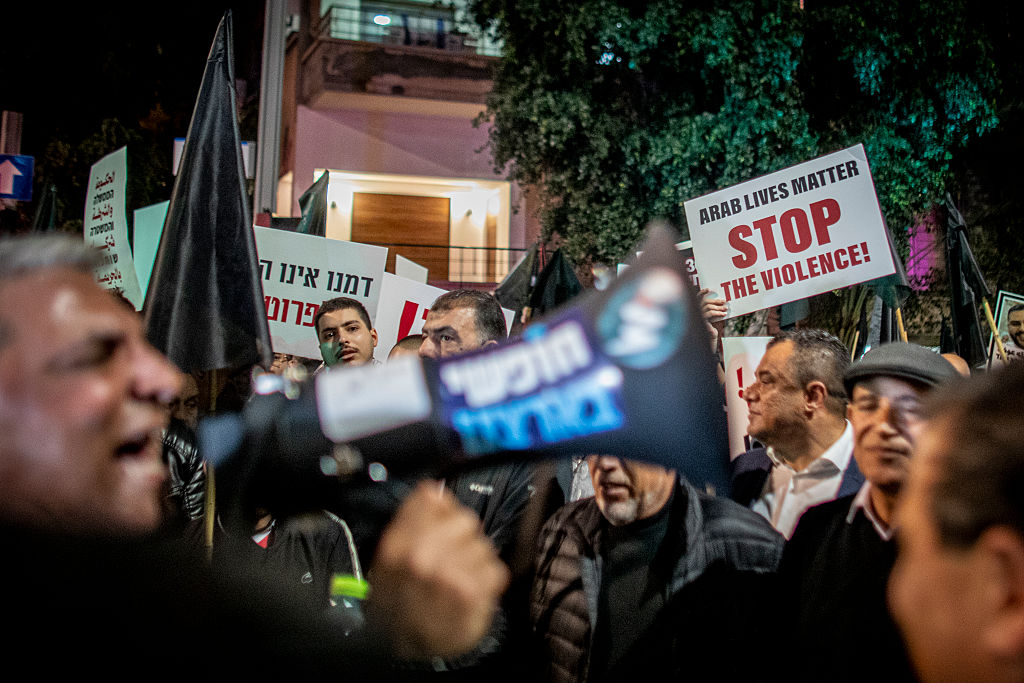
About 20% of Israeli citizens are Palestinian. They suffer from overtly discriminatory government policies and casual racism in everyday encounters. Most belong to the struggling working class, largely because government policies deprive their schools of funding and their communities of basic amenities; but a notable minority have achieved professional success in fields like medicine, law, media and the arts. About half the pharmacists in Israel are Palestinian citizens, as are just over a quarter of the physicians. Two of Israel’s best-known television news personalities are Palestinian. And Yousef Haddad is not the only Palestinian who volunteered for military service. Ella Waweya, a Muslim woman, is a lieutenant colonel who heads the Arabic desk of the Israeli military spokesperson’s unit. The Israeli government points to her as an illustration of the country’s purported tolerance and diversity, but in the Arabic-speaking world she has come under heavy criticism for her authoritarian attitude toward the media.
But even for the most assimilated Arab citizens of Israel, whether they identify as Palestinian or not, ugly discrimination is an ever-present reality. Sometimes it is violent, as seen during the terrifying explosion of rioting in May 2021. But mostly it is expressed in policies that act to marginalize, silence and humiliate.
A Tel Aviv-based Palestinian documentary filmmaker told me once that she had decided against traveling to Europe for a screening of her latest film because she didn’t have the energy for the humiliating interrogation and physical search at the airport. A gay Palestinian man who lives in Tel Aviv with his Jewish husband told me that they had to travel abroad to have a child because Israeli law doesn’t permit a Jewish surrogate to carry the baby of a Palestinian parent. A prominent Bedouin academic and civil society activist turned down an invitation to speak at a pro-democracy demonstration because the purportedly liberal organizers told her she couldn’t speak about Palestine.
Recently, I looked up a video clip from a 2014 television talk show episode that was co-hosted by Lucy Aharish, a Palestinian journalist married to a well-known Jewish actor. She has been a prominent figure in Israeli media for years and now hosts her own television program. In that 2014 episode, she sits on a panel next to Bentzi Gopstein, a notorious follower of Meir Kahane, the American-born rabbi and Israeli politician who preached ethnic cleansing of Palestinians from the territories under Israel’s control. After listening to Gopstein deliver a racist monologue, Aharish asks him how they are different. Aren’t they both children of God with two legs and a heart? We’re not different in that respect, answers Gopstein. But this country is for Jews, and you have 22 other countries to live in. “So I’m not supposed to be here?” asks Aharish. Without hesitation, Gopstein looks at her and answers, on live television: “No. You’re not supposed to be here.” Aharish looks devastated.
The culture of suspicion and discrimination toward Arab citizens became toxic during the first few months after Oct. 7 and the early days of the Gaza war. It’s fair to say that the Israeli domestic security forces were hunting Palestinian citizens. Social media posts that expressed something as anodyne as a hope for peace led to the expulsion of Palestinian students from universities, the arrest of Palestinian school teachers and even, in one incident, of a hairdresser who posted about grieving over dead children in Gaza. Video shows her trembling with fear and crying as police officers place handcuffs on her wrists and blindfold her like a political prisoner in the occupied territories.
At least one physician was fired from his hospital job for posting a prayer for peace on his Facebook wall, while a prominent professor at the Hebrew University of Jerusalem’s law school was arrested and hounded out of her tenured academic position for signing a petition that described Israel’s actions in Gaza as genocide. The fear these incidents engendered was so powerful that a Palestinian journalist friend who was once proud of voicing strong opinions as a guest analyst on Israeli television now told me he was, for the first time in his life, afraid to write for publication, let alone speak to the media.
The discrimination against Arab citizens extends to those who do not identify as Palestinian. In November 2023 Ynet, a widely-read Hebrew news platform with a centrist editorial position, published an article about a Druze officer in the Israeli military who said he received two government notices on Oct. 7, 2023; one was a call-up for active service in Gaza, and the other was a demolition order for his house, which he’d been forced to build without a permit because of a law that places impossible limitations on expanding residential housing in Israel’s Arab-majority areas. Another non-Palestinian group of Israeli citizens is Lebanese Maronites who served in the South Lebanon Army, Israel’s proxy military force in Lebanon. Many of them moved to Israel in 2000, after the Israeli military ended its 18-year occupation of southern Lebanon, fearing that Hezbollah would take revenge on them for collaborating with the Israelis. They now find themselves living in social isolation, rejected by Israeli Jews because they are Arab and by Palestinians for the role they played in supporting Israel’s occupation of southern Lebanon.
Despite substantial evidence to the contrary, there are still many Palestinian citizens who believe that the path toward improving their position in Israeli society is through the political establishment. Mansour Abbas, a politician who heads the Islamist United Arab List, is currently making headlines, in Israel and abroad, for his willingness to divest his party’s manifesto of Palestinian national aspirations, in exchange for a place at the political table. As Israel heads into a national election on Oct. 28, polling shows that both Netanyahu’s governing coalition and the Jewish-Zionist opposition parties are a few mandates short of the necessary 61-seat majority in Israel’s parliament, or Knesset. As political scientist Rida Abu Rass explains in his latest analysis for New Lines, Abbas can bring the mandates to break the stalemate, but even the liberal Zionist opposition parties have said they are opposed to forming a governing coalition with the Arab parties — even if that is the only means to achieve their goal of ousting Netanyahu from power.
Israeli society is very unstable these days. The endless wars, the post-Oct. 7 trauma, the political polarization, the politics of grievance, the astronomical cost of living, the spiking anti-Arab rhetoric and the fiscal corruption combine to make a toxic brew. A significant number of Israeli Jews have responded to the toxicity with “soft” emigration, trying life abroad for a couple of years while maintaining their homes in Israel; two years becomes five, and soon they have de facto decided not to return. There are similar trends among Palestinian citizens of Israel, particularly those anxious to escape the unchecked violence of criminal gangs that have taken over many Arab towns. As in the case of Jewish emigrants, it’s the younger and highly educated Palestinian citizens with mobile professions who are in a position to try life abroad. In interviews, they all say that, although leaving their friends and family is almost unbearable, so is the feeling that Israel’s future is at best uncertain and definitely not a good bet, whatever people like Mansour Abbas and Yousef Haddad might say.
“Spotlight” is a newsletter about underreported cultural trends and news from around the world, emailed to subscribers twice a week. Sign up here.