


Abu Mahmud’s grandson sits beside a rudimentary electric heater. The device crackles in a room lit by LED bulbs. Abu Mahmud, 60, lives in Palmyra, a city that symbolizes the height of the Islamic State group’s power. In 2015, the group seized the city at the peak of its military strength in Syria. It controlled Palmyra for nearly 10 months, destroying ancient sites and using the ruins for mass executions before being driven out.
Abu Mahmud left the area when he realized the Islamic State fighters were only 30 miles away. “I was afraid for my two daughters,” he says quietly. Surrounding the city is the Syrian Badiya, a vast desert expanse stretching across nearly half the country. It is an area with no clear boundary, extending from Homs to Deir ez-Zor and toward the Iraqi border, where the Islamic State found refuge as early as 2014. Officially defeated in 2018, the group has never left the area.
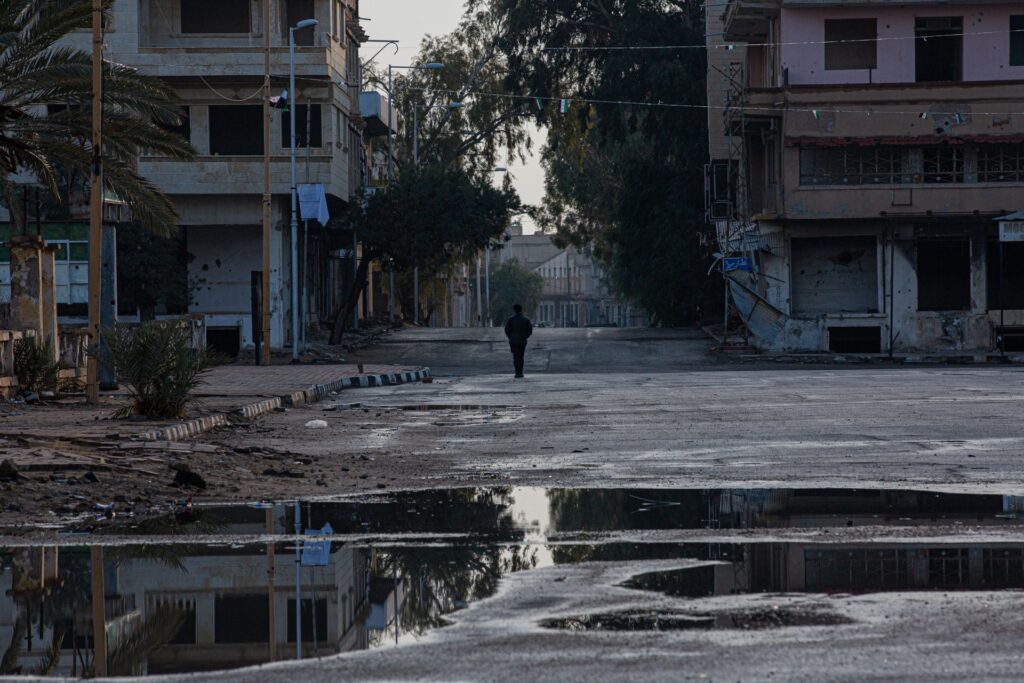
“With the Islamic State, it’s very complicated,” Abu Mahmud explains. “We have no experience to know who they are. They can be hiding in the mountains, or living among us.” He says he never suspects his neighbors. “We all come from tribes. Before 2014, we knew each other. After that, there were foreigners — people who came to look for work, to sell coffee.” Then he sums it up in a single sentence: “They exist, but they don’t exist. You don’t see them.”
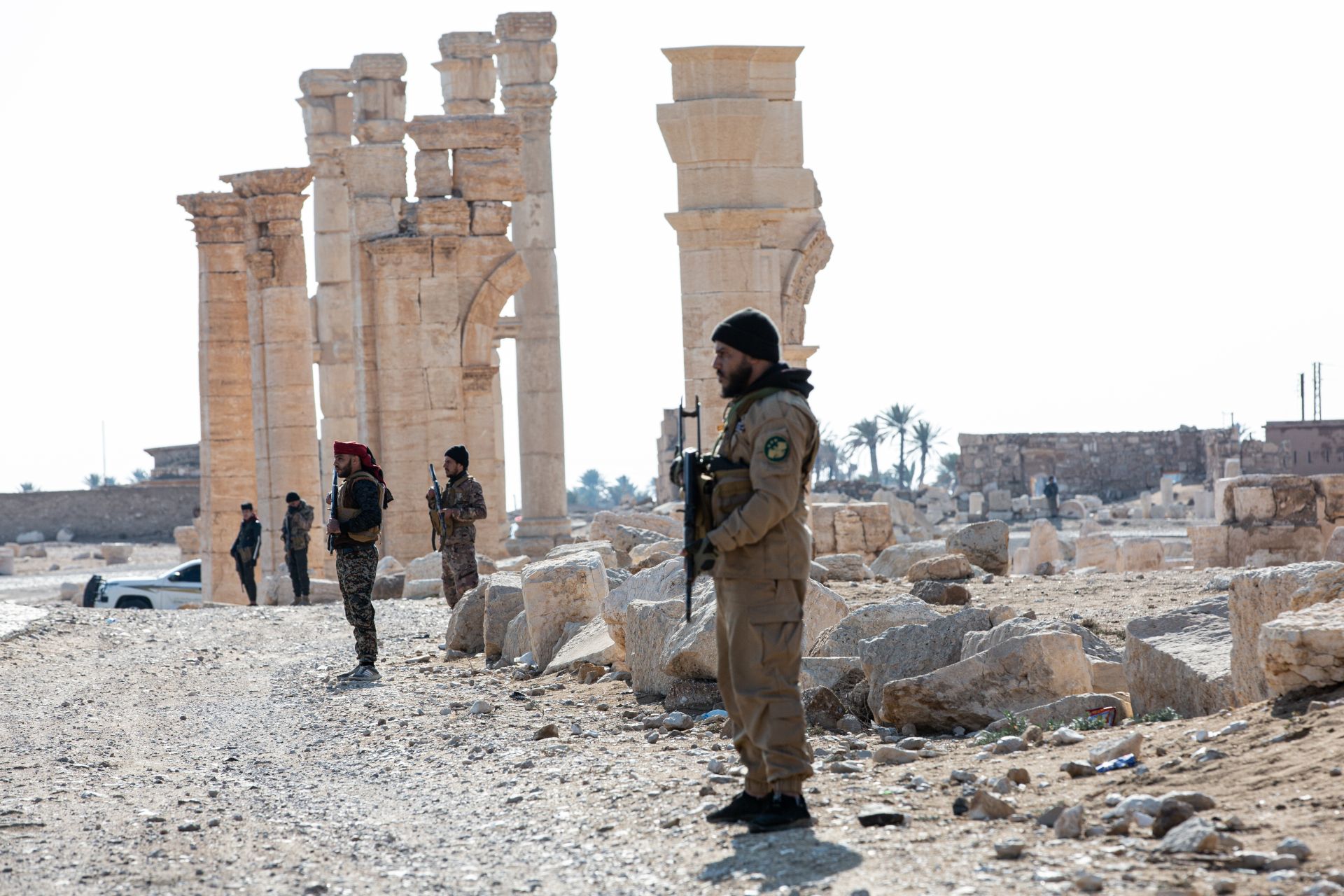
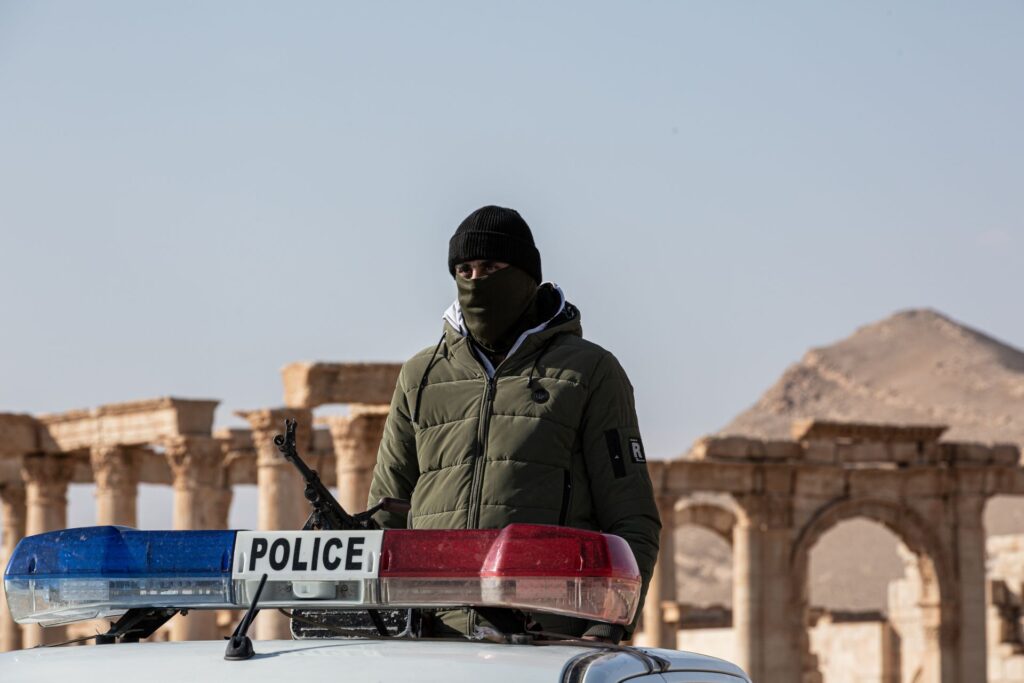
In Palmyra, this invisible threat took concrete form three days earlier, at the heart of a site presented as inviolable. A high black wall surrounds the entrance. Armed guards, ready to fire, monitor access. The base is located in the center of Palmyra.
Inside, a large tent serves as a reception lounge, a space arranged for meetings and official visits. It was in this place — described as “the safest in Palmyra” by Abu Mohamed, 27, one of the soldiers present — that two U.S. soldiers and a civilian interpreter were killed on Dec. 13. Members of the Syrian forces were also wounded, some later succumbing to their injuries. The man who opened fire was wearing the uniform of the Syrian security forces. He was killed on the spot in the ensuing exchange of gunfire.
Abu Hussein, the black-bearded commander of Syrian security forces operations in the Badiya, oversees nearly 4,000 men tasked, in particular, with hunting down the Islamic State, which he describes as the “main security threat.” When I meet him on Dec. 16, he is seated in the tent where the attack took place. He acknowledges a major failure: The attacker was integrated into the security forces and embraced a jihadist ideology. That day, a coordination meeting between Syrian forces and U.S. officers to track the Islamic State was being held on-site. The attack occurred just a few yards away. It is the first such incident reported since President Ahmad al-Sharaa came to power, following the fall of Bashar al-Assad.
“A guard from the new Syrian security forces opened fire, shouting, ‘God is great, infidels,’” Abu Hussein says.

Formed in haste after the fall of the Assad regime, these forces began to structure themselves in December 2024, when the new Syrian administration negotiated the dissolution of most rebel factions and their integration under the authority of the Ministry of Defense. The forces remain a heterogeneous ensemble, with loyalties that are still fragile. A sense of discomfort surfaces when Abu Hussein speaks about the incident.
“If we had known he had an Islamic State mindset beforehand, we would have acted,” the commander says. His version contradicts that of the Syrian Interior Ministry spokesperson, Noureddine al-Baba, who stated on Syrian television that authorities had “decided to dismiss” the perpetrator before the attack due to his “extremist Islamist ideas,” with the dismissal scheduled for Dec. 14.
“Screening procedures exist, but they take time,” the commander says. The investigation has yet to determine whether this was an isolated act or a coordinated one.
“The Islamic State has decentralized its operations at the cell level. In northeastern Syria, it has shifted to a guerrilla mode, relying on largely autonomous actions, sometimes carried out by isolated individuals with no direct link to the leadership. In major cities, cells are rebuilding independently,” says Arthur Quesnay, a political science researcher affiliated with Paris 1 Pantheon-Sorbonne University and co-author of “Syria: Anatomy of a Civil War.”
The attack comes as Syria’s new authorities are seeking to demonstrate their ability to secure the country. Until recently, the fight against the Islamic State was primarily embodied, for Washington, by the Syrian Democratic Forces (SDF), a Kurdish-led coalition backed by the United States and based in eastern and northeastern Syria, where Kurdish authorities exercise de facto autonomy — despite Damascus’ stated desire to reunify the territory — amid negotiations that are now stalled.
Damascus’ announcement that it is joining the U.S.-led international coalition against the Islamic State — becoming its 90th member — marks a political turning point. It positions al-Sharaa, a former jihadist who has since renounced that path, as a credible partner for Washington on this issue.
This move fits into the campaign al-Sharaa has led against the Islamic State since 2016, when his former organization, Hayat Tahrir al-Sham (HTS), took control of Idlib province in northwestern Syria. In its weekly newspaper Al-Naba, the Islamic State has since portrayed al-Sharaa as an “apostate” and a traitor — and depicted him as a puppet of the U.S. and Israel.
For Hosam Jazmati, a researcher and specialist on jihadist movements, “there may be other profiles similar to that of the attacker, hostile to rapprochement with the West and to the cooperation underway against the Islamic State.” He adds that the “objective of returning to territorial domination still exists, but it remains unrealistic.”
Washington and Damascus attributed the attack to the Islamic State. After the Palmyra attack, U.S. President Donald Trump promised a “very serious response” against the group, calling the assault a terrorist attack, while asserting that it was not directly linked to the Syrian government.
Seated on the benches inside the tent, soldiers show videos of recent operations: seven arrests in two days following the incident. The fight against the Islamic State has become a battle for legitimacy between Damascus and the SDF. Despite an October ceasefire, clashes between the two sides have continued, especially around Aleppo, highlighting deepening tensions over authority and stalled integration agreements, as fears of further escalation persist.
Night falls. Gunfire echoes near the bunker. No details are given. “Those who want to rebuild Syria are more numerous,” Abu Hussein concludes, “but the Islamic State can have a devastating effect, even in small numbers.”
According to a United Nations report published in January 2024, the Islamic State’s ranks fell from 20,000-30,000 fighters in 2018 to around 3,000-5,000 today, while remaining capable of carrying out sporadic attacks.
The hunt for the group relies on complex coordination among dispersed forces and on intelligence that is sometimes rudimentary. Weapons caches are often concealed in rocky outcrops, and some areas remain heavily mined, slowing movement and complicating pursuit.
“Information can come from a shepherd,” the commander explains. He says security services track a large share of Islamic State activity in the region in real time, claiming they are able to monitor at least 70% of its movements thanks to a network of informants. But this capability does not rule out isolated attacks. “A single Islamic State fighter can be enough to destabilize an entire area,” says Abu Malek, a Syrian soldier involved in tracking operations. Security services distinguish between “hot targets,” to be neutralized quickly, and “cold targets,” monitored over time. “After the liberation, it was calm. Over the past four months, we’ve observed a resurgence of activity.”
For many of these soldiers, this war is not new — it has simply changed its face.
Abu Ossama, 35, covers his face out of fear of becoming a target for the Islamic State. Originally from the mountainous Qalamoun region northeast of Damascus, he fought the group in 2015. A former member of the Free Syrian Army, created in 2011 by defectors from Assad’s army, he has seen the war evolve. “Before, they attacked head-on and you had to defend yourself. Today, they appear, then disappear.” For him, the country’s stability depends on the Islamic State’s total elimination. He lost friends in Homs during particularly deadly fighting in 2015. When it comes to the attack, he remains evasive. The soldiers avoid the subject. No one speaks of the guard they saw every day.
In the city, the struggle is not fought solely on the military front. At the entrance to Palmyra, ancient columns rise from the sand. An inscription reads “Tadmor,” the Arabic name of the city, which is also nicknamed “the bride of the desert.” Among the ruins, Hussam al-Khatib, 48, a teacher from Palmyra, has come with about 20 children. A Muslim, he fled the city in 2015, when the Islamic State seized it, and returned after the fall of the Assad regime.
When he speaks of the destruction of the archaeological site by the group, his eyes redden. “I saw smoke rising from the site. It was as if it were coming from my heart.” Before leaving, he had come to say goodbye to the ancient stones. During his exile, he continued to teach his displaced students about Palmyra. On his phone, he shows a 3D reconstruction of the city.
“I’m not worried about the military fight,” he says. “It’s the ideology that worries me.” It is to fight that ideology that he brings the children to the amphitheater that once served as a site of public executions under the Islamic State, to record a song. Outside the site, security forces check vehicles. Checkpoints, patrols and cameras blanket the roads leading into the desert.
The group has not claimed responsibility for the Dec. 13 attack. But on Friday evening, Dec. 19, Trump’s promise was fulfilled. The U.S. carried out airstrikes in Syria in response to the Palmyra attack. Washington says it targeted positions linked to the Islamic State. According to U.S. Central Command (Centcom), more than 70 targets were hit, including weapons depots, with the support of Jordanian aircraft. “U.S. forces and partners killed or captured nearly 25 ISIS operatives in Syria over nine days in late December,” Centcom said.
U.S. Defense Secretary Pete Hegseth described the strikes as a “direct response” to the Palmyra attack, signaling Washington’s determination to continue operations against the Islamic State. “Today we hunted down and killed enemies. Many enemies. And we will continue.”
For Quesnay, the American military response is far from effective: “U.S. strikes against ISIS today are driven more by communication aimed at American public opinion than by military effectiveness. Bombing fragmented groups with no clear chain of command repeats Afghan-era patterns that have already shown their limits. The operational impact is limited, but the political cost is likely to be high for the Syrian government, which must now justify this American interference.”
On Jan. 4, French and British forces also carried out joint airstrikes targeting an underground facility suspected of storing weapons linked to the Islamic State near Palmyra, framing the operation as part of ongoing international efforts against the group.
“If the objective is truly to contain the Islamic State, the response cannot be aerial and disconnected from the ground. It requires supporting local actors capable of operating in close contact with populations,” Quesnay says. That includes groups such as HTS that now form the backbone of the new Syrian security forces under al-Sharaa — providing them with intelligence, allowing them to carry out security operations, and minimizing Western military visibility, which can fuel anti-Western sentiment, as much as possible, Quesnay adds.
“Spotlight” is a newsletter about underreported cultural trends and news from around the world, emailed to subscribers twice a week. Sign up here.