

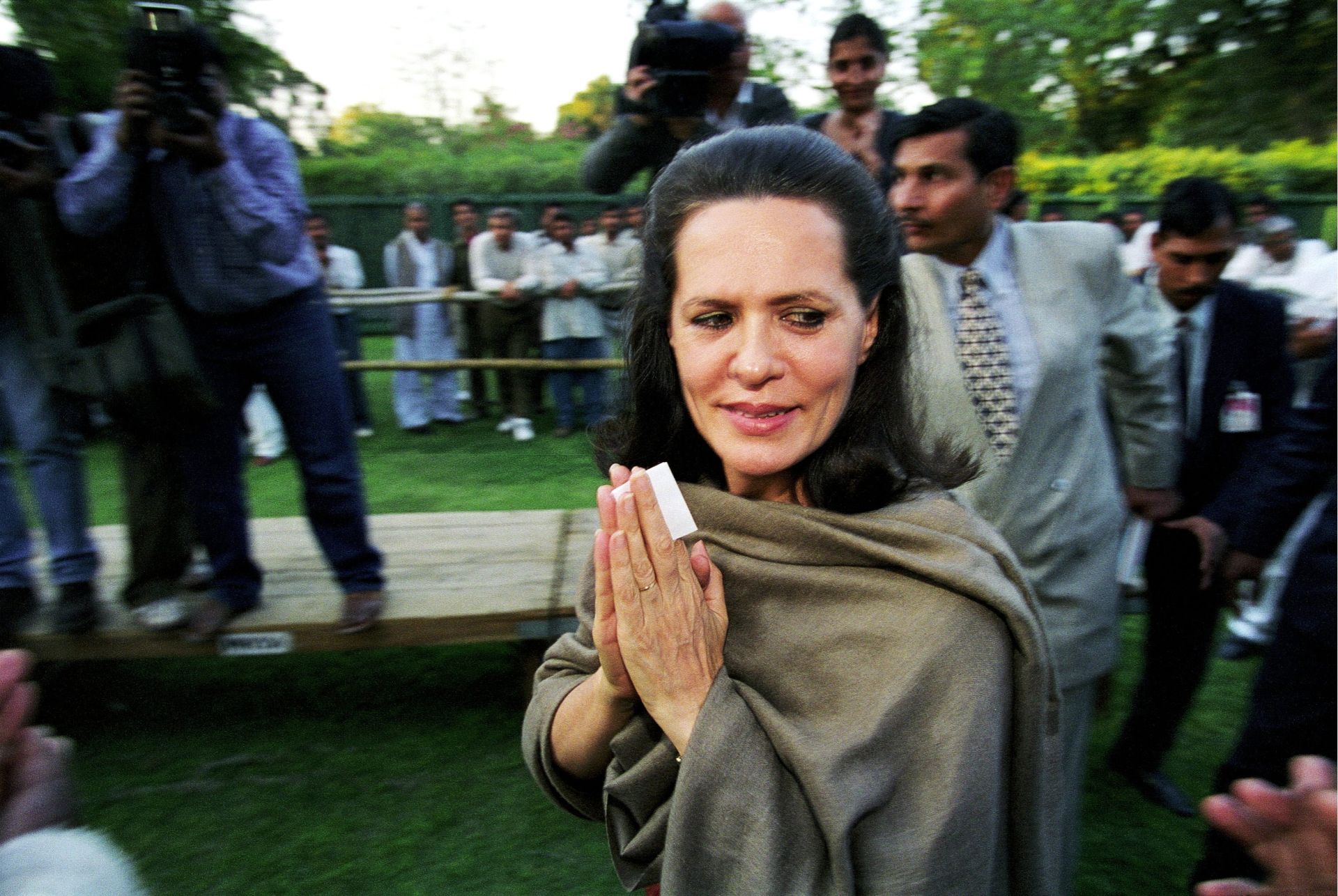
Unlike their American counterparts, few Indian politicians have chronicled their own lives through memoirs. So when New York-based publisher Alfred A. Knopf announced it would publish Sonia Gandhi’s “Belonging: A Story of Love,” out on Nov. 10, the news created a stir in India. And when The Indian Express reported that Penguin Random House India, Knopf’s sister company, would not publish the Indian edition, it came as a rude shock to all.
The dispute was over some “editorial changes and deletions” that were turned down by Gandhi. Since then, a back-and-forth of news reports and official Penguin India statements has widened the controversy. The Hindustan Times reported that the cuts pertained to Gandhi’s impressions of Prime Minister Narendra Modi from official meetings, his handling of India-China ties and the activities of Rashtriya Swayamsevak Sangh (RSS), the fountainhead of Hindu nationalism. Gandhi also weighed in on Modi calling her a “Jersey cow” at a 2004 rally, and compared him to other Indian prime ministers. Gandhi’s aides called it the most definitive account of her life, with a concluding section laying out her views on where Indian politics is headed.
In its most recent statement, Penguin India, also the publisher of multiple books by Modi, said there was no “external pressure” behind its decision. HarperCollins India, Penguin’s rival, will publish the Indian edition.
The intense outrage that followed led many to dub the publisher “Chicken India.” Graphics depicting the penguin from the publisher’s logo in RSS uniform — a white shirt with khaki shorts — also circulated online. Commentators pointed to a pattern of Penguin India dropping books critical of Hindu nationalism and the Modi government. Arpita Das, founding publisher of the independent Yoda Press, called it “the insidious phenomenon of large publishing houses self-censoring in anticipation of a crackdown from those in power.”
In June, before the controversy over Gandhi’s book, Penguin India dropped cartoonist-journalist Joe Sacco’s “The Once and Future Riot,” on the 2013 Muzaffarnagar riots that led to multiple deaths and mass displacement right before Modi assumed power. The publisher cited a map of India with “inaccurate boundaries” as the issue, but Sacco told The Wire that Penguin was looking for “excuses” to pull out of the project dealing with communal violence.
Sacco was issued a five-page list of changes, corrections and requirements, he said, some of which struck him as onerous. He called it “embarrassing” that the publisher didn’t want to distribute a book “because of the current political climate in India.” It will now be released by LeftWord Books, an independent, left-leaning publisher in Delhi.
Before Sacco’s book, another Penguin India title set off a political controversy. Former Indian army chief Gen. M.M. Naravane’s memoir, “Four Stars of Destiny,” was scheduled for an early 2024 release, but has been stuck in clearance with the Ministry of Defence.
In February, opposition leader Rahul Gandhi tried to read excerpts from the book manuscript, published by The Caravan magazine in an essay, in Parliament. They recounted the night of Aug. 31, 2020, during the India-China border standoff, when Naravane was making multiple frantic calls to India’s political establishment, asking for orders.
For a long time, the magazine reported, none came, until the defense minister, Rajnath Singh, relayed Modi’s instructions, consisting of a single sentence: “Do whatever you deem appropriate.” The episode, the magazine said, raised questions about the country’s national security because, in India’s political system, the decision to go to war belongs to the country’s democratically elected leaders. The book is still awaiting clearance from the ministry.
This is not all. Two more politically sensitive books were earlier dropped by Penguin India. Last year, author Dhirendra K. Jha told The Wire that his biography of former RSS chief M.S. Golwalkar had originally been slated for publication by the publisher but fell through after he submitted the manuscript.
Earlier in 2014, Penguin India canceled its contract as publisher of Wendy Doniger’s “The Hindus: An Alternative History” and pulped all existing copies in an out-of-court settlement with an RSS-affiliated group, after a four-year legal battle. The book was later published by Speaking Tiger, an Indian independent publisher.
In the 12 years of Modi’s regime, journalists and writers in India have faced mounting legal pressure and physical threats that publishers have largely been spared. Publishing insiders and authors sometimes say, only half in jest, that books require closer, slower reading than a news report or social media post, which manufacture quick outrage.
But Penguin India’s recent handling of politically sensitive books, including Gandhi’s memoir, shows that scrutiny is reaching books preemptively, without any legal apparatus. In today’s India, a publisher like Penguin India would rather give up on a potential bestseller, arguably the book of the decade, than deal with the fallout of publishing it.