


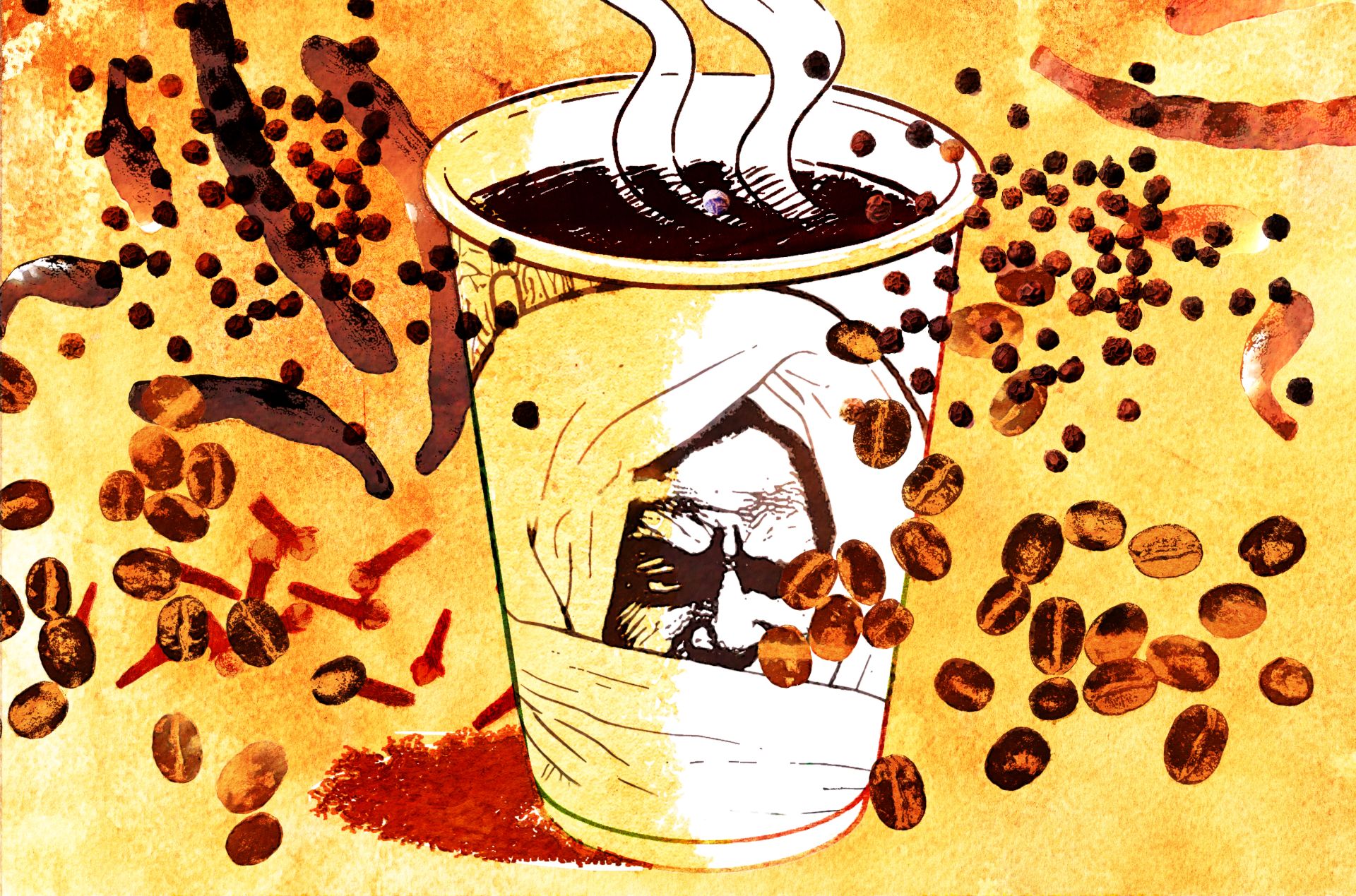
You could sample every concoction on the Starbucks menu. You could drink your way around the world’s coffee capitals: Addis Ababa, Rome, Seoul and Istanbul. You could buy a fancy espresso machine, learn to brew Vietnamese coffee or even experiment with a French press at home. And still, after all that, cafe Touba would taste like nothing you’ve ever had.
It’s a potent, spicy beverage sold on seemingly every street corner in Senegal. Local vendors tend to kettles, boiling water over charcoal fires on the sidewalk, where they ladle out the peppery, milkless coffee to customers for as little as 100 West African CFA francs — about 18 cents — a cup.
That spiciness, which defines cafe Touba’s flavor, comes from its signature ingredient: grains of Selim, also known as guinea peppers, the fruit of the evergreen tree Xylopia aethiopica. And the person who first thought to sprinkle grains of this aromatic African spice into black coffee was an Islamic saint, poet and nonviolent resister to French colonial rule — and, more or less by accident, a barista — named Sheikh Amadou Bamba. Bamba was and is still incredibly influential throughout Senegal. He founded one of the nation’s most prominent spiritual orders, the Mouride brotherhood, in 1883, as well as the holy city of Touba in 1887, and galvanized his followers to peacefully oppose their French colonizers. For his efforts, the French sent Bamba into exile — first to Gabon in 1895, then to Mauritania seven years later.
Exiled to a French-surveilled church on the Gabonese coast, Bamba discovered grains of Selim. When he wasn’t praying or meditating, the sheikh was apparently conducting his own experiments in gastronomy. Roasting the grains with his coffee, he found, boosted his alertness and stamina. This meant that he could write, meditate and stay in conversation with God longer.
When Bamba finally returned to Senegal, he brought this recipe back with him. For nearly a century, the spiced coffee stayed within Bamba’s Mouride brotherhood, a Sufi order based in the holy city of Touba. So cafe Touba was, for the majority of its existence, a drink used by the devout as fuel for prayer.
But that changed in 2008. The global financial crisis drove up the price of imported coffee across Senegal, which pushed people toward cafe Touba as a local, cheaper alternative. This mainstreamed the coffee so much so that, today, the entire country is hooked; an estimated 2 out of every 3 Senegalese reportedly drink it.
It has become so popular, in fact, that foreign multinational coffee companies have seen a drop in sales in Senegal. For many years, Nescafe — owned by the Swiss giant Nestle — ruled the West African coffee market without much resistance. Then cafe Touba showed up and undercut that hierarchy. Vendors across the country began brewing the cheaper, spiritually connoted, supposedly medicinal Bamba-branded coffee. Young people even took to the streets with thermoses and stacks of paper cups, essentially turning sidewalks into makeshift cafes. Suddenly, Nescafe, a brand long criticized by nongovernmental organizations as being neocolonial, with allegations in the press of slavery-like conditions on its farms abroad, was facing its fiercest competition ever in West Africa.
“Cafe Touba is an African drink,” Ousmane, a 27-year-old cafe Touba vendor, told me. “It’s our thing. Nescafe isn’t because Nescafe comes from Europe, not here. Not Africa.”
I first tasted cafe Touba on a busy street corner in Dakar. I’d stopped at one of the thousands of little “tangana” kiosks that dot the capital, where a vendor was tending to a dented, steaming pot. It sat atop a plywood counter facing the traffic, alongside a stack of small paper cups, a container of granulated sugar and a tin can of francs.
I handed over 100 francs (equivalent to about 18 cents). The man plucked the coin from my palm, opened his cauldron and then began ladling what appeared to be black coffee into a miniature paper cup. Then he began pouring the liquid to and fro, from cup to ladle, ladle back to cup, cup to ladle, ladle to cup. He did this several times, lifting a bit higher with each pour to aerate the drink.
Most vendors brew it with robusta beans imported from the Ivory Coast, which is a coffee juggernaut in terms of production and exports. I learned that the vast majority of vendors buy these beans in bulk from local markets, along with grains of Selim (which locals call “djar”) and cloves. A good cafe Touba vendor will buy these ingredients separately, then roast them together over a fire.
What’s so striking about cafe Touba is how unassuming it is. Nothing is branded, not even the cups. There isn’t really any pageantry, at least not the way there is in Ethiopian coffee ceremonies or Japanese pour-over rituals. And unlike the ultracommercialized coffee culture in Europe and North America, cafe Touba isn’t promoted via elaborate marketing campaigns or online advertisements. Had I not been tipped off to it by someone in the know, it’s possible I would’ve walked right past the unmarked roadside vendors without ever tasting what was simmering in their mysterious pots.
The drink is brewed, sold and drunk right on Dakar’s dusty, traffic-choked streets, which may explain, at least in part, why my first sip of cafe Touba caught me so off guard.
It was a spicy, almost violent barrage of the tongue. “Damn!” I gasped, immediately hit with the zing from the grains of Selim. What I’d just tasted was no ordinary, run-of-the-mill coffee. I took another sip — my God, it was delicious, unlike anything I’d ever had before. (High praise from a hopeless coffee addict.) A few gulps later, and my tiny cup of cafe Touba was empty. I turned back to the man with the big steaming pot of the stuff and asked for a refill. He smirked as he dipped his ladle back in, as if amused by the fact that I’d just discovered what is, at its heart, Senegal in a paper cup.
Senegal, and specifically Dakar, used to be the colonial capital of French West Africa. It was a strategic, exploitative, moneymaking outpost that facilitated the export of peanuts and coffee beans and even enslaved people to Europe and North America. Sheikh Amadou Bamba posed a danger to that outpost and, more broadly, the French grip on Senegal.
Macodou Fall, a Senegalese research associate at the University of Florida, told New Lines that the French occupation felt threatened by Senegal’s Sufi brotherhoods, which have historically acted as an organizing force and what scholars call a moral anchor within Senegalese society. The Mouride Sufi order in particular, which was founded by Bamba, emerged as a powerful alternative source of authority during a time of social and political crisis. Fall explained that as the Wolof kingdoms collapsed under colonial rule, the authority of traditional chiefs was undermined. What followed was a power vacuum that Bamba filled in a way the colonial authorities could not. He consolidated a mosaic of diverse followers that spanned the socioeconomic spectrum, from former rulers to low-caste peasants. This gave Bamba powerful influence that, as Fall said, “shook social and political order and undermined both colonial authority and the authority of local chiefs.”
“So, it was not armed resistance that alarmed the French per se, but Bamba’s ability to reorganize society outside colonial control,” Fall explained. “For instance, his disciples often migrated en masse under the direction of senior Mourides, and this contributed to reducing the taxes they had to pay to local chiefs and weakened the colonial administrative system that also relied on those taxes.”
Though Senegal was under the thumb of European occupiers, the Mourides refused to recognize any authority above Bamba, including European authority. Fall says this made Bamba “appear in the eyes of the French as a unifying figure capable of instigating large scale opposition.” Or, in other words, someone capable of mounting a rebellion.
It disturbed the French. So in 1895, they accused the sheikh of conspiring to launch an armed jihad against them. Macodou points out that Mouride sources refute that accusation. Bamba’s writings explicitly emphasize the jihad against the soul, which means “the greater jihad that is understood as the struggle to shield the soul from pride and worldly pleasure.”
Whether or not the French understood the nuance of jihad as a theological concept was beside the point. They wanted him gone, and waging a jihad — any kind of jihad — was enough of an excuse to do away with the subversive sheikh. And so on those grounds, he was deported to Gabon.
The French told Bamba he couldn’t pray on board the ship on which he was being banished. The sheikh responded, as legend has it, by hurling himself and his prayer rug overboard and praying atop the swells of the Atlantic Ocean.
Whether or not that really happened is up to the Mourides to decide. What is certain, though, is the defining role Bamba’s exile played in sculpting Mouride theology. Like the tale of Bamba riding the waves in an act of defiant prayer against his oppressors, the sheikh achieved a larger-than-life, divinely shielded, almost magical aura during his exile. Because the French hoped Gabon would break the sheikh — and because it ultimately didn’t — exile actually sanctified Bamba’s public image. Everything he did while banished, from the poetry he wrote to coffee recipes he invented, is regarded as holy by much of his following.
The French quickly realized that their attempts to suppress the man were actually turning him into a martyr. So, in 1907, they told him he could come back to Senegal for good. He brought the cafe Touba recipe back with him. Because of this “exile effect” described above, cafe Touba was instantly regarded by Bamba’s disciples as a holy drink.
“The most common popular story is that when Bamba returned from exile, he brought coffee with him as a gift for some of his followers,” Fall said. “Since then, Mourides have adopted coffee as a source of baraka, or blessing, because anything tied to Bamba is viewed by many of his followers as blessed.”
Not only has cafe Touba been deified, but it’s also earned a reputation as an “anti-colonial” coffee. It makes sense: Cafe Touba wasn’t introduced by white foreign colonizers, but by a beloved Muslim African saint; it wasn’t spread through colonial cafes or European institutions, but through religious networks and prayer circles; and, in contrast to how Europeans generally drink coffee (for pleasure, for leisure), cafe Touba was used for spiritual stamina. (To this day, when millions of Sufi Muslims travel to the holy city of Touba for the Grand Magal pilgrimage to commemorate Bamba’s exile, they drink cafe Touba as their fuel.)
“The anti-colonial coffee discourse stems from the fact that Mourides view Bamba’s return as a victory over the French. He returned to his people after being exiled,” Fall explained. “The coffee symbolizes Bamba’s return, which itself represents his victory over the French and the failure of the colonial administration.”
Only one known photograph of Bamba exists. It works much as the Starbucks logo does in other parts of the world. Walk past any given streetside tangana in Senegal, and odds are you’ll see the sheikh staring back at you.
Historians think the photo was taken in 1913 or 1914 by a French colonial bureaucrat. The photograph depicts Bamba, under house arrest at the time, wrapped in a white robe with a stoic expression on his half-concealed face — a kind of mug shot. The French could not have known at the time that this bland act of colonial documentation would go on to become legendary African iconography.
Because now, that lone photograph of Bamba is plastered across the whole of Senegal. It hangs in Senegalese homes, is painted on the hulls of fishing boats and appears on sprawling street murals, sharing wall space with Malcolm X, Nelson Mandela, Bob Marley, Muhammad Ali and Martin Luther King. Most conspicuous, though, is that his image is stamped on cafe Touba stands across the country, from Dakar to Saint-Louis to the holy city of Touba.
Bamba’s face acts as unofficial, noncorporatized branding for cafe Touba. This, argues Magatte Faye, the co-founder of the Senegalese coffee company Dialibatou Cafe, adds to the drink’s massive nationwide appeal. “Many consumers see cafe Touba as a product that reflects who they are and where they come from,” he told New Lines.
Cafe Touba has become the lifeblood of Senegal’s busy streets. It’s everywhere. The Senegalese news website seneweb.com described the phenomenon in 2011: “It’s difficult to walk a hundred meters in the streets of Dakar without seeing these vendors crisscrossing the streets, a Malagasy stove tucked under one arm, held by a handle, with a pot full of coffee still heating on top, while the other arm is occupied with a stack of disposable cups.”
Many researchers, including Macodou, say the cafe Touba business is booming today because of unemployment and urban migration. Thousands of farmers and Mourides left their farms and villages in the 1970s after a drought rocked the country’s rural areas. Many of these migrants lacked a French education, which pushed them to the margins of the workforce. What few job options Mouride migrants had were as wage laborers and street vendors.
Then came the 2008 global financial crisis. Across Senegal, prices skyrocketed, including for imported coffee. A 2012 World Bank report titled “Living Through Crises: How the Food, Fuel, and Financial Shocks Affect the Poor” quoted a Senegalese restaurant owner, who said: “Before, you could buy milk and butter, but now it is no longer the case. We weren’t used to consume the Touba coffee for breakfast, but since the crisis people drink it a lot, also children.”
The report went on to say that cafe Touba consumption became “a sort of social phenomenon with vendors distributing it at every street corner.” It was the financial crisis, in other words, that created a coffee vacuum. Those long-marginalized Mouride wage laborers and street vendors filled the hole, as they began ladling out their spicy black coffee on the cheap. It took off. Young women and men in need of income found that, in the wake of 2008, selling cafe Touba on the streets was a relatively lucrative business model, making roughly 5,000 francs (about $9) per day. This took the beverage from relative obscurity to nationwide ubiquity within just a couple of years.
For regular people, cafe Touba has been a good thing. The same cannot be said for multinational corporations, like Nestle. That’s because Nestle’s coffee arm, Nescafe, had long been the top dog in the West African coffee market. Until cafe Touba came on the scene, that is.
Nestle is a controversial company. The Swiss multinational corporation, whose estimated net worth exceeds $240 billion, has been a lightning rod for class-action lawsuits, boycotts and scathing criticism for decades. It’s been implicated in lawsuits for aiding and abetting child slave labor on cocoa farms in West Africa, persuaded the World Water Council to refer to drinking water access as a “need” instead of a “right,” demanded that the Ethiopian government repay $6 million of debt it owed in the throes of a brutal 2002 famine, been involved in union-busting throughout Colombia and accused of fueling widespread illegal deforestation in Ghana and the Ivory Coast via its cocoa farms. All this hardly scratches the surface of the various complaints levied and class-action lawsuits filed against the corporation.
So for a company with the abysmal track record of Nestle to take a financial hit from cafe Touba — a grassroots, informal network of street vendors who sell what was the brainchild of a Muslim anti-colonial Senegalese saint — inevitably invited a colonial vs. anti-colonial narrative. Why buy Nescafe’s expensive imported stuff when, instead, you could buy cafe Touba for a mere fraction of the price? Why buy a foreign European coffee when you could buy a fresh alternative that came from the divine genius of the sheikh? And why buy Nescafe when cafe Touba supposedly relieves pain, fights malaria, induces menstruation, purges pimples and even, as some say, boosts your sex life?
Such were the questions with which Senegalese coffee consumers were posed. And the choice was obvious. Nescafe had to watch its sales keep falling in Senegal as cafe Touba swept the nation. In response, Nescafe unveiled a new product to compete with cafe Touba’s rising popularity: “Nescafe Ginger & Spice.” It was a knockoff of its fiercest competitor; it emulated cafe Touba’s typical 1-to-4 ratio of spice to ground arabica or robusta coffee, and even tried to simulate the peppery gusto of the grains of Selim by making the product spicy.
What Nescafe couldn’t do was match the price. Nor could it live up to its competitor’s reputation as a sacred and medicinal beverage. When I visited the holy city of Touba in January, I made small talk with a woman who spoke English while waiting in line at a cafe Touba vendor’s stall. “Do you ever drink Nescafe’s version of cafe Touba? The ‘Ginger & Spice’ one?” I asked her. She didn’t know what it was, so I Googled it and showed her a photo.
“Oh, that? No,” she shook her head. “It’s gross and expensive.”
This doesn’t mean that Nescafe is obsolete in Senegal. Quite the opposite. What it does mean is Nescafe is no longer the undisputed front-runner in the West African coffee market — not by a long shot. (I reached out to Nescafe’s regional spokesperson, but they didn’t return my email asking for a comment.)
If I stroll into a hipsterized coffee joint in, say, New York, London, Melbourne or Paris, chances are pretty good that I’ll spot Turkish, Vietnamese or Italian coffee on the menu. Odds are slim, however, that cafe Touba will be among the ranks. This raises an obvious question: Why doesn’t cafe Touba have an international reputation the way those coffee variants do?
I asked Magatte Faye that exact question. According to him, cafe Touba has mostly been produced through informal and artisanal channels, sold from pots in the streets or via thermos-wielding youngsters. This, Faye argues, makes it tough, if not impossible, to meet international requirements for certification, traceability, packaging standards and food safety regulations, not to mention access to financing, export infrastructure and structured distribution networks — all of which have been limited for many local producers.
More importantly, Faye says, cafe Touba tells a story. It can’t be shipped across the globe like Folgers or Lavazza — well, technically, it could — but, like any good story, it needs a storyteller. Faye says that without the Mouride lore, the stoic face of Sheikh Bamba or the Senegalese hustlers trying to make a living ladling out the holy brew, cafe Touba’s significance risks being lost on the world.
“But that is gradually changing,” he said, “as Senegalese brands invest in modern production systems and international partnerships to introduce cafe Touba to a wider global audience.” His company, Dialibatou, is trying to do this by refining premium packaging, formal retail and export markets. He hopes to teach a whole new group of global coffee drinkers about Senegalese culture through cafe Touba.
But there’s still a long, long way to go before the world is introduced to the spicy, Sufi mystery that is cafe Touba. For now, it’ll remain as it has been for most of its existence: a delicious secret kept on the streets of Senegal.
Become a member today to receive access to all our paywalled essays and the best of New Lines delivered to your inbox through our newsletters.