



At nightfall on Wednesday, March 4, a bus had just made it across the Lebanese border into Syria when it was surrounded by a crowd of residents. Convinced it was carrying Hezbollah fighters, they began banging on the vehicle.
Videos circulating on social media show that dozens of people gathered around the bus while the passengers remained inside. Syrian authorities quickly denied the rumors: Those on board were civilians returning from Lebanon after passing through security checks.
Tensions along the border appear to have reached a boiling point in the last 24 hours, with the Syrian military reporting that Hezbollah has fired shells into Syrian territory. This comes as many Syrians attempt to return from exile in Lebanon, with memories still fresh of the role that Hezbollah played in their dispossession.
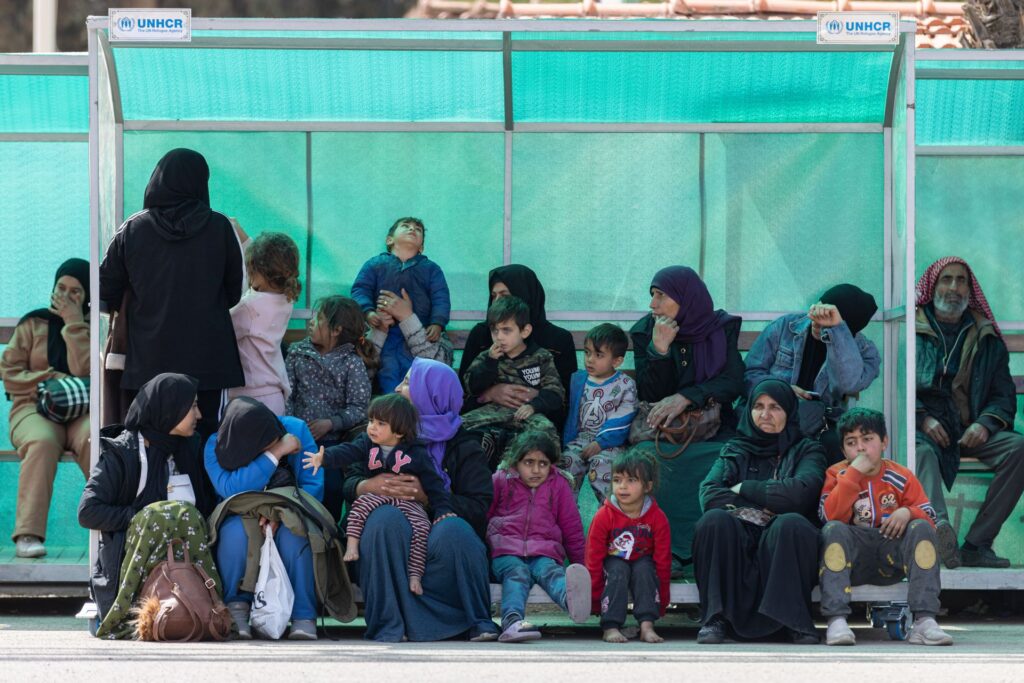
On Friday, Tharwat, 22, sat on the roadside by the Lebanese-Syrian border, feeding a bottle to her 8-month-old son, Khaled. Around them, women competed in making faces to amuse the baby. Tharwat knew this road already — in 2013, she fled Syria for Lebanon as the war spread, settling in Baalbek. Now, she was making the same journey in reverse, with a baby in her arms.
“It’s not the same now,” she said quietly. “When I left before, I was only desperate to reach safety. Now I’m thinking about my child.” She looked down at the baby. “He is the most beautiful thing that has happened to me. That’s why I’m so worried.”
She added quietly, “For many Lebanese in southern Lebanon, Hezbollah is seen as a resistance movement.” She said no more. Most people avoided commenting on Hezbollah and repeated almost in unison: “We are happy to return to Syria.”
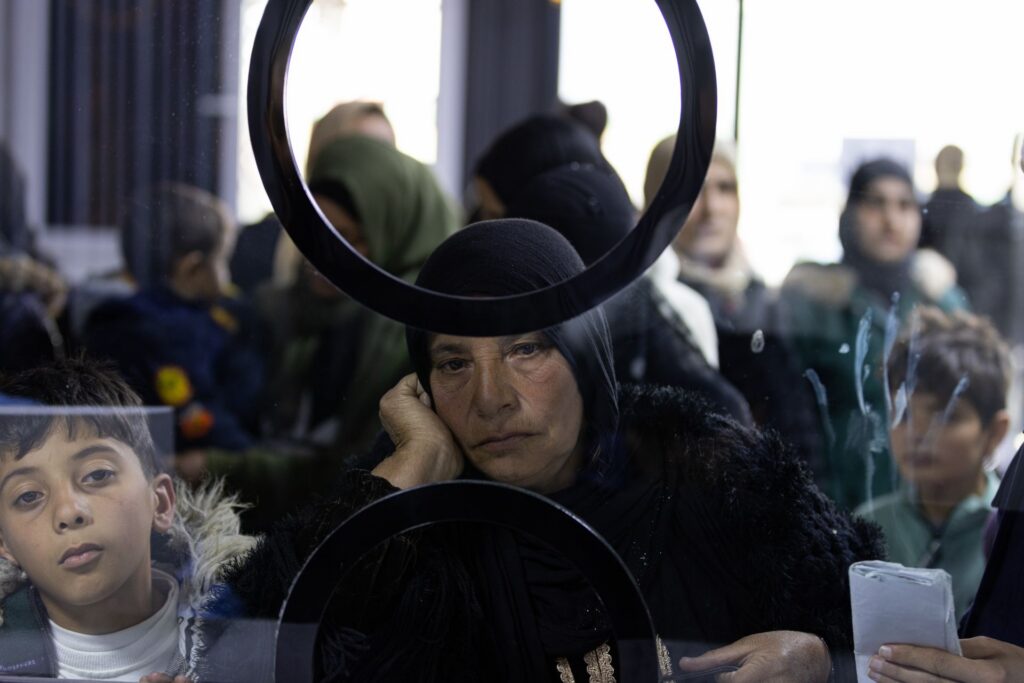
Nearby, Ibrahim, an 18-year-old Syrian mechanic returning from Lebanon, waited with his two sisters, aged 15 and 19. He wore a white sweatshirt. “I left Syria when the civil war began. For me, Lebanon became my home,” he said.
His mother, Fatmeh, looked at her children: “They know nothing about this place. They grew up there. It will take them time to adapt.”
Ibrahim said he was saddened by the death of Hassan Nasrallah, the former leader of Hezbollah, killed a year and a half ago in an Israeli operation.
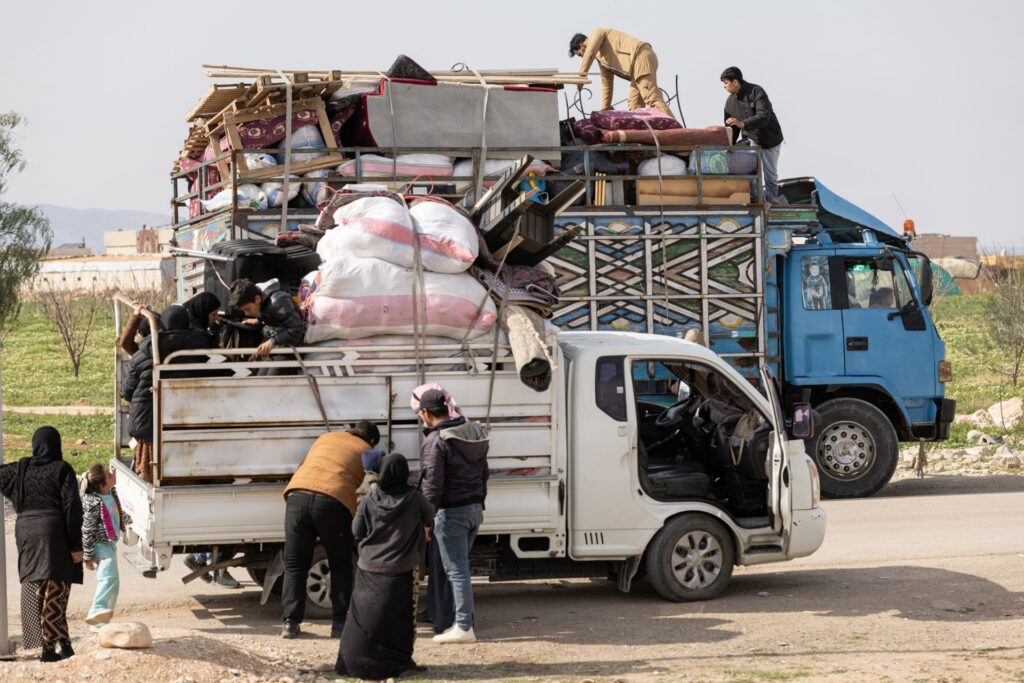
A little further down the road, on the side of the highway, two drivers stood watching the displaced families arrive. Lines began to form. Cars crawled past, carrying what looked like entire homes on their backs: carpets, dismantled sofas, blankets, a birdcage, even a goat tied among the luggage. They had left nothing behind. They were returning to settle.
On Monday, President Ahmad al-Sharaa declared his support for the efforts of the Lebanese military to disarm Hezbollah, his first clear statement on the issue since Bashar al-Assad’s overthrow 15 months ago.
“We coordinated a united position with regional states and strengthened our defensive forces on the border as a precautionary measure to prevent the spillover of the conflict into Syrian territory and to combat transnational organizations and prevent them from using Syrian territory,” he said. “We support the serious measures taken by the governments of Iraq and Lebanon to head off the danger from their countries and prevent a slide toward conflict.”
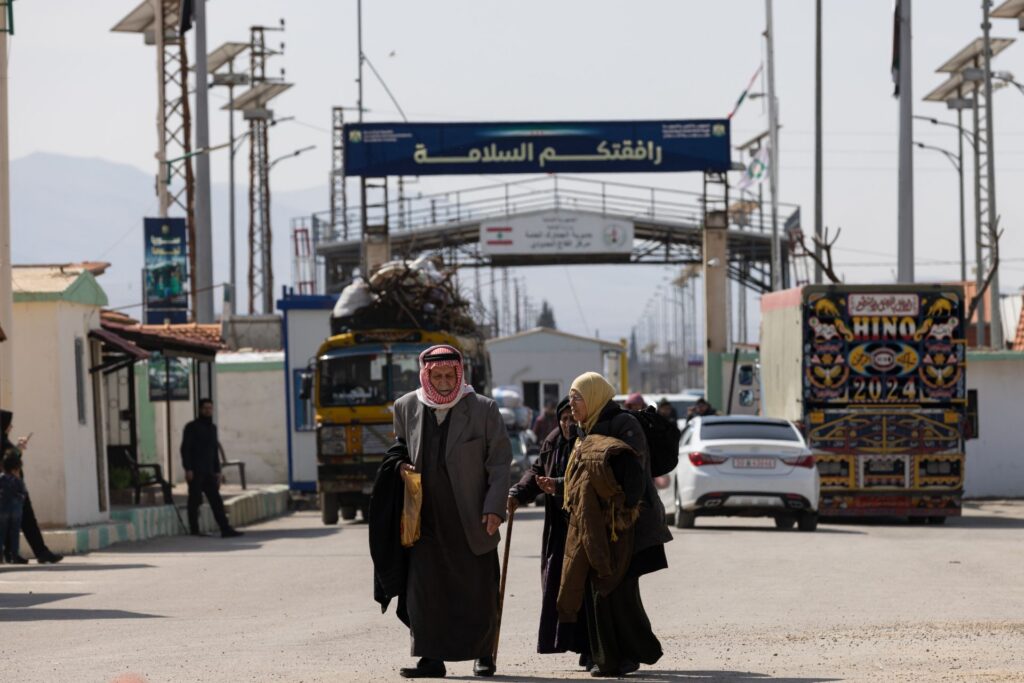
Near the border crossing, Abu Mohammed, 38, took out his phone. On the screen was a video of Syrians fleeing al-Qusayr in 2013, when Hezbollah fought alongside Assad’s forces against Syrian rebels. Below it, another image showed residents of Beirut’s southern suburbs, Hezbollah’s stronghold, fleeing bombardment a few days earlier. Under the video appeared a verse from the Quran about justice: “People of injustice will get their punishment.”
“For us, this is justice. We hope they will live the same suffering we lived here, inshallah [God willing],” he said, raising his eyes toward the sky. “If I find someone from Hezbollah, I will eat him,” he added, baring his teeth.
He said his cousin disappeared in Sednaya Prison after being arrested at a checkpoint controlled by Hezbollah during the Syrian civil war.
Next to him stood his friend Abu Shadi, 58, with green eyes, white hair and a military-style jacket. He shook his head slightly and answered with another verse from the Quran. “The one who forgives is the generous one,” he said.
In this border region, Hezbollah was once everywhere. In 2013, alongside Assad’s forces, the Lebanese Shiite movement played a decisive role in the battle for al-Qusayr against Syrian rebels. For weeks, regime artillery pounded the city before it was retaken in an offensive led by Hezbollah. The fighting drove almost the entire population into exile and left much of the city in ruins, turning the area into a rear base for the group. After the fall of Assad’s regime, the town changed hands again, and some residents began to return — among them, people who had fled after Assad’s collapse.
“They destroyed our schools, our mosques, everything,” Abu Mohammed said. “Of course we feel the desire for revenge.” He was arrested himself in 2012, at a Hezbollah checkpoint, and had to pay a bribe to be released because his identity card stated that he came from Homs and al-Qusayr, which he described as “a bad combination.”
“In al-Qusayr, there was a lot of resistance, so we were branded.”
As Abu Mohammed spoke, he nervously rolled his string of red prayer beads. He quoted al-Sharaa, who has said that people should forgive “when it is possible.”
He repeated the phrase. “Impossible,” he said, smiling.
In the nearby villages, they say several “shabiha” — pro-regime militia members who collaborated with Hezbollah — have been killed. “They slipped on a banana peel, or they poisoned themselves,” Abu Mohammed joked.
According to Abu Mohammed and Abu Shadi, the bus that crossed earlier in the day carried families of those who left the region on Dec. 8, 2024 — the date Assad’s regime fell. One of them is a 44-year-old mother arriving with her 4-year-old daughter, Rose. Her husband is not with them, like many of the families arriving, because the situation in Syria is simply too “unstable,” she said.
“If they come back, they will also slip on a banana peel,” Abu Mohammed said of the men. “Here, they would be dead.”
Similar messages circulate online. In a statement published on March 3 and shared on local social media pages, residents of the village of Akkum, near al-Qusayr on the Lebanese border, warned that anyone hosting families linked to Hezbollah would be “held responsible for what happens next.” The statement called for the “blood of the martyrs” to be avenged, described Hezbollah as the “party of Satan,” and warned that those who fought alongside it would have no place in the village.
“They really did everything to destroy us,” Abu Mohammed continued. “They even cut our trees. They cut all life.”
The men said they also keep watch for clandestine returns — buses that might cross the border without passing through the official checkpoint. Smuggling routes, they say, still exist.
On the roadside, all said that they would join the Syrian army if Syria were to invade Lebanon. But they added that in spite of any desire for revenge, they would ultimately follow orders.
Further along the road, Mohammed, 30, of Turkmen origin and with a wolf tattoo on his neck from his youth, waited for his aunt, who was expected to arrive from Lebanon with her four daughters on March 6. The day before, an Israeli bombardment had destroyed part of their house.
Originally from al-Qusayr, he pointed toward the plain in front of them. “My house was there,” he said. “Five rooms. Now there is nothing left.”
In 2013, Mohammed’s town was heavily bombarded during the offensive led by Hezbollah alongside the Syrian regime. He fled to Lebanon but was arrested in a camp near Baalbek, was accused of terrorism and spent three years in prison in Lebanon, then nine months in detention in Syria after being expelled.
“Hezbollah destroyed my life. They came, destroyed Syria and now they provoke the destruction of Lebanon. Here, 90% was destroyed by Hezbollah,” he said. “If anyone tells me he is Shiite, I am against him.”
The Syrian army says it has deployed reinforcements in the mountains overlooking the border since March 2, including vehicles and rocket launchers, to “secure” the frontier. Thousands of soldiers have been deployed, though the exact number remains unknown.
The Syrian Ministry of Defense told New Lines that the army had reinforced its deployment along the borders with Lebanon and Iraq as part of efforts to “protect and control the borders amid the escalating regional conflict.”
According to the ministry, the deployment is a “precautionary measure aimed at controlling the borders” and regulating movement across them, a “sovereign defensive measure” intended to protect Syria’s borders and prevent smuggling or other illegal activities. The ministry added that it “does not target any country or party.”
Syrian authorities said that they remain in communication with Lebanese and Iraqi counterparts to regulate and secure the shared borders.
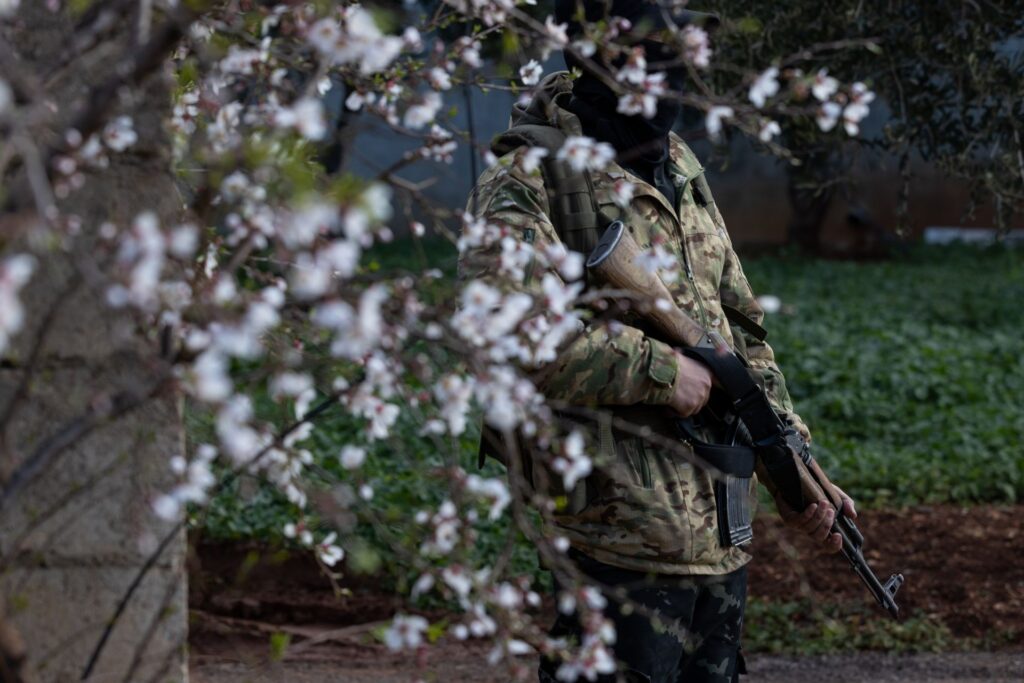
At a checkpoint roughly 200 yards from the first visible military positions, members of Syria’s General Security refused to speak to journalists and closed the entrance. Images circulating on social media appear to show the deployment on nearby hills, where men in combat uniforms walk through tall grass, launch drones and move along the slopes of the mountains to the sound of Syrian patriotic songs.
At least 75,000 Syrians have returned legally across the border in recent days, according to Moushir al-Rammah at the communication office of the borders agency. A Syrian security source familiar with the situation said that large numbers of Syrians are also attempting to cross the border illegally rather than through official crossings. Many fear that using official crossings could cost them their refugee status in Lebanon — and the aid that comes with it. The source added that security forces are currently working to identify and arrest individuals linked to pro-regime militias, including shabiha and people originally from al-Qusayr who are suspected of cooperating with Hezbollah. Preventing the return of such individuals is one of the reasons for the reinforced deployment along the border, the source said.
According to researcher Arthur Quesnay, Syrian authorities are primarily trying to prevent the Lebanese conflict from spilling over into Syria. The deployment also sends a signal internationally. “It is a message to the Americans and to Israel,” he said. “A kind of anti-Iranian posture to show they are among the ‘good students.’”
According to a Lebanese security source familiar with the situation, some Hezbollah elements fear that the Syrian army could enter Lebanon’s Bekaa Valley. The source added that there is significant pressure on the new Syrian authorities to move into the Bekaa, warning that such a step could provide Israel with a strong pretext to invade southern Lebanon under the guise of eliminating Hezbollah. The source said these fears are rooted in the legacy of Syria’s war, noting that many Syrians “have not forgotten the conflicts that occurred during Bashar al-Assad’s rule in Syria,” when the regime and some Hezbollah elements “wreaked havoc, killing, stealing and destroying.”
But the source said such a scenario remains unlikely. “I don’t believe the Syrian army will enter the Bekaa Valley,” the source said, adding that identifying Hezbollah’s rogue elements on the ground would be difficult and could risk broader escalation.
In the village of al-Qusayr, bullet marks scar the walls of half-destroyed buildings.
Um Mohamed, 39, lives with her children in a school where four families have been sheltering for the past year. Their home was destroyed and their land taken. Now they have been told they must leave — the school will soon reopen.
With no money and no reconstruction underway, they do not know where they will go. “They told us we will receive tents to live on the land where our house once stood,” she said. The children collect scrap metal to earn a little money. “Until now there has been no rebuilding, no help.”
For her, Hezbollah bears responsibility for what happened. But revenge is not her first thought. “Our priority is just to find a roof for our children.”
At the crossing point, families continue to arrive. Sitting on top of a pile of suitcases, a 4-year-old girl with green eyes quietly cut her fingernails. She had just come from Baalbek with her mother and was waiting to cross into Syria.
Her mother had been repeating since the morning that they were returning home and that school would resume after a month of interruption caused by the war in Lebanon.
The girl asked about her friend Zahra, a Lebanese classmate she used to walk to school with every day. Her mother told her Zahra had gone north, to northern Lebanon.
Become a member today to receive access to all our paywalled essays and the best of New Lines delivered to your inbox through our newsletters.