


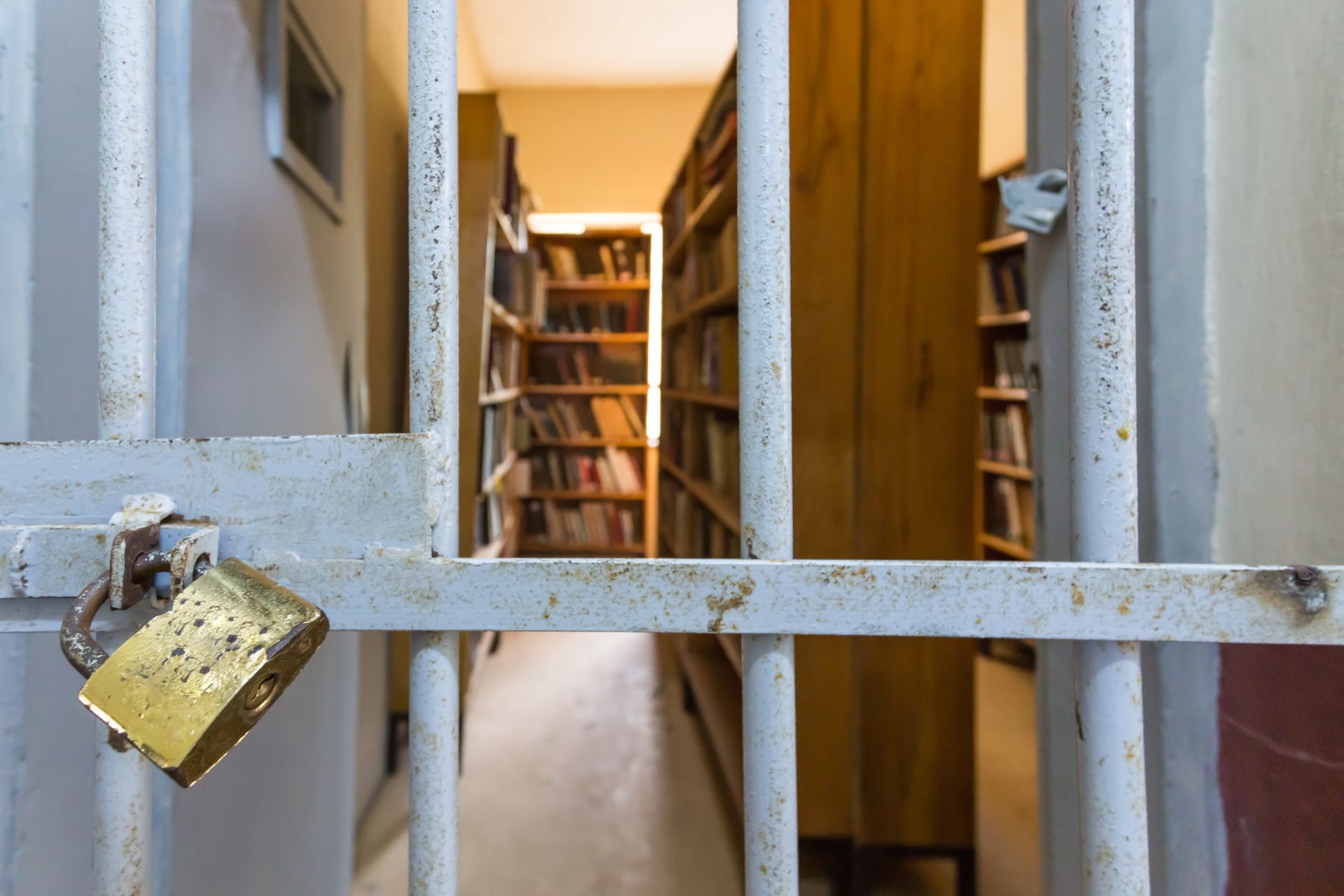
Before he became Malcolm X, Malcolm Little was holed up in a 150-year-old, 6-feet-by-8-feet cell when he heard about Norfolk Prison Colony’s massive library. In a revealing December 1946 letter to his half-sister Ella Little, Malcolm, then 21, wrote the following while incarcerated at Charlestown State Prison: “If you get me transferred to Norfolk, I’ll try and complete that whole book next year. They have a fine library down there, and one can learn so many more different things. My only reason for wanting to go, is the library alone.”
Prison libraries mattered once. Do they still matter in 2026?
After writing “Malcolm Before X,” a book that turns largely on the story of Malcolm X’s prison education, I set out to examine the state of prison libraries today, starting at the federal level.
Certain questions remain: How many trained librarians, for example, are employed at federal penitentiaries, run by the Federal Bureau of Prisons (BOP)? How many books are in each leisure library? What restrictions are placed upon incarcerated men using the library as a means of rehabilitation?
As Christopher Blackwell, serving a 45-year sentence at a prison in the state of Washington, put it in a 2022 op-ed for The Marshall Project, a publication devoted to criminal justice: “When people question why it’s important to educate prisoners, I remind them that to see change, we must support change. We must give individuals the opportunity to see themselves as more than the harm they’ve caused, more than what was once broken within them.”
During the years when I was working on my book, I was continuously surprised at how vital the Norfolk Prison Library was to Malcolm’s desire for self-improvement. But it took him years to get to what was then considered one of the most progressive prison libraries in the country. He’d endured the barbaric conditions at Charlestown State Prison (now Bunker Hill Community College), and struggled with infighting and idleness at the Massachusetts Reformatory in Concord (which became MCI-Concord, but closed in 2024).
I wondered how he would fare if he were incarcerated today.
Writing this was not easy. The 16 federal penitentiaries in the United States are not keen on releasing specific information about their facilities, even if the questions are as innocent as “How many books are in your leisure library?” Many didn’t respond to my queries, while others referred me to the BOP website, where each penitentiary is required by law to provide public access to their orientation handbook. I’ve read through each of these files, but some had not been updated in over a decade, as one Texas penitentiary shows. Others pointed me toward a painstaking research request process that would take three months just for the request to be approved — for each penitentiary. It’s no wonder that a full examination of the prison library system has not been conducted by an independent journalist.
Still, the responses I did receive were enough to gain a sense of the conditions.
There are two main types of libraries in correctional facilities. The first is the law library. The U.S. Supreme Court’s ruling of Bounds v. Smith in 1977 required “prison authorities to assist inmates in the presentation and filing of meaningful legal papers by providing prisoners with adequate law libraries or adequate assistance from persons trained in the law.” It’s that “or,” among other bits, that caused the law to be restricted even more by 1996’s Lewis v. Casey verdict, which required the incarcerated individual to show “actual injury” from, as prison legal scholar Dale Chappell put it, “being denied access to the courts because of a law library problem.”
Currently, there is a federal expectation that a law library area exists at least in some capacity in a prison, but, I was told, there are zero trained librarians employed at federal penitentiaries to help incarcerated individuals find what they are looking for. Going into a law library without any legal guidance is like going into a calculus class without any experience in math. The mountain to climb just to begin understanding your own case would feel Everest-like.
Leisure prison libraries, meanwhile, are supposed to contain a wide sampling of genres, similar to what someone on the “outside” would find at their public library. U.S. leisure prison libraries stretch as far back as 1790, when the puritanically minded Philadelphia Prison Society began delivering religious and other general materials to the Walnut Street jail. Even in the rotten and decrepit Charlestown State Prison in Massachusetts, built around 1805, where Malcolm X had initially been incarcerated, there were approximately 8,000 volumes in 1946, though many of the books carried mold or lice, and fell apart from weak binding once opened.
Big Sandy is a high-security penitentiary in Inez, Kentucky. It currently holds 1,218 incarcerated men in its main building and another 94 at a nearby camp. According to one official at the facility, Big Sandy does not have a librarian. They do, however, have “a staff member in Education [who] does keep the library in order.” Their current leisure library holds “nearly 1,300 books,” or approximately one book per incarcerated man.
Another high-security penitentiary with no employed librarian is USP Beaumont, in Texas, which holds 1,192 men and organizes their leisure library according to security level. Only through good behavior can an incarcerated man have the lowest threat level, and be given access to Beaumont’s full library, which contains 3,000 books — better than Big Sandy, but still fewer than three books per inmate — most likely hand-me-downs and, in the case of law volumes, now-dated material. As an incarcerated individual’s threat level increases, the library shrinks: For medium, 2,500; high 2,000; and critical 1,500.
A public affairs official from the BOP made it clear to me: Not one of the 122 institutions within the BOP network employs a librarian. Rather, “each institution designates an employee, typically the Supervisor of Education (SOE), to provide oversight of the leisure and law libraries. The SOE may delegate this daily role to an education staff member such as an Education Technician or Teacher.”
The official, understanding that managing a library is a tremendous responsibility that takes years of training, stated that “employees delegated to oversee library operations must receive training at least once by someone with a master’s degree in library science.” It’s unclear what “at least once” actually entails. It could mean as little as a one-hour Zoom meeting, just to tick the box. The official did add that “the training typically happens through a local school or public librarian.”
In an email, the public affairs official explained that the organization “spends at least half a million dollars per year on materials for its libraries.”
That works out to around $4,100 per prison, and $3.24 per incarcerated individual. For context, the amount the BOP spends on each person incarcerated is around $45,000 per year (or $120 per day).
I ran these numbers and more by Kelly Brotzman, the executive director of the Prison Book Program, a nonprofit founded in 1972, whose mission is “to send reading materials to incarcerated people to help them empower themselves.” When I let Brotzman know about the public affairs official’s response, she called it “pure PR fluff,” quickly pointing me to the annual budget of the BOP, which is $8.7 billion for 2026, after the Donald Trump administration increased funding by $366 million from 2025.
A quick calculation shows that, out of $8.7 billion, $500,000 represents 0.0057% of the budget.
The BOP official’s response also mentioned that its institutions participate in interlibrary loan (ILL) programs, whereby books, “through the partner library,” are “mailed to the institution if available, and delivered to the inmate.”
Yet Brotzman, who has experience with the Prison Book Program, which has over 1,550 volunteers across the country collecting information, believes that “less than 10% of federal facilities have an ILL partnership with a public/community library.”
According to Brotzman, it’s up to the actual trained librarian of a public library to travel for hours to the remote facility to make the partnership. Even when they do try, they are often hit with “a brick wall” of restrictions, stemming largely from a lack of understanding as to how book publishers actually distribute their books. “The only books [prisons] will allow in are those sent directly by publishers. But what they don’t know is that there are basically six companies that publish books in the United States. (The book publishing industry has seen massive consolidation over the last several decades.) Of those, only three permit sales directly to consumers. (The other three only sell to distributors or retailers, not to consumers.) Those three only do so on their websites, with payment by credit card. Needless to say, incarcerated people do not have credit cards, and do not have the Internet. So when [a prison] adopt[s] a publisher-only policy, it just means you need a loved one on the outside with the connectivity and disposable income to order books from one of those three companies.”
On top of this complication rests the ongoing problem of censorship, with most federal prisons applying their own rules on a unilateral basis. As PEN America examined in their groundbreaking 2023 report, “Reading Between the Bars,” the BOP subjectively analyzes each book based on the “alleged threat” of the content. It’s “a tactic similar to that of book banners who have targeted public schools and libraries. … Prison banned book lists in many states contain thousands of unique titles; any incarcerated individual in that state is barred from reading any title on the list.”
A policy statement by the BOP dated 2011 explained that the warden of the prison is allowed to “reject a publication only if it is determined detrimental to the security, good order, or discipline of the institution or if it might facilitate criminal activity.” Books that might be rejected by a warden, who usually has total discretion, include works “written in code,” books that describe the “construction or use of weapons,” books that “depict … methods of escape,” books that show “the brewing of alcoholic beverages, or the manufacture of drugs,” books that “encourage criminal activity,” books that “describe … activities which may lead to the use of physical violence or group disruption,” and “sexually explicit material,” which apparently can include Gray’s Anatomy books. Texas prisons have banned standard reading fare, such as multiple novels by John Grisham and Stephen King, including King’s novella “Rita Hayworth and Shawshank Redemption.” Florida’s lists have basic language books such as “Arabic for Beginners” banned; even simple boating and fishing magazines are forbidden, along with issues of National Geographic.
In the end, as many incarcerated individuals have explained, any staff member in the mailroom can deny a book’s entry into the prison, for any reason and without oversight, as they have — tens of thousands of times.
There are at least a couple of library partnerships between local institutions that have worked well, one being San Quentin and the San Francisco Public Library. Through my contact with librarians at MCI-Norfolk (where Malcolm X was held for two transformative years), I’ve learned that Massachusetts has various partnerships with local libraries and correctional facilities. Washington State and Colorado have also made inroads, but that’s state-level, not federal.
“The bottom line,” as Brotzman puts it, “is that there are no standards of basic adequacy that the BOP holds itself to.”
It’s not as if the BOP needs to write an entirely new book of standards. The American Library Association lays them out on its website. All the BOP needs to do is follow them.
Around November 2022, the BOP made a deal with Advanced Technologies Group (ATG), a subsidiary of the for-profit corporation Keefe Group devoted to the corrections industry, to provide a Score 7 tablet supposedly preloaded with e-books and other digital content. Incarcerated individuals could purchase the tablet for $125, but, as the incarcerated journalist Gregory Marcinski wrote for the Prison Journalism Project, the device leaves much to be desired — especially when it comes to content. Marcinski quoted Julion Parker, also incarcerated at a correctional facility in New York, as follows: “I’m in prison and am supposed to be trying to improve myself. This great opportunity arises with the introduction of tablets, and what does the BOP feel is the most important programing to give us? Movies and video games.” Project Gutenberg’s database of books had been promised, as had educational videos by Khan Academy, but as of this writing they have not been delivered. The tablets are mainly a money drain on inmates (or their loved ones, who fund them from the outside), since they typically pay around $5 per movie via a preloaded media account — a massive temptation, given the never-ending idleness that exists within a dull prison routine.
As the incarcerated man Simon Gutierrez expressed to scholar Norval Morris in “The Oxford History of the Prison,” idle time is its own kind of punishment: “For me, and many like me in prison, violence is not the major problem; [it’s] monotony. It is the dull sameness of prison life, its idleness and boredom, that grinds me down. Nothing matters; everything is inconsequential other than when you will be free and how to make time pass until then.”
Incarcerated individuals do not have access to the internet. Instead, the BOP uses Corrlinks, a heavily restricted email system that allows those incarcerated to email family and approved contacts.
Thanks to the help of memoirist Keri Blakinger, I was able to try out Corrlinks. Blakinger connected me to several currently incarcerated men in federal prisons. One man, who has done time at both USP-Lee in Virginia and USP-McCreary in Kentucky, explained via the message service how the law libraries at both institutions were completely inadequate, with USP-McCreary not having any actual physical volumes of law books, only a general library clerk who has some knowledge of electronic materials.
Just because a correctional facility has a library doesn’t mean one can have access to it. Over the past 14 months, Brotzman and volunteers with the Prison Books Program have gathered data from a survey given to incarcerated individuals who have received a free book from them. One of the questions asked was “Can you go to the library?” Out of 625 responses from incarcerated individuals across state and federal prisons, 40% said they could not.
The survey offered a chance for the respondents to say why they could not.
As one might imagine, their answers varied widely. Some said their prison only had “book carts.” Another responded that the library was “open two days a week and I work those days.” Another wrote that their library had closed down “because they can’t get anybody to work here.”
Many respondents mentioned being in lockdown for long stretches of time, meaning no one could leave their cell, while others referred to time restrictions and extreme law library rules. “They are only letting inmates go that have active cases or legal need. Cannot go to get general reading materials,” one respondent wrote.
At the moment, there are around 1.2 million people in the United States held in federal or state prisons. For decades, the country has had one of the highest incarceration rates in the world. In 2026, the per capita rate stands at around 614 people per 100,000. To compare this to fellow NATO countries, the United Kingdom is a distant second, with 144 per 100,000 people, while Iceland has just 36.
Only three countries worldwide have higher incarceration rates per capita than the U.S.: El Salvador (1,086), Cuba (794) and Rwanda (637). If the state of Louisiana were a country, noted the Prison Policy Initiative writer Emily Widra, it would very nearly overtake El Salvador, with 1,067 people incarcerated per 100,000 Louisiana residents. Mississippi is close behind, at 1,020.
There are many voters and lawmakers in the U.S. who are OK with this system, believing people who break the law should be punished severely. But 94% of all people incarcerated will be released. Educational resources are vital for them to become positive contributors to society.
This starts with prison libraries. The U.S. has a long way to go to catch up with Norway’s system. Norway’s recidivism rate hovers at around 20%, one of the lowest in the world, which is attributed to the level of civility Norwegians provide each incarcerated inmate. Norway’s “principle of normality” includes vast library services directly connected to the country’s public library system. In Norway, according to the Norwegian writers Nancy Bolt and Erlend Ra, “All prison libraries are run by professional librarians and their salaries and the prison library resources are paid for by the Norwegian National Library. The library director works for the public library, not for the prison, which gives her a degree of independence in making decisions about the collection and activities within the perimeters of prison security.”
This level of trust will seem to many Americans like an unobtainable fairy tale. Perhaps more realistically, the Chartered Institute of Library and Information Professionals (CILIP), a leading library organization in the U.K., has made practical efforts to provide incarcerated individuals with resources specifically geared toward helping with “reading skills and literacy.” In CILIP’s prison library framework, the organization lays out basic requirements for libraries, such as proper physical space, management and staffing, stock and access. Sue Wilkinson, who became one of the U.K.’s first prison librarians in 1985, writes of the impact a library can have on someone incarcerated. “Prison libraries really do change lives — not in earth-shattering ways, but simply by doing what public libraries do best. Providing a comfortable, neutral space, being non-judgemental, enabling people to discover, democratising knowledge, giving emotional enrichment. Simple things, but things which have a greater significance within the bleak landscape of a prison sentence.”
In the U.S., basic access to educational resources is indeed a bleak landscape, at both the federal and state levels. Brian Scott, formerly incarcerated for 20 years in North Carolina prisons, spoke movingly in 2023 about his experiences with prison libraries.
While incarcerated, Scott helped to launch Nash News, a prison newspaper still published today. “Access to information and knowledge is a human rights issue. It is just as important as access to health care for the incarcerated. What better time to gain knowledge than during incarceration, when you have the time to read and explore the world beyond yourself? And it always mystified me why that wasn’t more of an emphasis during incarceration. Why the library that we had access to was so limited in scope when it could have been a much bigger portal to another world. … Exploring the world beyond yourself is the only way to repair the world within.”
There are about 154,000 people in federal prison institutions. I started with the BOP because I’d assumed the governmental network would provide examples of functional libraries. I then expected to take these examples down to the state and privatized levels of prison, where the real educational neglect exists. I was wrong. The neglect is everywhere. Nearly 70% of incarcerated individuals do not have a high school diploma.
At Norfolk Prison Colony, Malcolm X had a fully stocked library and a trained librarian, and it changed his life — and our country. At Norfolk in 1950, there were around 800 incarcerated men. Their librarian, George F. Magraw, was a graduate of the Massachusetts Institute of Technology, and he took care of over 12,000 books. That’s about 15 books per man. “I knew right there in prison that reading had changed forever the course of my life,” Malcolm X recalled.
Reading still has that power. And, at a time when we’re spending $8.7 billion a year to incarcerate individuals, books remain one of the best investments we can make in their future and ours.
Become a member today to receive access to all our paywalled essays and the best of New Lines delivered to your inbox through our newsletters.