


Since its establishment in 1981, the Committee to Protect Journalists (CPJ) has recorded violence against media workers worldwide. Its databases and reports are frequently cited by governments, courts, policymakers and the United Nations, an authority that rests on a deceptively simple premise: that CPJ can determine, consistently and neutrally, who counts as a journalist.
That premise has become the subject of a public dispute, one that recently forced CPJ’s board to formally vote on whether to revisit the organization’s definition of a journalist.
On June 25, CPJ announced it was undertaking a comprehensive review of its widely cited list of “journalists or media workers killed by Israel in Gaza and in Israeli detention centers since Oct. 7, 2023.” The statement noted that they had removed 20 names from their database following further review. An accompanying memo cited a range of reasons for the removals, from determining that individuals were not on assignment at the time of their deaths to confirming that some had survived attacks initially thought to have killed them. The greatest attention, however, focused on eight individuals whom CPJ said subsequent research indicated had “participated in combat.” In a statement provided to New Lines, the organization said it was acting after “militant groups Hamas and Palestinian Islamic Jihad (PIJ) published obituaries identifying as combatants individuals previously listed by CPJ as journalists.” CPJ stressed that it “has not changed the way it classifies journalists” and that its methodology remains consistent across conflicts.
The announcement was quickly seized upon by pro-Israel advocates. Israel’s Foreign Ministry declared on X that “Even the Committee to Protect Journalists admits it. Gaza ‘Journalists’ = Hamas & Palestinian Islamic Jihad Terrorists.” HonestReporting claimed credit for the CPJ review, posting on X that it took place “because HonestReporting helped put them in an untenable position.” Meanwhile, many questioned CPJ’s verification methodology, given Israel’s ban on international media access to Gaza since 2023. “Determining participation in armed conflict seems beyond CPJ’s competence and capacity,” one user posted. Some threatened to withdraw their support, arguing that the organization is legitimizing efforts to discredit Palestinian reporters. “The CPJ’s recent decision is a terrible act of complicity in genocide,” posted the account for the Lemkin Institute for Genocide Prevention on X.
The difficulty, critics argued, lies in applying such distinctions consistently across conflicts. Former Human Rights Watch director Kenneth Roth noted that CPJ already excludes combatants and those advocating imminent violence. “It is a dangerous business,” he argued, “to expand that exclusion based on an outlet’s political character rather than a journalist’s professional function.”
In one sense, the announcement was routine. Documentation of conflicts is rarely straightforward, and organizations tracking casualties regularly revisit records when new information emerges. But this particular review comes amid heightened scrutiny — and stakes — over how journalists in Gaza are classified, and by whom. In various statements given to the media and across their own social media platforms, CPJ officials pushed back forcefully against suggestions that the review reflected political pressure.
But the controversy soon expanded beyond the review itself to reports that CPJ’s board was considering whether to revisit aspects of the organization’s definition of a journalist, particularly in relation to media workers affiliated with state-backed outlets or political movements. Yet the question of who qualifies as a journalist did not originate with the current controversy. According to new reporting by the Columbia Journalism Review published on July 6, CPJ staff conducted an organization-wide review of the issue in 2025, holding a series of meetings to examine difficult cases involving activists, propagandists, influencers and state-affiliated media workers. The process resulted in a revised definition describing journalists as people who “report or share fact-based information with an audience,” language that was formally adopted by CPJ’s board in June 2025.
The reports of an internal push for re-definition first gained traction when journalist and writer Mohammed El-Kurd posted on X on June 29 that CPJ had formed a task force to “reexamine the question of who is a journalist,” including whether individuals working for what CPJ might classify as “state-backed propaganda outlets” or organizations affiliated with armed groups should still qualify for its database. “Essentially, CPJ is saying you’re not a journalist unless you’re politically aligned with us,” he wrote.
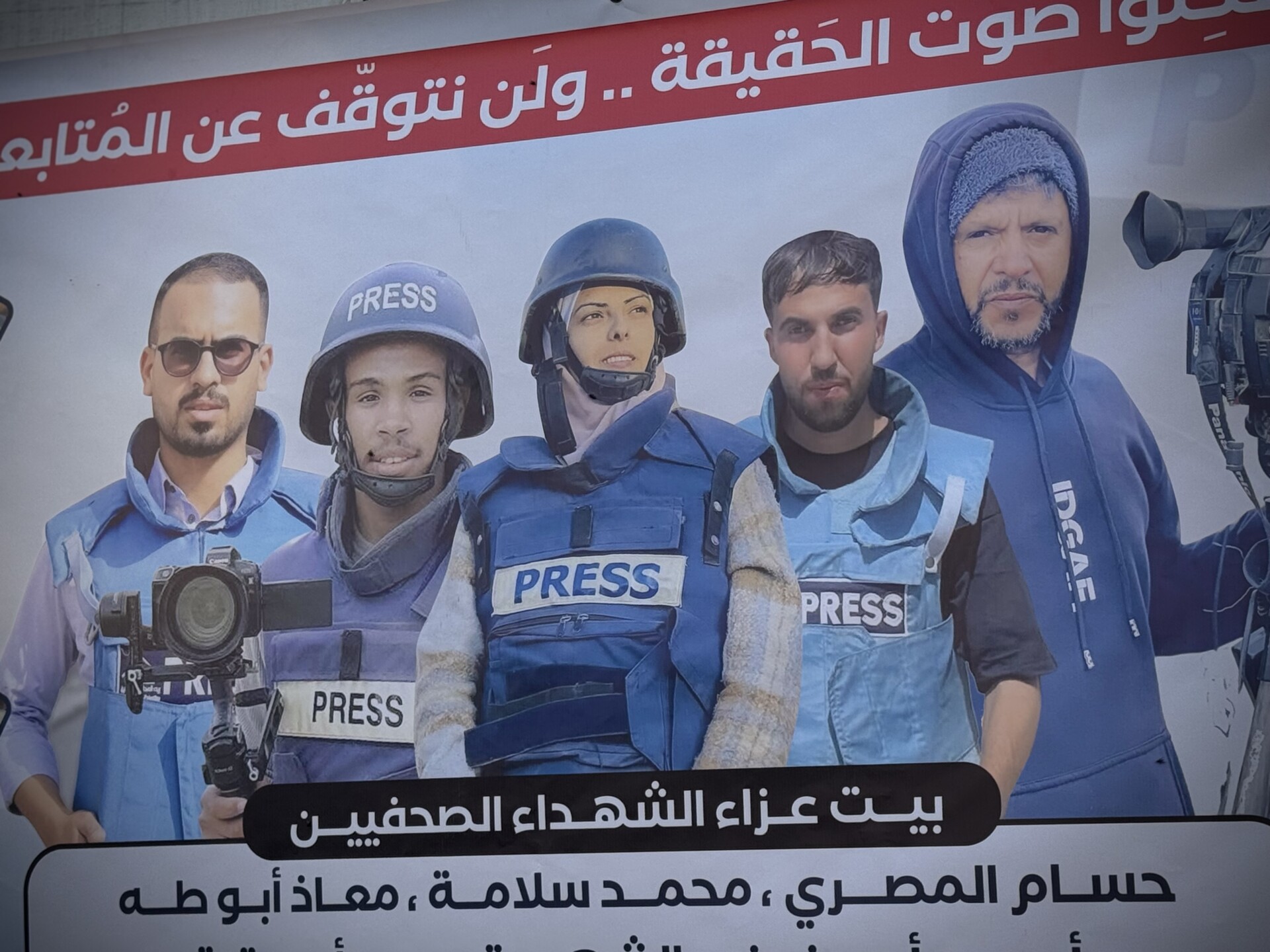
El-Kurd’s argument wasn’t theoretical. Journalists in Lebanon from various outlets have been killed by Israel with little accountability, just as in Gaza, where Israeli authorities have routinely labeled targeted Al Jazeera journalists as agents of Hamas. This was the case with Anas al-Sharif, an Al Jazeera journalist killed in Gaza City in an Israeli strike in August 2025 that killed four staff journalists, as well as two freelancers. Following the strike, Israeli authorities said the operation targeted “a Hamas operative posing as a journalist,” a claim they had made repeatedly leading up to it. A month before his murder, al-Sharif told CPJ that he had been receiving increasing threats from the IDF. “They accuse me of being a terrorist because the occupation wants to assassinate me morally,” the 28-year-old father of two was quoted as saying.
Soon after these claims of CPJ looking to change its definitions circulated, journalist and Drop Site News publisher Nika Soon-Shiong announced that she was no longer on CPJ’s board. CPJ told New Lines that her five-year term ended in June. Soon-Shiong publicly linked her departure to disagreements over the direction of the discussions. She shared on X an internal email she sent the board in which she questioned whether CPJ was moving toward a framework in which affiliation with certain institutions or alleged “behaviors and activities” could become grounds for excluding journalists from recognition or protection. The controversy had less to do with the organization’s staff researchers, whom even some critics praise for their documentation work, than with questions about governance and decision-making at the board level.
When asked, CPJ referred New Lines to its board chair, who did not respond to requests for comment. On July 1, however, CPJ released a statement saying the board had voted to affirm the organization’s existing definition of a journalist, rejecting claims that it planned to exclude particular groups. According to board chair Jacob Weisberg, members requested a vote on whether to revisit the definition and ultimately chose to maintain the current standard. Some credited Soon-Shiong’s public engagement on the topic with the CPJ’s sudden decision to publicly address and vote on the matter. “This decision is almost entirely due to her courage in sounding the alarm and stoking public interest over the last couple of days,” wrote Drop Site’s Julian Andreone on X.
In CPJ’s statement, Weisberg also rejected suggestions that CPJ had intended to exclude Palestinian or Lebanese journalists, arguing that such allegations undermined the organization’s documentation work and endangered journalists reporting on the ground.
Soon-Shiong disputed that characterization. “Israel endangers Palestinian and Lebanese journalists, not a tweet by Mohammed El-Kurd,” she told New Lines. “If there’s a dangerous, unsubstantiated allegation that demands correction, it’s the repeated claim that journalists in Gaza and Lebanon are terrorists and therefore legitimate targets. That’s exactly why embarking on a board-led effort to categorically evaluate the legitimacy of reporters facing these accusations is political. It’s a political decision to place them under further collective suspicion.”
That concern cannot be separated from the broader context in which the debate is taking place. CPJ is documenting what’s become the deadliest conflict for journalists in modern recorded history. Even excluding the disputed names, CPJ’s own figures still identify Israel as responsible for more journalist and media worker deaths than any other country. According to CPJ’s own data, Israel was responsible for roughly two-thirds of all journalist and media worker killings worldwide in 2025. Journalists in Gaza and the West Bank have been targeted since long before 2023, but the past three years have seen a sharp escalation in strikes affecting media workers, their families and the infrastructure they depend on, alongside severe shortages of food, medical supplies and safe evacuation routes. Stories such as that of al-Sharif, killed alongside his colleagues, the loss of multiple family members by Al Jazeera journalist Wael Dahdouh (including a son who was also a journalist) in Israeli strikes, and the paralysis of 24-year-old cameraman Fadi al-Wahidi after he was shot in the neck while reporting in Gaza, illustrate the human toll behind the statistics. The phrase “deadliest conflict for journalists” itself risks becoming an abstraction, a statistic repeated so often that it ends up obscuring the individual lives taken.
Walid Batrawi, a Palestinian journalist who worked on Forbidden Stories’ Gaza Project, a collaborative investigative initiative aimed at investigating the targeting and killing of journalists in Gaza and the West Bank and continuing their unfinished reporting, argued that the controversy risks obscuring a larger issue. “It’s not about numbers. It’s about accountability. It’s about documentation,” he told New Lines. Even if individual cases are revised, he argued, the central fact remains that Israel is responsible for the killing of Palestinian journalists.
CPJ’s Gaza data has become the authoritative source for news outlets (including New Lines) and governments trying to understand the scale of the violence. Changes to its records don’t just affect their accounting, they shape how the Gaza genocide itself is understood and remembered in the public record. But this is not the first time CPJ has faced criticism for its data around Israel-Palestine. Pro-Israel advocates have argued that individuals included in its Gaza casualty figures were improperly classified as journalists. Some Palestinian journalists, researchers and press freedom advocates argue that CPJ’s methodology may understate the extent to which journalists have been deliberately targeted by Israel. They point to CPJ’s distinction between journalists whose deaths are classified as “murder” and those killed on a “dangerous assignment.”
Since 2003, CPJ has maintained a database of media workers whose deaths it has confirmed were work-related, while using separate classifications to describe the circumstances of those killings. Critics argue that by classifying most journalist deaths in Gaza as occurring on dangerous assignments rather than as targeted killings, CPJ risks understating what they view as a broader pattern of deliberate attacks on Palestinian journalists. Some have even accused the organization of deleting the names of Palestinian journalists from the list with no public explanation, providing screenshots of the missing profiles on CPJ’s site. Batrawi argued that revisiting records when new evidence emerges should not automatically be viewed as political pressure. “It’s about accuracy,” he said, warning that errors in high-profile datasets can undermine broader efforts at accountability.
It’s important to note that CPJ’s figures also exist alongside other efforts to document the toll on Gaza’s press. Organizations such as Reporters Without Borders and the International Federation of Journalists employ different methodologies and often report different totals, while grassroots initiatives such as Databases for Palestine maintain their own records. As journalist and researcher Mostafa Al-A’sar, founder of REDWORD for Human Rights and Freedom of Expression, an advocacy group focused on press freedom and freedom of expression, told New Lines, these discrepancies reflect differing definitions, standards for evidence and documentation practices.
In a recent op-ed, CPJ’s Middle East and North Africa director, Sara Qudah, wrote that the review was initiated after new evidence emerged and was being conducted independently by researchers applying the organization’s existing methodology. She also rejected claims that CPJ’s board influences decisions about individual cases, describing the database as a “living record” that is routinely revisited when credible new information becomes available.
Ashraf Mashharawi, a Gaza-based Emmy Award-winning filmmaker, journalist and president of the Palestinian Journalists Protection Center, urged a distinction between legitimate scrutiny and efforts to undermine the organization’s credibility. “The power of documentation is based on accuracy and consistency,” he wrote on Facebook, arguing that professional organizations have a responsibility to review records when new evidence emerges. He also warned that the debate should not distract from what remains undisputed: that Palestinian journalists have paid an unprecedented price during Israel’s campaign of extermination in Gaza. Batrawi expressed a similar concern. “It’s the same whether it was Shireen [Abu Akleh], or now 250 or 209. … It does not negate the fact that Israel is responsible for the deliberate killing of Palestinian journalists,” he said, arguing that the larger failure has been the inability to hold Israel accountable for those deaths.
The board’s vote may have settled the immediate question of CPJ’s formal definition of a journalist, but it hasn’t settled the broader dispute that brought the issue to the surface. The controversy is not just about a handful of disputed names. It is about whether a decades-old institution built to document violence against journalists can withstand political pressure.
“Spotlight” is a newsletter about underreported cultural trends and news from around the world, emailed to subscribers twice a week. Sign up here.