


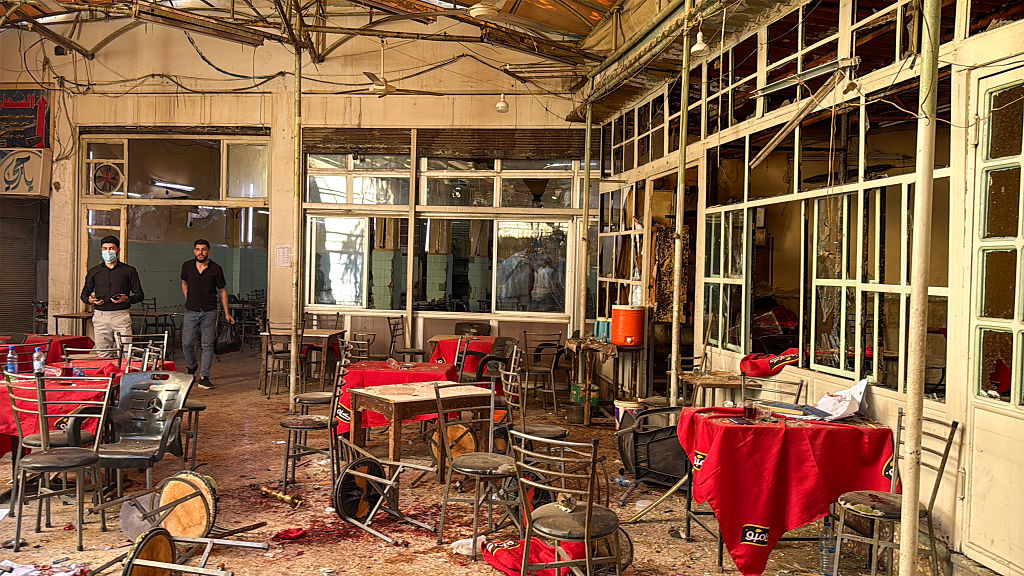
Around 3 p.m., as I was making lunch, I heard several booming sounds outside my window. I assumed it was gunfire and didn’t pay much attention. Rukneddine, a municipality of Damascus, is not unused to gunfire. Two nights earlier, two men died in a gunfight, and the neighborhood, with its favela-like homes climbing the slopes of Mount Qasioun, the mountain that overlooks Damascus, is known for hosting criminal elements hiding from the law.
It was only when I opened social media that I realized something much more serious had occurred. A cafe in the heart of Damascus, barely 2 miles from where I lived, had been bombed. I threw on a shirt and headed straight there.
By the time I arrived, the area had been sealed off. Armed police stood behind a flimsy cordon, doing their best to keep a curious public back. Behind it, members of the White Helmets, aid workers, armed police and journalists moved through the wreckage. Glass lay shattered, tables and chairs were overturned, and the cafe’s canvas roof had been ripped apart. Cleaners had the macabre task of washing away the blood.
Officials appeared bewildered, barking contradictory orders as people drifted in and out of the cordon as though it barely existed. One official told me four people had been killed and 25 injured, though the death toll would later rise to nine. Most of the victims were lawyers. In today’s Syria, they represented more than just their profession. They represented the return of civilian politics after years of war, where disputes had too often been settled by the gun rather than the courts.
The bombing initially appeared to be one more act of violence in a country that has endured too many. But another bombing followed on Tuesday, July 7, during President Emmanuel Macron’s landmark visit. It became harder for me to see these attacks as isolated events. Whether aimed at lawyers, politicians or foreign dignitaries, they struck at moments when Syria was trying to convince its own people and the outside world that it was becoming a functioning state again. It felt like the opening shots in a new sort of battle: keeping any transition off track.
Outside the cordon around the cafe, the rumor mill had already begun, with witnesses offering conflicting accounts. Some claimed that they had seen a man wearing a suicide belt enter the cafe. The government said the explosion had been caused by an improvised explosive device (IED) and that investigations were ongoing. Everyone from the Kurds to the Israelis, Assad elements and the Islamic State group was blamed by the crowd. In Damascus today, rumors often travel faster than official statements, TikTok being their favorite vehicle. Whoever it was, said Atef Sadek, an eyewitness who experienced the blast, “didn’t believe in God.”
Watching the rumors spread, I found myself asking a different question: Why did the bombers choose this shabby-looking cafe? The truth is that this was not an ordinary coffee shop. It was one of those places where lawyers gathered between hearings, where clients waited, where conversations spilled from legal disputes into politics. More importantly, it sits directly next to the Palace of Justice, where prominent figures from the Assad regime are now facing trial. The bombing also came on the day when 70 new members of parliament were being appointed. Whoever selected the target almost certainly did not choose it randomly. They understood its symbolism.
The cafe that was bombed carried political weight, not unlike the nearby Rawdah Cafe, which is also adjacent to the Syrian parliament. These venues had long been meeting places for politicians and intellectuals, and seemed like the kind of places where arguments are settled over checkers and politics discussed over a hookah. The attack achieved precisely the kind of attention its perpetrators must have hoped for. The Syrian Lawyers Syndicate condemned the attack and sent its condolences to the victims. The international community, from Turkey to the Arab League, likewise condemned the bombing. And that evening, the cafes appeared surprisingly quiet. That surely was the point of all this.
Even though no group claimed responsibility for the attack, to me the bombing bore some similarities to methods previously employed by the Islamic State, which frequently relied on IEDs during its insurgency across Syria and Iraq.
Around the same time as the bombing, the group also published an article condemning the appointment of Syria’s new parliament, describing it as a “parliament of idolatry.” For the group, elections are themselves an act of apostasy because legislation belongs to God alone. The democratic process and a judiciary that serves it are anathema to the organization. In fact, those lawyers would be considered infidels in the eyes of the Islamic State.
Syria has already experienced similar attacks apparently designed to undermine confidence in the country’s fragile transition. Last year a shadowy group, supposedly an Islamic State offshoot, calling itself Saraya Ansar al-Sunna, attacked Mar Elias Church in Damascus, killing 43 worshippers and sending shockwaves through Syria’s Christian community. The bombing also prompted a question: Is coexistence possible in the new Syria? Against that backdrop, an attack on a cafe associated with lawyers carried its own symbolism.
When I first began reporting this story, I assumed the bombing of the lawyers’ cafe was intended to intimidate one institution. But today, another attack challenged that assumption. Yesterday, President Ahmad al-Sharaa and Macron toured the Old City and took photos inside the Umayyad Mosque.
Today, that calm image was shattered. Two IEDs exploded near the Four Seasons Hotel in central Damascus where Macron was staying, shifting attention away from one of the most consequential diplomatic visits so far for the Syrian government. Eighteen people, including a government minister, were injured. Interior Minister Anas Khattab was immediately on the scene, as part of a damage limitation exercise. Instead of asking what Macron was saying, people were discussing the motives of the attackers.
But the damage was there for all to see. For the first time in years, I saw central Damascus experiencing something like a pandemic lockdown. Major roads were sealed off. People walked through streets normally choked with traffic. Soldiers, usually relaxed, searched bags and stopped pedestrians. There was an unusual quiet that felt eerie.
If the first bombing appeared to target the judiciary and, with it, the domestic politics of the country, this one seemed to take aim at something broader: the proposition that Syria was ready for the world, that it was open to investors, politicians and tourists.
Yet if the attack on Macron’s visit embarrassed the government abroad, the bombing of the lawyers’ cafe may prove more consequential at home. Although Syria’s judiciary may be its weakest institution, millions of Syrians still expect it to uphold the promises of the revolution.
The attacks came at a particularly sensitive moment. Syrians are watching how the judiciary behaves, and the institution is under immense pressure to deliver. Last month, protests broke out in Damascus suburbs and all over the country demanding transitional justice, the prosecution of Assad-era officials and the return of confiscated property. The government was further embarrassed by cases in which a pro-Assad businessperson allegedly used an archaic Assad-era law to imprison a Syrian activist and a former inmate of Sednaya prison. The legal system seemed to be trapped by its past.
That pressure helped explain why, months earlier, al-Sharaa announced a sweeping Ramadan amnesty. The decree canceled penalties for some offenses, reduced life sentences for others and only excluded crimes described as “serious violations against the Syrian people.” Many Syrians heard echoes of the Assad era, when presidential amnesties regularly accompanied religious holidays. Critics accused al-Sharaa of borrowing the habits of the old regime.
Yet the amnesty also reflected a more practical reality. Syria’s courts and security services are simply overwhelmed. On March 5, Syrian authorities working alongside Turkish intelligence announced that they had disrupted what they described as an Islamic State plot in Damascus. At the same time, the judiciary was expected to process thousands of cases left behind by more than a decade of war.
When I met Abdullah Sabbagh, deputy director of the Syrian Network for Human Rights, in Damascus earlier this year, he was remarkably frank. Many of the judges still serving today, he explained, were appointed under Assad. They cannot be replaced overnight. New judges are being trained, but until they are ready, Syria must continue relying on many officials whom the public associates with corruption and political repression. He estimated that it would take at least another year before enough qualified replacements entered the system.
That crisis has become visible in ordinary people’s lives, too. Mohammed Emad (not his real name), a 59-year-old Damascus resident, told me about his aunt, who owns property in Idlib but cannot reclaim it because government soldiers continue to occupy the house. The dispute has become complicated because her son was once suspected of belonging to the “shabiha,” pro-Assad paramilitary thugs.
“Even if that’s true,” Emad told me, “what does his mother have to do with her son? The property is in her name.”
Legally, the answer appears obvious. Practically, it is anything but. Judges connected to the previous regime are often accused of protecting former associates or simply avoiding politically sensitive rulings.
I encountered another illustration while driving through Damascus with Abu Ala, a 56-year-old business owner. His phone rang, and within seconds he was shouting. During the revolution, his son had been kidnapped. To secure his release, he surrendered four properties to the regime. After Assad’s fall, he reported several former shabiha members to the authorities. They were briefly detained, questioned, fined and released. To Abu Ala, the punishment amounted to little more than a bribe.
Worse followed. Police told the men who had identified them. Soon afterward, they began threatening Abu Ala’s life. Having lost faith in the authorities, he telephoned friends from Idlib who had fought in the capture of Damascus. They arrived, confronted the men, and the threats stopped. It was an effective solution and an indictment of the state’s weakness. When people trust armed friends more than courts or police, the rule of law remains immensely fragile and can spill over into lawlessness.
The bombing of the cafe was never simply about lawyers, though. Nor was the later attack simply about Macron’s visit. Churches, courts, parliament and diplomatic ceremonies all represent different aspects of Syria’s attempt to emerge from civil war. They are symbols of a state trying to replace violence with institutions.
Targeting the cafe suggests that there is an attempt to intimidate one of the country’s weakest institutions — its judiciary — the one that the new Syria depends on most. From the perspective of Syria’s transition, the symbolism of that attack matters more than the identity of the perpetrators.
Syria’s new government is attempting something extraordinarily ambitious: rebuilding a judiciary while simultaneously asking it to deliver transitional justice, prosecute atrocities, resolve millions of wartime disputes and reassure a deeply traumatized citizenry that the law now applies equally to everyone. That task is already immense. It became even harder the moment lawyers themselves became targets.
And Syria’s enemies don’t need to conquer cities to destabilize it. They simply have to convince Syrians — and the outside world — that the country remains too unstable to govern, keeping visiting dignitaries, investors and tourists away.