

Exhausted from playing with his younger sister Khadeja and his cousin Mozdalafa under the shadows of tall trees on the forested hillside, he spread the blanket over the veranda. They lay side by side, staring at the stars, counting them, teasing each other, arguing over the number of the stars before they fell asleep.
Then the drone returned.
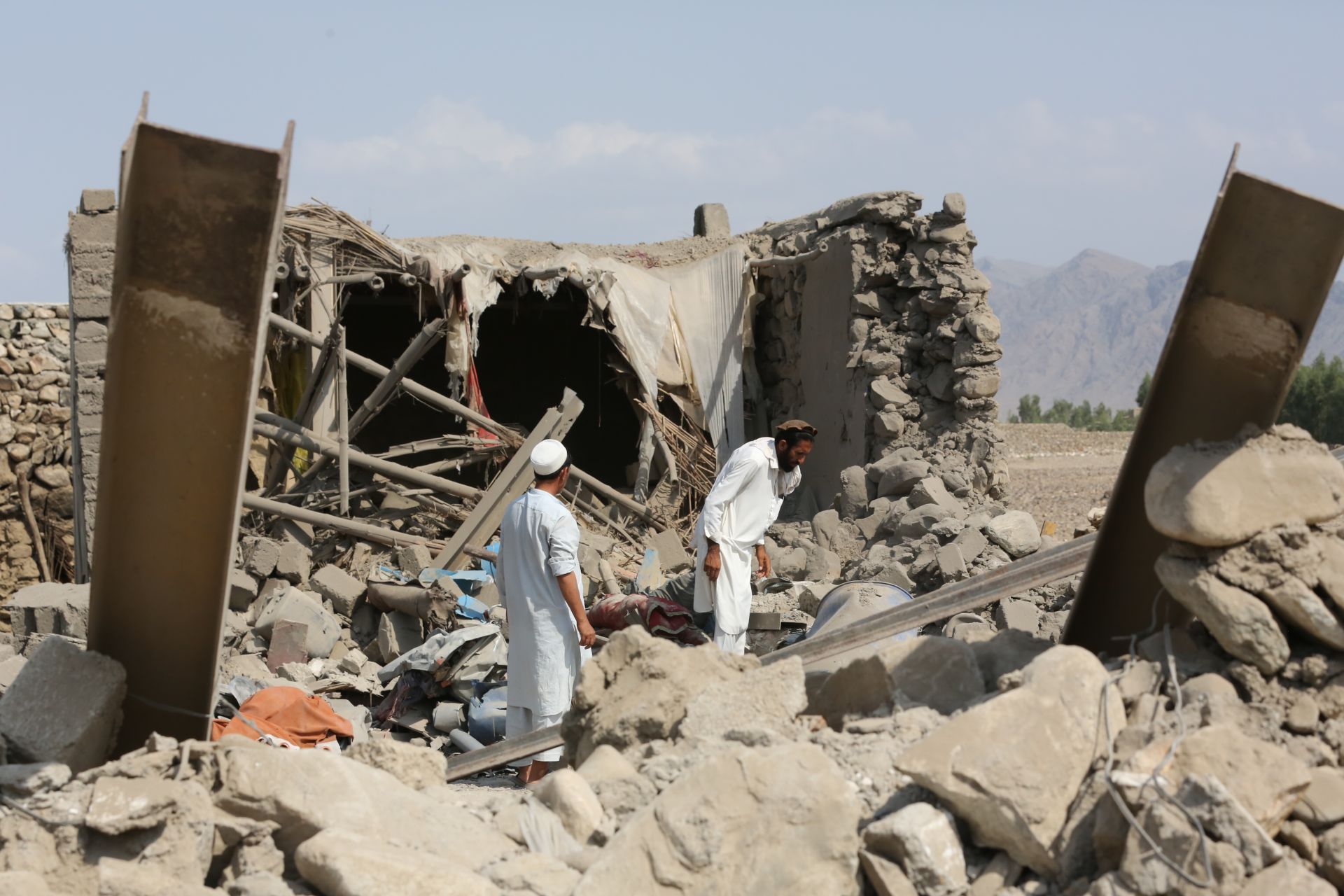
Above them, the stars disappeared beneath the sound of a drone, locally called a “bangana,” from the Pashto for a buzzing wasp. In a matter of minutes, the drone hit. It destroyed the house and killed much of the family and its livestock. Sher Mast, father of the two siblings, was thrown roughly 60 feet away by the force of the blast, alongside his wife.
Later, torches appeared from every corner of the village, circling the burning house. Shouting and cries of names filled the night air. Villagers rushed through the smoke toward the family, stepping over heads and hands, over the scattered remains of their neighbors, their cows and goats. Within an hour, they found the dead bodies of three children. The face of Nazam Khan, a 10-year-old boy, was still recognizable, but those of the two others — his sister and cousin — were not.
Zaman, a villager who reached the damaged house within 30 minutes of the strike, described the scene over the phone. He walked over the debris and collected the dead bodies and scattered body parts of the children from the rubble.
Zaman said that this area was badly affected during the Soviet invasion and again during the U.S. war. “Now we are being hit by Pakistan,” he said. “It has happened before, and we do not feel safe here because the Afghan government does not have modern weapons to prevent airpower.”
Sher Mast spoke to me despite his wounds. “I am wounded — thrown to the ground, onto the rocks and stakes — but my children’s sorrow has taken away my own sense of pain,” he said.
The funeral was held in the same village, with many from surrounding villages attending. In a nearby graveyard, three graves were dug side by side. The first small grave was for Nazam Khan; he was placed into the earth while his white shroud was still wet with blood. The next grave was for Khadeja, and the last for the youngest, Mozdalafa.
But the condition of the survivors remains fragile. “People are still in panic,” Zaman said. Traditionally, villagers cook for the victim’s family for three days. “But no one is able to eat,” he said.
The drone strike is part of a broader conflict between Kabul and Islamabad — a conflict marked by mutual accusations, cross-border violence, and a deep lack of trust. Pakistan says it is defending itself against militants, the Tehrik-e-Taliban Pakistan (TTP), which it claims operates from Afghan soil. The Taliban government says its sovereignty is being violated and warns that such strikes will not go unanswered. Each attack widens the rift, pushing the two countries closer to a cycle of retaliation that neither can easily control.
The strike that killed Sher Mast’s children was part of a wider wave of attacks across eastern Afghanistan on June 10. Residents and officials reported that Pakistani aircraft and drones struck locations in Paktika, Khost and Kunar provinces during the same night, ending more than a month of relative calm between the two neighbors. Afghan authorities said at least 13 civilians were killed, including 11 children, while Pakistan said the operation targeted militant hideouts linked with TTP. The United Nations Assistance Mission in Afghanistan (UNAMA) later confirmed the death of 13 civilians, most of them women and children, and called for the protection of civilians and renewed dialogue between Kabul and Islamabad. Pakistan maintained that its strikes were precise operations against militant infrastructure.
Sher Mast told me: “A villager cooked a meal for me and forced me to eat. When I tried — with the first handful of food to my mouth — my children came before my eyes with their bloodied faces. The meal stuck in my throat.”
Villagers are frustrated by Pakistan’s continued bombardment of civilian areas and are demanding that the Afghan government take action to prevent further strikes.
The Durand Line, the long frontier between Afghanistan and Pakistan, is not accepted by any Afghan government, nor is it accepted by the people who live and work along this border. For generations, movement in both directions has been fluid. Families, tribes and communities — sharing the same ethnicity, language and tribal codes — have crossed freely, protected by local and traditional norms rather than by any official border regime. The TTP emerged from among these very tribal peoples, and its fighters have long moved back and forth across the line.
Since the Taliban returned to power in 2021, TTP attacks on Pakistani security forces have risen sharply and continue to climb. Pakistan accuses the Kabul government of giving the group safe harbor to plan and carry out attacks on Pakistani soil. Taliban officials reject these claims.
But what stands out most clearly on the ground is this: So far, nearly all of Pakistan’s strikes inside Afghanistan have targeted civilian locations — homes, villages, hospitals, schools and markets — not military or militant positions. The dead are overwhelmingly women, children and elderly men. Whether by design or by poor intelligence, the strikes have done little to degrade the TTP’s fighting capacity. Instead, they have fueled anger among ordinary Afghans and deepened the cycle of retaliation.
Residents interviewed for this article said the strikes were fueling anger toward Pakistan. Afghans do not see this air campaign as an effort to fight the TTP. Across all the affected provinces, conversations with Afghans and local officials reveal a nearly unanimous view: These are not counterterrorism operations. They are attacks on Afghan sovereignty.
Pakistan said the strikes targeted militant infrastructure and killed 26 militants, rejecting Afghan claims that civilian areas were deliberately targeted.
China has hosted a round of talks between Taliban and Pakistani officials in Urumqi. The meeting focused on calming the border, TTP sanctuaries and economic cooperation. While both sides pledged to reduce tensions, no lasting agreement emerged.
The question now is whether this will become a recurring cycle — strikes, denial, civilian deaths, and then another round of strikes. Patterns from the past suggest so.
Since the Taliban returned to power in 2021, Pakistan has launched multiple waves of airstrikes inside Afghanistan. Each time, the Taliban protest. Each time, Pakistan insists it is targeting TTP hideouts. Each time, civilians bear the brunt. And each time, the underlying drivers of conflict — a contested border, militant sanctuaries, deep mutual distrust — remain untouched.
The destiny for Afghans has not changed. Bombs fall, children die, diplomats meet and things continue as before. For the families in Paktika, however, the cycle is not an abstraction: It is the empty bed. It is the meal that sticks in the throat. It is the three graves of innocents, side by side.
Sher Mast, the father who buried his young children, told me this before we ended our call: “I don’t know about TTP. I don’t know about other things. I only know that my children were playing with joy, and now they are under the dark dust. If that is what Pakistan calls fighting TTP, then Pakistan is Israel — worse than Israel.”
The drones will return. The stars will still shine. But for one father in Paktika, the sky has already fallen.
“Spotlight” is a newsletter about underreported cultural trends and news from around the world, emailed to subscribers twice a week. Sign up here.