


Under the warm rays of the coastal sun in Syria’s Tartus region, Ghazal Imad Rustum, 20, marched, an olive-green cap crowning her head. Her arms swung to the numbers that she chanted alongside dozens of peers, as rows of light brown sleeves moved up and down to the counting.
Rustum was clearly excited — and maybe even a little bit astonished at herself.
“I never expected that I’d enter such a field,” the Latakia local, who spent most of her life in Lebanon, said, smiling. Her words were laced with the tinge of a Beiruti accent. “But the experience has been nothing short of incredible.”
In late 2025, Syria’s Ministry of Interior released a recruitment notice for women. Rustum saw a link on social media and decided to apply to “serve her country.” Initially, her family was surprised at her decision, but soon began to encourage and support her.
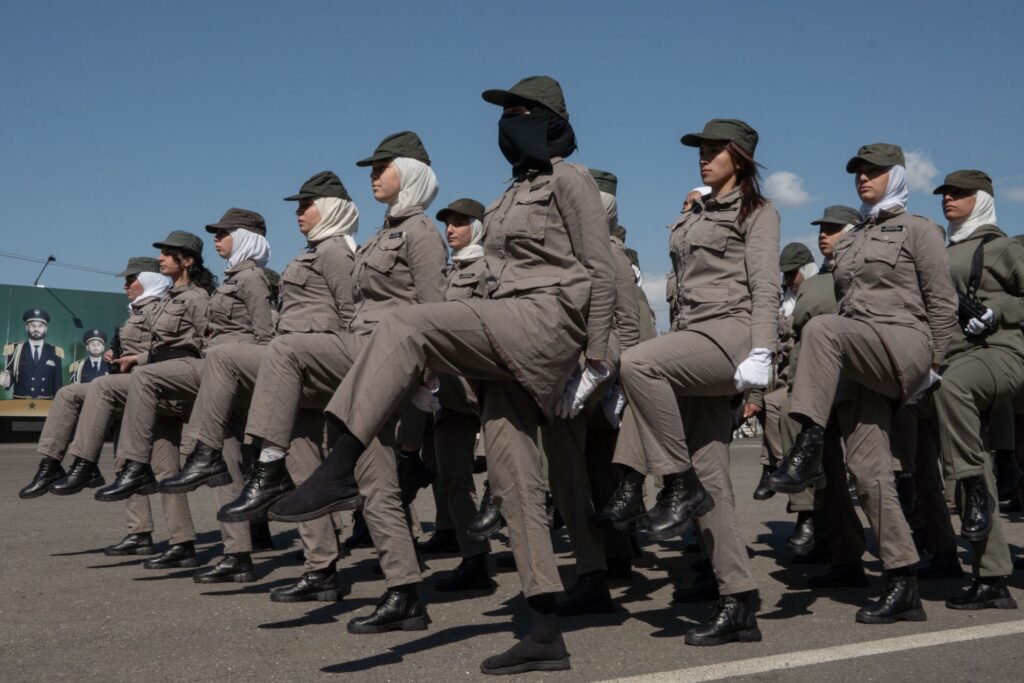
The scope of the role the young women were being recruited for was unclear, but the notice still prompted the excited enrollment of about 15,000 from all over the country. Last year, I visited the Ministry of Interior to ask for details.
“We’ve had so many women come to us lately, and we’ve had to redirect them,” said the woman conducting searches at the ministry’s entrance. One woman I spoke to at the time was worried her height wouldn’t meet the required threshold of 160 centimeters. A month or so later, I saw Facebook posts about applicants beginning to receive their acceptances. The comments were filled with women anxiously asking questions, as others (also mostly women) attempted to answer them: “Hi, I’ve sent in my application, but haven’t received a reply yet.” “Can we only enroll from specific governorates?” “Is the height requirement mandatory?”
There are two police institutes in Syria that train women police. One of them is located in Damascus’ al-Tall, the other on a Tartus highway, with “Training Branch of Tartus” emblazoned in gold against Syria’s official, dark green.
When I visited the Tartus site in March, the women were being trained as tourism police. Their daily routine consisted of exercise in the morning, rest time, lectures, then weapons training. In the first month of the four-month training, the women stayed at the institute throughout. After that, they visited their families every weekend.
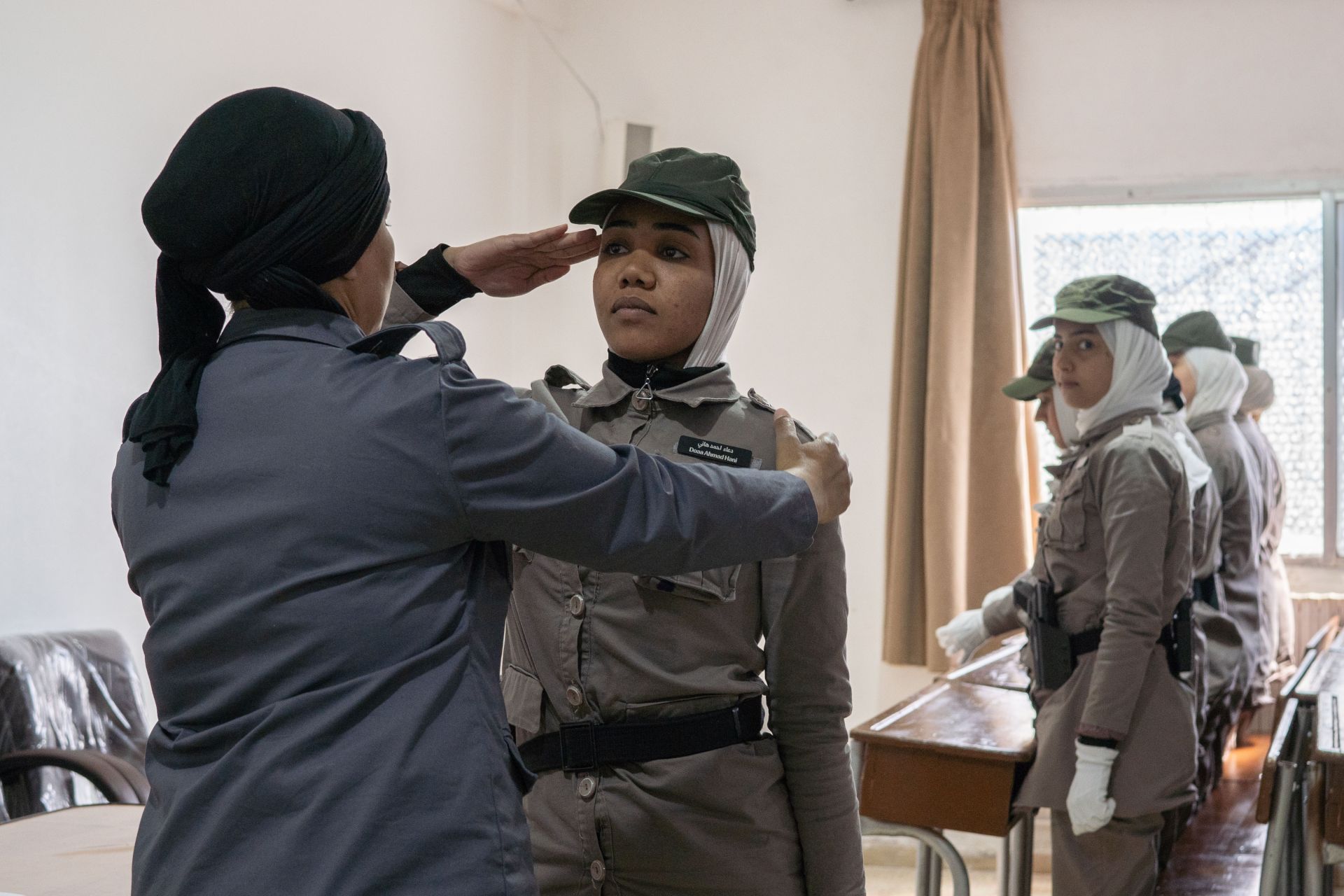
Yusra al-Qataaneh, 39, is the head of the training branch at the Women’s Police Institute. She took me for a tour and showed me where the women sleep, eat and study. Her presence was somehow endearing and intimidating all at once; the students at the academy seemed in quiet awe of her, with her black tieback hijab crowning her head.
She was eager to show me around — as she entered a classroom, the students scrambled to stand up before she motioned for them to sit down. Lectures and lessons about politics and human rights, among other subjects, are an integral aspect of the training.
“What are the parts of a KCR?” al-Qataaneh asked loudly, referring to a Turkish-made service rifle. Tens of white-gloved hands rose into the air. Each student she pointed to announced their name, preceded by “police student,” before proceeding to answer the question.
For Fatima Abdul Rahman al-Jubbad, 21, from Idlib, this part of her training appealed to her the most. She spoke softly, her voice hard to hear under her niqab.
She’s the youngest daughter in her family. Laughing, she said that her elder brother signed her up before she even knew about it. “But he knew I liked this field.”
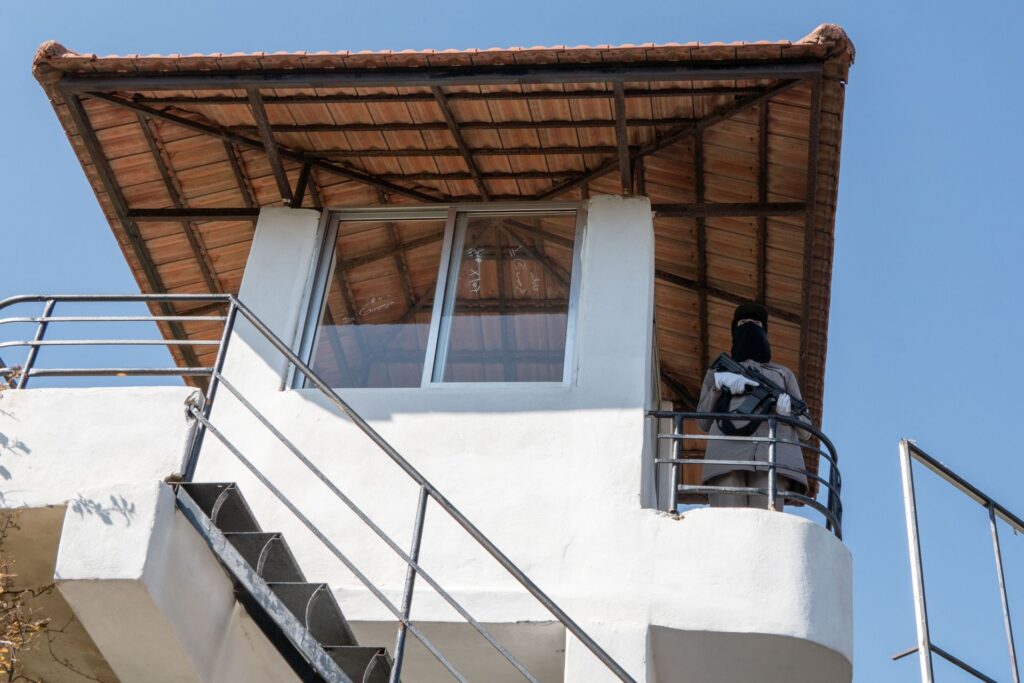
It’s at the academy that al-Jubbad held a weapon for the first time.
“Honestly, it felt good — I felt like I was strong,” she said.
Al-Qataaneh didn’t enjoy the support al-Jabbad did when she first decided to venture into the military field. Her father was an officer in the Assad regime’s military, and she always saw him as a role model, she told me, as we sipped on tea in her simple living quarters.
“I was ahead of time in my dreams. [I would ask myself] when will I grow up? When will I get my secondary school certificate?”
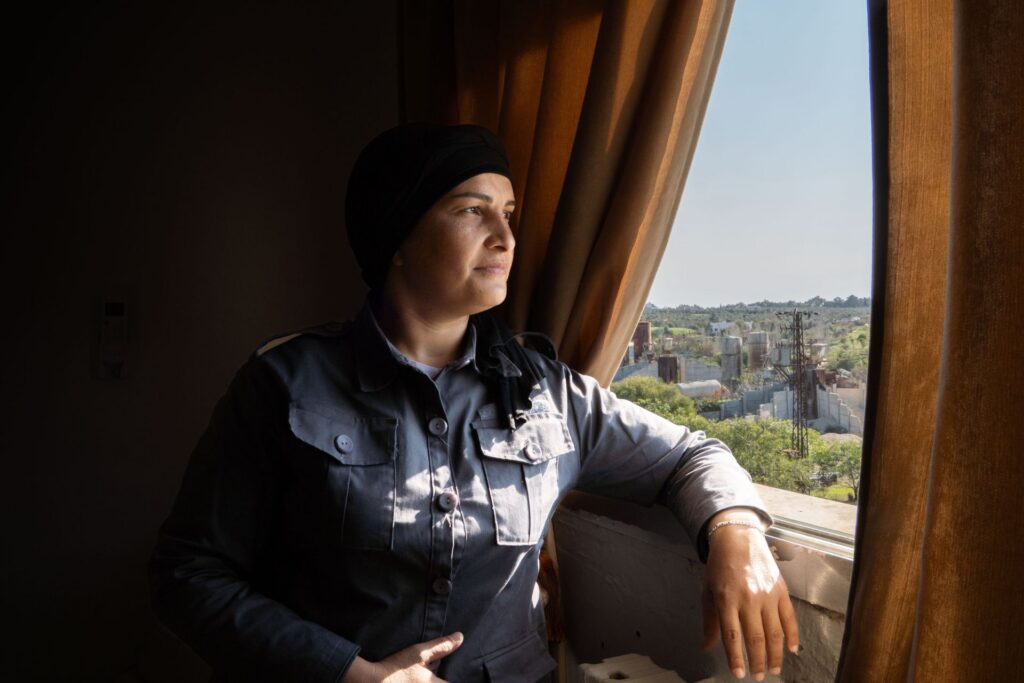
When she announced her decision to her family, they strongly rejected it. Adamant, she refused to go to college, saying that if she wasn’t going to enroll in the military, she wouldn’t enroll anywhere else. Eventually, they gave in, and she signed up to join the regime’s armed services just like her father. Yet following the popular antiregime protests and the start of the Syrian civil war in 2011, she defected in early 2012 and was eventually forced to flee to Jordan. Now, she’s leading the training of the women who have signed up.
My journey to covering this story began over a hot chocolate with a friend in old Damascus’ Qishle cafe. “You know what I think Syria needs? Women police,” I declared. A couple of hours later, he sent me a poster over WhatsApp: a recruitment call for women to sign up to the internal security forces, sent to him by a friend working with the Ministry of Interior.
I was intrigued about what the role of women in the internal security forces would be. There was part of me that wondered whether they would be out on drug busts or working office jobs. A friend warned me about the dangers of it being a double-edged sword, wherein having women police would be a way to better police women in society, in line with social norms.
“Are we going to end up in an Iran-style situation where women tell other women how to behave?” she thought out loud.
The question nagged at me, especially considering a now-clarified directive for women to wear “burkinis” on the beach, which caused a stir in media circles in mid-2025.
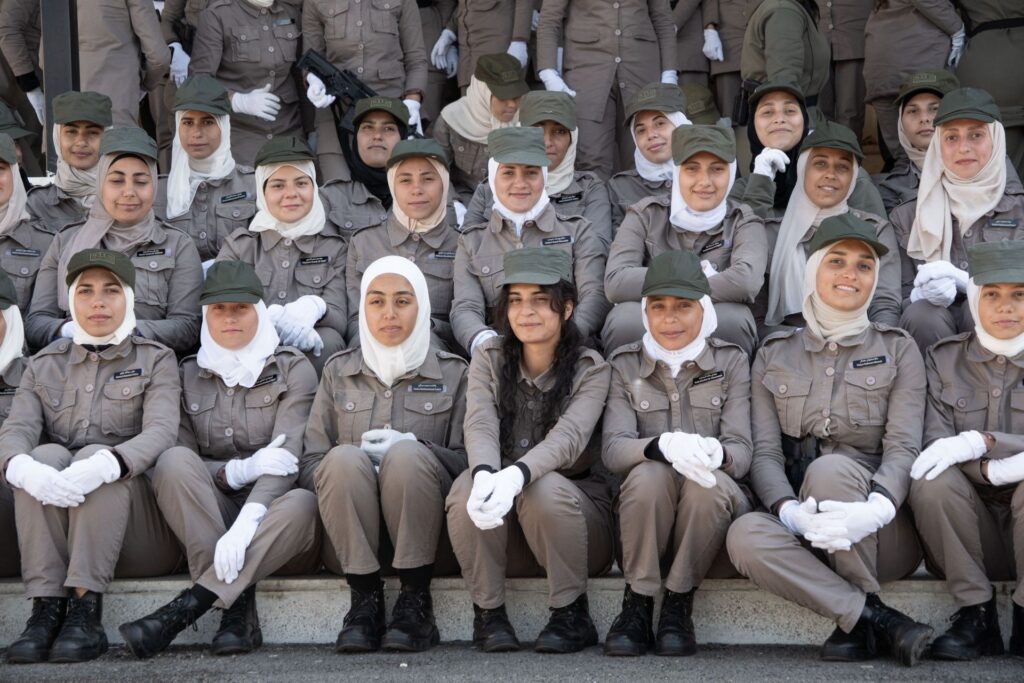
“As a tourist police force, we deal with tourist affairs; we have nothing to do with what any citizen is wearing, what they’re not wearing, or what they’re doing. That’s none of our business,” said al-Qataaneh when I asked her. She clarified that she had no idea about what other departments of the Interior Ministry were planning on the issue.
Huda Sarjawi, head of the Women’s Police Institute, reemphasized this.
“We have directives from the Ministry of Interior that personal freedoms are protected, and that we should ensure safety in the society.”
She added that the authorities were working toward the incorporation of women units in all sections of the Ministry of Interior, but that tourist police were being trained first in order to have them ready by the summer.
“The first thing tourists think about is safety, so this could make them feel more comfortable about visiting touristic spots,” she explained.
There were over 500 more women whose applications had been accepted. Sarjawi said they were hoping to train them according to the “needs” of the country, and to post them in different departments.
“We intend to have women involved in all parts of the country — [our interest in recruiting them] is also a way to make them feel confident in themselves.”
This is part of what motivated Hibatullah Samir Shabib, 25, to enroll in the Ministry of Interior. Her hair, bleached blonde, was fastened to the back of her head as she chatted.
“I want to have a role in society as a woman,” she said. “I wanted to have value, to depend on myself instead of just depending on my family.”
Some of the comments under the Ministry of Interior’s Facebook recruitment calls have criticized the age range for applicants as too low. Al-Qataaneh said that this is something she expects to see flexibility about in the future.
“[Here’s] the unique situation in Syria. One woman was a revolutionary. Another is the wife of a martyr; she’s a widow. She’s a mother to children without food,” she said. “I expect there’s a future vision for this [older] age group — the widows, wives of the missing, and wives of martyrs.”
Al-Qataaneh said that there were mothers in the training too — one of whom had left her 2-month-old child at home to participate. According to Sarjawi, many of the women who applied had degrees in dentistry, medicine, engineering or other fields.
Rama al-Syed, 23, from the outskirts of Damascus, was one of them. A year after she graduated with a degree in accounting, she came across the link to apply to be part of the Interior Ministry and to serve the country that she felt had now been returned to her and others.
“I’ve always loved shooting. It’s my hobby,” she said. When I told her I wanted to photograph her in a way that depicted her personality, she pulled out her gun from her waistband to pose.
Some of the trainers at both the al-Tall and Tartus facilities have worked with the state since the Assad era. Sarjawi says that their cases were assessed to bring those who had no blood on their hands on board.
“We’ve made reconciliation cards for them, and they are trainers now. There wasn’t a big presence of women in the field before, and we need them to be here to train the students.”
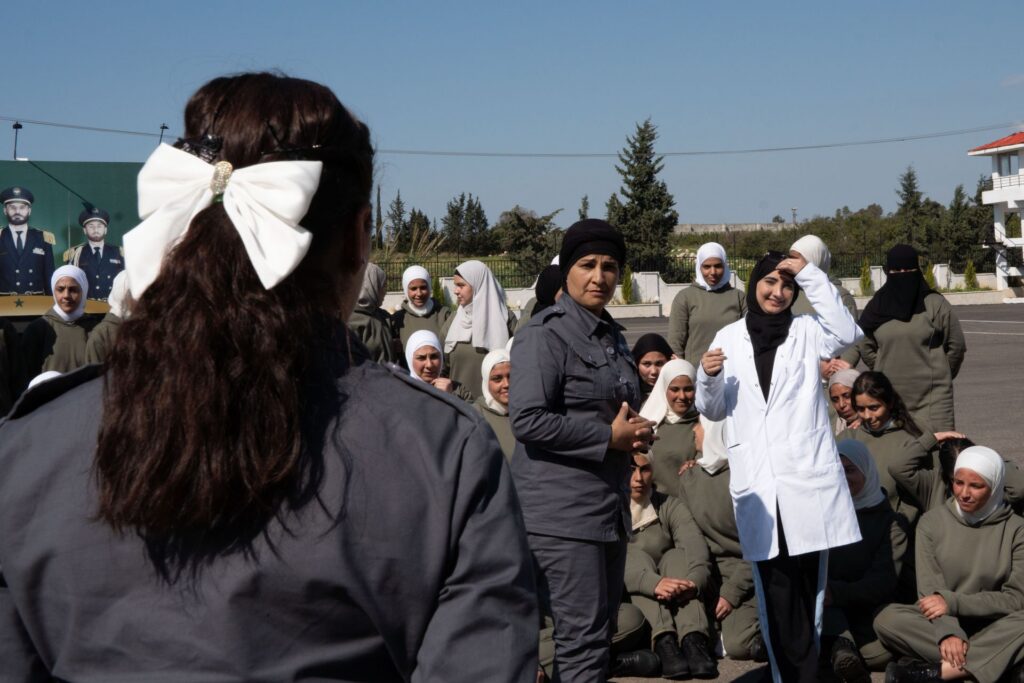
The al-Tall institute was being readied to accept students — it was formally inaugurated in mid-March. As I sat in Sarjawi’s office talking to her, team members came in with myriad requests. Some of them were asking about the installation of showers in the living quarters. A tailor came in a few minutes later, asking about taking measurements of the women to stitch uniforms.
Al-Syed admitted that, as in most countries, women face discrimination, but that it’s something she doesn’t pay attention to. She said that her dream was to develop herself and become a “mokadam” (senior officer) like al-Qataaneh.
“If there’s a man who looks at me in a discriminatory way, it should be me returning that gaze — I’m a woman, and still doing the same things as him. We do the same work, have the same salary,” al-Qataaneh said.
“Women have been present in this field; they are now and they will be, in the future.”
“Spotlight” is a newsletter about underreported cultural trends and news from around the world, emailed to subscribers twice a week. Sign up here.