

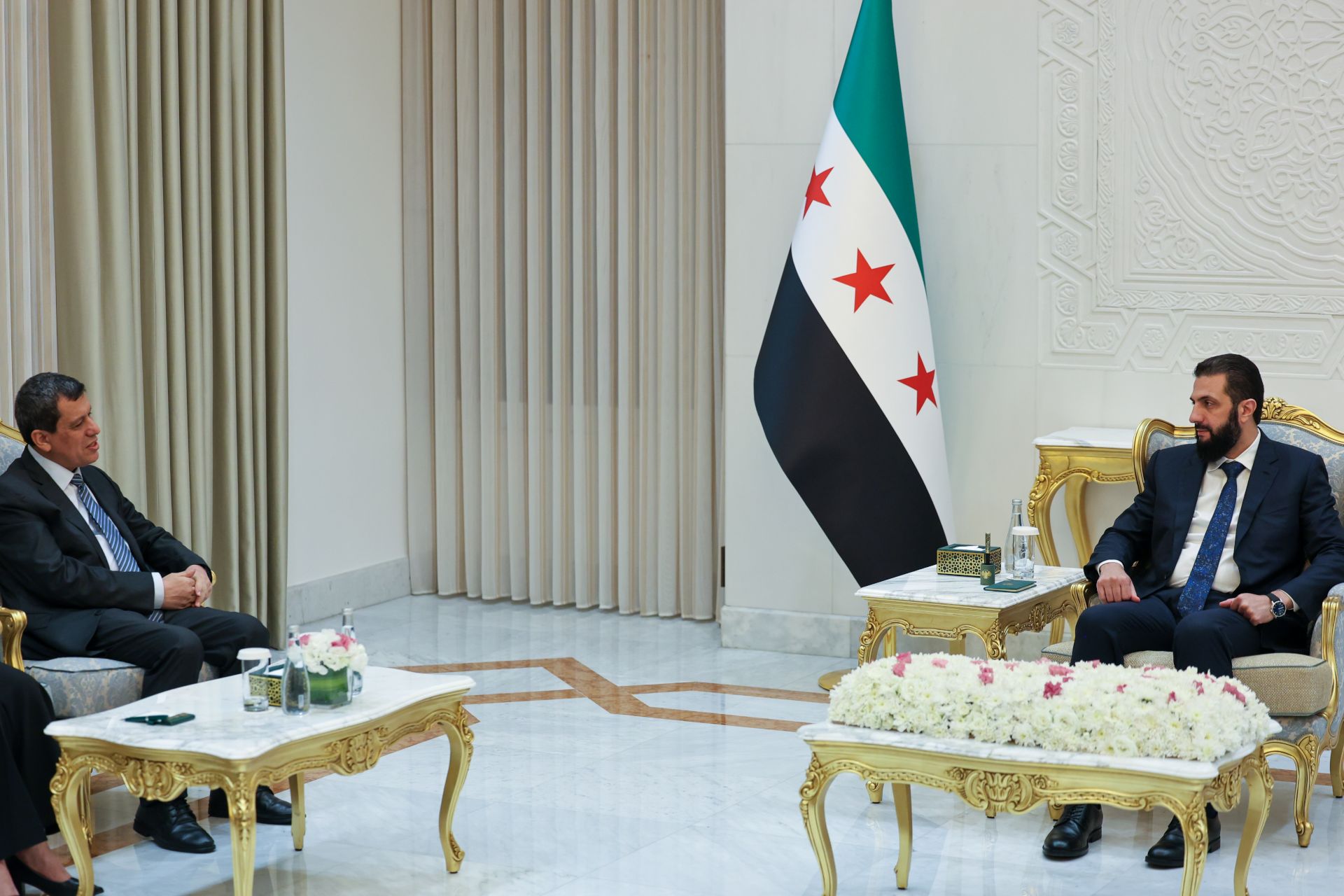
On Aug. 25, Mazloum Abdi, the commander in chief of the Syrian Democratic Forces (SDF), a Kurdish-led militia that had ruled swaths of northern and eastern Syria for over a decade, announced the group’s dissolution. This marked the end of the process of integrating SDF fighters into the Syrian Ministry of Defense. Three all-Kurdish brigades of the national army now serve in Hasakah and Qamishli, with a fourth in Kobani. That means Kurdish-majority areas are policed and guarded from external threats by local Kurds rather than by outsiders. Abdi has been appointed as an adviser to the Syrian presidency.
The integration process is a compromise for both sides. The dissolution of the SDF comes in concert with the winding up of the Autonomous Administration of North and East Syria (AANES) and the “Rojava” (or “Western Kurdistan”) experiment. This is experienced as liberation for many Arabs and others in northeastern Syria, who found SDF rule oppressive, but it also represents the end of Kurdish autonomy, leaving many Kurds wounded and worried about the future. For their part, many Syrian Arabs are discomfited that parts of their country are still managed by people who until recently ran their own state project, and who don’t necessarily believe in a unified and sovereign Syria.
But still, the process has more or less worked, and the northeast is no longer at war. A Syrian solution has been arrived at, rather than an international conflict. It could have all happened very differently, and Abdi and Syria’s transitional President Ahmad al-Sharaa should be credited with avoiding much worse scenarios.
In late November and early December 2024, while al-Sharaa’s Hayat Tahrir al-Sham (HTS) rebels were seizing Syria’s western cities from the collapsing regime of Bashar al-Assad, from Aleppo in the north via Homs to Damascus in the south, the Turkish-aligned militias of the so-called Syrian National Army (SNA) advanced eastward into SDF-controlled territory. Backed by the Turkish air force, the SNA took Tel Rifaat and Manbij from SDF control. In Manbij, according to a Kurdish resident I interviewed for my recent book on post-Assad Syria, SNA fighters and Arab residents together drove Kurds from their homes, which they then looted.
Motivated by homesickness as well as revenge, the SNA fighters wanted to continue. Many of them had been pushed out of their home areas in eastern Syria by the Islamic State group, then prevented from returning by the SDF. There were clear signs, too, that the Arab population of northern and eastern Syria would welcome a larger battle. As HTS arrived in Damascus, armed civilians attacked checkpoints in the city of Deir ez-Zor, and Arab fighters in the SDF defected. The city had liberated itself by Dec. 11, 2024, three days after Assad’s flight to Moscow.
The encouragements for war were plentiful. Both sides would have found powerful state backers: Turkey sponsoring Damascus, and Israel the SDF. The SDF had no wish to compromise with its archenemies. For their part, the SNA fighters were raring to go.
But al-Sharaa restrained them. Instead, he and Abdi signed the March 10, 2025, agreement to reintegrate the northeast into the Syrian state. This statement of intent was supported by the United States but opposed by hard-liners on both sides. The procedural nitty-gritty was consigned to committees. Each side understood the terms of the agreement differently. Often, the process seemed destined to fail.
Yet al-Sharaa and Abdi persevered, reining in both their respective hard-liners and cadres on the ground. For this reason, I’ve heard one Syrian journalist suggesting, and only partly tongue in cheek, that the two men deserve the Nobel Peace Prize.
Perhaps they do — even Henry Kissinger won the Nobel once, so it’s not a high bar — but if they do, it’s for their intelligent reading of reality rather than for any inherently pacific orientation. Both men have risen by accurately evaluating the potentials and risks presented by their changing environments. Both have survived the vicissitudes of the long Syrian conflict by understanding that war, like politics, is the art of the possible. When fighting is likely to achieve their aims, they fight. When it’s more likely to lead to disaster, they usually refrain. Unlike Assad or Israel’s Prime Minister Benjamin Netanyahu, their judgment has only rarely been clouded by hubris.
The March 10 agreement came only a few days after an Assadist insurgency on the coast, followed by sectarian massacres of Alawites at the hands of pro-government militias. The same Kurdish interlocutor who described the SDF defeat in Manbij told me that Abdi was a fool to give al-Sharaa a victory at that moment, rescuing him from intense domestic and international embarrassment. But perhaps Abdi chose his moment well, when al-Sharaa’s ability to rule the country without the consent of its minorities was being thrown so dramatically into doubt.
There was at least one occasion last year when al-Sharaa misread reality entirely. That was in July, when his government sent troops to Sweida to exploit an outbreak of fighting between Druze and Bedouin militias. As any government would, al-Sharaa’s wished to establish a monopoly on violence in the country, and the Druze militias were resisting dissolution. But by leaping for a quick military solution rather than doing the necessarily slow and difficult political work, al-Sharaa seriously miscalculated. Interviewed for my book, the academic and militia expert Rahaf Aldoughli recounted how a senior pro-government military figure had told her in advance of the assault that he believed they would defeat the Druze easily, and that their victory would intimidate the SDF into folding.
What actually happened — as Aldoughli had predicted — was that the previously divided Druze closed ranks against the external enemy. Worse, the pro-government forces engaged (again) in sectarian massacres, burning entire villages. Israel attacked the government’s forces. But even if Israel hadn’t intervened, it’s inconceivable that the tens of thousands of Druze militiamen would have submitted to the militantly anti-Druze Islamist and Bedouin militias. After the debacle, Sweida was further away from central control than before.
The Sweida disaster boosted those in the SDF who rejected any compromise with Damascus. They launched a conscription drive in the northeast, a bout of tunnel building and other war preparations.
Fortunately, al-Sharaa and Abdi soon returned to their intelligent reading of context. In al-Sharaa’s case, the Sweida failure showed how dangerous hubris could be. And Abdi was clever enough to understand that even if Damascus had been weakened by its blunder, the SDF’s position remained strategically unsustainable. Its role as the ground force of the Global Coalition Against Daesh was being taken on by Damascus. The U.S. wished to withdraw its troops from Syria and would no longer act as the SDF’s sponsor. France was stepping in, to an extent, but not so far that it would reject Syrian sovereignty in the northeast. Western support added weight to the Kurdish negotiators, but always aimed for a reunified Syria. As for Turkey, its army sat ominously on the borders of Rojava while its parliament ratified a peace process with Abdullah Öcalan, the imprisoned leader of the Kurdistan Workers’ Party (PKK), the SDF’s parent organization. The threat of Turkish military action was the stick, and the peace process the carrot, motivating SDF compromise.
There were setbacks, but all the while they were outstripped by the forward movement preserved and pushed along by Abdi and al-Sharaa. Nevertheless, it took another outbreak of fighting to resolve things.
This came in January 2026. First, Syrian government forces pushed the SDF out of Aleppo city, then fought to remove it from the dam on the Euphrates River. At that point, the Arab elements in the SDF deserted en masse while government forces and armed civilians drove Kurdish fighters back to Kurdish-majority areas. There were abuses on both sides — but on a much smaller scale than in Sweida — and there was also continuous and intense negotiation. U.S. envoy Tom Barrack shuttled between Erbil (in Iraqi Kurdistan) and Damascus.
Eventually, a new agreement was signed to implement what had been laid out on March 10 the previous year: border crossings and oil fields to be returned to the central government, the SDF integrated into the national army, and full citizenship for Syrian Kurds along with cultural and linguistic rights.
Even with the SDF dissolved, tensions continue. Previously unregistered Kurds have now been recognized as citizens, but they have had to register as “Syrian Arabs,” given that the official name of the country remains the Syrian Arab Republic. Protestors have repeatedly ripped down a government sign in Hasakah because it wasn’t written in Kurdish. Arab tribes have set up “war tents” to show their disgruntlement that SDF cadres are still manning checkpoints. The future role of the SDF’s all-female Women’s Protection Units (YPJ) militia is disputed, as is the status of Kurdish-language instruction in schools.
But the disputes are being negotiated, or argued on social media, rather than with guns in the streets. Northeastern Syria has neither fallen into civil war nor become the arena of an international conflict. For now, reality has been read correctly; hubris has been restrained. Long may it continue.
“Spotlight” is a newsletter about underreported cultural trends and news from around the world, emailed to subscribers twice a week. Sign up here.