


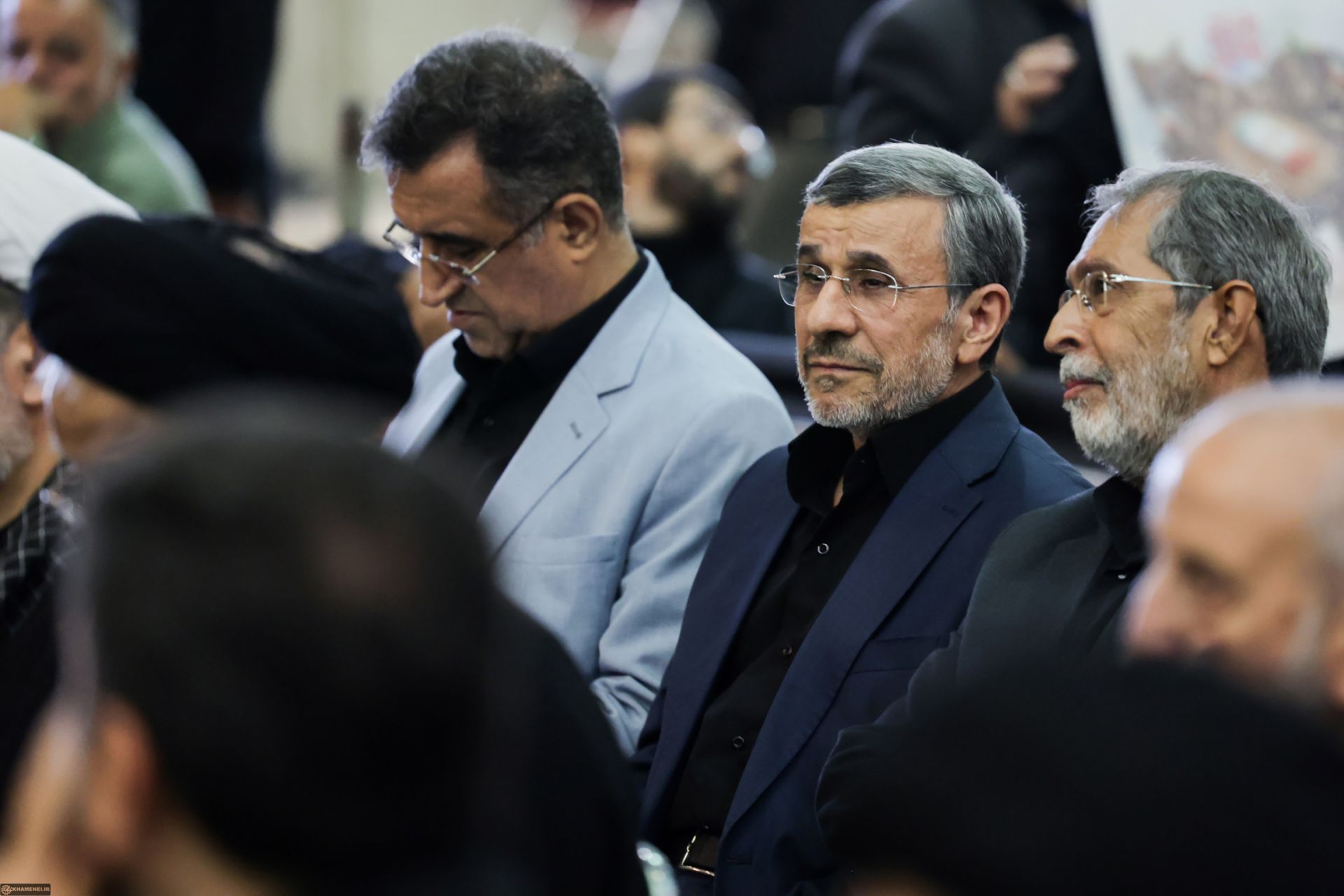
When he stepped down as the president of Iran in 2013, Mahmoud Ahmadinejad ceased to be a one-man news cycle, but he didn’t leave his controversial brand of politics behind. Still, few could have predicted the events involving the mercurial president in recent months.
In May, The New York Times published the outline of what appears to be a plan by Israeli intelligence to cultivate Ahmadinejad to lead Iran in the aftermath of the U.S.-Israeli war that started with surprise attacks on Iranian cities on Feb. 28. On July 13, Haaretz released more details of the astonishing scheme, codenamed Operation Puss in Boots, which it claimed had been personally approved by Israeli Prime Minister Benjamin Netanyahu.
After New Lines’ reporting last August that first examined the details of Ahmadinejad’s curious trips to Guatemala and Hungary after leaving office, The New York Times found out that the former Iranian president had met the then-director of Israel’s Mossad intelligence agency, David Barnea, in Budapest, where he traveled twice in 2024 and 2025 under the guise of academic conferences that never happened.
Once a sweetheart of Iran’s theocracy, Ahmadinejad was disqualified from running for president again three times after leaving office, which increasingly embittered him against the late Supreme Leader Ayatollah Ali Khamenei. The two men’s public estrangement offended many of the former president’s allies, who supported him on account of his unconditional loyalty to the senior cleric. It may be that Ahmadinejad’s putative rapport with the Israelis over a new role in postwar Iran was driven by his falling out with Khamenei.
One of Ahmadinejad’s relationships in particular lends credence to that interpretation. Mohammad Ali Ramin was a cultural adviser to Ahmadinejad, who is known for having instructed him on the Holocaust and Israel. Ramin’s top position under Ahmadinejad was deputy minister of culture between October 2009 and December 2010, a job in which he foregrounded his spiritual ideas, rolling out new restrictions on the press that led to multiple newspaper bans. He had reportedly pledged to pay a modest honorarium to news outlets that used the words “Imam Khamenei” in their headlines, referencing Iran’s late leader. He rescinded that offer under pressure from his seniors. He was also one of the companions who parted ways with his old boss following the rupture with Khamenei.
In an open letter to the former president in September 2012, ahead of his departure for New York to address the 67th U.N. General Assembly, Ramin urged Ahmadinejad to remember the favors Khamenei had done him, warning that inattention to the guidelines set by the ayatollah would “deliver heavy blows to our national and Islamic interests.”
“Why shouldn’t we introduce the idea of the guardianship of the jurist to the international community in order to correct the global structure and to guide humankind to ultimate salvation?” Ramin wrote, citing references from the Quran to make his point that the growing rift between Ahmadinejad and Khamenei was not theologically acceptable.
Any dealings between the famously antisemitic Ahmadinejad and Israel would be remarkable, but Ahmadinejad’s adoption of Ramin’s ideas and their later disagreements help to reveal the transformations that may have paved his way to that point.
While in power, Ahmadinejad polarized Iranian society along ideological lines. During his tenure, he spoke at the United Nations General Assembly eight times and gave more interviews to international media than perhaps any other Iranian official since 1979. But this excessive dependence on spectacle and publicity also laid bare aspects of his personality that seem to have impressed Israel, including a massive ego.
The populist politician who wished to impart simplicity and accessibility through his protocol-defying sartorial choices, gritty vernacular and countless public events had deeper motives for consistently courting attention.
In 2007, only two years into his presidency, Ahmadinejad approved the creation of what was dubbed the Council for Spreading Mahmoud Ahmadinejad’s Thoughts, a newly minted entity intended to disseminate his ideas through promotional activities. The nebulous council comprised some of Ahmadinejad’s stalwart allies and dissolved into oblivion after a while, but even some conservatives had found fault with it as being a stretch for a living leader.
Although conjectural, it seems likely that Ahmadinejad’s fixation on the Holocaust and his engagement with fringe revisionist voices on the subject were inspired by his desire to be seen as a singular advocate for a cause nobody else was talking about, rather than reflecting his curiosity about the historical event. Many Iranian academics warned that his Holocaust denial and inflammatory rhetoric about Israel would only drive a wedge between Tehran and the world and shore up sympathies for Tel Aviv.
Ahmadinejad’s ego also shaped the scale of his ambitions. Before becoming president in 2005, Ahmadinejad hadn’t left Iran other than on one occasion, but when he reluctantly handed the keys to the Saadabad Palace to his successor Hassan Rouhani, he understood the privileges that came with being the global face of a large, important country in West Asia. He didn’t want to lose those advantages.
For one thing, Ahmadinejad famously seized 26 official state cars and presidential limousines after stepping down and never surrendered them. On his last day as president, he wired 160 billion rials ($13.3 million in 2013) from the government treasury to a university he had just launched. As president, he made 119 international trips, often with a large entourage and groups of relatives, to countries that never became meaningful trade partners for Iran, including Benin, Djibouti and Comoros.
A political maverick with a yearning for power, Ahmadinejad would probably do anything it took to reclaim his former position, and if disowning his past and casting himself as a reformer looked like it could bring success through Israel’s support, then he might well have seized the moment. On a different front, Reza Pahlavi, the son of Iran’s former shah, was also vying for Israel’s attention. But he was apparently not the chosen candidate, if the Times and Haaretz are to be believed.
Mystery continues to swirl around Ahmadinejad’s fate. Not known for staying quiet, he hasn’t spoken out for months about the war on Iran and his own role in the unfolding drama. As such, it remains difficult to assess the accuracy of these Kafkaesque reports about his alleged maneuvers. But Ahmadinejad has evidently gone through a metamorphosis.
Although Ahmadinejad made commentary on the Israeli-Palestinian conflict a centerpiece of his platform and spent more time talking about the United States and Israel than any other foreign policy issue, he wasn’t an expert on these areas, and the ideas he aired about the Holocaust weren’t originally his. It is widely believed that Ramin helped to form Ahmadinejad’s antisemitic worldview and talked him into turning Holocaust denial into his political trademark.
As deputy minister of culture under Ahmadinejad, the office Ramin oversaw hosted the elected government’s media watchdog, the only organization outside of the leader-supervised judiciary that had the authority to restrict the press. Some of Iran’s most popular newspapers were shut down and banned on his watch, including Bahar, Hayat-e Now and Aftab-e Yazd.
Between 1977 and 1994, Ramin lived in Germany and studied at Clausthal University of Technology and Karlsruhe Institute of Technology. A student activist, he founded the Islamic association of Clausthal in 1982, currently known as Islamischer Weg (Islamic Way).
As a fluent German speaker, he was one of Ahmadinejad’s few foreign-educated confidantes, even though his international experience wasn’t entirely successful. In 1994, he was removed from Germany for his association with NPD, the National Democratic Party of Germany. In 2017, Germany’s constitutional court ruled against banning the far-right, extremist group even though it concluded that it resembled the Nazi Party.
Some of the conspiracy theories that Ahmadinejad rehashed, including the false claim that Adolf Hitler had Jewish origins and was one of the founders of the state of Israel, were references that Ramin had found in a 1974 pamphlet published by Hennecke Kardel, a neo-Nazi writer and army officer who died in 2007. Ramin, who was also influenced by the excommunicated French academic Robert Faurisson, reiterated those views in his own interviews.
In 2009, shortly before the disputed presidential election that extended Ahmadinejad’s tenure for another four years and precipitated Iran’s Green Movement, Jon Lee Anderson, a veteran staff writer at The New Yorker, traveled to Tehran and interviewed several officials, including Ahmadinejad himself. He also talked to Mohammad Ali Ramin.
“As I recall, he expressed widespread conspiracy theories that circulated widely amongst Islamists I had met over the years in the Middle East, and others beyond,” Anderson told New Lines of his meeting with Ramin. “There was an antisemitic tone to his beliefs, which again, were unsurprising to me for their ubiquity, especially in the years after 9/11, and most frequently expressed openly in the Middle East.”
Ramin’s life in Germany was ridden with controversy. In 1982, he was arrested and spent nearly six months in prison after an incident that involved a violent confrontation between a group of militant Iranian students supporting the new government in Tehran and antiregime dissidents fighting on a university campus. He said he was helping out as an interpreter and got entangled.
In a 2017 interview, he said that while in jail his cellmate was the “Iranian accused” in the Mykonos restaurant assassination trials that would happen a decade later, who was behind bars serving a different sentence then. He didn’t identify that cellmate or the reason he was first imprisoned, but two Iranian nationals were arrested in that case in 1992, when four Kurdish Iranian dissidents were killed in what was said to be an Iranian-sponsored operation. Kazem Darabi was sentenced to life and the other convict, Abdolrahman Banihashemi, managed to escape to Iran.
Ramin learned in 2003 that his visa to reenter Germany to give a talk at Islamic Way was now invalid. He hasn’t been allowed to go back to the country since. According to the Hamburg-based newspaper Hamburger Abendblatt, Islamic Way has been under surveillance by Germany’s Federal Office for the Protection of the Constitution for several years, because it considers it a “liaison” center for the Islamic Republic. The center founded by Ramin had previously organized rallies in Berlin calling for the “liberation” of Israel from Jews.
Ramin’s German-born son, Yasin, is a 45-year-old entrepreneur who was married to Mahnaz Afshar, a renowned Iranian actress and TV show host. Afshar announced in 2019 that they had divorced after five years together. Yasin Ramin spent seven months behind bars in 2017 following his indictment in a high-profile embezzlement case when the Iranian Red Crescent Society accused him of misappropriating funds he had received to import medical equipment.
Now, far from being a business partner with the Iranian government or a fan of its politicians, Yasin Ramin, who lives in Germany, openly supports Iran’s former royal family and espouses regime change as a solution to the country’s problems. He regularly appears on exiled Persian TV networks as a commentator on war, protests and the economy. His father remains an Islamic Republic apostle, though he doesn’t vouch for Ahmadinejad anymore.
Like many of his former allies who were antagonized by Ahmadinejad’s conceit and recklessness, Ramin fell out with him after his presidential term. During an April 2018 speech at the Razavi University of Islamic Sciences in Mashhad, Ramin suggested that he was observing Ahmadinejad’s decline, arguing “the enemy even hatches espionage plots for the religious singers and reciters of Quran, and Ahmadinejad was swept in this torrent.” He didn’t share specifics of what he meant.
Shortly after that speech, Dolat-e Bahar, a news website run by Ahmadinejad’s office, published the unusual claim that Ramin hadn’t ever worked with Ahmadinejad. The statement, which has since been deleted from the website, alleged that “the aforementioned individual had never worked as Dr. Ahmadinejad’s press adviser and essentially had no direct working or official relationship with the former president.”
In his 2018 public talk, Ramin mentioned some of the sternly worded letters Ahmadinejad had written to Khamenei, saying that it was Ahmadinejad’s conclusion after the 2009 events that the supreme leader didn’t have any other options to run the country but him. Indeed, Khamenei had squared up to almost every Islamic Republic heavyweight during the postelection protests to support Ahmadinejad, despite spiraling resentments against the incumbent.
In his Friday prayer sermon on June 19, 2009, Khamenei offered his unconditional support to Ahmadinejad, in what was widely interpreted as an ultimatum to the Green Movement protesters and Ahmadinejad’s critics, including the former President Ali Akbar Hashemi Rafsanjani, who had supported the opposition candidate. In the process, he also issued a rare public rebuke to Rafsanjani, his revolutionary companion, who had run against Ahmadinejad in the presidential elections four years earlier.
“Of course, there have been differences between him [Hashemi Rafsanjani] and Mr. President since the 2005 elections to this date, and they exist today,” Khamenei said. “They have differences on foreign policy issues, on how to administer social justice, and on some cultural issues, and Mr. President’s views are closer to my views.”
What the late ayatollah said became an inflection point in the history of the Islamic Republic of Iran, when many Iranians realized the establishment had taken a side, and they could no longer be seen as equal citizens. Ahmadinejad’s second term was marked by rampant mismanagement and corruption, but Khamenei never criticized him. The former mayor-turned-president, despite his antiestablishment reputation, had become the leader’s personal favorite.
According to Ramin, from 2009 Ahmadinejad expected to move on to something bigger and more rewarding. He said in his Mashhad speech that Ahmadinejad was approached by new advisers “who occasionally had foreign connections and convinced Ahmadinejad that on the international level, the establishment, the leader, and the name of Iran weren’t recognized, and he was the one who had to become an icon.”
In a 2020 interview, Ramin also said Ahmadinejad had developed “wrong” and “reactionary” ideas about the leader, which is why he decided to cut his personal ties with him. With the benefit of hindsight, it seems that Ahmadinejad had been agitating for defection as soon as it dawned upon him that he wasn’t destined to be anything more powerful than a retired former president, and this is something that Ramin had probably sensed.
In July 2008, Rasoul Montajabnia, a founding member of the reformist National Trust Party, wrote about the former president’s alarming invocations of messianic ideas in the Etemad-e Melli newspaper. He quoted an unnamed lawmaker who was present at a meeting between Ahmadinejad and Khamenei and said the supreme leader had objected to Ahmadinejad’s predictions about the 12th Shiite Imam’s coming after occultation.
“He [Ahmadinejad] responded after leaving the leader’s office, ‘He assumes that I am his president. I am the president of the Guided Imam,’” Montajabnia wrote.
It is difficult to say whether Ahmadinejad’s references to the eschatological Mahdi were rooted in his convictions or if he was using Shiite Islam’s promised savior as a cover for his personal project. But it is clear that Ramin both advocated for Iran’s role in paving the path to “appearance” as the only officially Shiite state, and insisted on the urgency of a Holocaust denial narrative. In both cases, Ahmadinejad may have borrowed Ramin’s rhetoric.
Bobby Ghosh, a geopolitics analyst and author of the Substack Ghoshworld, who had questioned Ahmadinejad during a 2009 press conference in New York as a Time magazine senior editor, has been skeptical of the putative plot to anoint the former president as Iran’s future leader, saying it contradicts Israel’s history of successful intelligence operations in Iran.
“I find it hard to believe that the Israeli intelligence service, which has a generally excellent track record on Iran, would come up with something this harebrained,” Ghosh told New Lines. “History tells us that stupidity is a prime mover in human affairs, so I’d never, ever rule it out, but this really strains my credulity.”
But as some Iran experts have observed, Ahmadinejad may have been considered by certain decision-makers in Israel as an agent of instability in Tehran who could take advantage of his influence, familiarity with executive institutions and popular base to complement the military phase of the U.S.-Israeli project politically.
“Although most people remember Mahmoud Ahmadinejad as a hard-line, anti-Israel president who denied the Holocaust and espoused Shiite messianic ideas, it was already clear during his presidency that he was also a populist and an opportunist,” said Raz Zimmt, director of the Iran program at the Institute for National Security Studies in Tel Aviv.
“As is well known, Ahmadinejad’s relationship with Supreme Leader Ali Khamenei deteriorated dramatically during his second term, after he dismissed his intelligence minister without the Supreme Leader’s approval. This triggered a serious confrontation not only between Ahmadinejad and Khamenei but also between Ahmadinejad and the Revolutionary Guards,” he told New Lines.
“It is therefore unsurprising that after leaving office, he came to be viewed by the establishment as a dissident. Several of his close associates were arrested on various charges, and he himself was barred from running in subsequent presidential elections,” he added.
According to Zimmt, the goal of regime change in Iran has been so important to Netanyahu that even making use of a politician such as Ahmadinejad to further that objective, despite his well-known ideology, was deemed permissible.
“Once a rift emerged between him [Ahmadinejad] and the political institutions of the Islamic Republic, it became relatively easy to try to exploit that divide and use him for various purposes, including against the Islamic Republic itself,” he said.
Ahmadinejad has been uncharacteristically quiet about the most consequential developments in Iran since 1979. His muted response to the 12-day war with Israel in June 2025, his silence after the January protests and his shrinking visibility after the U.S.-Israeli aggression in February point to, at least, a transformation in the mannerisms of a politician who was not a fan of being on the sidelines. The latest revelations about him suggest that he was willing to formally recognize Israel once he assumed authority in Tehran.
“His support in Iran comes from a sort of populist image now, which works well among people disaffected with the government. It would have been difficult, however, to sell that sector of the public on recognizing Israel,” said Mitchell Plitnick, a Maryland-based writer and president of the nonprofit think tank ReThinking Foreign Policy.
“During his time as president, his overt antisemitism, which was most clearly presented in his campaign of Holocaust denial, always seemed orchestrated,” Plitnick, the former director of the U.S. office of B’Tselem, told New Lines. “Of course, orchestrated or sincere, it was very harmful, even though a lot of his bellicosity toward Israel, certainly very real, was also amplified by the Western press to help demonize Iran, a process Ahmadinejad helped a great deal even then.”
Provided the recent leaks about Ahmadinejad’s deal with Israel are proven, then he has committed what any judicial system would classify as treason, something that he might have presumed his special ties with the former supreme leader would have covered up. But then, there are questions as to how Iran will respond to the scandal, and whether putting him on trial would involve the leadership admitting mistakes.
“If it was true, and Iran’s security services knew it to be so, wouldn’t Ahmadinejad be dangling by his neck from a crane by now?” asked Anderson, the New Yorker investigative journalist, who has also interviewed the former Venezuelan leader Nicolás Maduro. “If it was true, why would Israel, or the Times’ sources, presumably intelligence-linked, be so quick to out Ahmadinejad, a putative ally, publicly, and thus put him in mortal danger?”
“Spotlight” is a newsletter about underreported cultural trends and news from around the world, emailed to subscribers twice a week. Sign up here.