

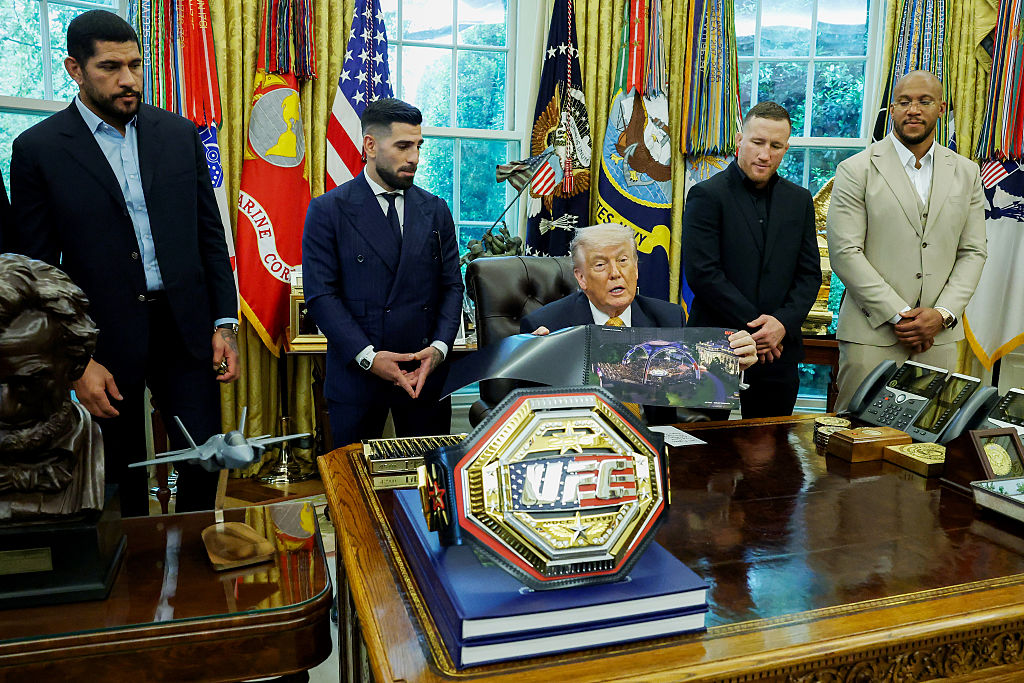
When President Donald Trump announced that “UFC Freedom 250” would be staged on the White House grounds as part of America’s 250th anniversary celebrations — conveniently coinciding with his 80th birthday — some critics complained that he had gone from commander in chief to entertainer in chief. Criticism came from the usual quarters. Sen. Patty Murray, a Democrat from Washington state, called it “out of touch.” A YouGov survey found that 51% of Americans disapproved of the event. Former wrestlers such as Dwayne Johnson reportedly declined invitations. But what was even more surprising was that objections came from UFC fighters themselves.
Trump, a man with a keen eye for show business, had conceived the event, to be held between June 12 and 14, as a celebration of the American fighting spirit. Even though the card featured Georgian, Brazilian and French fighters among its stars, it was being sold as a testament to the resilience of the American national character. Fight cards are usually built on a story, and this seemed like a great one.
But from the outset it troubled some of Trump’s formerly enthusiastic supporters. UFC commentator and podcaster Joe Rogan, whose endorsement was widely seen as helping Trump return to the White House, remarked in March: “Weird to have a fight at the White House in the middle of a fucking war.”
UFC president Dana White, one of Trump’s closest allies in sports and entertainment, brushed the criticisms aside and worked hard to marry this Trumpian vision of personalities, institutions and business. The event appears to contain all the ingredients that make Trumpism attractive: fighting, country music, energy drinks, cryptocurrency and big trucks, wrapped into one patriotic spectacle, complete with a ceremonial weigh-in at the Lincoln Memorial. What more could his fans want?
Except it wasn’t just Rogan who wasn’t buying it. UFC fighters such as Sean Strickland, Bryce Mitchell, Brandon Royval and even former champion Ronda Rousey expressed reservations.
That is surprising because, on paper at least, the event has everything a fighter could want: a historic venue, enormous media attention and the chance to compete before a sitting president. It is the modern equivalent of a gladiator fighting before a Roman emperor. But perhaps that is precisely the problem. As Royval, a Mexican-American fighter, put it, he wasn’t interested in fighting in front of millionaires and politicians, comparing the event to “The Hunger Games.”
Some of the loudest criticism has come from Strickland, the current UFC middleweight champion known for his controversial views and “America first” rhetoric. Strickland had previously supported Trump but has since turned against him over what he sees as the oversized role of Israel in U.S. politics, the war with Iran and the handling of the Epstein files. In a video, Strickland claims he was barred from attending Freedom 250 because: “The UFC higher-ups called me … and they said, ‘Sean, I’ve got to apologize but you’re not Israeli enough to go to UFC 250 Israel Edition.'” Strickland has threatened to protest outside the White House gates.
Strickland’s outburst fed into a wider online ecosystem of influencers and commentators, such as TikToker Ian Carroll, who have increasingly framed the UFC through the lens of its ownership history and alleged political connections to Zionists.
But while Strickland’s objections have become wrapped up in geopolitical grievances, an even more surprising and thoughtful criticism has come from Mitchell. The Arkansas-born fighter, whose reputation rests as much on conspiracy theories, Holocaust denial and populist commentary as on his performances in the cage, has argued that government exists to protect citizens rather than entertain them. In his view, staging a professional combat sports event in the White House amounts to “desecrating” an already “corrupted” government.
After all, there is something deeply unsettling about turning the South Lawn into a UFC cage while sponsorship packages run into the millions of dollars. It has the feel of a Roman emperor transforming the machinery of the republic into a personal stage while distracting the public with what the Roman poet Juvenal described as bread and circuses. Whatever one’s politics, it is difficult to imagine the White House as merely another venue for a pay-per-view spectacle without feeling that something important has been lost.
What Mitchell seems to be suggesting is that Freedom 250 was not conceived primarily to commemorate the American Revolution and its institutions. Rather, it was conceived by a president who understands better than most how television, branding and spectacle can be used to cultivate loyalty. A UFC card on the White House lawn feels less like an anomaly than the logical culmination of that worldview.
Trump is not Emperor Commodus of “Gladiator” fame. Yet there is something distinctly imperial about the image of Freedom 250: power no longer observing the spectacle from above, but placing the spectacle at the center of power itself.
In that sense, the debate over Freedom 250 is about far more than mixed martial arts. It raises a larger question about modern democracy: What happens when citizens cease to be participants in public life and become spectators instead? The fact that Strickland, Mitchell and others have raised their voices suggests that it is still not easy to hoodwink even the most mercenary of Americans when it comes to values cultivated over 250 years.