

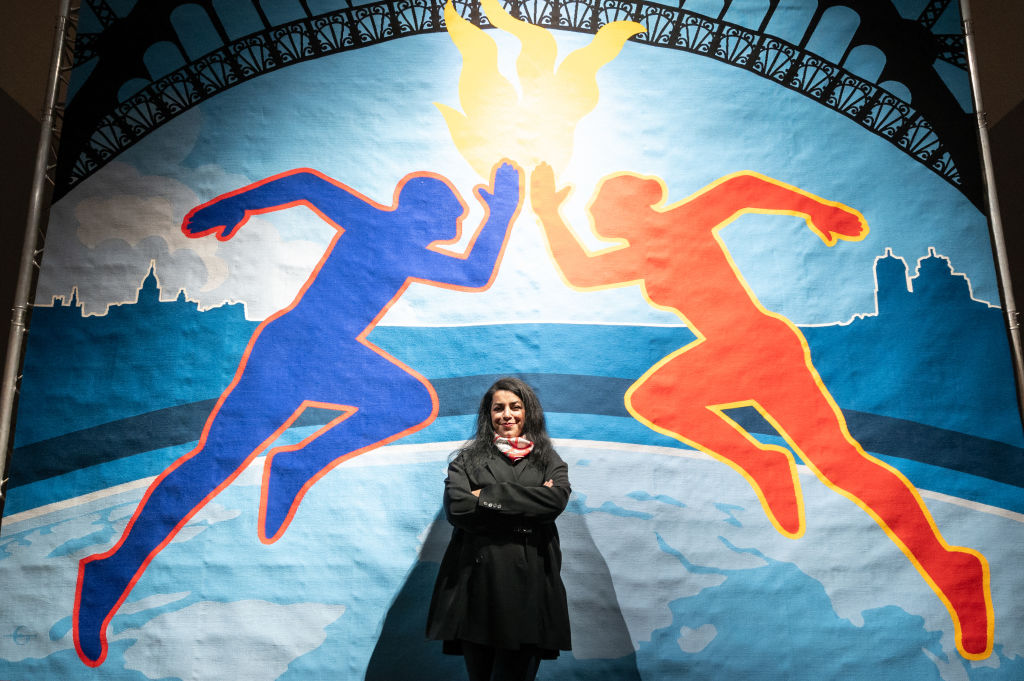
The death of Marjane Satrapi this week has revived a debate about the political reception of the Iranian cartoonist, writer, artist and filmmaker whose memoir, “Persepolis,” became one of the most acclaimed graphic novels ever published.
Tributes have poured in from around the world. But alongside the spirited praise came a wave of criticism from detractors who accused Satrapi of Orientalism, arguing that her work helped entrench Western stereotypes about Iran and Muslim women. The disagreement reveals something larger than just the legacy of a single author or creator. For over two decades, “Persepolis” has served as a flash point in a broader debate over how non-Western cultures are narrated to the world.
When “Persepolis” first appeared in France as a four-volume series released between 2000 and 2003, it was hailed as a breakthrough. Drawing on her own experiences of growing up in Tehran during the 1979 revolution, the memoir follows a rebellious young protagonist nicknamed Marji who is navigating political upheaval and, eventually, exile. Its humorous tone offered readers a glimpse into an Iran that did not exist in the charged coverage of hostage crises, nuclear threats and the so-called “Axis of Evil.”
Iranian women were frequently portrayed as either faceless victims or ideological fanatics, and Satrapi presented them as more complicated: politically engaged, complex, funny, flawed. Satrapi’s own parents were leftists, and her beloved uncle Anoosh was executed by the state for his communist associations. Satrapi often spoke about how her family joked, argued and mourned to endure the harsh rule of the Islamic Republic. Likewise, the book’s success rested on its ability to render Iranians not as strange symbols but as relatable people.
Yet, in recent years, a growing number of scholars and commentators have argued that “Persepolis” belongs to what some describe as a “neo-Orientalist” tradition. Their criticism is mainly that the book and film’s popularity in North America and Europe can’t be separated from the political context in which it emerged. Because it was published in the years surrounding the “war on terror,” the argument goes, “Persepolis” offered a picture of Iran that fit too comfortably within Western assumptions about authoritarian Islam and women’s oppression. Some have portrayed Satrapi as a “native informer” akin to Afghan-American novelist Khaled Hosseini, whose novel “The Kite Runner” became a staple of the post-9/11 literary canon but was also criticized by some commentators for presenting Afghanistan in a similar way. These critics argue that Satrapi’s work has been absorbed into broader narratives that have been used to justify sanctions and foreign interference aimed at regime change in Iran.
But these critiques are not without their critics.
Many scholars have argued that “Persepolis” actually achieved the opposite of what its detractors claim: Rather than reducing Iran to a caricature, it complicated stereotypes by foregrounding political and ideological diversity and class differences. Cultural critic Negar Mottahedeh, whose 2019 book “Whisper Tapes” examines the American feminist writer Kate Millett’s engagement with the Iranian revolution and the debate it occasioned, told New Lines that Satrapi’s memoir depicts a society united in opposition to the shah but deeply divided over what should follow, producing “an abundance of divisions and factions” that is “hardly stereotypical” — a departure from the monochrome portrait of the 1979 revolution as purely Islamic in character.
Others have pointed out that Satrapi’s target was never Iran as a culture but rather political authoritarianism. Far from glorifying the West, her work and public stances repeatedly critique Western interference. In a 2012 talk, Satrapi dismissed simplistic notions of an East-West divide altogether, arguing that the real divide in the world is “between fanatics and everyone else.” More than a decade later, she declined France’s Legion of Honor, citing her “principles” and attachment to her “birth country,” while rejecting the “hypocritical attitude of France toward Iran.”
Satrapi herself consistently rejected the idea that she was attempting to explain an entire country. Her goal, she said, was much smaller and more personal. If audiences came away viewing Iranians as human beings rather than as abstract categories like “terrorists” or “Islamic fundamentalists,” she considered it an accomplishment.
“Satrapi spoke very much from her own personal experience. But it also was representative of the experience of so many Iranians,” Nahid Siamdoust, the author of “Soundtrack of the Revolution: The Politics of Music in Iran” (and a contributor to these pages), told New Lines. Siamdoust argues that the critique itself is Orientalist, “because it doesn’t afford Iranians — or an Iranian like her — the right to represent herself freely of those kinds of considerations, of that Western gaze.”