

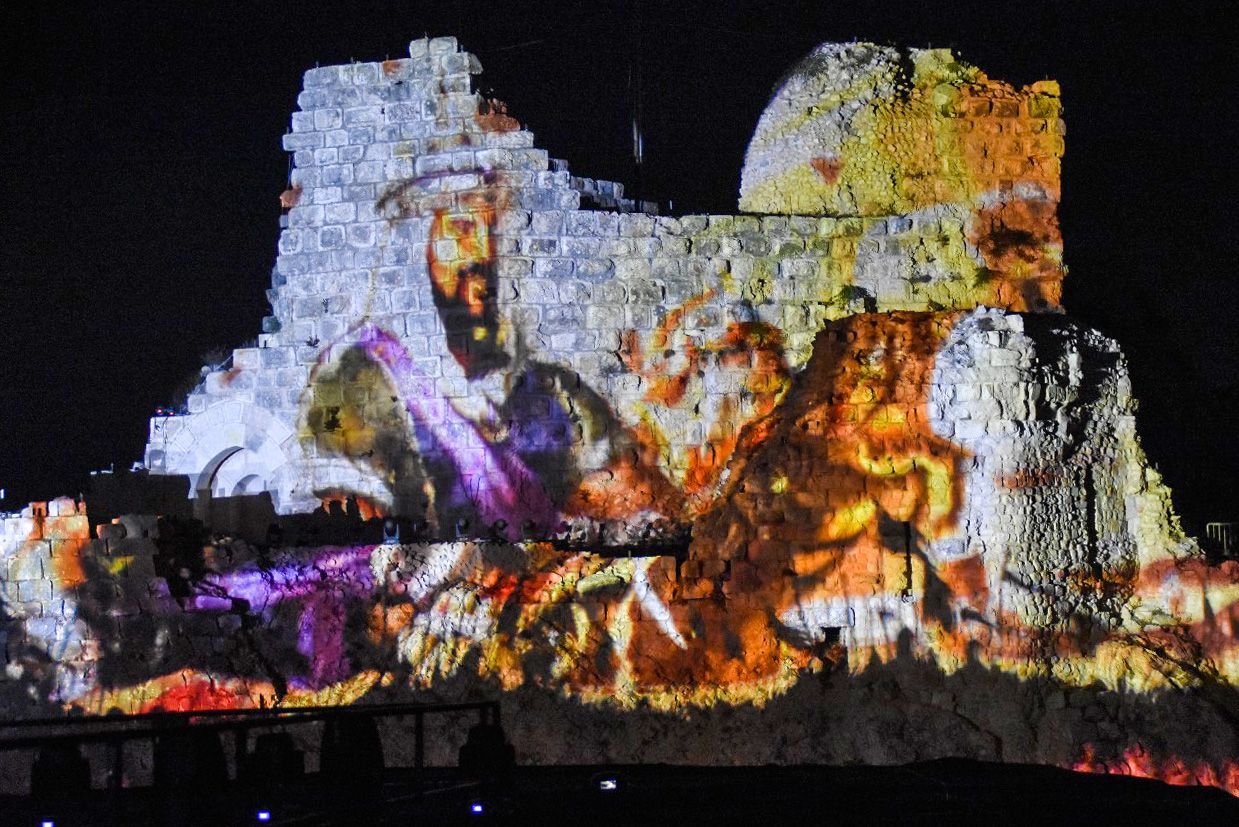
On Sunday, images circulated that felt like they combined different eras: Israeli flags raised over a Crusader-era castle in southern Lebanon. In a conflict defined by drones and electronic interceptions that require no physical presence, it was a significant moment. Its layers spanning nine centuries, Beaufort belongs to an older way of imagining war, one rendered through symbols like captured medieval fortresses and hilltop flags of foreign armies.
Built in the 12th century by Crusaders who called it Beau Fort (beautiful fortress), or Qalaat al-Shaqif in Arabic (fortress of the high rock), the UNESCO-registered heritage site (which enjoys “enhanced protection” status) sits on a limestone ridge above the Litani River, with views overlooking the valleys of southern Lebanon, almost all Litani River crossings, the Golan heights and the Mediterranean sea. It was taken by Saladin’s forces and later absorbed by the Ottomans, eventually playing a key role in the region’s more recent conflicts. “It has never been just a ruin,” noted Nada Bakri in her recent New Lines essay. A 2000 BBC article highlights its charged history: “Every invading army since the Crusades has seized, held and lost Beaufort.”
The latest assault comes amid a major Israeli escalation in Lebanon; the April ceasefire has proven futile even to the most optimistic of observers. The specific timing of the May 31 capture comes almost exactly 44 years after the Battle of Beaufort in 1982, one of the opening engagements of the Lebanon War in which Israeli forces seized the site from Palestinian fighters. When Israel eventually withdrew in 2000, Hezbollah marked the moment triumphantly, flying its own yellow flags from the site. This earlier battle carries its own symbolic weight, and is a key reference point in Israeli memories of their occupation of southern Lebanon. As military historian Danny Orbach, a New Lines contributor, told Reuters, Beaufort came to embody both heroism and, simultaneously, “the futility of war; the narrative that Israel has nothing to do with Lebanon.” The 2007 Oscar-nominated film “Beaufort,” directed by Joseph Cedar, portrays the final phase of the occupation in that vein.
The archaic symbolism of the site’s dominance over the surrounding landscape contrasts sharply with the technological environment of today’s asymmetric warfare. Some have pointed out that Beaufort is an odd site to reoccupy. Oliver Marsden wrote that its capture is more symbolic than strategic: In a drone-saturated war, holding a hilltop no longer delivers decisive advantage and can just as easily increase exposure. Axios reported that no Hezbollah weapons or fighters were even found at the castle, reinforcing the extent to which its significance appears to have been symbolic. Just a month earlier, a viral video showed a man climbing Beaufort Castle and removing an Israeli flag.
But while it might not represent any decisive gain in a conventional sense, it functions as psychological warfare and political theater in ways that drones and even exploding pagers cannot. Israeli military spokesperson Avichay Adraee posted that it was “a new shattering of the symbolism of the arrogance of the terrorist Hezbollah party, which threatened us with weakness only for its fortresses to crumble before our strikes.”
Statements from Israeli Prime Minister Benjamin Netanyahu and Defense Minister Israel Katz emphasized return and restoration, linking the capture to the 1982 battle and presenting it as a longer arc of unfinished history while carefully ignoring the many layers of occupation and withdrawal. The latter posted a video of Israeli flags raised at the site, boasting that they had “returned to the peak of the Beaufort and raised the flag of Israel and the flag of Golani over it once again.” This type of erasure is a familiar tactic across multiple chapters of Israeli military history in Lebanon, Syria and Palestine, where cycles of incursion, occupation, withdrawals and reoccupation are framed as singular moments of return: One commentator described Beaufort as: “an impregnable Crusader fortress that’s survived 800+ years of turbulent Middle East history. Then along came Netanyahu.”
Videos of the capture, first circulated by the Israeli military, were quickly reshared online with audio replaced by melancholic Fairuz songs, reframing them through Lebanese lament and loss. Hezbollah published footage showing a drone attack on an Israeli military position near Beaufort. Meanwhile, its critics contrasted its rhetoric of deterrence and victory with the visible reality of territorial loss. On X, Diana Moukalled mocked the response by Hezbollah official Hassan Fadlallah, who said Beaufort was merely a heritage site for which the Ministry of Culture was responsible. She argued that a movement that once mobilized public expectations around liberation now reduces its stance to treating the fortress as an archaeological responsibility. “This is not a mere slipup but a resounding political failure,” reformist politician Elie Mahfoud wrote in a post on X. “The Lebanese have every right to ask who brought the South to this humiliating scene after years of military monopoly.” Local media reported that residents in Tyre and Nabatieh petitioned for the Lebanese army’s full return to border areas, Hezbollah’s withdrawal from residential zones and the designation of both cities as open areas.
Another historical thread has remained less visible during this latest occupation but tells of the broader geography of transnational militancy in southern Lebanon. Kurdish fighters associated with the Palestinians trained in the vicinity of the fortress during the early 1980s. Much of their story was reported on in English for the first time by Matthew Petti in New Lines, including the 10 Kurds who died in the 1982 battle with Israel, becoming some of the first ever martyrs of the Kurdistan Workers’ Party (PKK), “a history that continues to ripple through the region.”
There are few locations in the region that compress such dense historical layers in such a striking way. While the site’s strategic value is debated, this latest capture shows that it has disproportionate symbolic value. Beaufort Castle’s appeal endures because it anchors a familiar, almost archetypal image of what war looks like.