

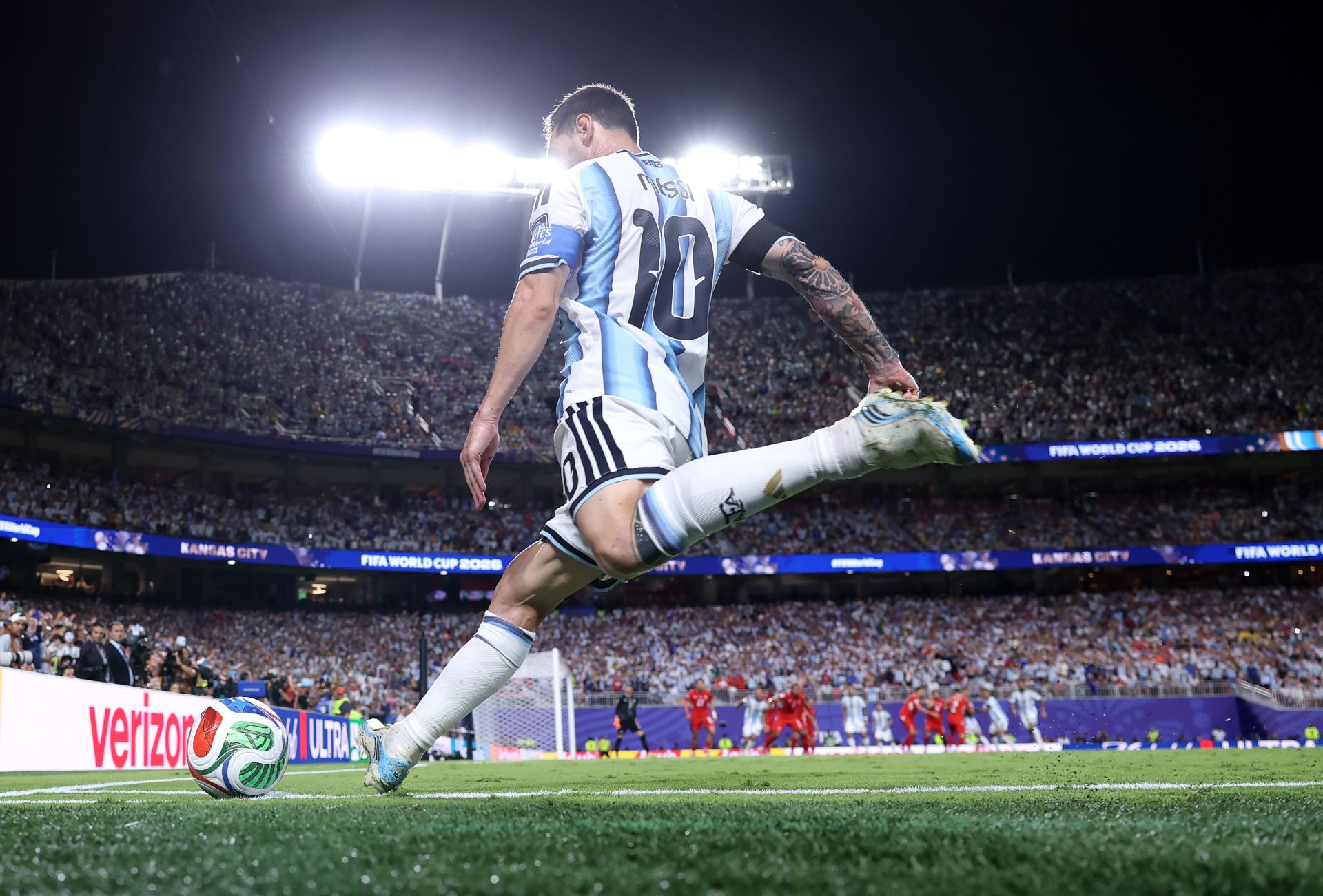
The World Cup came to an end this weekend, and with it my ability to stretch the remit of our magazine to the point where an unacceptable amount of time is taken up in editorial meetings debating the finer points of France’s midfield tactics and Jude Bellingham’s exacting fitness routine. It’s been an absolute pleasure, and I am incredibly grateful to you for reading and watching our soccer coverage these past weeks — whether it came in the form of Instagram reels, long-form essays, Running Notes or newsletters.
Soccer is “the most important of the least important things,” as legendary Italian coach Arrigo Sacchi once said. In a world crowded by many rather tragic important things, it was a joy to see the drama, cheers, tears, full and broken hearts — which, together, make up the day-to-day experience of following this sport — encompass the globe and my group of friends. To see the world enthralled by the upstarts of Cape Verde, scintillated by Michael Olise and Ousmane Dembélé, broken-hearted by Egypt’s exit. To see them obsess over Erling Haaland and his gentle-giant masculinity and sense of humor, wonder exactly how Marc Cucurella maintains the glorious bounce in his enormous mane of curly hair, and engage in Kylian Mbappé’s dictator memes.
Yet to me, one story rises above all the rest, and I find myself, in an almost religious sense, devotedly grateful for its coming to pass. It is the glorious last dance of a man who is perhaps the greatest to ever attempt to play this game — Argentina’s Lionel Messi.
My father was a Brazil supporter: He became a convert to the country’s “joga bonito” style that personified beautiful, flowing, attacking soccer after watching the 1982 World Cup, featuring legends like Falcão, Zico and Sócrates. He spoke with a glint in his eye about how they defended terribly but would just outscore everyone (except, in the quarterfinals, an Italian squad that went on to win the tournament). Naturally, therefore, when I started watching the World Cup, I picked Brazil’s rival Argentina, a gambit that largely failed in the late ’90s and early 2000s because the team was perennially disappointing.
That streak of disappointment continued with the emergence of the supernatural phenomenon that was Messi, though the team came close a few times, including losing the 2014 final to Germany. I was ecstatic when he lifted the trophy in 2022, when, in the words of commentator Peter Drury, he “conquered his final peak.” The tears streaming down his face as Argentina fell short on Sunday’s final underscored what it all meant — we would never again see Lionel Messi on the global stage that is the World Cup.
Those 20-odd years between Messi’s emergence out of La Masia, Barcelona’s youth academy, and his return, now, to the final of the World Cup are statistically extraordinary, and make an obvious case for why he is the greatest player of all time: over 900 career goals for club and country; over 400 assists; 46 trophies that include the World Cup, Copa America and the Champions League; and eight Ballon d’Or awards, given to the world’s best soccer player every year.
But the numbers don’t really tell the story of the last two decades, during which soccer fans witnessed one of the greatest rivalries in sports history between Messi and Portugal’s Cristiano Ronaldo, with both of them ascending to heights deemed impossible.
They also don’t tell another story — that moment when your eyes twinkle with delight at a Messi flicking pass and turn, the euphoric build-up that matches the crescendo of a musical chorus when he dribbles past one, two, three, four, five defenders to score a goal that equals Diego Maradona’s against England, or the hitch in your breath as he delivers an inch-perfect cross to the waiting header of yet another Argentine attacker. I still remember four years ago listening to Qatari commentator Khaled al-Hadi as he looked on in disbelief at a Messi assist against the Netherlands, a sensational pass that tore apart the Dutch defensive line in an instant to bring Argentina a step closer to the semifinals. Hadi, in a clip that has since become viral, kept repeating: “How did he see it? How did he see? How did he see him? How did he pass to him? How, how, how, how?”
Many had seen Qatar 2022 as Messi’s last real opportunity to win the World Cup. He was 35, had left Barcelona and would soon find himself in the American MLS league, a rung below the competitiveness of Europe’s top-flight competitions and another step toward that terrible moment when he retires from soccer.
And yet there he was at this year’s tournament. At 39, he delivered one of the most sensational World Cup performances in its 96-year history. He shattered a slew of individual records, becoming the all-time top World Cup goal scorer, with the all-time assists record and the most goal contributions. The final against Spain was his 34th World Cup match, and before the final two games of the tournament, he was leading the golden boot race with eight goals and four assists (France’s Kylian Mbappe ultimately won it after scoring two goals against England in the bronze medal match). At 39, he may well be a top contender for another Ballon d’Or.
And once again the numbers don’t quite capture the emotional resonance of the moment. Messi scored his first World Cup hat trick in the opening game against Algeria, but when his team was down 2-0 against Egypt in the round of 16, with 12 minutes left, he delivered an assist to narrow the gap, and then scored an equalizer before his country’s late winning goal, his tears of relief at the end underscoring the precarious nature of his final World Cup journey. Against England in the semifinals, he delivered two assists in five minutes at the end of the game to send the Albiceleste (the team’s nickname) into the final. This past weekend, though they lost, he had come close to scaling another peak he didn’t even need to conquer.
As an Egyptian, I will likely never cheer for Argentina again. But for this I am glad: that you and I got to watch him again, that the world had the chance to fly next to this particular Argentinian sun once again and simply bask in its shining glory.
Today, I will give thanks that I lived in the time of Lionel Messi.