



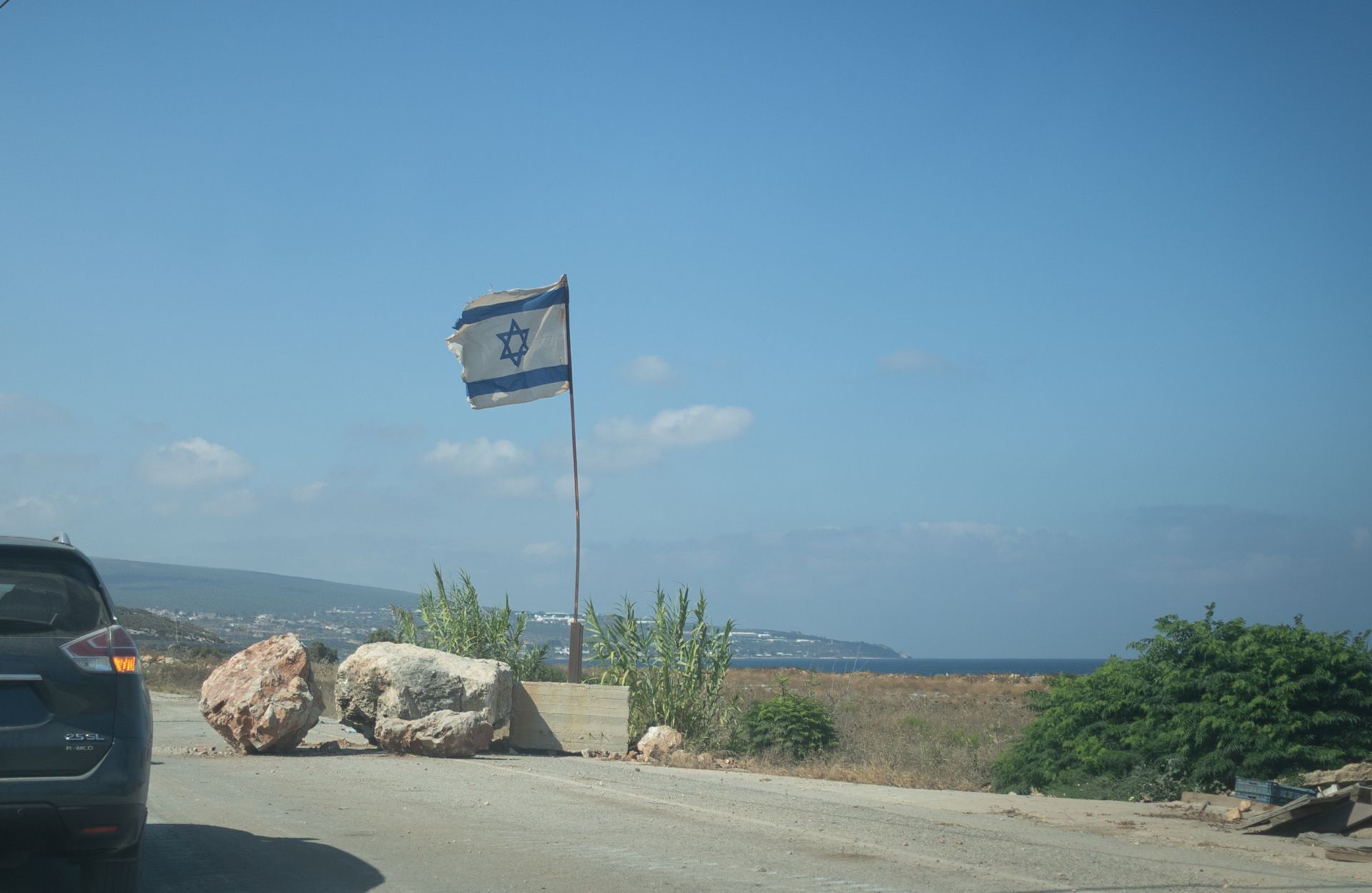
As the five-vehicle aid convoy made its way down the winding coastal road in southern Lebanon in July, a lone Israeli flag came into view. The vehicles stopped just before a closed swing gate. From our left came an order: “Go back!”
Roughly 10 yards away, Israeli soldiers stood on the balconies of two old stone houses. After a few moments, one of the men, a white megaphone in hand, repeated the order: “Turn around! You don’t have permission to pass.”
We were embedded with L’Œuvre d’Orient, one of several Catholic organizations providing critical aid to Christian villages located near Lebanon’s southern border with Israel. For the past few months, Israel has occupied the territory as part of a buffer zone aimed at eliminating security threats posed by Hezbollah. Replicating its Gaza strategy, Israel has systematically razed dozens of border villages within the territory. Only a handful of towns still stand, including the three villages of Ain Ebel, Debel and Rmeish, whose residents are predominantly Maronite Christians. Cut off from the rest of Lebanon, they depend heavily on humanitarian support for survival.
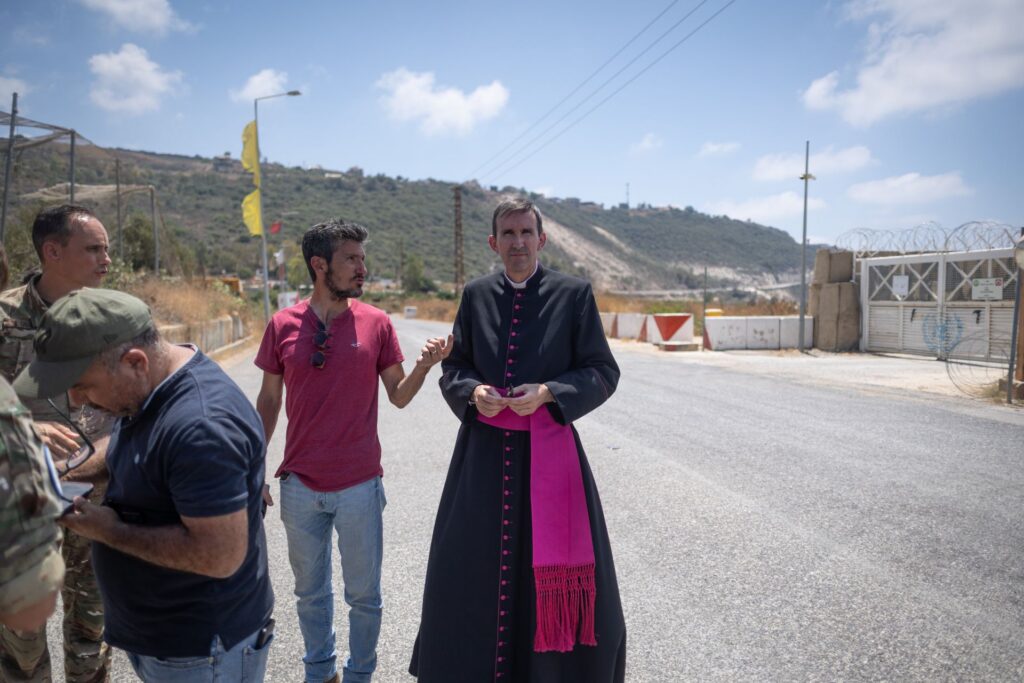
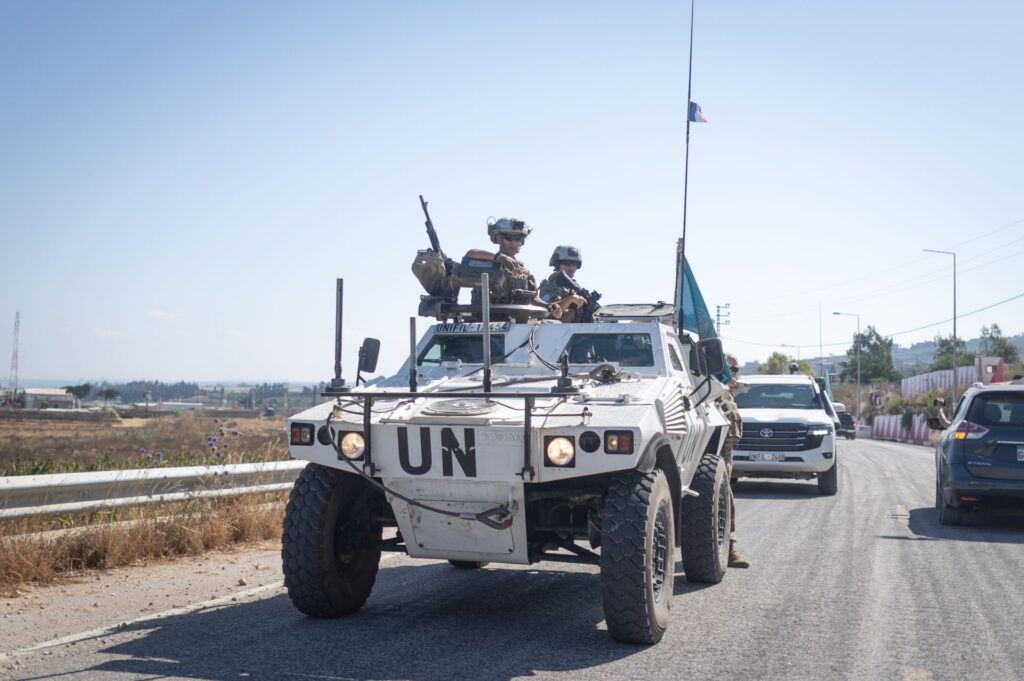
One by one, the vehicles turned around. The convoy drove a few minutes north before stopping outside a base belonging to the peacekeeping United Nations Interim Force in Lebanon (Unifil). From there, L’Œuvre d’Orient staff coordinated with Unifil intermediaries to try to secure access to the villages.
Israel controls all access to the occupied territory, restricting movement not just for organizations like L’Œuvre d’Orient but also for the several thousand people still living inside the area. Since the start of the latest war between Hezbollah and Israel in March, L’Œuvre d’Orient has made about 15 aid runs to the villages. To reach them, the charity must request permission from Israel through a multinational ceasefire monitoring committee known as the mechanism.
Typically, Israel gives L’Œuvre d’Orient the green light, but it’s not always a smooth procedure. In some instances, its staff have waited hours for the Israeli military to allow them to cross the so-called “yellow line” — the name given by Israel to mark the beginning of its occupation zone. In other instances, they’ve faced harrowing conditions. During an aid trip at Easter, their convoy ended up stuck in the crossfire of a battle between Hezbollah and Israel. It was then forced to turn around after one of the French peacekeepers escorting them was wounded by indirect fire.
Before departing with the charity for the aid mission in July, L’Œuvre d’Orient provided the names of everyone going on the trip to the mechanism. The convoy included L’Œuvre d’Orient staff, a Lebanese priest and more than a dozen local and international journalists.
L’Œuvre d’Orient’s mission that day was not a typical aid run. The main focus of the trip was to witness the launch of a renovation project for a sports zone in Ain Ebel, funded by L’Œuvre d’Orient and the French Unifil detachment. Having already opened a swimming pool for the village earlier this summer, the charity sought to provide additional recreational opportunities for youth in Ain Ebel by funding the expansion of a sports stadium to include space for soccer, basketball and handball. Through the project, L’Œuvre d’Orient hoped to give children and young people in the village a sliver of normalcy that might encourage them to stay in Ain Ebel.
Since March, most of the people living in the occupied territory have fled, including many of the Christian residents. As the war got underway that month, Israeli Defense Minister Israel Katz declared that Israel would replicate its Gaza strategy in southern Lebanon, establishing a buffer zone to remove security threats along its border.
Only about 7,000 people in total remain in Ain Ebel, Debel and Rmeish, said Vincent Gelo, the country manager of L’Œuvre d’Orient for Lebanon and Syria, who helped lead the aid convoy.
“We are very concerned about the existence of those villages,” Gelo said.
Speaking to us near the Unifil base, Hugues de Woillemont, the director of L’Œuvre d’Orient, emphasized how the charity sees the work that it does — alongside that of the Vatican’s diplomatic post in Lebanon, formally known as the Apostolic Nunciature, and other Catholic organizations like Caritas — as critical to helping residents to stay.
“This is important because it ensures a Lebanese presence in southern Lebanon,” said de Woillemont. “Without these villagers, there would be no Lebanese left in that part of Lebanon. Their presence is a presence for all of Lebanon, not just for Christians.”
Those still living in the villages have chosen to stay for multiple reasons. One is because of attachment to their land. Another is because they worry that they will never be able to return home if they leave.
Yet remaining is neither easy nor safe. While the Israeli military has not targeted the villages in the same way as other areas, attacks have killed and injured residents and damaged and destroyed homes and property.
With the Lebanese government only able to provide limited assistance to the villages, L’Œuvre d’Orient and other Catholic organizations fill a critical gap. Such support also reflects broader historical relations between French Catholics and their Maronite counterparts. While today L’Œuvre d’Orient works across the wider Middle East, its origins are in Lebanon.
“We have been supporting those villages since before the war,” Gelo said. “We know the people, the families, the mayors, the priests, the nuns. We are very attached to this country.”
Rev. Hani Tawk, a Lebanese priest from northern Lebanon who joined the convoy, has similar relationships. In addition to supporting displaced families in Beirut, his charity, La Cuisine de Mariam (Mary’s Soup Kitchen), is one of the other Catholic organizations helping to provide aid to the Christian villages in the occupied territory. Tawk sees the support as meeting not only the physical needs of residents, but also their spiritual and mental ones.
“When they see us, they think, ‘We are not alone,’” he said.
That day in July, we stood with Tawk in the shade of a truck parked on the opposite side of the convoy, trying to escape the scorching summer sun. Torn Hezbollah and Lebanese flags hanging from poles next to us fluttered in the wind. Destruction was present in every direction — a shell crater in the weed-infested field next to us, an abandoned Lebanese military checkpoint up the road, damaged homes on the slopes of hills. In the distance, we heard the familiar buzz of an Israeli drone. Then came the sound of a faraway explosion.
As minutes turned to hours, it became increasingly clear that Israel would not allow us to enter.
“We have tried,” de Woillemont remarked. Referring to the residents of the villages, he continued: “We have experienced for a few hours what these people go through every day.”
We waited more than four hours before we decided to head back north to the coastal city of Tyre. There, we thought, we could at least wait in the comfort of air conditioning.
After driving for a few minutes, Unifil told Gelo that the Israeli military had finally made a decision: We were not allowed to enter. A key reason, Unifil informed him, was the presence of journalists.
In hindsight, we were probably naive to think that the Israeli military would allow such a large group of reporters to enter the occupied territory, most of which now lies in ruins after nearly three years of conflict.
Since the end of the last Israel-Hezbollah war in late 2024, the Israeli military has steadily demolished homes and infrastructure that it claims have been used by Hezbollah for military purposes. It is impossible to know with any certainty which homes may have been used by Hezbollah and which ones were purely civilian, but the immense scale of destruction has prompted fierce backlash in Lebanon and beyond. Last year, Amnesty International called for an investigation into whether Israel’s systematic demolitions amounted to war crimes.
Much of the destruction has focused on villages made up predominantly of Shiite Muslims, members of one of more than a dozen religious sects in Lebanon who form the core base of Hezbollah. In a statement in March, Katz specifically mentioned Shiites, saying that hundreds of thousands of them would not be allowed to return home until Israel ensured the safety of its citizens.
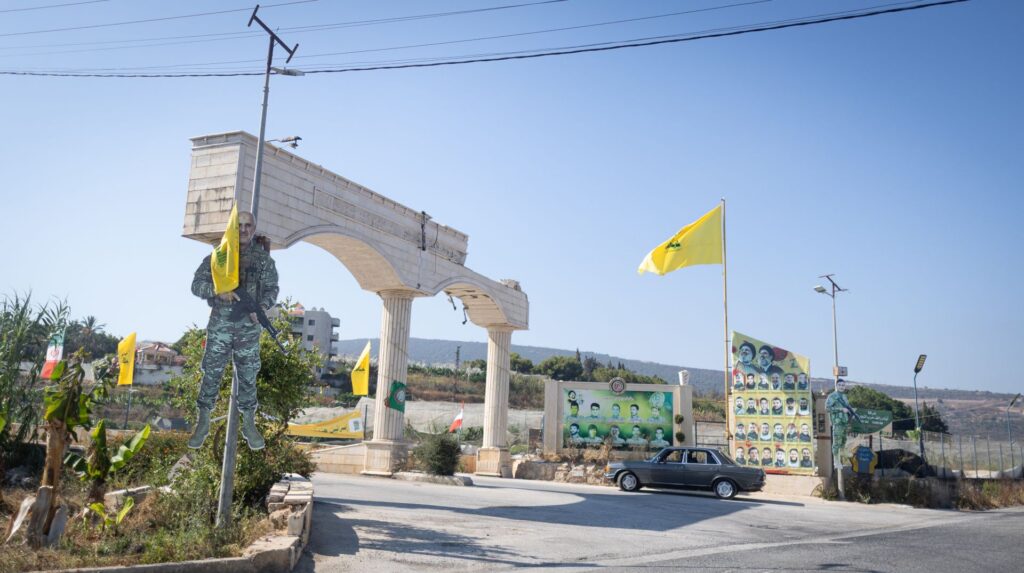
As war got underway in March, a priest in Rmeish told us that residents had received assurances through Unifil and the Apostolic Nunciature that Christian villages such as theirs would not be targeted by Israel.
Unaffiliated with Hezbollah, they would be spared from the worst of the Israeli onslaught. But that did not mean they would be unaffected.
In Debel, Fadi Felefli, a local priest, and other residents braced for another war that none of them wanted. From their homes, they watched the Israeli military bombing and entering nearby villages. Still, some families in Debel decided to leave.
On March 25, a friend invited Felefli to his house after a Mass service. As they sat drinking coffee, they saw Hezbollah launch a rocket next to a home on the outskirts of Debel where a family of three lived, Felefli said. Moments later, Israel returned fire with artillery, striking the house. While the mother and daughter living in that house were unharmed, the father was injured.
Felefli and his friend contacted the Red Cross, which told them that it was not allowed by Israeli forces to enter Debel. So instead, the duo sought permission through the mechanism to go and retrieve the injured man. After receiving approval, Felefli drove to the house and loaded the man into his car. Then he took him to Rmeish, where the Red Cross treated the man’s injuries before sending him north to another hospital.
As Felefli and other residents made their way back to Debel, they encountered Israeli troops who had blocked the road. Making the sign of the cross, Felefli said a quick prayer. He started honking at the Israeli troops.
“I wanted them to know that we are civilians,” he said.
The troops approached Felefli, but neither party could understand each other. Finally, an Israeli soldier who spoke Arabic showed up. Felefli told him that they wanted to return to Debel, but the soldiers told them to wait. They went back to Rmeish, where they waited a few hours before finally being able to return to their village.
For the next 42 days, Felefli said they lived effectively under siege, as Israel destroyed roads leading to Debel and prohibited residents from leaving and entering. The only way in and out was through the mechanism.
Around Debel, fighting raged between Hezbollah and Israel. People remained in their homes, terrified. As the days went by, they began to run low on supplies. People survived by eating whatever they had stored and collecting rainwater for drinking and cooking, Felefli said.
In Ain Ebel and Rmeish, residents faced similar hardships.
As the situation worsened, some aid did come in. From the Israeli side, the Christian humanitarian organization Samaritan’s Purse reportedly provided supplies through the Israeli military, which dropped them in a field near Rmeish. In Lebanon, the Apostolic Nunciature and Catholic charities organized aid convoys.
The supplies brought a breath of fresh air. “We felt like the suffering had started to end,” Felefli said. But their woes were far from over. The situation remained dangerous and challenging, especially as homes continued to be damaged and destroyed in Debel and the other Christian villages.
In May, about a month into a fraught ceasefire agreement, we spoke by phone with Nabil, a father who lives on the outskirts of Rmeish, just a few hundred yards from the border with Israel, and whose name was changed for security reasons. His home was heavily damaged during the 2024 war. He had just finished rebuilding it when the latest war began. As we talked, he lamented finding himself in the crossfire of Hezbollah and Israel once again. He said that the day before our call, bullets and shrapnel had hit his home.
“We’re feeling the house shaking more than five times a day, as if we’re living in a constant earthquake,” he said.
Adding to his woes were the ongoing movement restrictions imposed by the Israeli military.
“We are in a big prison,” he said.
Israel’s war in Lebanon has focused on Hezbollah, the Shiite group with which it has fought multiple wars. This has led Shiite-majority areas to bear the brunt of Israeli attacks. Nowhere is this more evident than among the dozens of destroyed Shiite villages surrounding Ain Ebel, Debel and Rmeish.
“The Israelis have essentially engaged in the ethnic cleansing of the Shia population in the area,” said Michael Young, senior editor at the Malcolm H. Kerr Carnegie Middle East Center, a think tank in Beirut.
In May, the open-source news organization Bellingcat analyzed satellite imagery and found that Israel had damaged or destroyed 46 of 54 villages inside the occupied territory. The destruction has continued steadily since then, despite a tenuous ceasefire agreement. In early August, Israel announced that it detonated a massive Hezbollah tunnel network near Lebanon’s Crusader-era Beaufort Castle using 700 tons of explosives. Meanwhile, Israel has gradually expanded the occupation zone, cutting off more villages from the rest of the country. In June, the southern coastal town of al-Mansouri found itself effectively cut in half after Israel redrew the “yellow line.”
On the same day as L’Œuvre d’Orient’s failed aid convoy in July, the Lebanese military launched the first phase of a so-called “pilot zone” plan that is aimed at facilitating an incremental withdrawal of Israeli forces from southern Lebanon. Under the terms of the plan, which is part of a wider “Trilateral Framework” agreement among Lebanon, Israel and the United States, the Israeli military is set to withdraw from designated pockets of occupied territory and hand them over to the Lebanese military, which is tasked with dismantling nonstate military infrastructure and acting as the sole security force in the area.
The framework agreement has faced intense scrutiny and criticism, especially from Hezbollah and its supporters, who see it as legitimizing the Israeli military’s occupation and ongoing strikes and demolition operations. Hezbollah also staunchly opposes the deal’s terms, which call for the group’s disarmament, something it deems an existential threat.
Proponents of the pilot zone plan see it as the most realistic option available for restoring Lebanon’s sovereignty and territorial integrity.
Young, the Lebanon expert at the Carnegie Middle East Center, laid out three conditions necessary for the plan to succeed.
“The first is that Israel must withdraw from all Lebanese territory. The second is that the inhabitants of the areas from which the Israelis have withdrawn come back relatively quickly to these areas. And the third is that the Lebanese state must immediately return to these areas and provide services to the inhabitants who decide to stay or who at least want to begin rebuilding,” Young said.
“Pilot zones are very useful if the Lebanese government and the Lebanese state ensure that there’s no vacuum in these areas that Hezbollah can take advantage of,” he continued.
Critics note that the framework agreement does not include a clear timeline for an Israeli withdrawal. Its current wording provides room for Israel to maintain its occupation absent a full Hezbollah disarmament. To avert an indefinite Israeli presence, Young argued that the U.S. must pressure Israel to fully withdraw.
“The Israelis have said they want to maintain buffer zones,” he said. “The pilot zones cannot be there to protect these illegal buffer zones. The Israeli withdrawal has to be complete, so that the Lebanese state gains credibility for having secured a full Israeli withdrawal.”
Paul Salem, a senior associate at the Center for Strategic and International Studies, a Washington-based bipartisan nonprofit, said that successfully implementing the initial stages of the pilot zone program would give the Lebanese government leverage with the U.S. in securing such a full withdrawal.
“Israel’s current position is that they will not withdraw before Hezbollah is fully disarmed,” Salem said. “But the U.S. position is not that. The U.S. position is probably, in a way, closer to the Lebanese position — that if Lebanon is able to effectively implement these pilot zones with support from the U.S. and the international community, then the U.S. would like Israel to negotiate the second phase of pilot zones, and the third phase, and the fourth phase.”
The next round of discussions between Lebanon and Israel, which will include talks on the pilot zone plan, is scheduled for early September. It is not clear exactly where the next pilot zones will be, or when they will be agreed.
Tawk, the Lebanese priest who joined us on the aid convoy, said he supports the framework agreement, seeing it as the only option left for Lebanon.
“Perhaps it’s a bad deal, but we don’t have a choice,” he said. “We tried the other choice. We lost thousands of martyrs and victims. We lost the war. We lost our territory. We cannot fight Israel.”
Gesturing toward the destroyed Shiite villages, he continued: “You think I am happy with this? No. Every time I return home, I cry. … They’re our neighbors, our friends. They’re our people, Lebanese people. But what can we do?”
Still, Tawk is skeptical that the Israeli occupation will end any time soon. The last long-term Israeli occupation lasted from 1982 to 2000. Tawk said he believes that the current occupation could be similarly long, possibly 10 to 15 years, given the deep animosity between Hezbollah and Israel.
“To resolve this problem, we need time,” he said. “It’s not a small problem. It’s not an accident between two cars. It’s a big problem.”
Back in Tyre, during our embedded trip in July, after receiving the final denial from the Israeli military, we returned to Beirut with L’Œuvre d’Orient. Later that afternoon, the charity hosted a Zoom call at their offices with the local leaders in Ain Ebel, whom we had planned to meet.
The call began with a discussion about the sports zone rehabilitation project, which had still launched as planned in the presence of French Unifil troops and local officials and residents. The conversation then shifted to the current difficulties facing Ain Ebel. The village’s mayor, Ayoub Khreich, said that thanks to the aid convoys organized by Catholic organizations and the local municipality, the village was no longer short on supplies.
“There was a period when things weren’t reaching us properly,” he said. “For about a month or a little longer, for example, we had no vegetables. There was no fuel, nothing at all. We also lost internet and cellular service. But that period passed. Now, almost everything is available again.”
Today, Ain Ebel faces different challenges.
“The current situation is difficult. We’re giving people food, but they’re out of work, and they have to deal with the new academic year,” said Sandy Diab, a member of the local municipality, who had come in person to L’Œuvre d’Orient’s offices. “There are a lot of other things to address besides food.”
One is agriculture, which forms an important part of life in southern Lebanon. Since the conflict started in 2023, Ain Ebel residents have been unable to reach their farmlands, leading residents to lose three seasons of olive harvests. The loss has affected not only the land but also people’s livelihoods, deepening the financial strains on families. Beekeepers, another staple of the region, have been similarly impacted.
Diab noted that the medical situation is another issue. There are no nearby hospitals, only a clinic that Caritas helped open to provide basic care.
Restriction of movement remains a challenge. Residents must request permission from Israel through the mechanism 48 hours in advance to move, with no guarantee that Israel will approve the request.
“We are still under siege. We are still trapped,” said Tony Farah, the deputy mayor.
Local officials said that Israeli forces are positioned on the outskirts of the village. Diab noted that, despite the ceasefire, “nothing has changed for us.” She said there are still daily explosions near the town of Bint Jbeil, some of which have damaged homes in Ain Ebel.
“There’s a lot of damage,” she said. “They [Israel] do whatever they want.”
While residents would like to continue staying in Ain Ebel, she acknowledged that such challenges make it difficult, especially given that no one knows how long the Israeli occupation will last.
“More and more people are considering leaving,” Diab said. “But we’re also very attached to our land. We’re very attached to our village. We don’t want to leave. We want to stay. We want to live a normal life. We want peace. That’s all we want. I hope the families won’t leave, but I don’t know how long this situation will last.”
Pierre Hanna Sleiman, a local priest, echoed her comments, saying that he and his parish want to remain in Ain Ebel. Yet he also acknowledged the current challenges, the uncertainty that lies ahead and the village’s vulnerable dependence on aid convoys.
“We place all of this in God’s hands, in the hands of the Virgin Mary, and we carry on with our lives,” he said. “That’s what we want to do here. But what does the future hold? We don’t know. We live day by day.”
Become a member today to receive access to all our paywalled essays and the best of New Lines delivered to your inbox through our newsletters.