



People who don’t watch professional wrestling, and even many who do, find the “sport” to be more than a little silly. When you combine absurd ingredients such as muscle-bound men in candy-colored tights slicing into their own foreheads with razor blades, fake-breasted women pulling each other’s fake hair, breathlessly earnest commentaries from dudes with muscles bulging under too-tight suits, fake-gold belts the size of Renaissance Faire corsets and storylines that make grandma’s favorite soap operas seem like children’s bedtime stories, the whole is improbably often even more farcical than the sum of the parts.
Mixed martial arts is a completely different animal. There are no scripted finishes, no deliberately oblivious referees ignoring a chair shot — and although there are fake-gold belts, they don’t change hands simply because a promoter decided it was time for a new champion. Like professional wrestling, and to some extent all sports, the Ultimate Fighting Championship (UFC) has “storylines”: grudges, rematches, trash talk, redemption arcs, villains, underdogs and plenty of prefight mythmaking. During its rise from relative obscurity to its current global brand, the UFC even employed its own pro wrestling-style “booker,” Joe Silva, to set up fights and storylines. But unlike what one sees five times each week on Netflix, TBS, TNT, USA and the CW broadcast networks, UFC fighters are actually trying to inflict pain and injury to the point of physically incapacitating one another.
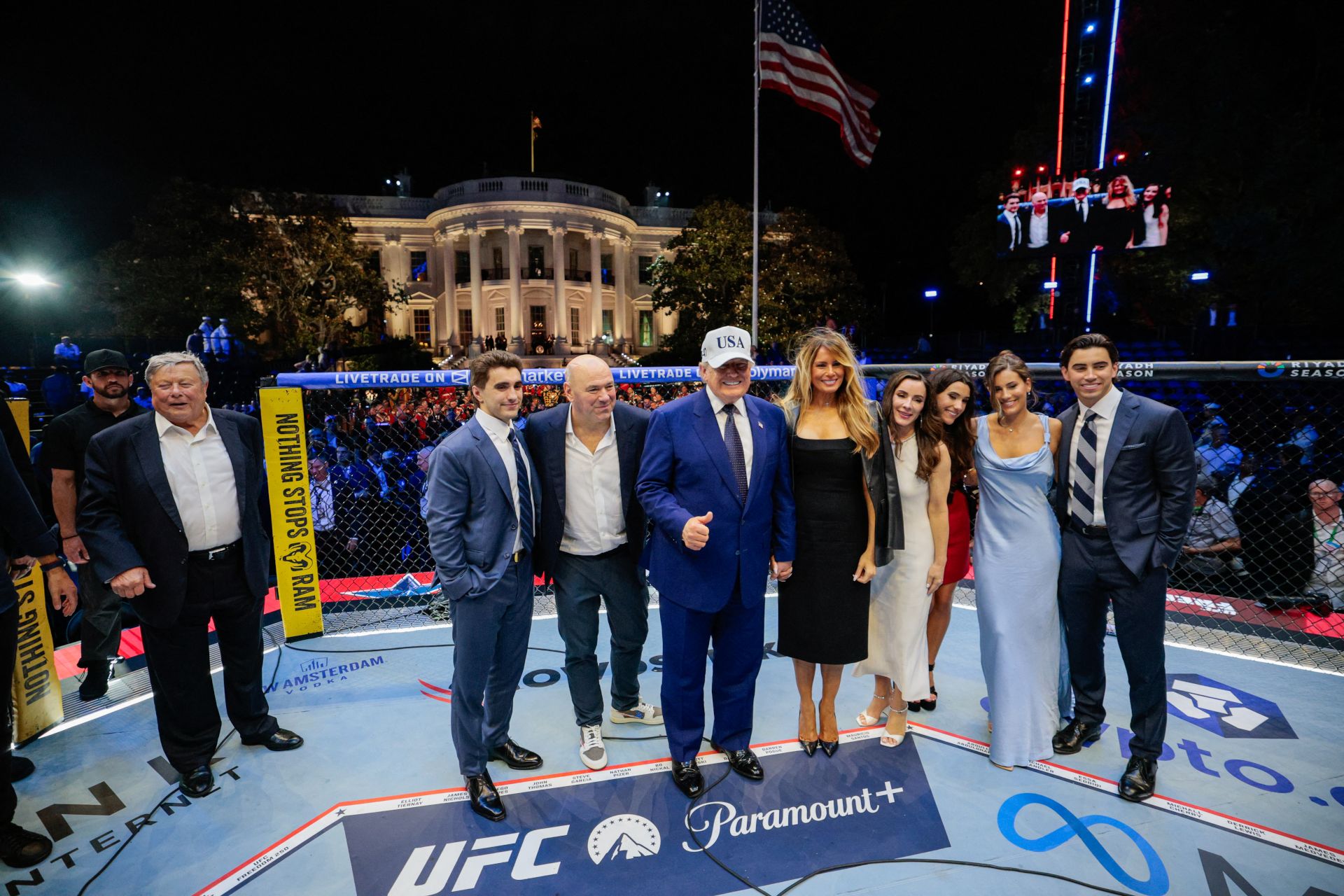
So what does it mean that Donald J. Trump, whose political persona was profoundly shaped by Vince McMahon’s World Wrestling Entertainment (WWE), chose to hold, instead of a professional wrestling match, a mixed martial arts event on the White House lawn? What does replacing the “squared circle” with the cage symbolize for the president, MAGA and the country as a whole?
According to White House spokesperson Davis Ingle, the answer is obvious. “This will be one of the greatest and most historic sports events in history,” Ingle said, “and President Trump hosting it at the White House is a testament to his vision to celebrate America’s monumental 250th anniversary.” “UFC Freedom 250” also fell on Trump’s 80th birthday, surely a coincidence and not at all relevant to the spectacle.
For the rest of us to really understand the significance of this event, we must return to the beginning of Trump’s relationship with WWE. As we recount in our recently published book “Kayfabe Nation: Professional Wrestling, Donald Trump, and the New Cynicism,” Trump’s relationship with professional wrestling began with the young Donald adoringly watching it on television. By the 2000s, he was regularly appearing as a version of himself in events held by the World Wrestling Federation (WWF) — the name of the organization until 2002, when it became World Wrestling Entertainment. Inducted into the WWE Hall of Fame in 2013, Trump became the first nonfictional U.S. president to hold that title. (“President” Dwayne Elizondo Mountain Dew Herbert Camacho from the movie “Idiocracy” beat him to this honor by over a decade.)
Portraying the character of the “good billionaire,” Trump sponsored a virtuous (or “babyface”) wrestler who bested McMahon’s villainous (or “heel”) proxy in an event dubbed the Battle of the Billionaires at WrestleMania 23. (Professional wrestling took this kind of lingo from traveling carnivals, where workers needed to discuss the mechanics of a con in front of customers — the “marks” — without being understood.) During the promotional buildup to the event, Trump cut numerous promos (wrestling’s term for televised speeches), trash-talking McMahon’s evil billionaire character. Trump’s relationship with McMahon during this period became remarkably close. McMahon is widely reported to be, along with Vladimir Putin, one of the only people in the world whose phone calls Trump takes in private.
The parallels between McMahon and Trump are lurid enough on the surface: the attacks on the media, the public contempt for prosecutors, the gross sexualized comments and storylines involving their own daughters, the opaque business failures and bailouts, the impunity and the strange centrality of Saudi money to both men’s empires. But our book shows that the deepest similarities are not merely biographical. McMahon and Trump together fundamentally changed the way modern media manipulates truth, belief and authenticity.
Understanding these changes in sports or politics requires a working understanding of “kayfabe.”
Kayfabe, as most wrestling fans know, did not start with Vince McMahon. Probably derived from a pig latin word for “fake,” kayfabe is the universal code among those in the professional wrestling industry to never reveal that the outcomes of matches are predetermined or that the storylines pushed as “real” by the industry (such as rivalries among wrestlers, love interests, even character deaths) are in fact fictions. Prior to McMahon’s near-complete takeover of the industry, wrestlers in independent regional promotions around the United States could be fired for instances of “breaking kayfabe,” such as fraternizing on their own time with their storyline rivals. Kayfabe had to be maintained at all costs.
By 1997, most fans knew that wrestling was entertainment, not an actual sport. Very few watching thought that Ric Flair and Ricky Steamboat actually hated each other or that whichever wrestler won a match had actually physically bested the loser. Still, everyone inside and outside the industry pretended not to know because, just like suspension of disbelief during a play or movie, accepting kayfabe was just a normal part of the experience of watching professional wrestling.
That all changed during the pay-per-view main event of WWF’s Nov. 9, 1997, “Survivor Series” at Montreal’s Molson Centre. Bret Hart, the reigning WWF champion and a Canadian hero, believed he would end the evening with his title intact. Hart would soon be leaving the WWF for rival World Championship Wrestling (WCW), and his contract allowed him creative control over the finishes of matches during his final days with the company. Hart refused to lose to his American rival Shawn Michaels in Canada, so McMahon agreed to let Hart instead surrender the belt to Michaels on the next episode of the “Monday Night Raw” television show, which would be filmed in the United States. But on the night of “Survivor Series,” McMahon double-crossed Hart in an event now forever dubbed the “Montreal Screwjob.” During the match, Michaels placed Hart in the Canadian’s own signature hold, the “sharpshooter.” Abruptly, referee Earl Hebner called for the bell, even though Hart had not submitted, and Michaels was declared the winner.
It was far from the first “screwjob” (a match in which a wrestler is genuinely double-crossed, usually through an outcome different from the one agreed upon beforehand) in wrestling history, but it was the most decisive one. Hart broke kayfabe in front of the thousands of fans in the arena and the additional million watching on television. He destroyed WWF equipment, traced the initials “WCW” in the ring and spit in McMahon’s face. The fact that McMahon, who in the storyline at the time was presented as just an announcer, controlled the outcome of matches behind the scenes had exploded into the story itself. Rather than try to cover up the incident, WWF acknowledged the screwjob in the storyline, revealing the fact that match outcomes were predetermined within the storylines shown on television.
Again, before 1997, most people knew that professional wrestling had predetermined outcomes, but the industry had pretended not to know this, and fans pretended that they still believed. The few who didn’t know (mostly children and the delightful handful of adult viewers who still believed the matches were genuine contests) could understand the storylines despite their ignorance of that fact. You didn’t have to know that outcomes were predetermined to follow the soap opera of storylines or enjoy a match. Crucially, after the Montreal Screwjob, you did have to know that. No one who thought that matches were actual fighting contests could understand how someone who had been treated as a ring announcer could call a match and change the predetermined outcome.
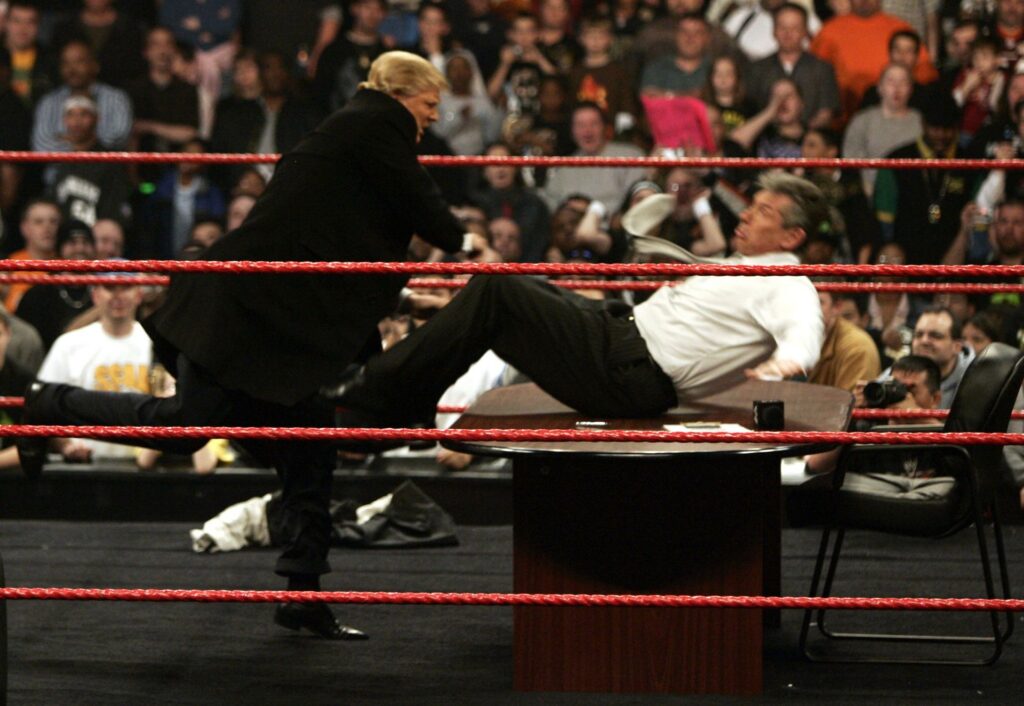
In the 2023 book “Ringmaster: Vince McMahon and the Unmaking of America” by Abraham Josephine Riesman (now Josephine Riesman), this condition is referred to as “neokayfabe.” Understanding wrestling after the Montreal Screwjob required that everyone was in on the secret that wrestling matches were predetermined, and that everyone knew that everyone else was in on the secret — but everyone still had to pretend that the secret was still a secret. Fans had to become postmodern spectators, tracking the fictional storyline and the real one simultaneously while accepting the enormous inconsistencies created whenever the fiction was revised in response to real events.
This is the situation that Trump stepped into during his appearances on WWE in the buildup to the Battle of the Billionaires. Every fan thought they were in on the con. They knew wrestling was fake, no one seriously pretended anymore that it was real, and no one cared because it was all in good fun anyway. Fans still rooted for their favorite wrestlers, and professional wrestling remained popular, but some of the magic was gone, and the Montreal Screwjob was arguably the beginning of the death of professional wrestling as it had been presented for more than a century.
At the time, many true wrestling fans thought that WWF would collapse as a result of the Montreal Screwjob. Fans hated what had been done to Hart, and since everyone now knew that McMahon wasn’t simply an announcer, audiences blamed him for Hart’s onscreen, real-life downfall. Improbably, instead of trying to fight this development, McMahon leaned into it. McMahon made himself (and by extension, the entire WWF) into the biggest heel in the entire professional wrestling industry.
Silliness was always part of the heel persona in professional wrestling. So McMahon didn’t become a scary, evil villain in the storyline as much as an angry, periodically humiliated clown. Our favorite instance of this narrative arc was when McMahon, while supposedly recovering from a broken ankle, was visited by wrestler Mick Foley (“Mankind”) and an actual clown named Yurple. The episode culminated with McMahon receiving unwanted affection from Foley’s hand puppet, Mr. Socko. Over and over, McMahon willingly allowed himself to become an object of mockery for fans while still holding all the power in the promotion — power he wasn’t afraid to wield against anyone who crossed him.
McMahon’s genius was to realize that the collapse of old-time kayfabe did not have to kill the show. It could make the audience feel smarter, angrier and more implicated in the performance. In our book, we describe four authoritarian tropes that WWE perfected after the final collapse of kayfabe and that Trump later perfected as political tropes: cynicism, buffoonery, misogyny and conspiracy.
Cynicism taught viewers that everyone was lying, so exposure no longer discredited the liar. Buffoonery made humiliation productive: Laughing at McMahon, and later at Trump, entertained the audience while bonding those humiliated by life to a leader who seemed to absorb their degradation and throw it back in everyone’s face. During WWE’s late-1990s “Attitude Era,” when the company embraced a more violent, sexually explicit and deliberately transgressive style, McMahon’s humiliations often took the form of Stone Cold Steve Austin attacking his tyrannical boss character. These confrontations gave viewers the fantasy of defying the neoliberal economic order: While today’s worker might not be able to punch his union card, he damn sure could punch his boss and win. Misogyny supplied the matching fantasy of overturning a liberal social order, turning the abasement of women into a ritual through which men could imagine the restoration of a patriarchal hierarchy. Conspiracy converted structural problems into the work of a small set of hidden villains who could be named, hated and theatrically punished.
Together, these tropes allowed WWE to keep selling a show that, by 1997, everyone knew was fake, and helped Trump sell a politics in which obvious falsehoods could still feel like insider knowledge two decades later.
The strange relationship with the truth forced on us by neokayfabe is not merely that of the liar or the bullshitter. It’s much closer to the axiom that Nietzsche attributed to the Order of Assassins, that nothing is true and therefore everything is permitted, or to the ancient paradox of a Cretan who declares that all Cretans are liars, a claim St. Paul cites as evidence against the Cretans without pausing over the point of the claim: If the speaker is telling the truth, the statement undermines itself. The person who tells you they are a liar is at least honest about that. This is a version of the lovable scoundrel character, or of the logic captured by the line often attributed to President Franklin Roosevelt about the Nicaraguan dictator Anastasio Somoza: “He may be a son of a bitch, but he’s our son of a bitch.” Trump is more genuine than his opponents because he is honest about being completely full of shit.
But why still tune in? Because openly embracing the false in these ways can be entertaining, especially when ordinary politics no longer seems capable of improving anyone’s life. When neither party appears willing to reverse austerity, offshoring, inequality, monopolization or the hollowing out of rural life, politics starts to look less like collective self-government than like choosing which team gets to humiliate the people you hate.
In replacing WWE with UFC, Trump appears to have thrown all this away. One possible reason why is that Trump has reached the material limits of neokayfabe. The problem with being in on the con is that eventually the con has to pay. Successful authoritarians usually, early in their reign, deliver real material gains to a constituency beyond their subset of the elite and begin with an inheritance of people already accustomed to political violence. Hitler had veterans, Freikorps remnants and street fighters shaped by war and counterrevolution. Putin inherited security services, oligarchic networks and mafioso habits of violence from the ruins of the Soviet state. El Salvador’s Nayib Bukele can point to the felt reality of streets made safer, even as he builds a horrifyingly dystopian carceral state.
Trump has done nothing to improve the material conditions of his base and has moreover failed to turn Immigration and Customs Enforcement (ICE) into a disciplined armed wing of his political movement. A federal bureaucracy, even one capable of immense cruelty, is not a movement’s street army. Jan. 6 was horrific, and nothing about this comparison should minimize the courage of the Capitol Police officers who fought, bled and were nearly crushed defending the U.S. Congress. But Jan. 6’s “Night of the Living Chuds” was also a reminder that spectacle is not discipline (and here we use “chud” to refer to ignorant reactionaries, following the podcast Chapo Trap House and their trenchant analysis of the subterranean monsters in the 1984 science-fiction horror cult classic “C.H.U.D.”). Used-car salesmen, divorced dentists, online supplement dealers and men dressed like minor characters from “Braveheart” do not a revolutionary army make. Trump could summon a crowd angry enough to smash windows and torture police officers. He could not turn that crowd into a loyal corps capable of making state violence feel like national rebirth. ICE harms vulnerable people, but it has not become the mythic instrument through which his supporters experience order restored.
And here we see the point of UFC over WWE for a failing regime. UFC offers the clearest image of what Trump has not been able to wield triumphantly in the United States of America: organized and trained violence, public domination and force as destiny.
This is also why UFC is a riskier symbol than Trump seems to understand. To its devotees, mixed martial arts can look like discipline, courage and mastery. To some people outside that world, it looks less like Achilles before the walls of Troy than like the nightmare image of prison violence we absorbed from shows like HBO’s “Oz”: a body trapped in a cage, surrounded by shouting men, with escape replaced by traumatizing submission. That does not make Brazilian jiu-jitsu holds equivalent to prison rape, any more than professional wrestling is equivalent to actual murder because someone gets hit with a chair. But symbols do not only mean what their fans want them to mean. For viewers not already mesmerized into admiring domination and the infliction of trauma for its own sake, the cage does not signify national rebirth so much as the fantasy life of bad men who mistake coercion for order.
If Trump were still an astute student of McMahon, he would have learned from WWE’s strangest experiment with attempting to perform authenticity under conditions of neokayfabe: Brock Lesnar. Lesnar was not a fake fighter pretending to be a real one. He had been an NCAA wrestling champion and UFC heavyweight champion before returning to WWE as “The Beast.” As a professional wrestler, his gimmick was that he was, in some unnerving sense, too real for professional wrestling. But again, by the 2000s, everyone knew wrestling was scripted. The trick was to make the audience feel the danger without destroying the form.
Lesnar threatened that balance. His 2016 SummerSlam match with Randy Orton featured so many real elbow strikes that the match ended with Orton bleeding badly enough to need 10 staples in his head. As the legendary professional wrestling manager and current podcaster Jim Cornette once complained about stunt-heavy wrestling, the wrestling business had moved from grown men pretending to hurt each other while fans believed it was real to grown men actually hurting each other while fans still assumed it was fake. At this point, he asked, “Who’s the marks?” The spectacle had folded in on itself: a real fighter playing a fake fighter playing a real fighter, hurting another wrestler for real in a match that remained, somehow, fake.
Reality can break neokayfabe, but not when it appears merely as blood, pain and domination. This is the lesson Trump should have taken from Lesnar. Once an audience has been trained to treat exposure itself as part of the show, even real injury can be absorbed as content. Lesnar did not bring WWE back to reality. Nor did he restore the box office of the Attitude Era. He did show how easily one kind of reality, the brutal kind, could be eaten by the performance.
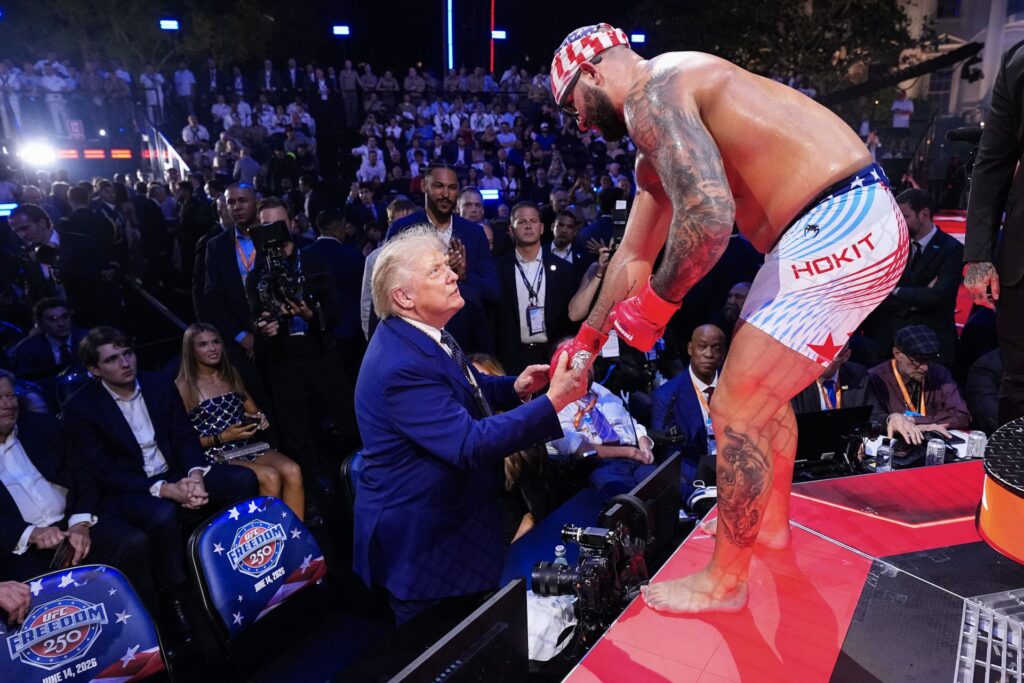
Trump’s decision to stage a UFC, rather than a WWE, match on the White House lawn can be read in a number of different ways. It could signal that he is giving up on allowing himself to look silly in service to popularity. Now in his final term, Trump no longer has to worry about pleasing his MAGA supporters. This is evident both in the sheer amount of grift embraced by the administration and in Trump’s increasingly careless dismissal of ordinary people’s economic lives. Defending the effects of his tariffs, he suggested that American children could make do with three dolls instead of “30” and five pencils instead of “250.” Asked more recently whether Americans’ financial struggles were motivating him to end the war with Iran, he replied, “Not even a little bit,” before adding, “I don’t think about Americans’ financial situation. I don’t think about anybody.”
After all, ordinary members of the public weren’t admitted to the White House grounds for the event. The military service members in attendance received free tickets but had to pay for their own transportation and lodging. They also had to meet strict height and weight requirements to ensure that the event would come across on television as aesthetically pleasing to Trump and Secretary of Defense Pete Hegseth. No such guidelines are in place for Trump and his overweight friends and business associates.
And for anyone still wondering what Trump means by “the American people,” the guest list and sponsors supplied a useful answer. Mark Zuckerberg, whose great contribution to public life has been placing manosphere sewage between family photographs and mattress ads, appeared as the avatar of platform capitalism. Paramount CEO David Ellison represented the new media baron: the nepo failson buying up the institutions that manufacture what still passes for American culture while depending on friendly regulators to decide how much of it he may own. World Liberty Financial, the Trump family’s crypto business, turned public office into a private financial product by contributing $250,000 to a fighter bonus pool paid in USD1, the dollar-pegged cryptocurrency it issues. Polymarket advertised on the cage amid crypto casinos, beer, pickup trucks, energy drinks and the official grill of the UFC. Even the closed captions were sponsored by Trump Coin, because apparently no function of this presidency, the broadcast or the English language itself could be permitted to escape the family gift shop.
The fights were unusually eventful by UFC standards, yet the political economy staged around the cage recalled nothing so much as the moment in the series “Trailer Park Boys” when Ray Flower begins tearing the copper plumbing out of his still-occupied trailer because he can sell it for liquor money. For now, the American empire continues to enjoy the privilege of issuing the world’s reserve currency, allowing it to borrow on terms unavailable to ordinary countries and sustain deficits that would punish weaker states much sooner. That immense advantage could finance infrastructure, industry and public goods; increasingly, it is captured by military contractors, financial intermediaries, platform monopolists, private-equity looters and political families finding new tollbooths to erect across public life.
UFC Freedom 250 somehow gathered the beneficiaries, intermediaries and carnival barkers of this extraction beneath fighter jets representing military adventures abroad, and all while the ruins of the White House East Wing gaped behind them, as if Ray had already opened the walls and started pricing the copper. Heavyweight Josh Hokit then supplied the event’s civic philosophy. After beating Derrick Lewis, he praised Trump, presented him with a medallion and promptly declared that Michelle Obama was a man. Beat somebody senseless, kiss the ring and spread one of the favorite lies of a visibly decaying old man who increasingly stages his senescence by offering unsolicited appraisals of the strapping young male bodies with whom he surrounds himself.
Hegseth’s insistence that the military audience satisfy height and weight standards belonged to the familiar grammar of dictatorship spectacle: Curate the bodies surrounding the ruler so they can perform a vitality that Dear Leader’s body was never required to possess. One parallel is to the infamous “Collision in Korea.” This 1995 professional wrestling show was promoted in Pyongyang, North Korea, by legendary Japanese wrestling promoter Antonio Inoki to celebrate Kim Jong Il’s installation as North Korea’s Supreme Leader. But where Kim Jong Il wanted to mask his country’s brutality under a veneer of theatricality, Trump’s UFC event was the opposite, reflecting the president’s turn away from theatrics and toward brutality by promoting a sporting event where hurting someone is the point.
Another way to understand this event is that Trump’s symbolic wars against the media; diversity, equity and inclusion; and the “deep state” have increasingly given way to more literal spectacles of state violence, especially around immigration and foreign enemies. The smoke and mirrors are not gone, but instead the deception has become cruder and more dangerous. A UFC fight on the White House lawn doesn’t mean that Trump has decided to tell the truth. In one sense, he has been telling us the truth all along: The lies were the point, the joke, the shared password, the kayfabe everyone was supposed to know was fake. What the turn to UFC suggests is that Trump is done pretending the performance is for his supporters’ benefit. MAGA thought they were in on the con. They thought they were smart marks, laughing at the suckers who still believed in the old rules. They thought the new boss was on their side against the old bosses. Instead, Trump put them in their own signature hold and called for the bell.
Under the neoliberal order ushered in by decades of political triangulation by both political parties and the rise of increasingly conservative rule in the United States, politics became kayfabe. Under Trump, it became neokayfabe.
Like Bret Hart in Montreal, the people who thought they understood the business have been screwed.
Become a member today to receive access to all our paywalled essays and the best of New Lines delivered to your inbox through our newsletters.