


Some 60 miles northwest of Mexico City, way up in the rugged mountains of Michoacan, are dense oyamel forests. Scientifically, the oyamel tree, a type of conifer, is called Abies religiosa, meaning “sacred fir.” It earned this holy connotation because its branches look similar to hands folded in prayer, and the association deepened because locals use those boughs to decorate churches at Christmastime. To get to Michoacan’s sacred forests, I first came to Angangueo, an old mining town of red-tiled roofs, cobbled streets, a 19th-century Notre Dame lookalike and sprawling, colorful wall murals that tell the story of greedy tycoons who exploit this place. It was here, in Angangueo, that I linked up with an armada of Mexican cowboys who led me on horseback into the oyamel forests to see the biggest (and most spectacular) butterfly migration on Earth.
After a jarring, innard-scrambling ride atop my horse, Relampago, I dismounted and stepped, for the first time, into the world-famous El Rosario Monarch Butterfly Sanctuary. At about 11,000 feet above sea level, the sanctuary is chilly, especially in March, when I was there. But once I got a glimpse of all the soaring oyamel trees and wildflower-studded meadows, the cold became a mere afterthought.
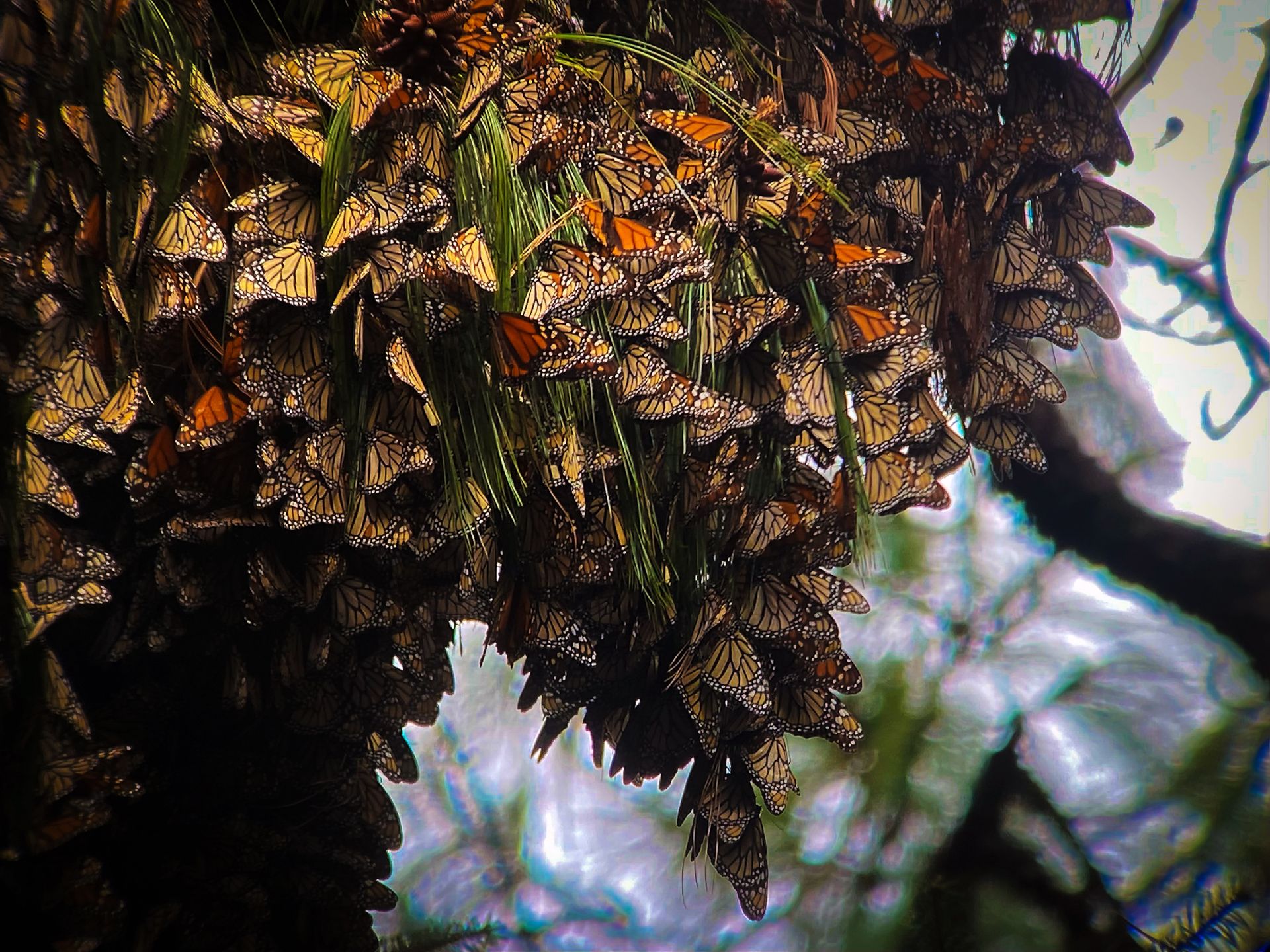
At first glance, I didn’t see the tens of millions of butterflies around and above me. It was cool and dark in the dense forest, and the insects kept inconspicuously still, huddled together on tree trunks and branches. With their wings folded, I mistakenly thought they were brown leaves.
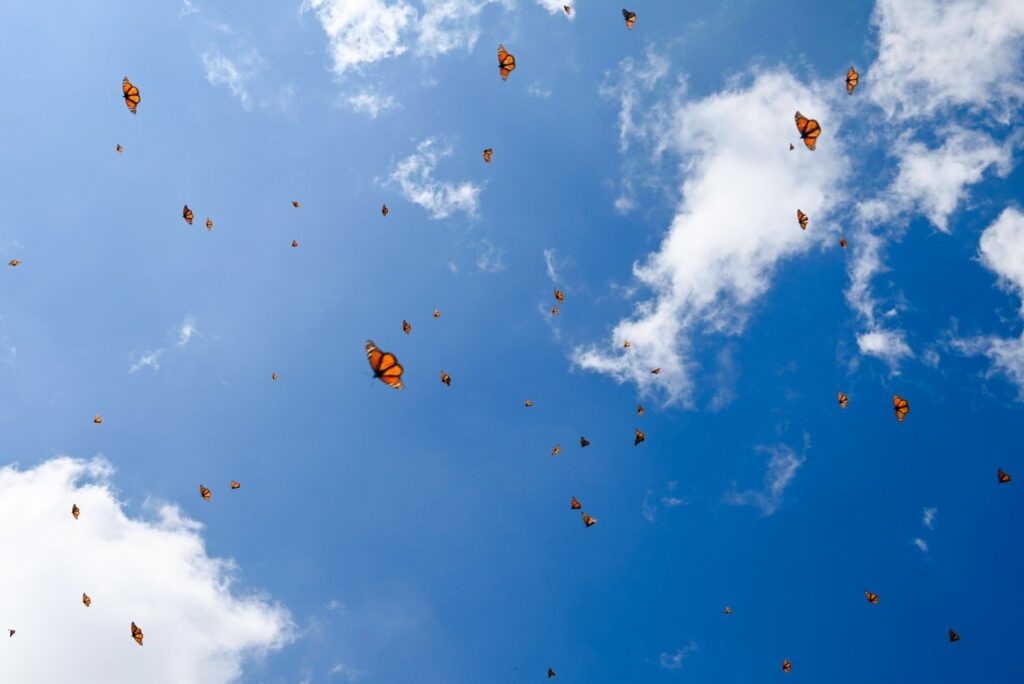
I waited. After an hour or so, a ray of morning sunlight pierced the canopy. The temperature began to gradually climb, too. Without warning, the butterfly clusters erupted into a dizzying orange-and-black kaleidoscope. One of my travel partners, a committed atheist, would later jokingly tell me that the sight of all those millions of monarch butterflies gently fluttering around her was so visually poetic, so ineffable, that it made her “reconsider my belief in the existence of God.”
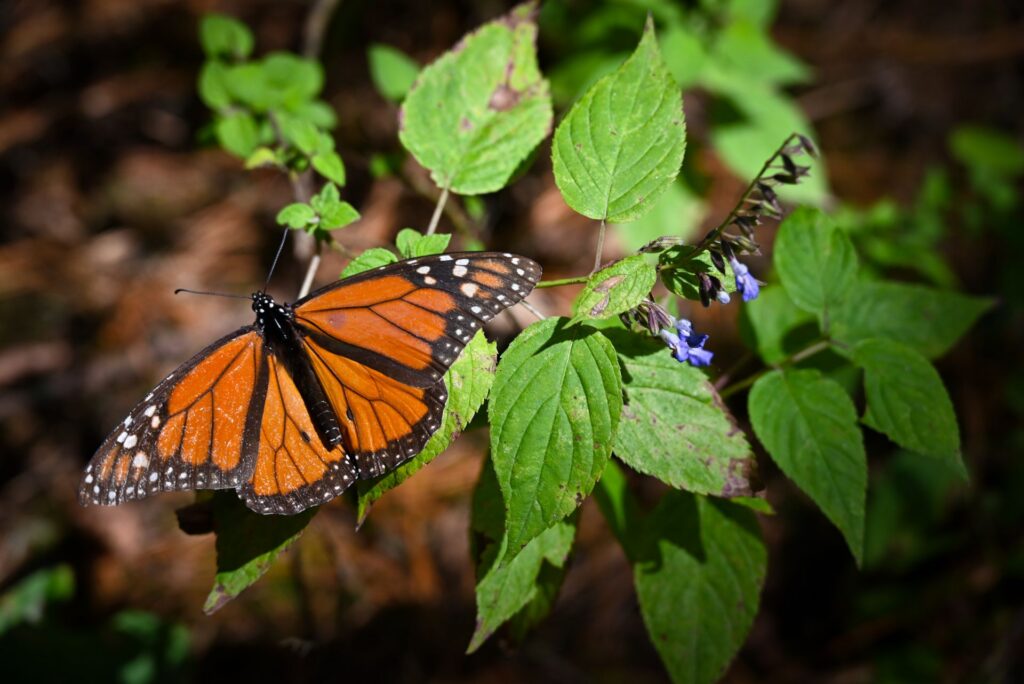
Caught in the middle of this butterfly tornado, at one point I knelt down to observe a monarch that settled on a purple flower right in front of me. What a creature! Those delicate wings, with a pattern as unique as a fingerprint that appeared hand-painted in vivid shades of black and orange, speckled with dots of white.
Each year, millions of these fragile, living pieces of artwork make a 3,000-mile journey that begins in Canada and roughly follows the Interstate 35 corridor from Minnesota down to Texas, before finally settling in Mexico, just in time for Dia de los Muertos: the Day of the Dead. They stay in Michoacan until about mid-March.
The monarchs’ yearly arrival in Mexico both unites and divides the local community. Beyond being a source of tourism income, many people regard the butterflies as the reincarnated spirits of their lost ancestors. Some adore these creatures so much that they’ve staked their own lives to protect the species, becoming targets of violence for speaking and acting in their defense.
But because of widespread poverty and pressure from the drug cartels that run much of the parallel economy in Mexico, the essential habitat these butterflies so heavily rely on — the oyamel forests — is being wiped out. The butterflies also face a litany of threats en route to Michoacan, in the form of pesticides and habitat loss across North America. Without better governmental protection in Mexico and the United States, conservationists warn the great monarch migration may collapse.
The Monarch Butterfly Biosphere Reserve is a UNESCO World Heritage Site spanning about 139,000 acres. Conservationists have divided it into two zones: the core zone, where most butterflies come during the winter, logging is prohibited and human activity is strictly monitored; and the outer zone, where locals are allowed to extract some natural resources.
“Illegal logging was a big concern in the early 2000s,” the World Wildlife Fund (WWF) told me. Luckily, an intense conservation push that emphasized local involvement and education brought deforestation down to “almost zero” by 2009. This number has held steady since then. In fact, when I was there in March, reports stated that the monarch population had actually increased a whopping 64% from 2025 — a figure that offered real hope and grabbed international attention.
But outside of the reserve, it’s a different story. Control is in the hands of the “ejidos,” which are local, democratically elected committees of community members that decide how the land is managed.
High poverty rates in these communities mean that, despite a cultural love for the monarchs, the economic pressure to log for timber or clear land for crops is high. More than 40% of people live below the international poverty line in Michoacan (and another roughly 372,000 residents live in “extreme poverty,” according to data from the Mexican government).
Speaking with locals on the outskirts of El Rosario, I learned that many families struggle to keep their children in school. Education rarely continues beyond the elementary level, because families need the extra labor to support themselves financially.
“Nobody here wants to harm the butterflies,” one local woman explained to me in Angangueo. She gave me an in-depth explanation about an Indigenous belief tracing back to Aztec legend, which posits that the butterflies represent the “souls of the dead” — something that many Mexican families still carry today. “If one lands on you,” the woman told me, gently tapping my shoulder with her finger, “it is a loved one, coming to make sure you are OK.”
But even she admitted that, despite the widespread adoration for the creatures, people still have to find a way to feed their families. Just like anywhere else in the world, conservation success often hinges on Maslow’s hierarchy of needs.
Michoacan also happens to be the world’s leading producer of “green gold” — the creamy, oil-rich avocados that grow in the volcanic soil. The Mexican avocado industry generates over $2.5 billion annually, driven in large part by a ravenous American appetite (80% of shipments go to the U.S.). Michoacan is the industry linchpin, producing about 75% of the country’s entire avocado crop. Lucrative avocado prices incentivize farmers — and the cartels that cut a profit from them — to clear native tree cover to make room for orchards. These illegal plantations have even been found inside the Monarch Butterfly Biosphere Reserve.
Major cartels like the Jalisco New Generation Cartel illegally tax avocado farmers. It’s good money; these groups manage to siphon off about $770 million a year from the industry by charging what they call a mandatory monthly “protection fee.” For farmers, refusal is often a death sentence.
Homero Gomez Gonzalez spent the first phase of his life as an illegal logger, before he metamorphosed into a zealous environmental activist. A jovial, burly, mustachioed man, Gonzalez helped transform El Rosario reserve into a major ecotourism hub, and worked alongside the WWF to combat deforestation in the area. He even took on the regional criminal gangs and cartel groups who extort illegal logging operations. A Netflix documentary, “The Guardian of the Monarchs,” was made of his life, the film’s title inspired by Gonzalez’s local nickname.
Then, Gonzalez disappeared in January 2020. A couple of weeks later, his corpse was discovered floating at the bottom of a well.
Not a month later, on Feb. 1, 2020, Raul Hernandez Romero — a local tour guide and environmental activist at El Rosario — was also found dead. He’d suffered blunt trauma to the head and a stab wound, officials discovered.
Two environmental defenders had wound up dead in a part of Mexico where illicit operations thrive, both of whom were extorted by major organized crime groups. Officially, the attorney general’s office of Michoacan ruled Gonzalez’s death an accident. That, however, did not satiate the community’s appetite for answers. Gonzalez had faced numerous death threats before going missing. There was also the unexplained head wound he’d suffered, according to the state’s own autopsy, before ending up in the well.
Gonzalez’s brother told reporters: “My brother was murdered. … This was not an accident.” Gonzalez’s son added that the family believed he was killed by illegal loggers for “impeding” their business. Romero’s family echoed this same theory.
Mexico is, according to a 2024 report from the nongovernmental organization Global Witness, the third-deadliest country in the world for environmental activists. It’s a paradox; Mexico itself is one of the most biodiverse nations on Earth. “If they can kidnap and kill the people who work for the reserves, who is going to defend the environment in Mexico?” fellow El Rosario butterfly reserve defender Homero Aridjis asked reporters in the wake of his colleagues’ murders.
To protect the butterflies in Michoacan is to interfere with the cartels’ bottom line. It makes the job of Mexican conservationists risky. But even if the cartels weren’t fueling illegal logging operations, the monarch butterflies’ fate would still be far from guaranteed.
That’s because Mexico makes up only one piece of the larger conservation puzzle. Monarchs migrate across nearly the whole of the North American continent. In the north, the butterflies must contend with the United States’ liberal use of deadly pesticides, like dicamba and glyphosate, that wipe out milkweed — the sole food source of monarch caterpillars.
Because of this, the Joe Biden administration had planned to classify the insects as “threatened” under the Endangered Species Act at the end of 2024, which could have helped to spur new conservation measures. But since President Donald Trump’s return to office, the federal government has kept deferring action.
Two environmental groups have filed a lawsuit against the Trump administration over its indefinite delaying of the matter. One group — the Center for Biological Diversity — said in a March statement that “It would be unforgivable” for the butterflies’ “epic migration to collapse because of political cowardice on enacting range-wide protections for them,” before adding: “Even the Trump administration has to think twice about letting these iconic butterflies collapse toward oblivion.”
The survival of these delicate insects, in other words, is a messy political endeavor. It involves everyone from Trump to Mexico’s President Claudia Sheinbaum, American farmers and Mexican ejido members, conservation groups and even the cartels.
This is why my guide, Clara de Alba, felt that the first step toward making a difference, toward saving the butterflies, was simply to try to show people their beauty. Butterfly conservation, she told me, “begins with the people who call these forests home.” If those communities have a stake in the butterflies’ survival, then Clara believes that conservation efforts will be fruitful.
The day before I was to drive back to Mexico City, an ejido elder and his 10-year-old grandson told us of a “beautiful secret.” Up a steep stretch of mountain, through the oyamel trees, there was, they said, a congregation of butterflies that nobody — not even the guides — yet knew about.
They offered to show us. Obviously, myself, Clara, and a small handful of other entomophiles weren’t about to refuse such a mysterious, enticing offer. And so we trekked up the mountain, deeper into the forest. In total, the detour took about an hour.
What we were led to was a butterfly mecca. Entire trunks of oyamel trees were blanketed in millions of orange-and-black wings. Every flower, branch and leaf seemed to be accompanied by a monarch butterfly. At first, the creatures kept still. Then, slowly, sunlight began slipping through the canopy. When the light touched the butterflies, the clusters would pop, sending millions of monarchs fluttering through the forest.
We sat there as a tornado of butterflies swirled around us. The ejido and his grandson sat on the hillside, placed their cowboy hats in their laps, lifted their gazes and simply watched. Another woman who’d joined us — a travel guide from the U.S. — sat atop a mossy log and quietly wept. Her son, I learned, had died unexpectedly last year, and when a butterfly landed on her finger she believed it was him.
As the air thickened with insects, I made my way over to the grandfather-grandson duo who’d led us here.
“Thanks for bringing us,” I said in my mediocre Spanish.
“You’re welcome,” the old man nodded.
“Have you ever seen something like this?” the boy then asked me, right as a monarch settled on my shoulder.
“No,” I looked up at the vortex of winged organisms churning above. “I don’t think I have.”
After a pause, the grandfather then replied: “Me neither.”
Become a member today to receive access to all our paywalled essays and the best of New Lines delivered to your inbox through our newsletters.