

In the wake of the Iran war, the president who promised to prioritize America’s needs at home has since doubled down on a global agenda of regime change from Tehran to Havana.
While Donald Trump’s interventionist turn has dismayed prominent supporters, few have been as enthusiastic as Latino neoconservatives concentrated in Miami. The broader collective of South Florida voters, activists and elected officials — mostly of Cuban but also Nicaraguan and South American descent — comprises what I have elsewhere termed the Miami neocons and the Miami lobby. Within the Trump administration, this constituency — embodied by Secretary of State Marco Rubio — has exerted considerable influence on hemispheric policy and the so-called “Donroe Doctrine.”
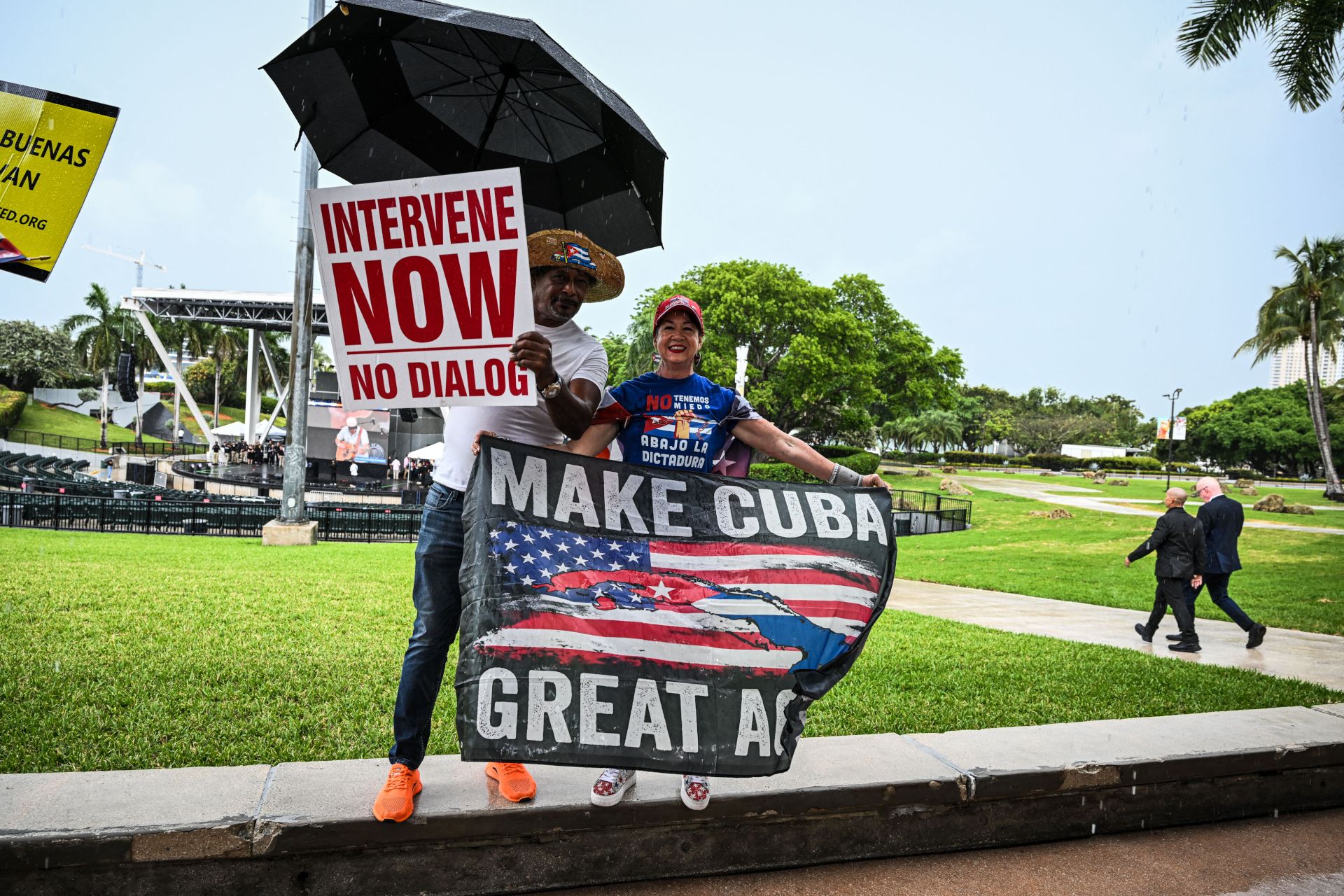
On the day of Iranian Supreme Leader Ali Khamenei’s Feb. 28 assassination, Miamians of mostly Cuban descent demonstrated in favor of similar action toward the socialist island. The demonstrations followed the January kidnapping of Venezuelan dictator Nicolás Maduro and a subsequent U.S. blockade of oil shipments to Cuba. The blockade has aggravated a postpandemic crisis, worsening blackouts and shortages for as many as 8 million Cubans, with Rubio leading talks between the Trump administration and Havana. Many in Miami have welcomed these developments as a sign of the regime’s imminent demise. “From Tehran to Caracas, dictators are falling,” Florida’s Republican Rep. Maria Elvira Salazar wrote on X. “[T]he message to the Cuban regime is simple: you’re next!”
Neoconservatism interprets U.S. foreign policy within a binary, Manichaean dogma. The world, its proponents say, is fundamentally divided between allies and enemies of the U.S. Those who stand with Washington do so in the name of freedom, while those who oppose it are oppressors. In Miami, and Latin America more broadly, this worldview considers leftist governments — mostly though not exclusively of the autocratic variety — as the pawns of a sinister, international axis headed by Russia, China and Iran. In the case of the Western Hemisphere, citizens living under the yoke of these regimes will eventually find “freedom” in the form of a right-wing, pro-American government.
As a native of South Florida, opposition to this ideology shaped much of my worldview, including a broad affinity toward leftist politics. Contrary to decades of exile propaganda, my first visit to Havana in 2017 left a marked impression of the Cuban regime’s limited but concrete achievements. Surrounded by neighbors besieged by violence and drug trafficking — such as Jamaica, Haiti and the Dominican Republic — the Caribbean’s largest island hosted virtually no drug trade and a shockingly low crime rate. At night, I saw scores of young children unsupervised and at play in the streets of the capital. One Cuban-American visiting family even conceded to me that Havana was safer than his impoverished neighborhood in the notoriously violent Miami Gardens in Florida.
Remarkably, this was also the regime that fought apartheid-era South Africa to a standstill in Angola and repelled the 1961 Bay of Pigs invasion, a U.S.-sponsored attempt to overthrow the Cuban government. As I walked through the halls of prerevolution dictator Fulgencio Batista’s presidential palace — now the Museum of the Revolution — it wasn’t hard to appreciate the pride of the Cuban Communist Party’s dwindling number of supporters. In Havana’s Museum of Fine Arts, I admired a painting depicting heavyweight boxer Teófilo Stevenson’s 1976 victory over John Tate of the U.S. “Those were the days when Cuba was great,” said the nearby guard.
At a nearby bookstore, a compilation of comic strips from the 1970s recounted the entirety of the Cuban Revolution, beginning with the 1956 landing of the Granma, the vessel that transported Fidel Castro and 81 other revolutionaries from exile to the island. The message for foreign and domestic audiences was clear. In the six decades before the 1959 revolution, Cuba was a dutiful vassal of Washington. In the six decades since, the island, against all odds, has successfully defied its former master. Like so many other visitors to the island, I found much of this mythology appealing.
Of course, it was likewise impossible to ignore the repressive one-party state I saw around me. Like El Salvador, Cuba’s relative security is an obvious by-product of its utter contempt for due process. The island is home to over 1,000 political prisoners, and its incarceration rate is the second highest in the hemisphere, behind only El Salvador. An ominous and ever-present police and surveillance state scrutinizes Cubans’ everyday interactions. A culture of fear dominates every street corner in an environment where neighbors report on one another to the government.
The rational calculus of nearly every soul on the island is to curry favor with visitors by telling them what they want to hear — myself included. It’s almost impossible to gauge Cubans’ sincerity on anything remotely political. In subsequent visits in 2018 and, especially, in 2024, there was, however, an unwavering constant in local attitudes on the island. “There’s no future here,” one Cuban after another told me. Without meaningful connections to the party or a chance at emigration, the average resident has little chance of social advancement.
For many — those in the regime and its international apologists — it’s easy to blame any and all of Cuba’s woes on Washington’s 66-year embargo. At various times — most notably since 2021 and even more so since January this year — this posture has been vindicated by Washington’s actions. At other times, however, it’s been quite clear that the Cuban Communist Party has not lacked means for national development. Objectionable as it may be, Washington’s embargo has ebbed and flowed over a course of decades. Its adverse effects were at points entirely nullified by subsidies worth hundreds of billions from Moscow and Caracas.
In the latter half of the 20th century, the Soviet Union paid Cuba six times the market price of sugar, amounting to roughly $65 billion. Following the collapse of the USSR in 1991, the island descended into a decade-long depression known as the “special period.” Then, in 2000, Havana secured the patronage of Venezuela, which practically donated billions in oil for resale on the global market. All told, the island received around $122 billion in oil shipments between just 2007 and 2017 — a colossal figure considering that Cuba’s total annual gross domestic product is around $100 billion. Thereafter, the onset of Venezuela’s ongoing crisis since 2014 was partially offset by a thaw in relations with Washington, allowing for increased tourism to the island after 2015.
It’s simply dishonest to claim that the Cuban government could never have emulated its successful socialist peer countries due to the embargo. Both Vietnam and Maduro’s Venezuela embraced and even deepened reforms in spite of respective embargoes during the 1980s and 2020s. The Cuban Communist Party itself allowed for private enterprise in a small number of service industries during the 2010s.
Yet, contrary to the advice of its own economists and Beijing, the regime has consistently rejected the market socialism practiced by Vietnam and China, where agriculture is privately managed although the state remains the owner of all land, and where most companies are privately owned, but state firms compete among each other and comprise half of the country’s market cap. Instead, Cuban Communist Party cronies have grown rich pocketing the once-generous aid of its former patrons. Worse, the party has since rolled back many of its piecemeal changes in private retail and other services.
A familiar worldview emerges from the Cuban Communist Party and other self-styled anti-imperialist autocracies. The world, in effect, is fundamentally divided between allies and opponents of Washington: Those that side with the U.S. empire are oppressors while those that align with the imperiums of the East are “anti-imperialists.” The aims and nefarious methods of both neoconservatives and anti-imperialist autocracies are, quite literally, the same. Starvation, torture and mass killings are small prices to pay for “freedom” enabled by or from Washington.
In Cuba’s case, recent events have shown that neoconservative hard-liners such as Rubio have far outdone their regime counterparts — a development contingent on Rubio’s appropriation of Trump’s transactionalism. In 2021, Washington sabotaged Cuba’s postpandemic recovery by designating the island as a “state sponsor of terrorism.” The designation and related restrictions led to the forced exodus of dozens of multinationals from Cuba, with foreign visitors plummeting to less than half of prepandemic arrivals; at least 2 million Cubans are thought to have left the island since 2021. Add to this the ongoing oil blockade, and the country has since experienced an economic downturn and humanitarian catastrophe on par with the “special period” following the collapse of its Soviet benefactor.
Recent reports also suggest that infants have likely perished amid losses of power in hospitals. Contrary to the propaganda from Miami neocons, it’s self-evident that an oil blockade of any Caribbean island — socialist or otherwise — would yield dire results for the population. In the words of Salazar, it’s “devastating to think about a mother’s hunger, about a child who needs immediate help. But that is precisely the brutal dilemma we face as an exile community: to ease suffering in the short term or to free Cuba once and for all.”
It is not difficult to poke holes in the internal logic of fundamentalists within respective neoconservative and anti-imperialist camps. For decades, the former have celebrated friendly autocracies such as Augusto Pinochet’s Chile, Efraín Ríos Montt’s Guatemala and, more recently, Nayib Bukele’s El Salvador. In true Orwellian logic, torturing “subversives,” genocide against Indigenous people and the indefinite suspension of due process are justified in the name of combating greater evils. Last August, the Salvadoran National Assembly approved a series of constitutional reforms extending presidential terms from five to six years as well as allowing for indefinite reelection. In response, the U.S. State Department defended El Salvador’s right to self-determination and rejected “comparisons with illegitimate dictatorial regimes elsewhere in our region.”
Many on the American right see the Salvadoran leader’s high approval ratings and success in tackling crime as legitimizing popular autocracy. Naturally, however, this standard would never apply to the Cuban, Nicaraguan or Venezuelan regimes. Never mind the fact that Bukele was a self-described radical leftist and admirer of the Cuban and Venezuelan regimes throughout most of the 2010s. Like the “world’s coolest dictator,” Hugo Chávez enjoyed high approval ratings for virtually all of his presidency, even as he followed the same playbook of extending his term — for life. El Salvador’s repressive police state and lack of constitutional protections are, moreover, key facets of Bolivarianism.
Speaking at the Saudi-sponsored FII Priority Summit in March, the former mayor of Miami — and paid lobbyist for the Gulf kingdom — Francis Suarez said: “You might ask, Why do we care about Cuba? They export one of the most dangerous things on the planet. It’s not nuclear weapons. It’s communism.” Minutes later, the event featured a virtual address from Venezuela’s socialist dictator, Delcy Rodríguez, who ruled out questions from the audience.
The absurdity of this scene is comprehensible only through the eyes of the overwhelmingly Cuban-American Miami lobby. Since January, exile activists, influencers and elected officials have downplayed the Trump administration’s apparent symbiosis with the socialist Venezuelan regime as a stroke of Trumpian genius. Yet for many of the rank and file in Miami, doubts have emerged about the White House’s long-term intentions in Caracas.
Seen through this light, the counterfactual on Trump’s Cuba policy is instructive. If Caracas continued shipping oil to Havana, many neoconservative Latinos — Cuban Americans, most notably — would be less inclined to give the administration the benefit of the doubt. Ahead of the November midterms, strangling Cuba also serves a clear electoral calculus at a time when Trump’s once-historic support from Latinos has plummeted to record lows. Indeed, whatever the outcome of talks with Havana, Miamians are unlikely to tolerate an arrangement lacking a clear timeline on a democratic transition, as is currently the case in Venezuela. Speaking with the Miami Herald, one Cuban-American respondent stated, “Nothing has actually happened in Venezuela; they are just shuffling ministers around. … Let not a single communist remain.”
There are also strategic lessons to be learned from the aims, conduct and influence of the allied Miami and Israel lobbies. In Venezuela, Maduro was reportedly willing to meet all of the White House’s demands save for immediately leaving office — a red line for Rubio and his allies. Yet while the ultimate goal of the Miami neocons in Havana and Caracas was and remains regime change, competing factions in the administration cautioned that prolonged military action could produce a quagmire, jeopardizing oil production and an eventual transition in Venezuela.
Conversely, Israeli doctrine arguably views a failed state as the most optimal outcome in Iran. While Trump has repeatedly claimed that Venezuela was the model for the Iran war, the reality is that a surprise assassination of Maduro and half of his Cabinet would have sown further chaos close to home. In the same vein, the joint force in Iran has actively elevated the most radical elements within the Islamic Revolutionary Guard Corps by assassinating figures who had been more open to dialogue with the West, such as Ali Larijani. The irony is that arguably the greatest beneficiary of the Iran war’s spike in oil prices — Vladimir Putin’s Russia — is the grand antagonist of Miami neoconservatism. Much to the chagrin of the Miami neocons, in early April the White House allowed a Russian ship carrying around 700,000 barrels of crude through to Cuba amid a slight loosening of the ongoing oil blockade.
Much of the historical record directly contradicts the competing narratives espoused by ideologues in Havana and Miami. Castro’s prerevolution predecessor, Batista, featured communist Cabinet members in his pro-worker first term (1940-1944) — though he later sided with landowners and U.S. special interests in his second (1952-1958). The 1959 revolution itself was ideologically heterogeneous at its onset. Some of those who initially aided Castro, such as Orlando Bosch, were virulent anti-communists who later mutated into infamous militants in exile; Bosch’s United Revolutionary Organizations Command (CORU) went so far as to bomb fellow exiles that the group deemed insufficiently anti-communist.
Prominent Cuban revolutionaries, such as the student leader José Antonio Echeverría, who was killed in a shootout with police and hailed as a martyr, never espoused adherence to Marxism-Lenism — a fact that the Communist Party has since whitewashed on the island. Castro himself professed adherence to Marxism-Leninism only in November 1961, six months after the U.S.-sponsored Bay of Pigs invasion. The invasion ultimately facilitated the very outcome it sought to prevent, pushing Cuba into the Soviet orbit. The propaganda boost for the revolutionary regime was instrumental to the consolidation of one-party rule.
Free-market capitalism and socialism — or Iranian theocracy, for that matter — are discrete ideologies with discrete domestic goals and modes of governance. Yet the respective geopolitical doctrines of neoconservatism and anti-American imperialism are nothing more than symmetrical rationalizations for Orwellian aims and methods. Juxtapose the propaganda of both factions, and you will encounter competing, incoherent realities. Genocide in Xinjiang is a mark of totalitarianism, while genocide in Gaza is slander against the “most moral army on the planet.” In turn, mass deportations in the U.S. constitute state repression in contrast to Nicaragua’s denaturalization and expulsion of allegedly “imperialist” Catholic priests; since 2018, around 300 members of clergy have been deported or forced into exile by the Nicaraguan government.
There is a better path forward for those on either side of the political spectrum. Leftists such as Progressive International co-founder Yanis Varoufakis and Spanish Prime Minister Pedro Sánchez have repeatedly condemned U.S. imperialism while also rejecting the related mental gymnastics of Iranian, Cuban and Venezuelan apologists. In the same vein, conservatives such as Sen. Rand Paul and The American Conservative’s Curt Mills have opposed collective punishment writ large even as they remain committed to free enterprise and civil liberties. Even in Miami, some Cuban Americans have protested against the Trump administration’s blockade of the island — a fact that in no way precludes opposition to the Cuban government.
Until such time as Miamians writ large renounce their faith in neoconservative evangelism, they will inevitably replicate the worst crimes of those they claim to stand against.
Become a member today to receive access to all our paywalled essays and the best of New Lines delivered to your inbox through our newsletters.