

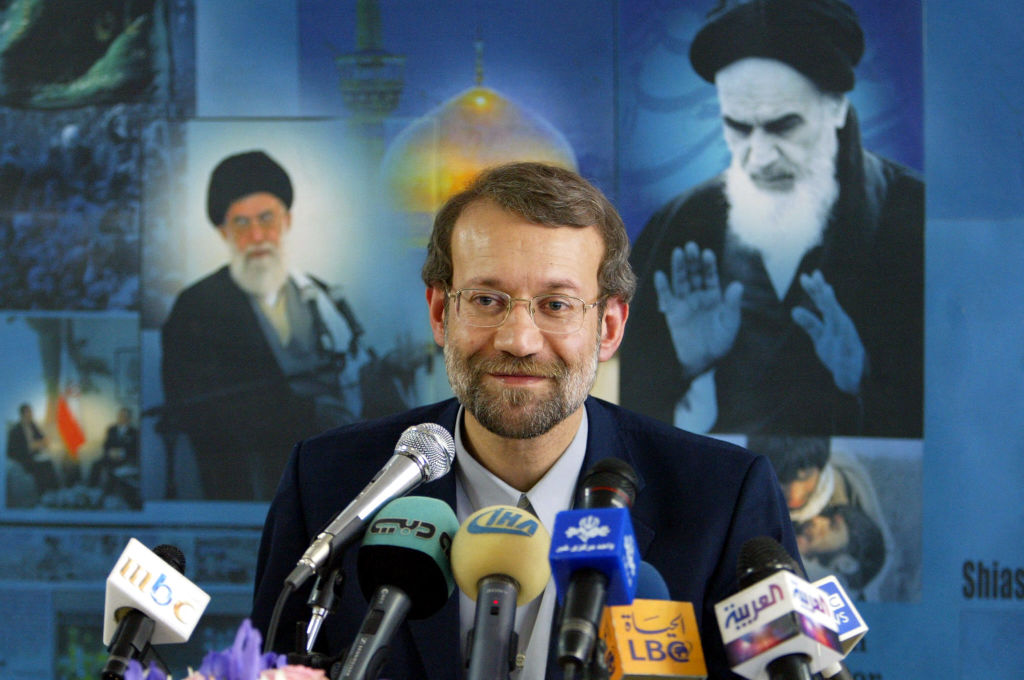
Iran’s top national security official Ali Larijani has been killed, marking the first time that Israel has claimed responsibility for assassinating a sitting politician during the ongoing war on Iran. Tehran confirmed the report, and Prime Minister Benjamin Netanyahu of Israel issued a statement confirming Israel’s role and repeating his earlier claims that his government is trying to help the Iranian people “take their fate into their own hands.”
As the secretary of the Supreme National Security Council, Larijani had been, to a large extent, in charge of supervising Iran’s defense and regional coordination. His departure presages another escalation in a cycle of spiraling violence that has now spread throughout the region, begetting enormous civilian suffering.
Two days before his death, Larijani wrote a letter addressing the governments of Muslim-majority countries and their citizens. Originally released in Arabic, the widely shared letter deplored the Islamic countries’ indifference to the violation of Iran’s sovereignty, calling on readers to reflect on the region’s future, one in which, Larijani said, Iran doesn’t seek dominance.
The note generated sympathy and controversy in the region, especially since it highlighted the growing perception that Iran’s neighbors and other Muslim nations have abandoned it at a time of urgency. His death has evoked mixed sentiments, even among Iran’s opponents, and it was perhaps his increasing visibility, especially on social media, that turned him into a target for Israel’s action.
Larijani was the speaker of Iran’s parliament for three consecutive terms, heading the nation’s unicameral legislative body between 2008 and 2020. He also served in other key roles, such as minister of culture under the late President Ali Akbar Hashemi Rafsanjani and chief of the state-run broadcasting corporation.
But the Western philosophy graduate, whose doctoral dissertation was about the Enlightenment thinker Immanuel Kant, came to be known to the world more intimately when he was first appointed to serve in his latest role as the national security adviser by former President Mahmoud Ahmadinejad in 2005.
In that capacity, he became the country’s de facto nuclear negotiator, closely engaged with the European Union foreign policy high representative Javier Solana as his primary interlocutor. Larijani’s pragmatic approach earned him some trust among other European politicians, too. Still, he was culturally orthodox and had overseen a public radio and television organization that was deeply unpopular.
Diplomats who had worked with Larijani mostly referred to him as a reasonable partner who used his rapport with Iran’s top leadership to strike a balance between the hard-line forces and the more technocratic actors within the state hierarchy. Frank Wisner, a former U.S. ambassador to Egypt and India, called him “a very careful spokesman of the Iranian government.”
Larijani came from a powerful family, which the late Middle East reporter Gareth Smyth once described as a force in “Iran’s new aristocracy,” a country that has historically been known to have been influenced by an “oligarchy of one thousand families” and well-heeled households.
His younger brother, Sadeq Amoli Larijani, once considered a top contender to succeed Ayatollah Ali Khamenei as supreme leader, is the chair of the authoritative Expediency Discernment Council, tasked with resolving differences between the parliament and the Guardian Council.
In 2005, Ali Larijani ran for the presidency but didn’t garner more than 1.7 million votes in a race that catapulted Ahmadinejad to power. He ran again on two occasions in 2021 and 2024, but the Guardian Council disqualified him. In 2021, following a public campaign demanding accountability, Ahmad Jannati, the chair of the council, sent him a letter detailing the grounds for his alleged ineligibility.
Among the reasons cited were his “political views and statements regarding different subjects and periods, including the 2009 sedition,” the official derogatory term used by establishment loyalists to describe the Green Movement that launched that year. At that time, former Prime Minister Mir-Hossein Mousavi stood for the presidency and disputed the legitimacy of the results when Ahmadinejad’s victory was announced.
With Larijani gone, there are now few figures who could understand and engage with the same range of actors inside and outside the regime.