

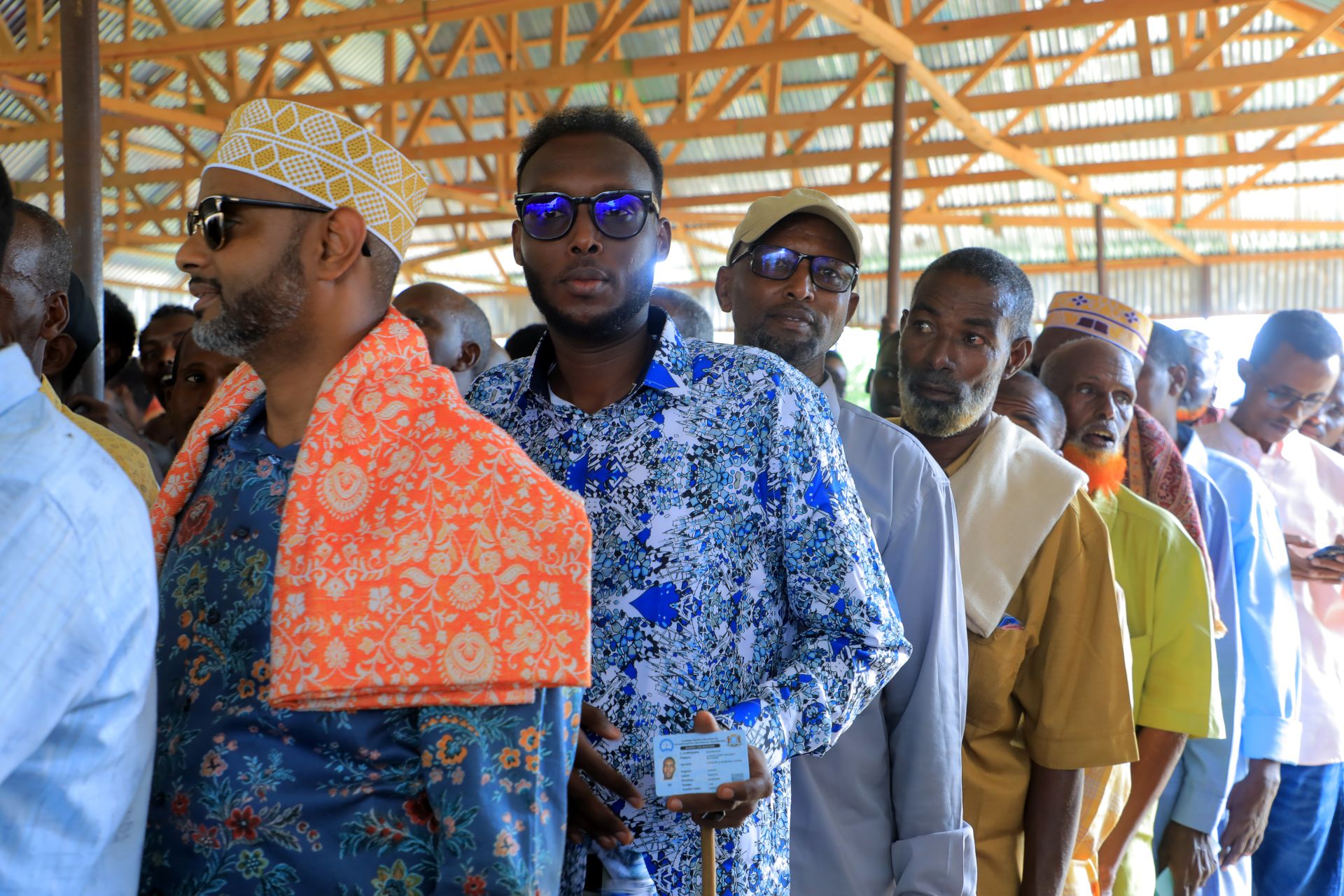
On the morning of May 10, security forces flooded parts of Mogadishu at the crack of dawn, suddenly bringing areas where prominent opposition politicians live under partial lockdown. The politicians said the government’s term was ending and wanted to pressure it to call an election by holding a rally, while authorities said they feared large crowds could unravel hard-won security gains in a city still vulnerable to insurgent violence.
There was also an additional fear that the politicians, some of whom command private militias, could deploy them to the city and clash with federal forces. For a few hours, Mogadishu was on edge.
Abdulkarim Jama, a driver of a three-wheeled Bajaj taxi — ubiquitous in Mogadishu — told me that the disputes between politicians whose “bank accounts overflow” were “making things impossible for us who make our wages daily.” He asked if I could pay a bit more as he anticipated the disruption would hit his bottom line.
Though the lockdown eased after opposition leaders agreed to hold their rally inside a stadium, the episode laid bare how fragile the capital’s relative calm remains and how quickly Somalia’s deepening political crisis could become dangerous.
Over the past several years, Mogadishu has experienced a tentative revival. Al-Shabab attacks in the capital have become extremely rare; Turkish-style high-rises are reshaping the skyline in central districts like Hodan and Waberi; and a growing wave of international restaurants and trendy cafes has begun to transform the city’s social life. Somalia’s golden beaches are even attracting tourists to a city that many governments still classify as too dangerous to visit.
That fragile progress is now the backdrop to what one politician described to me as an “unprecedented” political crisis. Earlier this year, with its term nearly expired, the government pushed through constitutional amendments that President Hassan Sheikh Mohamud had previously pledged would not apply to his own tenure. He suddenly changed his mind, however, and — without addressing his earlier statements — declared that he will remain in office until 2027, a year beyond the May 15 deadline that has now passed.
Another provision inflaming the opposition is his pledge to hold nationwide one-person-one-vote elections. Even partial implementation would mark Somalia’s first direct national vote since the late 1960s, replacing a decade-old negotiated system through which clan elders and political elites elect a Parliament and head of state themselves, perpetuating a political class many young people feel disconnected from. “It is an old man’s game,” said Fadumo, 22, a barista and student.
But in a country where vast swaths of territory remain outside state control — and much of it in the hands of al-Shabab — how such an election might work in practice remains an open question. Opposition figures have accused the president of using democratic reform as a way to further his own career.
The Mogadishu-based opposition — including two former presidents — along with the federal states of Puntland and Jubaland, have rejected the amendments and withdrawn from the federal system entirely. Opposition figures have taken to calling Mohamud the “former president,” and an X post by the EU ambassador that omitted his title reportedly nearly caused a diplomatic incident. In a subsequent post, the EU communications team made sure the word “president” was there.
As in previous standoffs (these have happened a few times before), talks between the government and opposition are being shepherded by international diplomats in the secure zone near the airport.
Everything in Somalia has always been contested, but its elites have broadly agreed on two things: regular and timely elections on a collectively negotiated model, and a constitutional framework that, however flawed, commanded rough consensus. Both are now in dispute simultaneously.
The crisis also comes at a particularly difficult moment for the country as a whole.
Donor funding, which underwrites the majority of the federal government’s budget, is shrinking. International organizations are warning of famine. Jubaland and Puntland — historically autonomous, rebellious states over which the capital has exercised little control — have gone rogue and threatened to hold separate presidential elections. And Somaliland, in a striking geopolitical twist, has been recognized by Israel, with ambassadors exchanged. In some ways, despite the improvements in Mogadishu, the provinces are burning.
Abdiweli Ali Mohamed, a former president of Puntland, said in 2018 that “Somalia is not Mogadishu and Mogadishu is not Somalia,” meaning the country is larger and more complex than its capital. That remains true. Nesrine Malik, a Guardian writer, has observed that politics in Khartoum long had a self-obsessed quality, and Mogadishu is similar: An elite class is absorbed in its own rivalries, increasingly detached from the growing storm around it.