


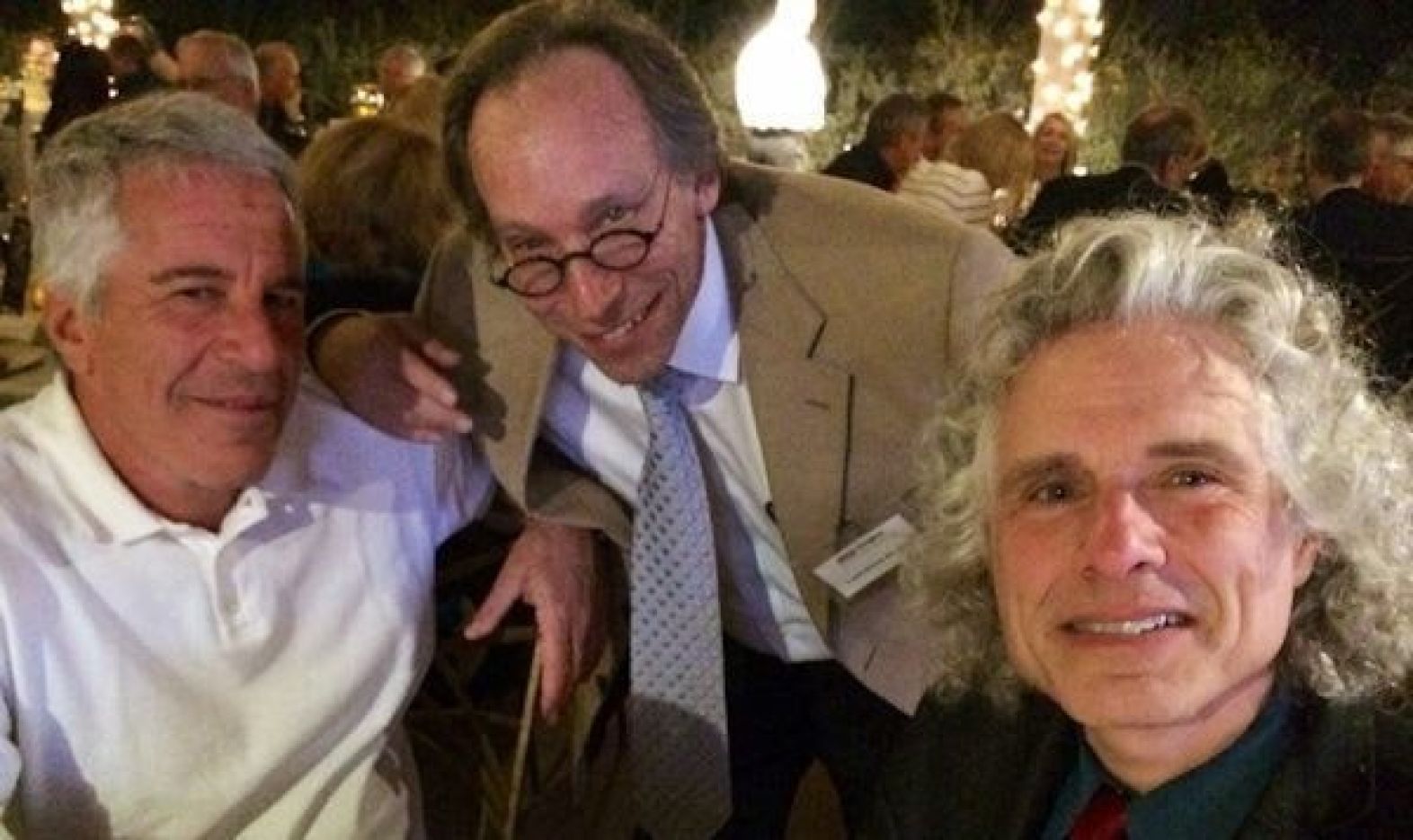
Ever since the giant cache of correspondence that forms the Jeffrey Epstein files landed, much has been made of the man’s apparent illiteracy. Epstein’s bad spelling and grammar, his skipped words and incomplete sentences, have led to endless questioning and assessment of his intellectual capacity. But to focus on his disregard for precision is to gloss over what appears to be a genuine interest in many intellectual fields: His emails are threaded through with recommendations for reading and thinkers and discussions of a range of topics. The content and style of these discussions — and the people present for them — illuminate not only Epstein’s belief system but also the state of Western academia.
One of the distinctive features of the Epstein files, even the limited selection we have access to, is the sheer breadth of Epstein’s contacts, spanning finance, academia, the arts and different political persuasions. One explanation would be that Epstein was good at bridging divides, socially flexible enough to be at home anywhere. But there’s another way of looking at it that is borne out by many of the emails I have read. These people don’t really disagree with each other, not at some basic level — they share a worldview that can be summarized as entitled. Reading through these emails only confirmed my own experiences of elite academic institutions and many of those I worked with, and had unsettling echoes of my research into the manosphere.
Epstein funded academic research to the tune of around $20 million per year, and hosted many of the academics he supported in his home and on his plane, at lavish dinners and parties. When more and more names of academics appeared in news headlines, I began to look for myself, and quickly found the names of old colleagues and associates. Pulling on these threads led to a picture of a cozy circle of complicit elites, each providing legitimation to the other: Epstein with cash and access, the academics offering their reputations and expertise in support of Epstein’s worldview. This legitimation may have played a role in how these ideas have seeped into the mainstream, and not just in the very visible pronouncements of Donald Trump, Elon Musk and their ilk. The ideas Epstein funded shape the way that Western governments try to influence the behavior of their populations.
It is no accident that one of Epstein’s favored disciplines was evolutionary psychology, with its explanations for male dominance, justifications for male aggression, legitimizing of female submission and connections to the race “science” in which Epstein was also interested. The theory offers a universal picture of human nature as a product of the hunter-gatherer environment our species evolved in, which explains our behavior, from promiscuity to gender differences in reading maps. (Criticisms include the difficulty in testing these theories, the fact that we evolved in a range of environments and social groups, and the counterevidence as seen in the social shaping and malleability of supposedly innate abilities and preferences.)
The foundation of evolutionary psychology, the idea that we have been shaped cognitively and behaviorally by the environmental pressures selecting our genes, permeated Epstein’s mind, leading him to pronounce on racial differences in intelligence as a result of environmental differences. “We know, for example, that if I was in the forest and I had to run from the lion or figure out a way not to be eaten, and my competition is a local African, I’m the one who’s getting eaten,” he said in a video interview with Steve Bannon, filmed around 2019. “Because they have the intelligence to deal with their local environment.” He hastened to claim this isn’t racist. “It’s not better, it’s not worse. But there’s many differences amongst different types of people, and people have different intelligences and they excel in some intelligences usually and less so in others.”
Men and women also have such fundamental differences, he claimed in numerous emails. For example, in 2010 he wrote: “why do women confuse knowing facts with knowledge they are good at trivila pursuit but not theory or laws// you want to rasie your questions to a higher level of organization.. instead of honeybees dying, why does anything die.?” (Typos in original.) Perhaps this belief is why there are so few female academics in the Epstein files, a point Anand Giridharadas has fleshed out by analyzing the many photos in the files. There are plenty of girls and women, but they are perched on knees or standing close; never around a dinner table, discussing ideas. The same attitude created the scandal around Larry Summers, a close friend of Epstein, which was perhaps the most memorable incident during his time as president of Harvard University, when he claimed in a speech to the National Bureau of Economic Research in 2005 that there was a biological basis for the gender disparity in mathematical and scientific disciplines. Plenty of academics leaped to his defense during the resulting row, including Richard Freeman, the economist who had invited Summers to speak. “Some people took offense because they were very sensitive,” he said. “It does not seem to me insane to think that men and women have biological differences.” And this is the issue: Theories from evolutionary psychology often sound reasonable. Of course men and women have biological differences; it would be “very sensitive” to think otherwise.
This tone, which could be described as “be reasonable,” characterizes many of Epstein’s close academic associates, such as the Harvard professor Steven Pinker, who appears extensively in the files. Pinker, best known for his popular books such as “The Better Angels of Our Nature” and “The Language Instinct,” has written whole books drawing on biological explanations to explain human behavior, many invoking the evolutionary pressures of passing on genes. He has explicitly included male aggression and even rape in these discussions, suggesting that they are “natural” tendencies.
Pinker himself is careful to distinguish between such biological predispositions and moral concerns that make certain actions reprehensible, but Epstein clearly saw the potential in Pinker’s theories to justify his own worldview. He hosted the academic at dinners and parties, and the resulting photos suggest Pinker was comfortable in this environment. Evolutionary arguments for trafficking girls and young women for the purposes of predatory males can easily be extrapolated from Pinker’s work; Pinker himself does not make these claims, though he was one of Summers’ defenders. The files show that in 2007 he was consulted by Epstein’s lawyer (as “one of the world’s leading experts on grammar”), “to analyze the statute” of a law which criminalizes contact with minors for the purpose of sexual exploitation. When this emerged, during Epstein’s 2019 court case, Pinker claimed he didn’t realize it was for the defense of Epstein, but it is difficult to imagine what he might have thought his advice was to be used for — did he think his verdict, that the “sole rational reading” of the statute was that “communication must be the vehicle through which the persuading or enticing directly occurs,” was in defense of the “enticed” girls? It seems unlikely.
It makes sense, then, that Epstein lavished money on a field that could give such support to his lifestyle. Martin Nowak, an academic at Harvard, was given $6.5 million to found his Program for Evolutionary Dynamics (PED), on top of at least $500,000 Epstein gave him personally throughout the 1990s and early 2000s. It is clear from the emails that their friendship was close. “Did you torture her?” Epstein asks Nowak, after the latter reported, “our spy was captured / after completing her mission.” (It’s not clear what or who is being referred to.) Nowak’s work has been wide-ranging, taking in the evolution of cooperation, the origins of life on Earth and the operation of biological networks. Epstein was clearly interested: He visited the PED offices more than 40 times between 2010 and 2018, after his release from his first jail term. Nowak reportedly gave him his own office and access card. (Harvard shut down the PED in 2021, and Nowak has been placed on paid leave since the files were released.)
The only problem with the field is that the arguments don’t hold water, and resorting to a biological explanation for every facet of human life has led to critiques that evolutionary psychology is providing “just-so stories”: A behavior or trait is explained as a result of some function it served, with no means of testing whether this actually happened in our evolutionary past, let alone taking into account other contributing factors. The cumulative results of anthropology and archaeology would suggest that there are no fixed gender roles for humans — in fact, it appears that it’s our very flexibility as a species, from our plastic brains to our responsive hormonal systems to the form and size of our societies, that has enabled us to dominate the globe.
Any society’s norms shape interpretation of archaeological and historical material, and gender norms have led to egregious misconceptions of finds. For example, the label of “anomalous” was applied to burials when clearly female bones were found alongside weapons. The mystery was only solved when DNA testing became widespread, forcing reinterpretation of the societies that buried weapons with women. (They were female warriors, rather than men with anomalous bones or burials with unusual configurations. This was by far the simplest explanation, only missed because of the assumptions of the archaeologists.) Such norms have proven stubbornly resistant to change, as I have observed in my own work, particularly when I was researching online manosphere communities — chatrooms and forums for discussions of issues facing men, including dating, fitness, looks and diets — and their huge overlap with white supremacist forums, in both themes and membership. But it wasn’t only the posts of the far right or incels that contained such fixed attitudes to gender. I’ve heard them from academics, too, and many of those figures are to be found in the Epstein files.
Late one evening, in November 2021, I was on a webinar in my office in the Computer Lab at the University of Cambridge. Our group, the Cybercrime Centre, was presenting our research into online extremism to the Center for Evolutionary Psychology (CEP) at the University of California, Santa Barbara, a group led by the founding couple of evolutionary psychology, John Tooby and Leda Cosmides. The pair have written seminal works in the field, starting with “The Adapted Mind: Evolutionary Psychology and the Generation of Culture,” published in 1992.
The seminar started with what we thought was a mistake but turned out to be an apt introduction to what was about to unfold. Tooby himself introduced us, seamlessly swapping the “misogyny” in our research for “misandry” (hatred of men) — that is, he stated we were exploring the links between extremism and misandry, giving the impression that we were examining how the online extremist world was against men, rather than women. We assumed it was a slip, Freudian or not. Yet not only did he carry on using the term —none of us knowing how to break in and correct a giant in the field in his own seminar, on a Zoom call — we slowly realized that a preoccupation with misandry lay at the heart of CEP’s work, as well as at the heart of the groups we were monitoring online.
“Gamergate,” the horrifying case of Zoe Quinn’s extensive harassment and character assassination after a blog post by her ex, was dismissed as an “online kerfuffle” by Tooby. Incels, he said, were characterized as “normal” apart from the single issue of not being able to “get a girl.” He suggested extremism could be defined as starting from violence, so that these people with such a “normal” struggle would not be swept up in the definition, despite the many attacks on both sides of the Atlantic carried out by self-proclaimed incels. To be clear: Not everyone in the California center agreed with these definitions, and at times the discussion became robust, but Tooby and Cosmides were in charge, and this was the inexorable direction of the seminar.
When I took over and began presenting the different types of racism and misogyny we had encountered in our vast dataset of online extremism, I was interrupted almost immediately. “Why is this misogyny,” Cosmides enquired, “when people could use anti-male discourse in the same way?” Misandry was again made the focus, when what I was presenting was clear misogyny — irrespective of whether men, too, experience sexist attitudes (something I would never deny). We showed how we tested Google’s then-new tool to detect hate speech, Perspective, and found it could not assess misogyny. (“Women are more suited to jobs in the home” came back with 0% toxicity rating; “Raping women is not OK” came back with 82.01%, while “Raping women is OK” was assessed as 88.77%.) To our point that the tool didn’t work, Tooby responded, “Well, women do think it’s OK to say men are stupid.” Cosmides backed up her husband’s point. “What I find interesting is how, in everyday life, it is commonplace and often celebrated to say horrible things about men as a category,” she wrote in the chat. The conversation was being constantly diverted away from the misogyny of the manosphere using whataboutism — in this case: “What about men?”
While Cosmides was an undergraduate at Harvard, she worked under the evolutionary biologist Robert Trivers. Trivers was a close friend of Epstein and supported him during his legal woes, arguing that “by the time [girls are] 14 or 15, they’re like grown women were 60 years ago, so I don’t see these acts as so heinous.” Emails from Trivers to Epstein include advice about the “pscyho-sexual opportunities” in the Dominican Republic (“notorious for their availability and quality if you are into that kind of phenotype”) and “ethnic humour” about Jamaicans (and their “violent tendencies”). He had experience researching lizards in Jamaica, explaining, “I took one look at the women [in Jamaica] and thought, if I have to study lizards to pay for frequent trips to this island, I’ll do it.” In his book, “The Folly of Fools: The Logic of Deceit and Self-Deception in Human Life,” he wrote that we have “been selected to rape on occasion, to wage aggressive war when it suits us, and to abuse our own children if this brings some compensatory return benefit.”
These are all opinions that are not out of place in the manosphere, and were given the veneer of scientific “truth” by an academic, repeatedly funded by Epstein — although, it seems, he was suddenly cut off. Trivers whined, in 2019, that “after 7 years of continuous support, you seemed to flip, no support at all for past two years nor response to requests,” continuing, “my God, Jeffrey, rent is 8 grand, i would like to eat, have a modest social life and an occasional psychosexual experience.” Epstein replied, suggesting different research for Trivers that he would fund (on transgender biology, an idea which is not spelled out, though other correspondence between the two on the subject shows some excessive dehumanization), showing just how much power Epstein wielded over academic directions.
My research at the time of the seminar with Tooby and Cosmides entailed reading thousands of posts, chosen at random, to dig into various patterns that computer modeling had identified in the huge dataset we were constantly collecting by scraping online chat forums and other websites. Going through the Epstein files over the past two weeks, disappearing down rabbit holes looking for ex-colleagues and others in my field, using search terms like “evolutionary,” “psychology,” “longevity” and “race,” has been uncomfortably reminiscent of that work, just as the evolutionary psychology seminar presented opinions reminiscent of the most active posters in the manosphere. For both tasks, I could only read for one or two hours a day, for the same reasons. Much of the content of both datasets is dull. In the manosphere, it’s the details of diets and gym routines that start numbing my brain; in the Epstein files, there is, predictably, a lot of mundane admin. And in both cases, much of the content is plain stupid, dumb jokes you feel embarrassed to be eavesdropping on, a result of the camaraderie built in online spaces and by Epstein. Now and again comes the truly horrifying material: the casual, pointed or jokey racism and misogyny, framed in pseudoscientific arguments that justify the feelings of white male superiority, as well as their outrage when they are rejected or held accountable.
Most disturbing are the justifications of violence against and sexual ownership over women through extreme dehumanization. Women, according to one of Epstein’s quips, as recounted by Virginia Giuffre, the most prominently outspoken accuser of Epstein, are “a life-support system for a vagina.” While, according to numerous posts on the dating advice website Pick Up Artists, health and beauty community Looksmaxx and other such forums, women actually like being beaten and raped, because it shows a man’s strength and therefore suitability as a mate.
In San Francisco in July 2011, a decade before my seminar with Tooby and Cosmides, the couple had dinner with Epstein, along with Elon Musk, Mark Zuckerberg and others. It was hosted by Edge, an online publication styled as an intellectual “salon,” which was run by Epstein’s friend and close associate, the literary agent John Brockman. In its pages can be found many thinkers who populate the Epstein files (Epstein donated hundreds of thousands of dollars to Edge), and, more importantly, it reveals the style of argument that emerged from the way these men talk to and about each other.
Edge’s website proclaims its mission: “To arrive at the edge of the world’s knowledge, seek out the most complex and sophisticated minds, put them in a room together, and have them ask each other the questions they are asking themselves.” Brockman’s invitations to Edge writers in the files use exactly this type of grandiose language. “If you are on this particular email list,” Brockman writes, “you are 1) one the world’s great scientists … 2) a pioneer in computation, software, the internet … 3) a major player in the avant grade art world.” (Typos in original.) This mutual congratulatory tone extends into the mainstream media coverage of Edge. John Naughton (a Cambridge academic in the pages of Edge) interviewed Brockman for the Guardian, with the headline: “John Brockman: the man who runs the world’s smartest website.”
The interview continued the extravagant praise of both Brockman (“at the cutting edge of ideas”) and Edge (“a salon for the world’s finest minds”). The picture Naughton painted of Brockman’s Renaissance-man approach to life is appealing (if overblown): his involvement with avant-garde cinema, having dinners with the late American composer John Cage and his circle, acting as the literary agent of Nobel Prize-winning scientists — a life of the mind, spanning arts and sciences, as he explicitly says is needed throughout his writing, as is listening to a true “elite,” that is, those at the top of their fields. But then you read his own words, and a different picture emerges of this man at the center of this illustrious intellectual circle, intimately tied to Epstein and his interactions with academia.
The idea of a meritocracy is strong among such elites; to suggest they had advantages others did not is perceived as a slight — they are not, perhaps, as brilliant as they thought — and so they have to insist they got to where they are on merit. Brockman describes Edge as “Elitist, yes, but in the good sense of an open elite, based on meritocracy.” He goes on to describe the process, saying: “The way someone is added to the Edge list is when I receive a word from a Steven Pinker, a Brian Eno, a Martin Rees or a Richard Dawkins, telling me to do so. It’s as simple as that and I don’t recall ever saying no in such circumstances.” Rather than a meritocracy, this is a good description of an “old boys’ network” (and all four he cites are indeed men). He does not mention any other way to be added, meaning if you’re not already within these circles and do not know the right people, there is no way to join the Brockman — and Epstein — elites.
The example Naughton chooses to illustrate the brilliance of Edge is an essay by the evolutionary biologist Mark Pagel, which argues that “over the last 200,000 years or so, we have been selected to be very, very good at copying other people, rather than innovating on our own. We like to think we’re a highly inventive, innovative species. But social learning means that most of us can make use of what other people do, and not have to invest the time and energy in innovation ourselves.” This doesn’t stand up to much scrutiny. Many of the tech bros in Brockman’s network — including Musk, Zuckerberg and Bill Gates — are lauded for their innovation, and the last 200,000 years of human history are often narrated as a series of huge breakthroughs. There is also no reason given as to why social learning and innovation cannot both exist within our species; variation, after all, is the key to the process of evolution.
This is a classic example of big theories based on evolutionary arguments that are perfect for headlines. And although it’s impossible to prove (what proof would look like is not mentioned), it has a plausible shape for a theory. It belongs to a category that could be called “truth-adjacent.” The manosphere is full of such statements about what women look for when selecting a mate, despite the abundance of evidence that women as a class exhibit quite a varied taste in mates, and to generalize is to make a mistake. It is this plausibility that perhaps explains why the ideas have gained such purchase, not only in the manosphere but also in policy. The behavioralism of psychologists such as Daniel Kahneman (another Epstein associate and Edge author; also at the dinner with Tooby and Cosmides) has led to governments believing that they can work with our underlying natures to nudge us toward the right behavior, an idea that has shaped policy on issues from littering to knife crime.
For governments, behavioral science drawing on evolutionary arguments has provided an apparently easy fix for a wide range of stubborn problems (no matter that evaluations in a number of sectors have shown abysmal results, including backlash effects). Meanwhile, for Epstein and the men in his circle, it has provided justification for male domination and white supremacy. As the writer Ana Marie Cox put it a few weeks ago, after a similar deep dive into the emails from academics, “Epstein gravitated toward fields and figures that rank humans, explain away cruelty, or biologize inequality.” He didn’t choose intellectuals for their success or status alone, she continued: “He identified and aligned himself with the intellectual machinery now justifying our current dystopia, including the academic rationalizations and motivated reasoning that hover behind the most terrible excesses of the Trump administration: glorified phrenology, violent misogyny, genetic determinism, and elite impunity.”
When I read through many of the email threads between Brockman, Epstein and various intellectuals, what was most jarring wasn’t the crude codes about women and sex that wouldn’t have been out of place in messages between teenage boys — the mass media coverage had to some extent prepared me for this boorish childishness of successful men. What unsettled me was, in fact, the familiarity of how these men were speaking to each other, from my interactions with certain older male academics in my time at elite universities in both America and the U.K. The emails lay bare what I had witnessed in fragments and suggestions, and in the manner in which they dealt with me and others.
In particular, they display the supreme conviction that they are right, whatever they are pronouncing on and whether it falls within their domain of expertise or not, combined with a curious fragility when questioned in any way. This combination of backslapping and peacocking, alongside sensitivity when contradicted, has always fascinated me: If they are the most brilliant men in the world, as Brockman’s invitations suggest, why are they so threatened by fields like critical theory and feminism? If they are so sure they are right, why do they react to challenges with either fury or whining?
The answer is the entitlement they feel about being at the top of society. Different types of elites and types of capital exhibit a camaraderie that is based on their social positions, positions they have no intention of giving up. They use their various attributes — money, reputation, ideas — to buttress each other as members of the same gang. In the language of the manosphere, Epstein’s circle of academics are the “chads” of their world, the 1% even of the white male elites they come from. This is just as bad for the majority of men in society as for the women being relegated to positions of servitude.
The closeness of those at the top is also seen in the way they draw together when one of their number is under attack. Noam Chomsky sympathized with Epstein over “the horrible way you are being treated in the press and public.” He wrote, in February 2019, long after Epstein’s first conviction and soon before his second, about “the hysteria that has developed about abuse of women, which has reached the point that even questioning a charge is a crime worse than murder.” This is a man more concerned about the treatment of a convicted pedophile than his victims.
Evolutionary psychologists proved particularly useful in legitimizing Epstein’s grooming, trafficking and raping of girls and young women, and in return he provided support for the Ivy League academics in this field in the form of huge research grants and new buildings. This circle of money and prestige proved irresistible to many, especially at a time when research funding is being reduced all over the world, but there was more to it than that. Epstein, often via Brockman, created a network of almost exclusively white men, enabling them to cling on to their privileged positions — at least until the emails were made public. One after another, they are now leaving their jobs, including Summers from Harvard, and the Nobel Prize winner Richard Axel from Columbia, who enjoyed hospitality and a warm correspondence with Epstein. Brockman has kept a low profile since the release of the files. Trivers had already left Rutgers, over a dispute about teaching, and is also attempting to stay out of the spotlight. As for Summers, after the latest release of emails laid bare in far more detail his perception of the inferior capabilities of women, he has stepped back from numerous roles, from OpenAI to Santander, but he continues to teach at Harvard.
A reckoning for academic elites may be coming, but perhaps, as with other such movements, the old boys’ network will once again swing into action. It is clear, now, that Epstein and his associates engineered much of the backlash against the #MeToo movement. Based on what I know of academia, I have no doubt that, despite the high-level resignations, these networks will remain intact for a long while yet.
Become a member today to receive access to all our paywalled essays and the best of New Lines delivered to your inbox through our newsletters.