


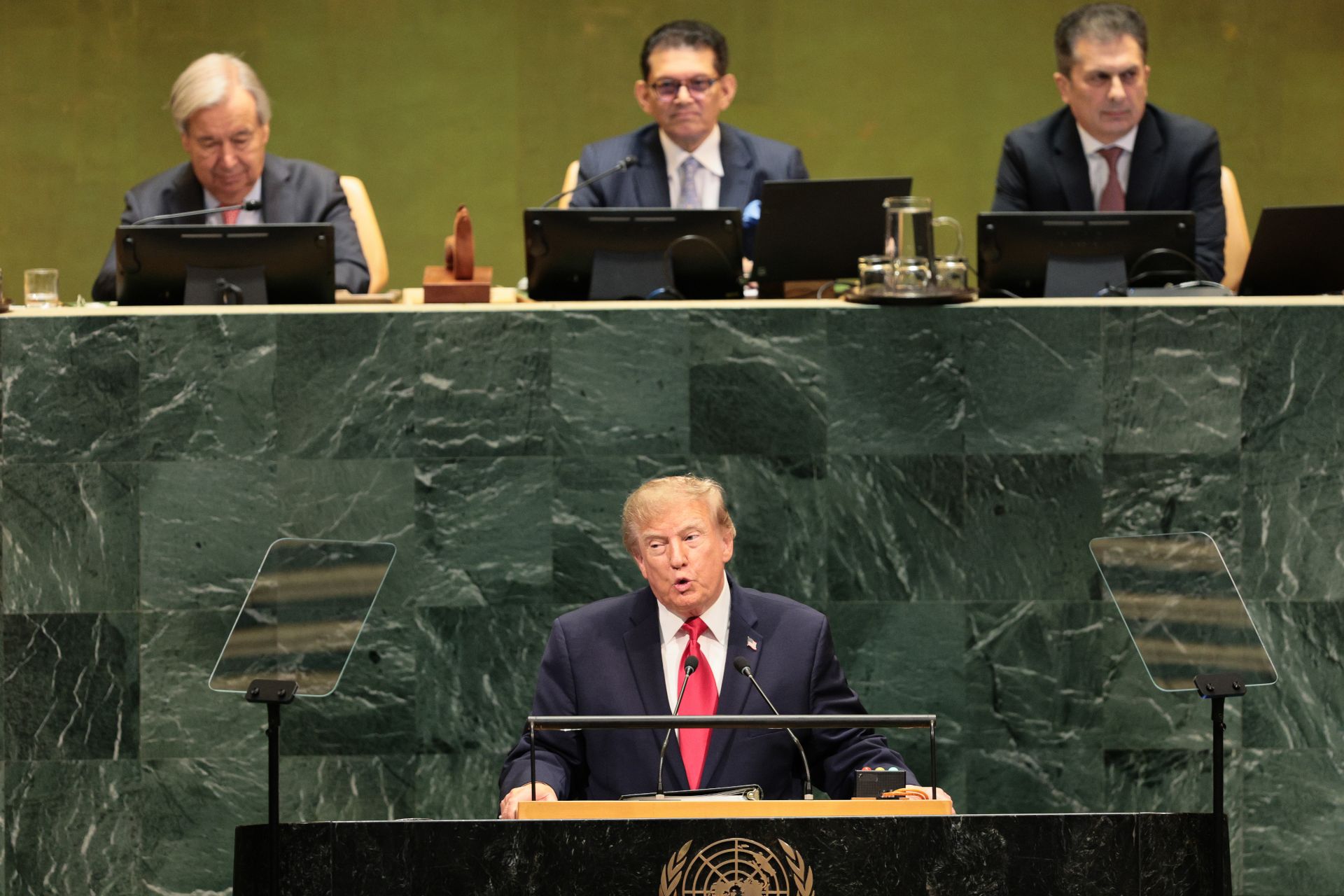
For decades after Soviet Premier Nikita Khrushchev said “We will bury you” in 1956, it was widely (though incorrectly) understood as a mad leader threatening America with destruction. Seventy years later, for the first time in history, a U.S. leader unambiguously threatened genocide at the United Nations.
It was not a euphemism. When he addressed the U.N. General Assembly on Sept. 22, President Donald Trump was absolutely clear that he was threatening to kill every man, woman and child in Iran — all 92 million of them. “Do I annihilate the Islamic Republic and do it quickly?” he asked, posturing as an absolute monarch with the power to destroy a nation on a whim. “Do I drive them into hell with no chance of survival and no hope of future greatness or generations?”
Worse, the only way to do this “quickly” is by using nuclear weapons. There is simply no other way to kill that many people. Horrifyingly, Trump actually has the ability to do this. As president, he has the sole, unfettered ability to launch nuclear weapons whenever he wants, for whatever reason he wants. In the archaic system established by past presidents during the Cold War, Trump can pick up the phone, issue an order, and in five minutes missiles would be flying.
Trump’s threat was consistent with his history of declaring that he would destroy all of Iran if it did not surrender. On April 7 of this year, as it became clear that the war he began would not be quick or easy, he declared on social media: “A whole civilization will die tonight, never to be brought back again.”
“This would be nuclear genocide,” Tara Drozdenko, director of the Global Security Program at the Union of Concerned Scientists, said about Trump’s latest threats. “Though it may be tempting to write this off as just another bombastic speech, the public must read President Trump’s words, and consider their true meaning and the real human impacts of nuclear war,” she said.
So, the president of the United States certainly appeared to threaten nuclear devastation at the podium of an organization the United States founded 81 years ago specifically “to save succeeding generations from the scourge of war, which twice in our lifetime has brought untold sorrow to mankind,” including preventing any further use of nuclear weapons.
Article 2 of the United Nations Charter — which American leaders drafted with 50 other nations in San Francisco in 1945 — expressly requires all member states to “refrain in their international relations from the threat or use of force against the territorial integrity or political independence of any state.” Today, we have the U.S. president openly, casually, insanely threatening genocide if another nation doesn’t surrender to his demands. The threat of genocide is, in itself, a war crime. Can we simply dismiss it as bombast?
Many may think that Trump’s threats are empty, but we can’t be sure. He is stuck in a repeating pattern with Iran: Threaten, bomb, retreat. The only variation is that sometimes there is no actual bombing following his threats. It is simply threaten, retreat.
Trump has blundered into a war for which he has no strategy. He cannot win the war — in fact, it’s clear to most observers that he has lost his (and Israel’s) war with Iran — but he cannot simply walk away, which would be a huge political humiliation for him. The one thing his father drummed into him all those years ago was: Never be a loser, or appear to be a loser.
So he’s stuck. And so are we.
Matt Duss, vice president of the Center for International Policy, called Trump’s threats “dangerously unhinged.” “Such rhetoric is not merely reckless, it is a criminal threat of genocide against an entire nation,” he said in a statement. Many global leaders at the United Nations had the same reaction. “I was worried when I heard a leader of a great power saying that he is considering annihilating a country. I mean, this is clearly a massive violation of the whole principle of the U.N.,” Norwegian Foreign Minister Espen Barth Eide said in an interview with Politico.
But Trump is still president, still has his finger on the nuclear button, still delivers a daily stream of threats, lies and hallucinations.
There are some hopeful signs that his power has peaked, though. Globally, statements like that of Norway’s foreign minister are becoming more common. Whereas world leaders flattered and fawned over Trump two years ago, they now keep their distance. Canadian Prime Minister Mark Carney, for example, ignored Trump at the U.N. and made a strong pitch for “values-based realism” during his remarks to the global body, promoting a new multilateralism independent of the United States. World leaders are starting to look toward a post-Trump future and even a post-U.S. international order.
Domestically, many of Trump’s most loyal supporters are distancing themselves from the deeply unpopular Iran war — now supported by only 29% of the American public according to a recent CNN poll — and a historically unpopular president. Just this week, The Washington Post reported, “two Republicans in key Senate contests, former congressman Mike Rogers in Michigan and Rep. Ashley Hinson in Iowa, called for the war to end, despite their earlier support for the conflict.” Even House Speaker Mike Johnson called, on Sept. 23, for “a resolution” to the war. More will follow as GOP prospects in the coming November elections continue to sink.
CNN analyst Harry Enten called Trump’s low approval ratings “stunning,” citing new polling that shows Trump has a minus 71% net approval rating among independent voters. This is a political death sentence. “These are the deep depths of the ocean,” he said, “You never see numbers like these.”
Decades ago, Khrushchev clarified that he meant that his communist system would bury capitalism, referring to the theory that the proletariat acts as “the gravedigger” of capitalism. (A poor translation of his remark had added to the misinterpretation.) It didn’t work. The American public saw him and the Soviet Union as an existential threat to the nation.
With Trump, there is no ambiguity. He is not speaking metaphorically. When he says, as he also did in his speech, that he has the right to Venezuelan oil because “to the victor goes the spoils,” he is openly embracing imperialism and rejecting every principle of international relations that past U.S. presidents have tried to create through the United Nations. When he threatens genocide, he means it.
The next few weeks before the elections will likely see an escalation of outrageous threats, as Trump tries desperately to salvage his sinking political fortunes. The next two years, particularly if the Democrats regain one or both houses of Congress, could be even more dangerous as Trump tries to protect his personal fortune and his personal freedom for after his presidency.
There will be no way to sugarcoat the U.S. defeat in this war. It will end, as Trump demanded at the beginning of the conflict, with “unconditional surrender.” It will be the United States, however, that will render that surrender, not Iran.
Iran holds most of the cards. It controls the Strait of Hormuz and now, with the help of its ally, the Houthis of Yemen, the critical Bab al-Mandab Strait at the entrance to the Red Sea. Iran’s drones and missiles hold the economies of its Gulf neighbors hostage. Iran has more offensive weapons than the U.S. has defensive interceptors. The price of oil (and gas) will only go up, and Republican political prospects will only go down.
Trump will be forced to end the war on Iran’s terms and will try his best to spin what is arguably the most crushing strategic defeat the United States has ever suffered as some sort of “deal.” Talks between U.S. and Iranian officials at the U.N. following Trump’s speech may represent a beginning of that process.
But with Trump, nothing is certain. His megalomania, his insatiable lust for power and wealth, his increasingly obvious instability and delusions of imperial grandeur threaten not just the future of this war, or of the United States, but of the entire global order. We cannot ignore the madness Trump increasingly displays. Only by naming it and confronting it can we hope to treat it.
Become a member today to receive access to all our paywalled essays and the best of New Lines delivered to your inbox through our newsletters.