


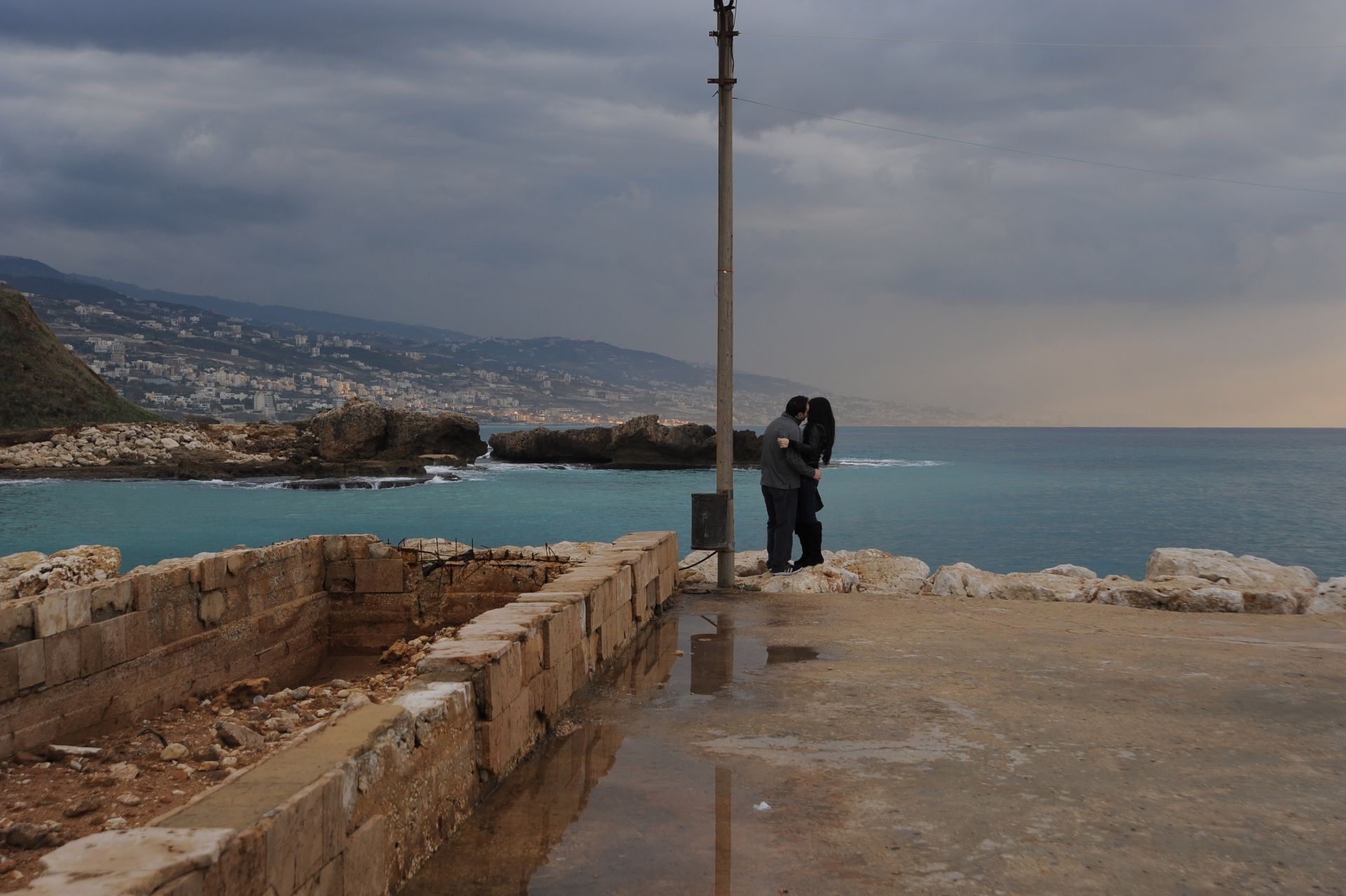
A couple of hours after sunset, about a dozen nervous 20-somethings were bundled up in jackets, milling about outside a trendy cafe bar in Beirut.
Inside, organizers were setting up for a blind speed dating party, the first such event to gain big traction in Beirut since, well, whatever people who are inclined to “dating” did before apps like Tinder, Bumble and Grindr went mainstream.
It was a Friday night in mid-December, in the buzzy few weeks between Pope Leo XIV’s visit to Lebanon and the Christmas holiday. The streets were packed with young Lebanese, including expats visiting home from France, the Gulf and pretty much everywhere else across the world for the season, ongoing Israeli bombings be damned.
Waiting outside the bar were Hamza and Jaafar, two best friends from Beirut in their early 20s (like others in this piece, their names were changed to protect their identities). They signed up for the party together after seeing a viral ad on Instagram. They could be each other’s wingmen, they figured.
They asked if I was one of the speed dating participants. I laughed, rather awkwardly, then fished out my notebook and told them no, I’m here in pursuit of hard-hitting journalism.
“Is it hard to date in Lebanon?” I asked, after we introduced ourselves. Only the hardball questions.
The two young men laughed. Behind them, Whitney Houston’s “I Wanna Dance With Somebody” blared on the speakers. “Yes!”
“Dating is so difficult in Lebanon,” Jaafar gushed. We didn’t have much time to delve deeper — the daters had to file inside to meet their matches and flip through icebreaker conversation cards in between happy, bouncy pop songs. Adam Zeidan, the 20-year-old hospitality management student who organized the night’s party, said more than 120 people signed up as soon as the ad went online in early December. It’s part of a new dating party business he’s calling “The Blind Spark.” Hundreds of others reached out to ask him for details.
The past seven years in Lebanon have seen, in no particular order, a deadly war, a financial crisis of historic proportions, political deadlock and one of the largest nonnuclear explosions ever experienced by humans — in the heart of Beirut. For more than two of those years, there wasn’t even a president.
Young people are, understandably, streaming abroad in search of jobs and greener pastures. Nearly 80,000 people emigrated in 2021, four and a half times as many as in 2020, according to a recent report by the American University of Beirut. More than 40% of those aged 25 to 44 said they, too, want out of Lebanon.
The Blind Spark wingmen Hamza and Jaafar told me that, out of their friend group, half have left the country. Hamza, too, is hoping to leave sometime soon. Another group of friends, all in their mid-20s and early 30s, and employed as full-time software engineers, told me over drinks one Friday night that their childhood buddies have all seemingly streamed out, one by one, over the past few years. “Who is still left?”
“All of my school friends are not here,” Daniel, one of the group, told me, counting in his head. “All of my uni friends are not here,” he went on.
Love, famously, isn’t easy to quantify. But its paperwork is — sort of. In 2018, the last year before Lebanon’s crash began, there were 4,280 marriages recorded in Beirut. By the end of 2024, there were just over 3,000.
Marriage rates, if they are any metric to go by, have decreased across the country, according to government data. In places like Greater Beirut and northern Lebanon, they peaked in the mid-2010s before nosediving in the years immediately after the country’s 2019 financial crash.
Even the late Hezbollah leader Hassan Nasrallah called for upholding marriage in a 2023 speech (while also calling LGBTQ+ people a “threat to society,” in that very same speech).
A falling rate of marriage isn’t a problem in itself. It doesn’t even necessarily mean there are fewer people falling in love, or that less dating and hooking up is happening. It just means that fewer people are making the decision to get married. That decision costs money and comes with expectations of homeownership and paying for child rearing, explained the anthropologist Maya Mikdashi. She wrote a book about the messy interplay between gender, law and Lebanon’s sectarian system, a Gordian knot of social phenomena she dubs “sextarianism.”
Lebanon’s overlapping crises have left the dating scene and the pursuit of partnering up feeling like something of a barren dust bowl, young Lebanese people tell me.
“I think I only have one friend who’s in a relationship,” 23-year-old Nina told me recently, after taking a long pause to do some mental math. I imagined tumbleweeds rolling across whatever mental image she was conjuring to count her friends. “Nobody wants to commit.”
Love, marriage and partnership in Lebanon are tied up in a web of social and sectarian expectations. That’s not unique to the country. But here the vestiges of Ottoman- and French Mandate-era laws remain in force, leaving civil matters like marriage and divorce to the country’s 18 recognized religious sects — each with its own catalog of civil laws, assumed political alignments and stigmas. And there’s still no civil marriage to bypass it all, despite decades of activists calling for it.
Dating, or marrying, across those sectarian lines can mean navigating a contradictory mirror maze of laws on the matter, on top of disapproving in-laws. Some people simply give up, anticipating the headache. In my own case, it meant scheduling a courthouse marriage in another country altogether, since my fiance’s Druze sect doesn’t perform interfaith marriages — Druze are only permitted to marry other Druze. Meanwhile, dating within sectarian lines means finding love (or at least partnership) within the tiny pool of Lebanese people in one’s own sect (pour out a sympathetic beverage of your choice for the Syriac Catholics, who, by one count, number only 13,000). That’s not to mention same-sex marriage not being an option at all, and a law punishing “any sexual intercourse contrary to the order of nature.” Add brain drain and poor job prospects, and the sea of fish you might actually click with shrinks further.
It’s a lot of weight to load onto the pursuit of love.
For Rami and Dana, a couple in their early 20s, it means hiding their relationship from their families altogether, even though they plan on getting married in a few years. They fell in love while volunteering together in northern Lebanon, which they are both from, but he is “Sunni, Sunni, 100%,” Rami told me, laughing, while Dana is from a deeply religious Christian family.
For both of their families, dating outside the religion is “a very, very, very big ‘No.’” Their solution: simply break the news of their relationship after the wedding.
Perhaps the online algorithms were catching on to my interest in the topic. Time and again, despite being in what is very much a happy, long-term relationship, I kept scrolling past social media ads for a Lebanese dating app called Taaruf (the name means “getting to know each other” in Arabic).
Here’s how a typical Taaruf ad goes: Eleonour Khaten, a young woman on the app’s marketing team, is standing in a cafe, reading in the first person from one of the dating profiles’ “about me” sections. She speaks with a sense of urgency that can only be described as heightened.
“If he’s not an Aounist, I don’t want him! I love the Free Patriotic Movement [of former Lebanese president and army general Michel Aoun], and I want a Christian man who also loves them!”
“I want a Druze girl in her 20s who is affectionate, pretty and cute.”
“I only want a Shiite man! I don’t want any man who isn’t Shiite, and I don’t want non-Shiite men to talk to me!”
The founder behind Taaruf is a web developer from Zahle, Lebanon, named Kamal Frenn. By design, the app sorts users using the usual categories of smoker/nonsmoker, age and location, but also by religious sect and by Lebanese political parties such as Hezbollah and the Lebanese Forces. Kamal told me the app was for dating with “traditional Lebanese values” in mind, which, according to him, means marriage and having kids.
Imagine an idyllic Lebanese town, or at least the Christmas-card version of one, lined with arch-windowed stone houses atop hills and white bed linen hanging out to dry in sun-dappled gardens.
A teenage girl steps up to hang a sheet on the laundry line, but she hides behind it coyly when she catches one of the neighbors’ boys sneaking a peek at her. Suddenly, once the neighbors catch on, the two young people are stuffed and zipped into wedding clothes and made to walk down the aisle, all amid the ululating cheers of the local aunties.
This is, in fact, a sequence from the 1998 short comedy film “Wayn, yo, Zahle?” (“What’s Up, Zahle?”), about neighborhood gossip and fraught sex lives amid provincial life in the eponymous Bekaa Valley town.
Kamal and Eleonour (who is also from Zahle) laughed when I asked them if they’d seen it. “Of course we have!” One of the cast members even features in a Taaruf video ad, they told me, about a mother trying to set up her son with a local bride.
Taaruf is a more online version of the traditional method, a la “Wayn, yo, Zahle,” of simply asking one’s parents to find a suitable match within one’s sect or social class. According to Kamal, the app has some 180,000 active accounts, 40% of which belong to Lebanese living in the diaspora, where the “traditional” methods are hard to come by anyway.
Maybe it’s easy to laugh at an app like Taaruf, with its unabashedly goofy ads and what some young Lebanese folks told me were outdated ideals of matchmaking. But it’s not alone.
For one, there’s also DruzeLink, founded in 2017 by Lebanese-American emergency medicine physician (and TikTok influencer of the gym selfie persuasion) Fayez Ajib. Ajib’s app, like Taaruf, is a step further online from the analog “Druze cruise” package vacations and Druze youth groups of matchmaking from yesteryear.
And why not? According to Lara Deeb, a Lebanese anthropologist who has studied interfaith marriages, partnership isn’t always about what we as individuals want but also what our families and communities deem acceptable.
“Are we individuals with definitive boundaries … or are we like an aspen grove understood as a single organism, roots connected, edges porous, desires and identities never quite distinct from our families?” Deeb wrote in her 2024 book “Love Across Difference.”
“Look, sometimes I come across someone cute on the apps,” one friend, a single Muslim woman in her early 30s, whom I’ll call Samara, told me recently. She’s not particularly picky about religion, but knows her parents are. “As soon as I see that his name is ‘Tony,’ or something Christian like that, I say, ‘forget it.’”
Not everyone is on board with apps like Taaruf or Druzelink. In an increasingly popular reaction, analog matchmaking is coming back in style, but with a twist.
Marielyn Haddad, 25, owns Iconik, an art teaching studio in Beirut that, since nine months ago, doubles as a space for blind “art dates.” The idea is that singles who are looking for love fill out a form, Marielyn makes the matches based on their responses, then the two of them show up to the art studio to paint whatever they like while answering icebreaker questions and sipping wine. The whole time, a wooden board down the center of their table prevents them from seeing each other.
Samara, my friend who swipes left on guys named Tony, signed up for one of the dates, too, but didn’t find a spark with her match, she laughed.
Still, Marielyn said, the idea is a hit. She’s hosted more than 100 blind art dates so far, including some LGBTQ+ matches. At least one of the couples is still dating.
For many young Lebanese, like her, simply to “fit” together by class or religion isn’t enough. “My grandpa saw my grandma [at a time when] he was ready for marriage; he had his house, furniture and car. Those were things that you had back then in order to marry. So he asked her brothers if he could marry her.” And that was that.
“I asked her so many times: ‘You didn’t have a love story — Why did you marry him? I don’t think we accept that now. How can we live with someone we don’t love?”
Adam Zeidan, too, says his “The Blind Spark” date parties have become popular. By January, a few Fridays after the first one, a second party was underway, full of several dozen 25- to 40-year-olds at a popular Beirut restaurant. One female participant even brought along two friends for “emotional support,” who giggled over drinks by the bar as they watched the blind dates.
Natasha, a young language interpreter, told me she signed up for this round simply because she’s “bored” of dating apps. Her friend, Pamela, thought she’d give it a go, too — meeting people has become too difficult after about a third of her friend group emigrated from Lebanon, she told me, as I squeezed in some questions before their first round of dates. A couple of young men, sharing the bar table with us, laughed shyly at the impromptu interview.
According to Zeidan, several of his couples from the last round are still going on dates with each other, or at least talking. “It makes me happy,” he told me, in between helping organize the DJ and question cards. “It’s grounded in real human connection.”
I’ll admit, I’m struggling to report a story about love, flirting and dating at this moment. As I write these words, Israel is still bombing parts of Lebanon daily despite a ceasefire deal more than a year ago that was supposed to end the war. In my home country, the United States, squads of armed immigration enforcement crews are rounding up and killing people in the streets — all while sickening new revelations emerge about the dealings of child sex trafficker Jeffrey Epstein.
Lara Deeb, the anthropologist who wrote about interfaith marriages in Lebanon, compiled much of the text in the aftermath of the Beirut port explosion, and amid the ongoing genocide in Gaza. Love isn’t necessarily a solution to all that suffering. Deeb told me that interfaith marriages, which spiked in the years of 1960s student activism, stopped rising in the midst of Lebanon’s 15-year civil war, which pitted Muslims against Christians against Druze, in all manner of deadly combinations.
What about today? “I think it’s totally crazy to imagine that because there is a war and an occupation, people won’t fall in love. Love can become a way of survival, it can be a reminder of human worth,” Mikdashi told me. “It can be a tether to life, a reinvestment in life, in living. I think it’s a powerful thing to insist on love in the face of death.”
Dana and Rami, the young interfaith couple who are dating in secret, were both studying at university in Beirut at the height of Israeli bombing on the city in 2024.
“I used to go to his apartment and hear the bombs nearby,” Dana remembered. “I was afraid that something would happen to us, and my family would find out I was with him,” she laughed. “But still, at least if something happened to us, we would be together. If you don’t have a relationship, someone you feel safe with, then the world feels heavier — especially in Lebanon.”
Such love spans the march of generations, I found, as a grandfather’s tale of meeting his love gets passed down, or a grandmother remembers a distant smile from long ago.
My friend Nadine Kheshen, from Aley, still smiles when she asks her 94-year-old grandmother Leila how she and her grandfather met back in the 1950s. Now experiencing dementia, Leila nevertheless remembers the story in little wisps.
Jamil Chehayeb, a young pilot, fell in love with Leila’s dark, fringed hair and modern style. “Did I mention what he used to do with the plane?” she asked me one afternoon, sitting in her kitchen and flipping through an old photo album. We gathered near her iron stove, burning in the center of the room.
“He’d fly his plane around the house, in between the buildings!” She smiled. “People would say, ‘Look, he came to see his love!’”
The two were married for 70 years before Jamil passed away from the flu just a few years ago. Before he went, he self-published a book of the love poems he wrote over the decades for his Leila. She and Nadine, who looks just like those old black-and-white photos of Leila, began reciting one of the poems to me, together, having memorized its lines: “I love you, Leila / And that love is a beautiful melody / Which we sang together / Before we announced our departure.”
Outside, we heard the low echoes of Israeli warplanes flying above us in the cold, on their way to strike a town in eastern Lebanon. But here beside Leila’s stove, we were warm.
“Spotlight” is a newsletter about underreported cultural trends and news from around the world, emailed to subscribers twice a week. Sign up here.