


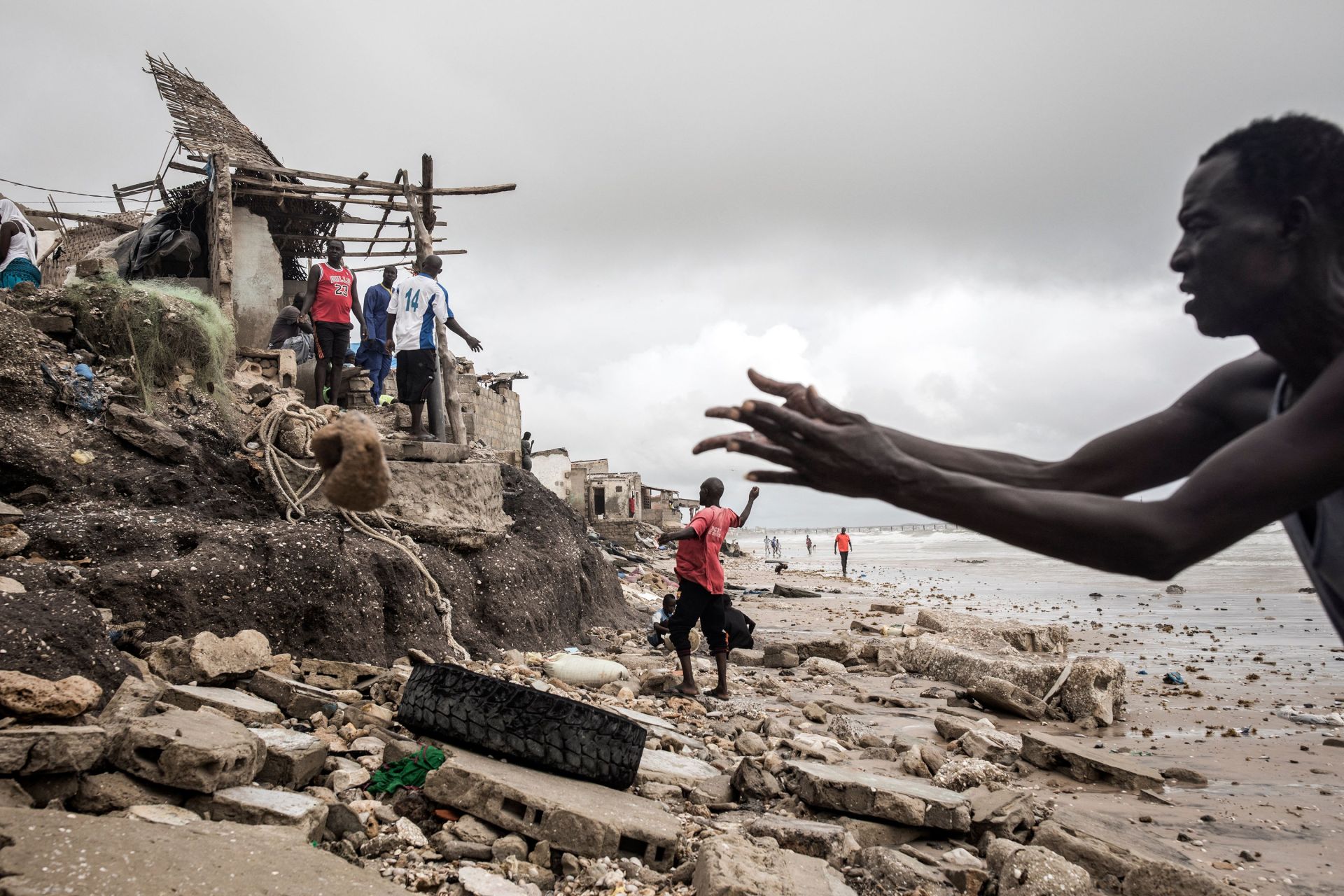
In the early hours of Monday, Sept. 8, 2025, Oluwambe Ojagbohunmi woke up with a start, his chest heaving from the strain of another sleepless night. Overnight, the Atlantic Ocean abutting Ayetoro, his community, had once again surged at high tide and engulfed parts of the village, leaving a trail of destruction.
Rising from his bed to peek from the half-open window of his weather-beaten palace, Ojagbohunmi, who is the village’s traditional ruler, was startled to see an expanse of choppy water filled with rubble creeping within yards of the building. In place of the tidy wooden houses raised on stilts that previously lined each side of Broad Street, the village’s main thoroughfare, lay a vast pile of torn planks, mangled iron rods, smashed concrete slabs and overturned zinc roofs.
Before heading out to inspect the wreckage and mourn with those who had lost their homes, he grabbed his phone and typed out an urgent post on Facebook to raise the alarm that Ayetoro’s ancestral palace, its last surviving piece of cultural heritage, was about to be swallowed by the Atlantic Ocean — not suddenly, in a storm, but bit by bit as the Nigerian government watched. “While waiting for the government project” that would create a sea wall and protect the village, he wrote, “we have been bombarded by a new rage of sea waves which have destroyed yet more houses and businesses and has threatened the ancestral palace.”
The plight of Ayetoro shines a spotlight on the compounding problems facing low-lying coastal communities across Nigeria. On the front line of climate change, these towns are seeing massive rises in sea levels, with surging tides that flood infrastructure and cause coastal erosion, washing swaths of land out to sea. Local economies that once depended on the coastline are collapsing. But for poor communities like Ayetoro, the reality of climate change intersects with issues of government inaction and rampant corruption, making it harder for the 20 million people inhabiting this crucial ecosystem to access the support they need to save their land and heritage.
Ayetoro is just one of several clusters of fishing villages situated along the Atlantic shoreline in the oil-producing region of South West Nigeria, but it stands out for its unique history. The village was founded as a theocratic Christian commune in 1947, 13 years before British colonial rule ended in Nigeria, by a group known as the Holy Apostles that was fleeing persecution.
According to folklore, they chose to settle this low-lying mudflat following a prophetic vision received by one of their spiritual leaders. It was hardly the best location, but the inhabitants managed to turn adversity into fortune by building, through communal effort, an industrious village that flourished over the next three decades. To cope with the swampy terrain, they built their houses on elevated stilt foundations. For roads, they built a network of wooden planks crisscrossing the entire village.
The community practiced a kind of communism, pooling resources. This soon enabled Ayetoro to become a hub for fishing and industry in the region, with soapmaking factories, a textile mill and boatbuilders. In 1953, the village became just the second location in the whole country to have electricity.
“If you need shoes, they will be given to you. If you need soap, soap would be supplied to you,” Prince Akingboye Thompson told New Lines. All the villagers ate together at a common cafeteria, and on Sunday, they all gathered to sing, dance and pray at a single church presided over by the traditional ruler, who is also the village’s spiritual head. Due to this unique way of life, Ayetoro became known around the region as “the Happy City.”
Ayetoro’s fortunes began to change for the worse when logging and crude oil exploration led to environmental damage. The Ilaje area of Ondo state, where Ayetoro lies, contributes 4% to Nigeria’s total daily crude oil production. Major oil companies like Chevron have been operating in the area since 1968, with frequent oil spills that impact the environment, often without clean up and remediation.
Along with the pollution, communities on the coastline began to experience regular flooding at high tides, causing erosion. An analysis of satellite imagery from 1986 to 2020 shows that a large portion of the Ilaje coastline, some 40 miles, has been eroded at an alarming rate. Ayetoro, in particular, lost about 86% of its coastline between 2008 and 2023 — over 50 acres of land swept into the sea. The rising sea level and coastal erosion also lead to salination — an accumulation of salt in the water and soil — which upends ecosystems in both salt and fresh water, making traditional fishing nearly impossible. “Fishing has become very difficult. Now you have to row far into the ocean before any hope of catching any fish at all,” Felix Atorise, who said he stopped fishing last year due to declining income, told New Lines.
With the local economy in tatters thanks to the rising tides, many are forced to make tough decisions about whether to abandon their village, its unique history and way of life for safer and potentially more prosperous climes.
“Even though our people are resilient, sadly some have left,” Thompson added. Twenty years ago, in 2006, Ayetoro had a population of 26,000, according to census data; but now, the villagers estimate there are no more than 5,000 residents. Those left behind now occupy a shrinking landscape, as the sea continues to encroach, as if with a mission to obliterate the community.
“We have lost nothing less than 5,000 buildings in the last 20 years,” Thompson said, “including iconic parts of our history.” He said that now the rising generation only hears of Ayetoro’s prosperous past from folklore — all the physical evidence lies underneath the sea.
The ancestral palace is the last surviving piece of that heritage, and the community is desperate to save it. Built in 1960, reportedly at a cost of $160,000 — an incredibly extravagant amount at the time — the 100-room, three-story palace was a great feat of architecture when it was built. Unlike the stilt foundation common to other buildings in the village, the palace was built on a concrete foundation that can withstand oceanic pressure. Its external walls were made of reinforced concrete; only the balconies, parapets, windows and interiors were constructed with wood. Now the first floor of the once-magnificent building is nearly buried in silt, while its courtyard is filled with brackish water that plays host to a knot of giant toads croaking at the top of their lungs. Despite its physical decline, for many Ayetoro residents the palace still stands as a symbol of the community’s exceptional history. In recent years, it has become a refuge for the elderly who have lost their homes to sea incursion and do not have the means to rebuild.
Armed with a plastic bucket filled with a mixture of cement and a hand trowel, and shod with rubber slides laden with mud, Zechariah Momoh had only one mission on the Saturday in mid-October when New Lines visited Ayetoro: filling cracks in a failing sea wall the Nigerian government has paid a fortune to build.
The company Momoh works for, DBC Nigeria Construction and Mech Company Limited, had secured a contract from the Ministry of Regional Development to plant a concrete wall along Ayetoro’s shoreline. It is a temporary measure; the government has plans to build a more durable sea wall, but with a longer time horizon for its construction. Just two months and 65 feet into what is meant to be a 1.2-mile-long project, construction had to be paused when several sections of the wall cracked wide open as the foundation gave way. Now it was Momoh’s job to save what was left by filling the cracks with liquid cement mixed with gravel.
Raymond Werdan Dagher, the director of the Lebanese-owned construction company, told New Lines, “The problem is not with our concrete; it is the soil sediment.” The soggy soil requires a pile foundation “that would require billions of naira. The money I have been given cannot do this. What they paid me for is to construct a temporary wall,” he added. Although he refused to disclose the total contract sum for the wall, Dagher did reveal that he had received between 20 million and 80 million naira (roughly between $14,500 and $58,000 at current exchange rates) as a mobilization fee before starting the project.
As Momoh went about his task, whistling tunes to the horizon, the villagers stood listless and unamused by the unfolding spectacle. Over the last two decades, they had seen far too many contractors and corrupt government officials use the villagers’ misfortune for personal gain. “It has been an all-too-familiar pattern since 2004,” Atunmise Benson Adebayo, a native of Ayetoro, told New Lines. “It is a game. Once they receive the mobilization fee, which often runs into millions of naira, the contractor abandons the project knowing that the politicians will not come after them.”
In December 2004, the Niger Delta Development Commission (NDDC), an agency set up at the start of the millennium to cater to developmental issues in Nigeria’s oil-producing communities, awarded a contract of 2.4 billion naira to Gallet Nigeria Limited to build shoreline protection for Ayetoro. The community was overjoyed. But soon after the contract was granted, the construction firm absconded after pocketing 25% of the contract sum.
“We expected anti-corruption agencies to go after the firm, at least to try to retrieve the money paid, but nothing happened,” Adebayo explained. Instead, the NDDC simply reawarded the contract five years later to another firm, at a cost of 6.2 billion naira, nearly three times the previous amount. Fifteen years after the contract was awarded, Ayetoro is still without shoreline protection, as the new company soon abandoned the project, claiming “difficult terrain and logistics” — but not before it had pocketed at least 1.7 billion naira.
Within a month of Ojagbohunmi’s public outcry, efforts to save the ancestral palace began to take shape. Every household donated whatever money they could to a collective purse to procure sand and cement. Residents also formed work groups and began gathering concrete and stones from the wreckage of buildings to build a temporary sea break that runs along the foot of the palace, about 100 feet from the collapsing wall the government paid for. When New Lines visited in October, a group of about a dozen men and women were working on the wall in the early afternoon. One of them, Womiterin Toyin, a 40-year-old mother of four, told New Lines, “We can’t leave our land for the ocean to destroy completely. The palace is part of our history. It is how we remember we were once great. That is why we are doing the little we can to save it.”
The wave breakers, massive 4-ton concrete slabs, were set side by side until they formed a 100-foot-long protective wall across the frontage of the palace and Broad Street. It is a crude construction, no doubt, but at high tide, the wave breakers held firm and remained standing, unlike the shoddy wall the government paid millions for.
“This is another proof that communities at the front line of the climate crisis ought to be involved in the solutions. We know our land better, and we have been here for decades,” Ojagbohunmi told New Lines. He added that, if the government could support the community with equipment, materials and money, it could extend the wave breakers beyond the palace and across the entire Ayetoro coastline.
Several months have passed since Ojagbohunmi made this passionate plea, but nothing has been heard from the government. For over two decades, Ayetoro’s cry for help has mostly fallen on deaf ears, and politicians and contractors appear to see the people’s plight as an opportunity for self-enrichment rather than a call to serve. In the final analysis, Ayetoro’s story is not just about the scourge of an encroaching ocean. It is also a story of indifference and neglect by Africa’s policymakers, whose inability to act decisively is accelerating the risk facing coastal communities at the front line of climate change.
“Spotlight” is a newsletter about underreported cultural trends and news from around the world, emailed to subscribers twice a week. Sign up here.