


In the heart of Tunis, the medina’s stone walls wrap around a dense knot of low buildings, historic houses and palaces stacked next to and on top of one another, cheek by jowl. Cobblestoned streets are lined with carved mashrabiya balconies and arched wooden gateways, details that gradually thin as you move outward, inching toward Avenue Habib Bourguiba. There, the city’s primary thoroughfare shifts into a markedly more European register. Palatial apartment blocks from the French colonial period rise on either side, their shuttered windows and wrought-iron balconies repeating in orderly succession. The massive Cathedral of Saint Vincent de Paul interrupts this rhythm, its neo-Byzantine bulk softened by Gothic flourishes. Nearby, the Municipal Theater of Tunis also asserts itself with art nouveau sculpted reliefs and delicate ornamentation — it is a favored backdrop for political rallies, and, at one time, protests.
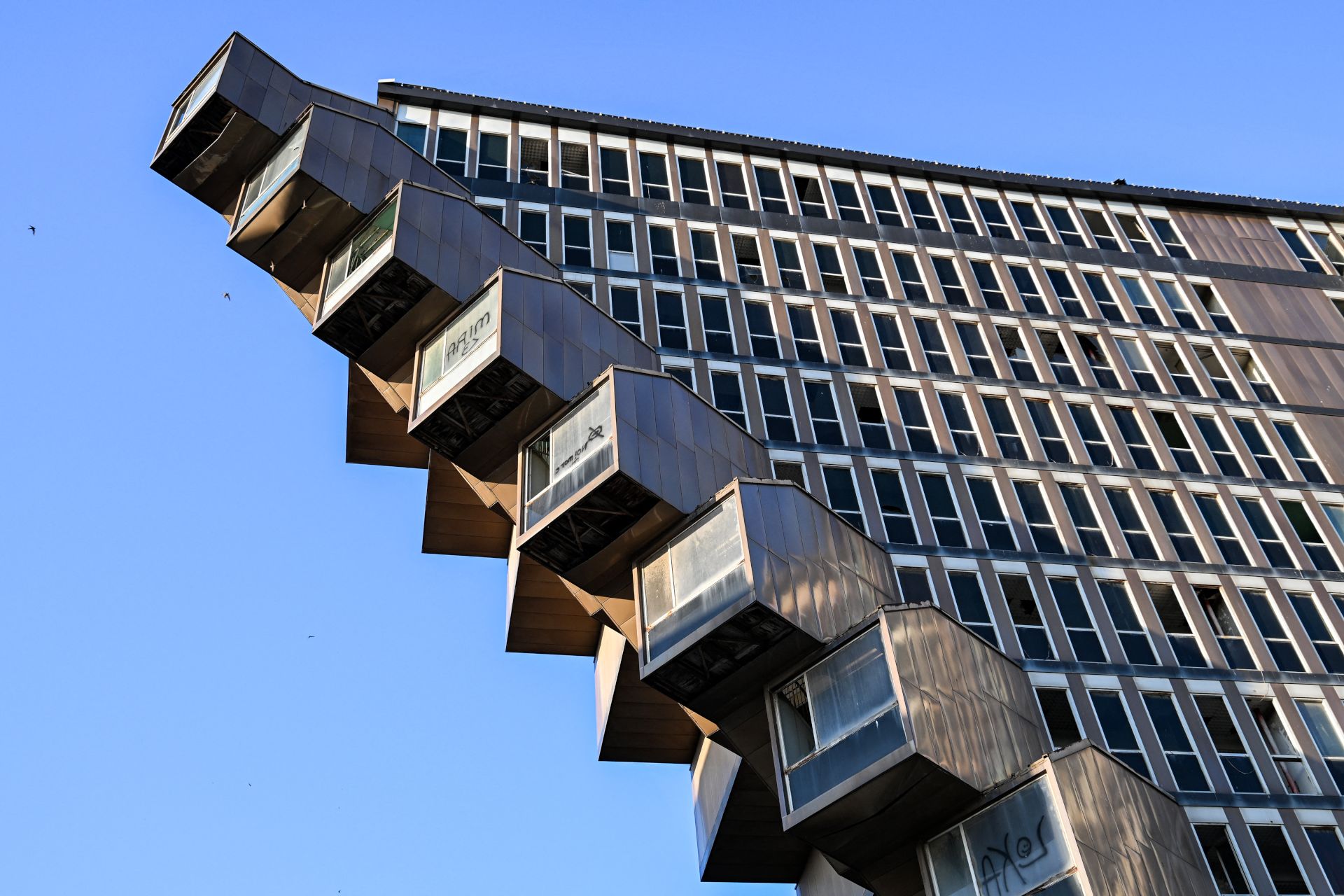
But travel just a few hundred yards further east, and you’ll stumble upon something that feels utterly alien to the orderly French colonial landscape of central Tunis: an inverted step pyramid of steel and exposed concrete, each successive floor jutting outward in a cantilevered sequence, the upper levels occupying twice the length of the narrow base below. This is the Hotel du Lac, a brutalist masterpiece and one of Tunisia’s most controversial monuments.
Today, the horizontal bands of windows that cut across the facade have been blown out. The hotel’s roof has also been stripped away. Portions of the interior are left exposed to the elements, concrete ribs laid bare alongside shattered furniture and broken glass, the first steps in a fraught demolition slated for later this year.
The demolition of the Hotel du Lac is set to erase a national landmark. During the 20th century, newly independent states in the Global South embraced brutalist and modernist styles as declarations of strength and sovereignty. Designed by Italian architect Raffaele Contigiani and commissioned under President Habib Bourguiba, the Hotel du Lac was conceived in 1973 to project this message. Its stark form severed ties with the colonial architecture around it. Even its construction was a technical feat: Set on unstable, waterlogged ground by the Lake of Tunis, the structure rests on 190 reinforced concrete piles driven nearly 60 meters into the earth.
After its construction, the building was widely celebrated in tourism brochures and postcards, its silhouette becoming part of the city’s visual identity. There are even apocryphal stories that the hotel inspired the design of the sand crawler — one of the vehicles in the 1977 Star Wars film “A New Hope,” parts of which were shot in southern Tunisia.
As the demolition of such an iconic structure gets underway, the wrecking ball feels less like an isolated event than a symptom of something deeper. In a country filled to the brim with medieval Islamic architecture, Carthaginian ruins, colonial facades and postindependence modernism, that heritage is facing new threats. Weak legal protections, fragmented governance and funding issues have long left these architectural triumphs vulnerable. Recently, however, a new obstacle has emerged: a political climate defined by suspicion toward elites and intellectuals. Now, architects must contend with being cast as actors working against the public interest while they fight to save the country’s prized buildings.
Long before the rise of populism, Tunisia’s preservation system was structurally ill-equipped to protect its architecture. “The heritage code,” the legal system that defines what buildings are worthy of state protection, “spans only five pages,” Adnen El Ghali, architect, historian and member of the International Council of Monuments and Sites, explained. “The system for classifying or grading buildings is vague and imprecise, so protection is largely selective.”
There is also the problem of fragmentation — different departments inside the government not communicating or working at cross-purposes, which makes trying to secure legal preservation for a building nearly impossible. “The Ministry of Equipment and Habitat may push to demolish a site for housing or commerce,” El Ghali said. “Meanwhile, the Cultural Ministry or municipality tries to protect the same building, without any coordination between them.” Universities, nongovernmental organizations and architectural experts also possess extensive knowledge of Tunisia’s built history, but their research rarely informs policy. “It is like having an orchestra without a conductor,” El Ghali added. “Each musician is playing their part in isolation.”
Governance changes then further paralyze action. “Since the revolution, frequent government reshuffles have made it hard to implement lasting policies,” saud Adel Hidar, a local architect.
The Hotel du Lac illustrates just how dysfunctional the classification system is. Between 2010 and 2020, two demolition attempts were shelved following civic mobilization. In 2022, another proposal was halted after a coordinated campaign involving media pressure and detailed documentation of the site’s value being shared with the Ministry of Culture. “Hotel du Lac was then granted temporary protection,” recalled Sami Aloulou, co-founder of Septembre Architecture and member of local NGO Buildings and Memory (Edifices et Memoire). “But efforts to permanently classify the building were derailed when the cultural minister leading the initiative resigned before the process could be completed. It was a complete mess.”
Even the small subset of historical buildings that do get a classification is still at risk, because preservation and restoration largely rely on private individuals willing to absorb the financial risk.
Leila Ben Gacem has spent two decades restoring historic “dars” (traditional town houses), in the medina of Tunis, converting them into guesthouses. The first property she renovated dates back to the 15th century. Paved with mismatched stones, the courtyard slopes unevenly and is flanked by columns believed to have been repurposed from Carthage. Over centuries, layers accumulated: ceramic tiles, carved wood and sculpted gypsum were added to the property. “The dar is a witness of the cultural diversity of our identity,” Ben Gacem tells me. “It has been impacted by centuries of events. I had to restore it properly.” But to do so, she had to rely on a loan from her brother.
“The majority of homeowners in the medina cannot afford an architect,” she said. Local banks rarely offer loans for restorations. “There are no tax exemptions or help schemes for heritage projects like you see in some other countries,” El Ghali explained.
Without financial support, buildings either deteriorate or fall to the mercy of market logic. “In most cases, private actors are indifferent to the building’s cultural value,” El Ghali said. “Demolition and reconstruction are predominantly the easiest way to receive immediate profits.”
These long-term structural weaknesses have only created the conditions for something more corrosive to take root. Preservation is no longer merely neglected and underfunded; it has become politically suspect.
Under President Zine El Abidine Ben Ali, corruption was pervasive. After the 2011 revolution, a purge targeted the entrenched elites. President Kais Saied, who consolidated power in 2021, and his loyal supporters have harnessed this narrative in the past few years.
“What began as a response to real abuses has since hardened into a populist ideology,” Aloulou said. In practice, education, economic security and professional visibility alone do not attract suspicion; it is those who act independently, operating beyond the state’s remit, who are more readily framed as threats.
This shift in the political climate became painfully real for local architect Adel Hidar at the end of May 2025. He was indicted and briefly detained over alleged professional misconduct related to two public architecture projects in Sousse. The charges were partly entangled with local rivalries and power struggles, but Hidar also suspects that his active public engagement in the architectural sphere was a factor.
“In the current political climate, such a position can be perceived as disturbing, or even threatening,” he said. “It implies intellectual independence and, at times, a form of disobedience toward a rigid and sclerotic administrative system.”
Even after his release, Hidar remains tethered by a travel ban, and the case is still unresolved. The ordeal has left a mark not only on him but on those around him.
“It encourages architects, urban planners and intellectuals to retreat into strictly technical positions and to avoid critical public engagement,” Hidar explained. “This mechanism poses a serious threat to architectural preservation — particularly modern heritage — which inherently requires intellectual courage, responsibility, and long-term vision.”
That fear has already begun to materialize in tangible ways. During an unannounced visit to survey the erosion damage to the historical village of Sidi Bou Said following a series of storms in January, the president publicly referred to the demolition of the Hotel du Lac. In his remarks, Saied dismissed the idea that the building could be considered national heritage, suggesting that the authorities were incapable of distinguishing what truly deserved protection. A video documenting his visit has since been broadcast on his official Facebook page.
“What followed was, in my view, even more significant than the statement itself: a near-total silence,” Hidar said, referring to the architects, academics and professionals who had previously expressed concern about the Hotel du Lac suddenly withdrawing from public discussion.
“Some refrained from signing petitions, others declined to attend meetings or site visits, and several explicitly said — privately — that they were afraid of being seen as opposing an official narrative,” Hidar continued. “This is a very concrete example of paralysis by fear.”
Fear has even seeped into the administration itself. In 2024, during a visit to the medina, Saied publicly criticized the restoration of a palace by a private investor, alleging that the permits for renovations were gained through corrupt means. The visit was also broadcast on his official Facebook page; thousands watched Saied walking briskly through narrow alleys, visibly irked, gesturing toward the restoration work, his voice sharp as he challenged the cultural minister on what had been done. The video sparked countless comments calling for further purges.
“Everyone in the administration is now overly aware that any decision can later be scrutinized or publicly denounced,” Ben Gacem said. “Rather than take responsibility, officials favor inaction.”
This only further delays processes to classify buildings or receive permits for projects in protected areas like the medina. “Files circulate endlessly and administrators seek co-signers for backing,” Ben Gacem continued. No one wants to be the sole supporter of a project. The delays only further disincentivize people from pursuing heritage projects in the first place.
Civil society faces similar suspicion and constraints. Saied’s rejection of what he calls “foreign diktats” has cast international funding as suspect. Since 2023, several NGOs have seen their activities suspended for receiving foreign funding.
“Heritage projects traditionally supported by the German and French cultural councils now attract suspicion, too,” Aloulou said. Regulatory scrutiny has intensified, discouraging initiatives that once sustained preservation efforts.
Against this populist backdrop, a moral hierarchy is increasingly imposed on architecture. Structures associated with mass use or religious life are prioritized; since Saied took power, a mid-century swimming pool and a public park have been restored and reopened.
“Colonial-era neighborhoods in Centre-Ville are often dismissed as foreign intrusions that fall outside our national history,” El Ghali said. Postindependence modernism is folded into the same accusation. Brutalist and modernist buildings commissioned after independence are framed as elite mimicry of Europe. The fact that many of these spaces were appropriated over time by locals — inhabited, modified and embedded into daily routines — is overlooked.
Once architecture is stripped of social memory and recast as elite excess, its economic fate becomes easier to justify. “Investors pretend that a building is unsafe by exaggerating its deterioration,” El Ghali said. “Profit is the real motive, but they frame it as a public good for better housing, offices or development.”
This rhetoric can be seen playing out in the case of the Hotel du Lac. The Libyan public investment fund Lafico, which owns the site, plans to replace the monument with a mall and a 20-story luxury hotel. In order to complete the project, the fund has pledged $150 million in investment and 3,000 jobs. Framed as a contribution to economic recovery after years of recession, preservationists opposing the project are cast as obstructionists.
On Instagram, comments under campaigns to save the building echo this sentiment. One user posts a common refrain: There are more urgent priorities — jobs, food, schools, hospitals, housing.
Wary of being branded as elitist or opposed to the public good, architects, urban planners, and even those within the administration are often too fearful to advocate for preservation. At the same time, by framing architectural care as the concern of a privileged few, Tunisia’s citizens are being distanced from a culture that should belong to them. The shell of the Hotel du Lac still stands, for now, looming over Avenue Habib Bourguiba as it awaits total annihilation — a stark reminder that, by the time the culture war is over, there may be nothing left to defend.
“Spotlight” is a newsletter about underreported cultural trends and news from around the world, emailed to subscribers twice a week. Sign up here.