


On April 21, hospitals all over the Israeli-occupied West Bank shut their doors. Notices said: “General Strike. Lifesaving cases only.” Medical unions issued joint statements, specifying an unprecedented crisis in unpaid salaries and medical supply shortages as the reason for the action. Medics are not the only ones facing such dire financial circumstances in the West Bank: All public sector workers have had their salaries cut over the past two and a half years.
More than $5 billion of tax revenue is owed to the Palestinian Authority (PA) by Israel, and is being withheld by the Netanyahu government. The resulting fiscal crisis has trickled down to individual workers across the West Bank, where successive reductions in salaries have resulted in payments far short of most Palestinians’ ordinary wages — and insufficient to cope with the effects of a suffocating Israeli siege, along with violence from state-backed settlers. To better understand the impact on Palestinian sovereignty in the West Bank, New Lines spoke with the PA’s former Prime Minister Mohammad Shtayyeh, who described an economy on the brink and people driven toward desperation.
Israel collects Palestinian taxes, fees and import duties through a mechanism negotiated and agreed in Paris in 1995, the Protocol on Economic Relations — known more commonly as the Paris Protocol. It was adopted, with minor amendments, into the Oslo II Accord, signed in 1995. For the past three decades, Israel has thus been collecting what is called tax clearance money and transferring it back to the PA, with the Ministry of Finance of Israel and the PA Ministry of Finance meeting at the end of every month to compare invoices. In this way, money raised in the West Bank is first sent to Israel, depriving Palestinians of control over their own funds.
This tool has given Israel easy leverage over the politics and population of the West Bank. Collected money has been withheld multiple times, including during the Second Intifada in the early 2000s, after Hamas’ electoral victory in 2006, in 2012 after Palestine became a nonmember observer state at the U.N., and in 2015, after Palestine accepted jurisdiction of the International Criminal Court, which opened the door for criminal investigations into crimes against humanity and war crimes in Gaza and the West Bank.
But since the Hamas attacks of Oct. 7, 2023, that started the Gaza war, this tool of financial punishment has seen a step change in its use. The total now withheld from the PA since then has reached 15 billion shekels ($5 billion). Salaries were first cut to 60%, then 40%. This month, salaries were reduced to just 2,000 shekels, or $670, across the board, including for high-ranking officials. There is also no money for medical supplies or equipment, for infrastructure or for educational materials. The PA has been resorting to bank loans with commercial interest rates to cover essentials, but the banks are now reaching a critical situation, having repeatedly rescheduled payments that the PA is unable to make. After two and a half years of this collective punishment, the economy of Palestine has reached a breaking point.
The taxes collected by Israel amount to around 65% of the total budget of the PA; the remaining money is made up of local taxes and international aid, or at least it was. Aid has dwindled from 30% of the budget to a minuscule 1%, with only the European Union, certain European countries, Saudi Arabia and Algeria still donating to the PA (with other donations, including from other countries, still coming in as humanitarian contributions, including to Gaza). The U.S. government’s previous contribution of $400 million a year (in total, including to UNRWA, the PA and nongovernmental organizations) has been stopped entirely.
For the past two years, “the Palestinian government has been actually borrowing money from commercial banks, on commercial interest rates, to pay salaries,” Shtayyeh told New Lines. Hospitals, too, have been taking bank loans to keep the supplies coming in (“medical suppliers don’t normally work on credit,” as Shtayyeh dryly pointed out.) Perhaps officials responsible for paying the salaries thought that this was a temporary situation, that Israel would stop this withholding of Palestinian-paid taxes, which is illegal according to the international agreements signed in 1994 and 1995, and therefore that the loans were just to bridge a difficult moment. But it has only gotten worse. Israel withheld more and more until the tax revenue stopped altogether and borrowing became unsustainable, not only for the borrowers. “The banks are going to start facing serious liquidity issues,” Shtayyeh said, meaning the private sector, too, won’t be able to borrow.
As New Lines previously reported, 200,000 Palestinian workers of Israel were abruptly expelled after the start of the Gaza war — so abruptly that many left materials behind, meaning they can’t work elsewhere, either. Total unemployment has reached 41% in the West Bank. The loss of money in the system — both from cuts to public-sector wages and the significant job losses for those who were working inside Israel — means there is a loss of demand in the private sector, too, with everyone cutting down expenditure. The West Bank, therefore, fulfills all the conditions for a major recession, and with no avenue left to alleviate the issues.
“The effect on the ground is catastrophic,” Shtayyeh said bluntly, while a doctor wishing to remain anonymous went even further. “We are being made to work in circumstances where patients will inevitably die,” he told New Lines. “A lot of our colleagues haven’t been paid for many months, and their families are suffering. All we want is to provide our patients with equitable health care similar to what Israelis give their patients. But we are unable to do that.”
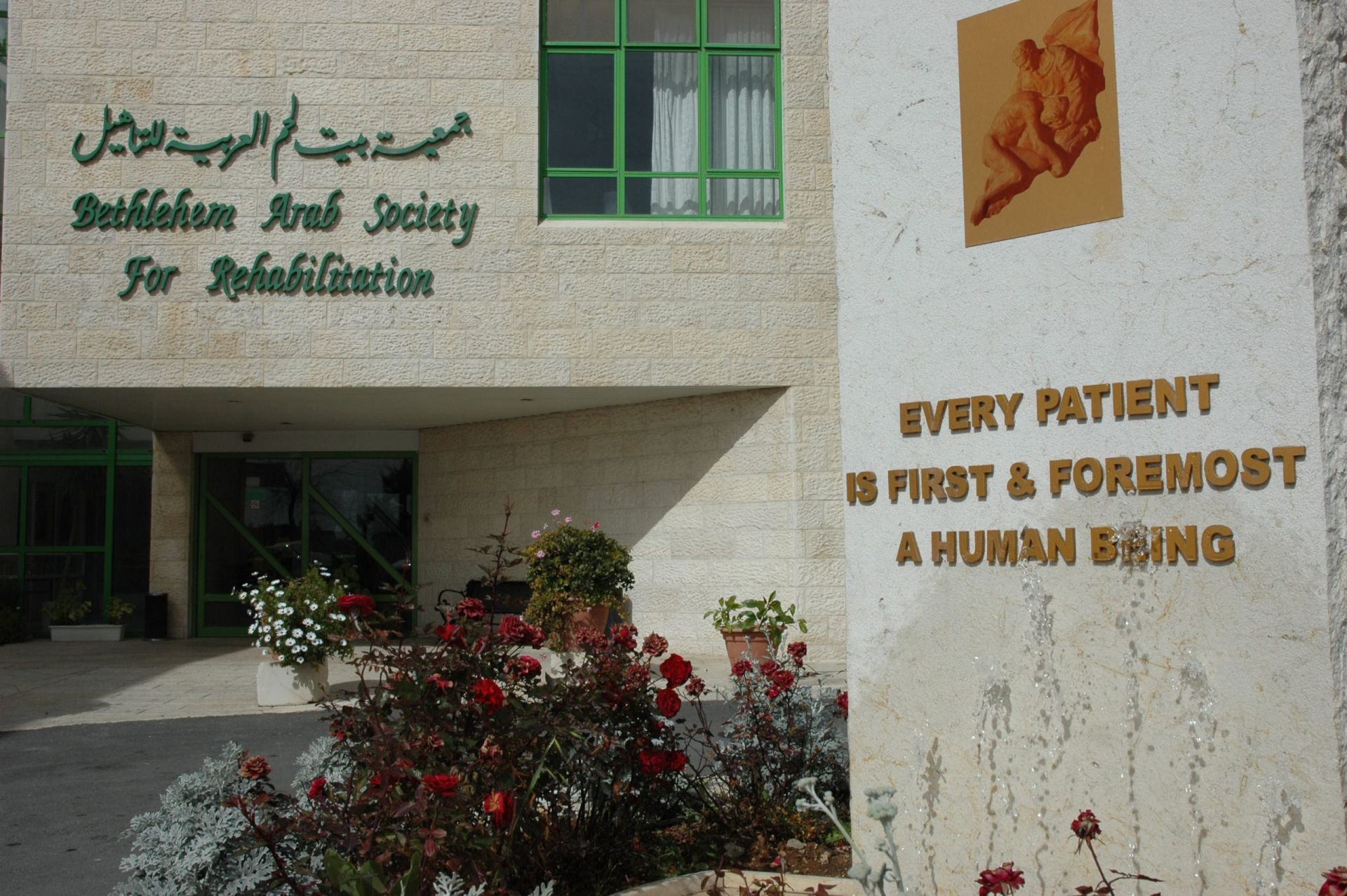
I visited a hospital in Bethlehem just a few months ago. I was greeted at reception by the sign: “Every patient is a human being,” a mantra I heard throughout my visit. The place was busy, and even then it was only just surviving. Salaries and supplies were already running low, and fundraising was a frequent topic of conversation. We visited a new ICU unit that was about to open, a result of international fundraising. Back in 2020, the hospital got a large injection of funding from graffiti artist Banksy, who donated a triptych that raised around £2.2m ($2.9m) at auction.
Doctors, nurses, teachers and other public servants have only been working for two or three days a week, trying to fulfill the bare minimum requirements, while taking jobs elsewhere to make ends meet. The effect on life expectancy is not yet known, but given the amount of treatment canceled, it’s clearly going to have severe and long-lasting consequences.
This economic collapse comes on top of increasing, and increasingly unpunished, violence in the West Bank from both settlers and Israeli occupation forces, which itself has major implications for the economy in addition to the loss of human life. Settlers have found myriad ways to deprive Palestinians of their livelihoods, including taking their livestock and preventing them from reaching their crops. Only 20% of the olives grown in the West Bank were harvested last year, Shtayyeh estimates. Other crops and orchards have been burned or bulldozed. None of these crimes has been punished by Israel or the international community.
For decades, Israeli settlement construction and settler-only bypass roads have gradually reduced the West Bank to a mosaic of isolated cities, towns and villages, now divided by a wall that the International Court of Justice has deemed illegal under international law. There are now 921 military checkpoints across the region, with some towns encircled by the Israeli wall with a single checkpoint that can be easily closed, making them instant prisons. “When I was prime minister,” Shtayyeh remembered, “I invited children from Gaza to Ramallah. I asked them what most surprised them about their trip.” Their reply shocked him. “Four or five of them replied that they’d never seen a mountain before. And I answered them that many of our children in Ramallah had never seen the sea, the beaches of Gaza.”
This is not only about freedom of travel and knowledge of their own country. The economic impacts of fragmentation are vast. The wall was built down the middle of roads, dividing not only families but also people from their businesses, and forcing far longer commutes that now involve checkpoints that may or may not be passable on any particular day. Businesses are difficult to run under such conditions. Profits, and therefore taxes, are reduced, a point that is now moot given that the taxes collected do not even make it into the public coffers.
“Every single institution, whether private sector, not-for-profit organizations or government institutions, is being affected. The situation is really seriously collapsing,” Shtayyeh summarized. “The international community has invested a lot of effort, energy and money to keep these institutions alive, and to build institutions of the Palestinian state, and now Israel is pushing these institutions to collapse.”
New Lines approached the office of Israeli Finance Minister Bezalel Smotrich to ask why it withholds money it is legally obligated to transfer. They replied only to say they needed to check the figures and would get back to us, which had not happened by the time of publication. Previous reports state that some goes to Israeli families as compensation for death and injury at the hands of Palestinians — any Palestinian, no matter whether this was a Hamas attack or a road accident: 10 million shekels for a death, 3 million for an injury. But this is not part of the original agreement, and the amounts were unilaterally decided by Israel. And even with these payments, there is still a lot of money unaccounted for, probably sitting in a bank account accruing interest.
Taken together, the building of the wall through towns and villages which has resulted in families being separated and business choked, the steady growth of settlements and the roads that connect them, the removal of access to land as well as the appropriation of the land itself, and now the complete withholding of the revenue Israel collects, all amounts to deliberate, collective punishment of the West Bank, via slow economic collapse. “It’s an attack on the daily life of people, to push people to migrate,” Shtayyeh summarized, “But more than ever before, Israel’s actions are pushing us to the edge.” The difference now lies both in the scale of the crisis and the number of sources of help that have been closed off. While the eyes of the world were turned first to Gaza and then the war in Iran, the West Bank has been slowly brought to this point with scant attention or support.
“Spotlight” is a newsletter about underreported cultural trends and news from around the world, emailed to subscribers twice a week. Sign up here.