

For many residents of Tehran, the shock of the five-week-long aerial bombardment of their city lasted for only the first few days. Afterward, the city and its residents settled into a grim routine, bearing witness to new types of suffering: images of limbs beneath rubble, a corpse hanging by its arm from a building, a young woman who lost three generations of family in one attack and now lies in a coma with a chest wound.
As the devastation from the U.S.-Israeli air campaign became normalized, the political situation inside Iran, as well as in the large Iranian diaspora, only grew more tense and bitter — with some already planning for what might come after the regime while the bombs were falling, justifying civilian suffering as the side effects of “chemotherapy” or portraying the current war as merely a prelude to a more apocalyptic battle to come.
In such conditions, long dominated by division and suffering, a unifying voice for Iranians emerged from music. Mohsen Chavoshi, a singer who for more than a decade has been associated with middle-class values, activism against the death penalty and charitable fundraising, released a song without the official approval of Iran’s regulatory authorities, opening up a space to breathe for Iranians struggling to express their inner turmoil about the war.
“Hasbi Allah” (“God Is Enough”) by Chavoshi is a religious song, but leans toward Sufism rather than Shiite themes more closely associated with the state. The song protests against warmongering, both inside and outside Iran, and places its focus on human suffering caused by the war. Its popularity revealed a need for words to channel emotion. It also inspired other songs that fostered empathy and morale, both essential in wartime.
In the absence of free and widespread access to the internet and international social media platforms, the song circulated across domestic, intranet-based networks, passed hand to hand and shared via memory cards. It became the dominant sound in car stereos at dusk, as people ventured out to confront the depression and anxiety of staying indoors under the constant threat of bombs and missiles.
Soon after “Hasbi Allah,” a song known as a “rajaz,” or epic boasting, followed. This martial music tells of bravery and inspires victory. Its performer, Mehdi Rasouli, references historic battles, the story of the sacrifices of the family of the Prophet Muhammad at the Battle of Karbala, and the “Shahnameh,” the great poetic epic in the Persian language, to mobilize listeners. Rapidly popular, the song appeared on state TV and became part of marches and funeral processions.
Shortly after, the Shiite tradition of “noha,” or religious lament, offered a collective voice for mourning and roused emotion. One lament, sung in Persian but styled after the Pakistani singer Nusrat Fateh Ali Khan, emphasized again Karbala’s tragedy and the bravery of young men defending the country from external attack. This song also recognized the solidarity that Iranians had received from neighboring countries and became popular on social media beyond the Persian-speaking world, especially among Pakistani, Iraqi and Turkish listeners.
Other artists joined in, composing more music for the war effort. Still, these three pieces defined the soundscape and will shape the war’s memory, though they are not the only musical testament, nor perhaps the most significant.
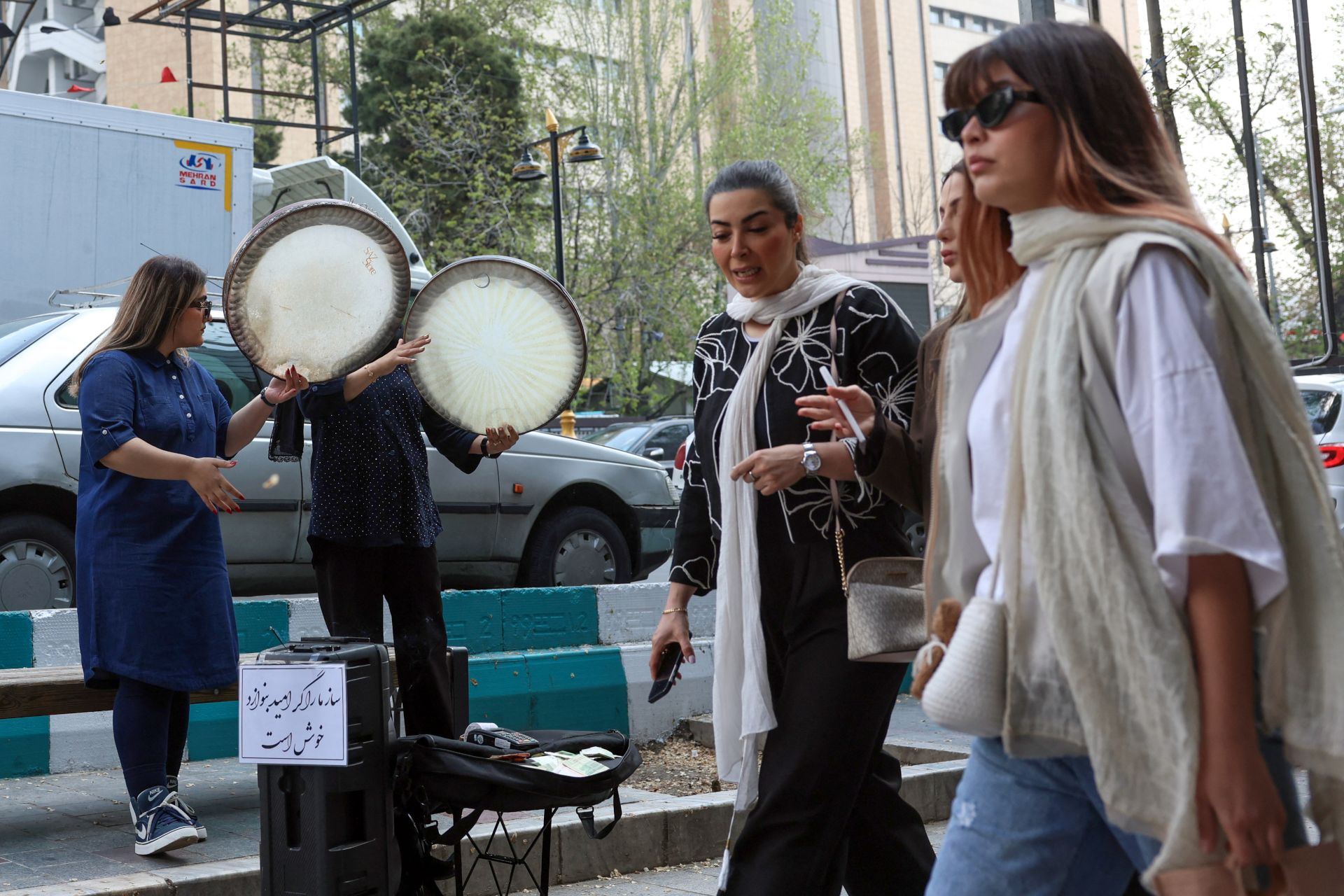
Beneath the loud resonance of these songs, other musical stories have unfolded in the city. At street level, Tehran has become a city of street musicians. After last summer’s war, their numbers grew so much that some streets would host the equivalent of a full rock concert in a single afternoon. Solo performers, though, were most often seen with lighter stringed instruments, such as the violin, guitar, tar and setar. Alongside them, many young people brought the handpan to the streets. The handpan’s popularity, tied to a youthful, bohemian lifestyle, has grown so much in Tehran that even in neighborhoods beyond the center of the city, its sound can be heard outside nearly every small cafe.
During the days of war, although the number of street musicians, especially handpan players, declined, they were not erased from the streets. Footage from Nowruz street markets still shows them performing. In addition, after a Lebanese cellist played atop the ruins of a house, some street musicians in Iran repeated the act and produced widely viewed videos, though most of those videos still featured performers from the Nowruz markets.
“Before the war, I played in the streets for money; during the war, I played for myself,” said one of them, who agreed to speak only on condition of anonymity. “Nowruz nights usually offer musicians a chance to earn well, but this year, few felt like celebrating. Still, the pre-Nowruz markets brought some crowds. During the war, I rarely played for money, mostly to record myself. With borrowed equipment and difficulty, I uploaded videos online. Few inside Iran could watch, but outsiders believed Tehran had been destroyed. Many things were ruined, but not everything. We have to keep living.”
Playing music in the streets, whether to demonstrate the flow of life or simply to protest the war, quickly took on a new form, becoming a tool of resistance. This shift became especially clear when Donald Trump threatened to target Tehran’s power plants, a move that could have plunged a population of around 10 million people into darkness, immediately endangering the lives of many, including patients dependent on life-support systems, not to mention the devastating consequences that could unfold in the hours and days that followed.
In response to this threat, some Iranian artists went to stand in front of power plants and performed music, protesting what they described as an open threat of a crime against humanity. One of them, Yasaman Heydari, a classical cellist, performed Beethoven’s Symphony No. 9, often associated with peace, in front of Tehran’s power plant. After her performance, she said in a phone interview about her presence at a site marked as a potential target by the U.S. military: “The purpose of this performance was to remind people of calm, empathy and mutual respect. I believe that music can serve as a bridge between hearts, fostering peace and closeness among people. It was with this belief that I played in front of the power plant. I hope our voices are heard.”
A week after Trump’s initial threat to strike Iran’s power plants, when he repeated it once again on social media, a tar player in Tehran responded by announcing a sit-in in front of the Damavand power plant. Ali Ghamsari, in a video he recorded there, addressed the public: “It doesn’t matter where you have stood until now. What matters is that you understand that threats against infrastructure are threats against the lives of all of us, not only in Iran, but across the entire region.”
He not only continued his sit-in in front of the power plant, but also called on artists and ordinary people in Iran and across neighboring countries to form a human chain around such facilities, so that “the lights in everyone’s homes remain on.”
Before Donald Trump had the opportunity to carry out his threat against Iran’s infrastructure, and before Iran, in turn, might have found justification to target electrical infrastructure across the Persian Gulf, a temporary ceasefire was agreed upon. The human chains formed around vital infrastructure and the sit-ins in front of power plants came to an end. But this was not the whole story of music under bombs and missiles.
In one of several U.S. and Israeli attacks on residential areas in Rey, in southern Tehran, a house located near one of Iran’s largest music archives was struck. Ali Dolou, an oud and daf player who has spent more than 15 years of his professional life collecting and digitizing Iran’s musical archives, said that the attack could have wiped out a vast body of Iranian musical heritage, and that only sheer luck prevented such a catastrophe: “For years, I have been working to digitize Iran’s music archives. In one of the attacks on Rey, my home was severely damaged, but fortunately, the digital archive I had compiled, one of the most comprehensive collections of Iranian music and national radio programs from 100 years ago, was not harmed. Out of fear, despite the high costs of maintaining such archives, I have created several backup copies and stored them in different locations. So that if, in future attacks, this house or the other archive locations are damaged, at least this history of music will not be lost.”
Not everyone, of course, was as fortunate as Dolou. Some things cannot be protected from the dangers of war through technology, musical instruments and music schools among them. The Haniyak Music Institute in Tehran is one such example. Just three days after the Persian New Year, during one of the many U.S. and Israeli attacks on residential neighborhoods in Tehran, a medical building in the Pirouzi district in eastern Tehran was struck. One of its floors had been dedicated to a music school.
In videos published in the first hours after the bombardment, a distressed and frantic man can be seen pulling black instrument cases from beneath a mountain of rubble, showing them to the camera before dropping them onto the ground. Mr. Afrideh, the owner of the now-destroyed music school, said in a phone interview: “For 15 years, my wife and I worked, struggled, saved money, took out loans, borrowed, and built a music school. We had 250 students and 20 instructors. That was all before the war. Now we have nothing. No students, no teachers, no instruments, no school. All that remains are debts, a broken heart and 15 years of hard work that vanished in the blink of an eye.”
The destruction of music-related businesses by war also means the loss of livelihoods for musicians and artists. “Nothing in war-stricken Tehran is normal, nor can it be. It is only natural that one of the first groups unable to endure these conditions is artists, especially musicians,” Heydari said. “Even now, under the shadow of this war, there is widespread concern about unemployment. Artists usually need to gather to work; losing the ability to be physically present with one another means losing the ability to work. With no internet access, even holding online classes or teaching remotely is impossible. What can be done? In such conditions, most artists retreat inward and turn to practice to preserve some semblance of normal life, but that does not mean life actually remains normal. The mental and physical conditions necessary for practice and artistic creativity simply do not exist under bombs and missiles. Even for practice, one needs peace of mind and a sense of safety. When you are afraid for your life and your livelihood, pretending that things are normal, retreating into a room to practice for a future that may or may not come, is not an easy task.”
Reaching a ceasefire does not mean the end of the war. The recent conflict erupted only eight months after the previous one, which had also been halted by a ceasefire. Political predictions about the future of negotiations do little to ease public anxiety. Although the continuous sound of bombs and missiles has stopped in Tehran, the loud roar of spring storms, usually accompanied by the city’s beautiful seasonal weather, now revives the trauma of war more than it evokes the joy of spring. Artists and their businesses, who during the war used the circumstances to create in the service of solidarity and peace, are now concerned that the economic and political turbulence that follows every war will become yet another wound layered upon their already deep scars.
Become a member today to receive access to all our paywalled essays and the best of New Lines delivered to your inbox through our newsletters.